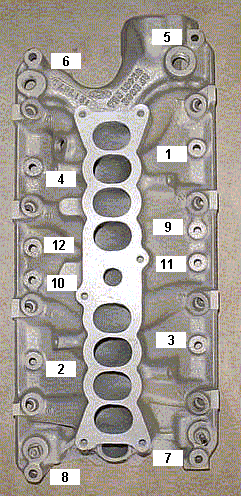
Firing order

Remove the #1 & #3 spark plugs. Put your finger in #1 spark plug hole. Crank the engine over until you feel compression on #1 cylinder. Slowly turn the engine until the TDC mark and the timing pointer line up. Mark TDC on the balancer with chalk or paint. Put your finger in #3 spark plug hole and crank the engine 90 degrees. You should feel pressure trying to blow past your finger. If you do not feel pressure, repeat the process again. If you feel pressure, it is a HO engine.

This doesn’t prove that the block has an HO cam. Some trucks evidently use a HO firing order
with a low lift cam. However, it will definitely prove that a cam can’t be HO because the firing order is wrong.


No pressure the second time, remove spark plug #5. Put your finger in #1 spark plug hole. Crank the engine over until you feel compression on #1 cylinder. Put your finger in #5 spark plug hole and crank the engine 90 degrees. If you feel pressure now, the engine is not a HO model, no matter what it says on the engine.

Using a small carpenter or machinist square to mark the harmonic balancer off into 90 degree sections may be helpful here.

A 15/16 deep socket & breaker bar or ratchet may be used to turn the engine.

The HO firing order is 1-3-7-2-6-5-4-8.
Non HO firing order is 1-5-4-2-6-3-7-8
attachment.php
 
Thanks guys. I really aprreciate all of the help. When I have it wired for the non H.O. the engine just cranks and cranks and nothing happens. But, when I have it worred for an H.O. it fires a couple of times and then cranks, then firfe a couple of times and then crank. I do know the spark plugs that afre in it now are bad. Lol I have been meaning to change them but, I have to put my wife and kids first. I will definitely try the compression thing tomorrow and see what the result is. I have a good friend with an 82 GT and he said it could be possible that my motor is a 351. Unfortunately the guy I got the motor and tranny from did know much about the motor, just that it run and didnt burn any oil. he was going to put it in a 32 ford but he sold it and the motor sat for 3 years. Could it be that it sat for 3 years be part of the problem of why it isn't starting?
 
I don't have an ECU. I am running a carb. I will eventually go to fuel injection though. I am slowly getting all the parts for that now. I had to go the cheaper way to make the wife happy for now. Lol. Plus the military doesn't pay all that much either!
 
Thanks guys. I really aprreciate all of the help. When I have it wired for the non H.O. the engine just cranks and cranks and nothing happens. But, when I have it worred for an H.O. it fires a couple of times and then cranks, then firfe a couple of times and then crank. I do know the spark plugs that afre in it now are bad. Lol I have been meaning to change them but, I have to put my wife and kids first. I will definitely try the compression thing tomorrow and see what the result is. I have a good friend with an 82 GT and he said it could be possible that my motor is a 351. Unfortunately the guy I got the motor and tranny from did know much about the motor, just that it run and didnt burn any oil. he was going to put it in a 32 ford but he sold it and the motor sat for 3 years. Could it be that it sat for 3 years be part of the problem of why it isn't starting?
1. Most mustang ecu's fire sequentially... changing the wiring would cause issues... not solve them...
2. how are your plugs bad?
3. 351w is the same firing order as 302HO... ???
4. sitting wouldn't be an issue, unless things were really bad... which would show with compression & leak down testing....
 
It's all good. I consider it to be useful information to learn for the future for when i eventually do go EFI. I could probably just clean the spark plugs and that will probably work just fine. I am goin to try to stafrt it tomorrow again. It doesn't help that Imin North Dakota and the temp during the day is a high of 10 degrees. Could my choke on the carb need to be adjusted? Would that have anything to do with it not starting?
 
It's all good. I consider it to be useful information to learn for the future for when i eventually do go EFI. I could probably just clean the spark plugs and that will probably work just fine. I am goin to try to stafrt it tomorrow again. It doesn't help that Imin North Dakota and the temp during the day is a high of 10 degrees. Could my choke on the carb need to be adjusted? Would that have anything to do with it not starting?

The choke will need to wok on a carb'd engine especailly if it is that cold.

Cranks Ok but no start for carb’d cars.
Updated 16Aug-2010 revise fuel filter and firing order text.
Carb'd cars require an old time approach to troubleshooting.

1.) Remove push on connector from starter solenoid and turn ignition switch on. Place car in neutral or Park. Remove coil wire from distributor & and hold 3/8” away from engine block. Jumper the screw with the red wire to the big bolt on the starter solenoid that has the battery wire connected to it. You should get a nice fat blue spark.
Most of the items are electrical in nature, so a test light, or even better, a voltmeter, is helpful to be sure they have power to them.
No spark, possible failed items in order of their probability:
A.) Coil
B.) Distributor PIP sensor or points & condenser
C.) Bad ignition Box or Duraspark unit
D.) No power to ignition system wiring or ignition box (if used)
E.) Bad ignition switch
F.) Bad fuse links.


2.) Spark at coil wire, pull #1 plug wire off at the spark plug and check to see spark. No spark, possible failed items in order of their probability:
A.) Moisture inside distributor – remove cap, dry off & spray with WD40
B.) Distributor cap
C.) Rotor
D.) Spark Plug wires
E.) Coil weak or intermittent - you should see 3/8" fat blue spark with a good coil

3.) Spark at spark plug, but no start.
4.) Pull the air cleaner and sniff for fuel vapor - look for signs of flooding. If so, then press the accelerator to the floor and crank for a while – if the engine is flooded, this will clear it out. You may want to have a jumper battery & cables handy.
5.) Electric fuel pump if you have one, is it getting power? Use a volt meter or test light to probe the wires at the pump.

Don't see any evidence of flooding? Then pump the throttle - does the accelerator pump squirt fuel? If so then you should have enough fuel to start the engine. If not look for fuel delivery problems. Check the fuel pump, and fuel filter. Remember that most carbs have a fuel inlet filter that protects the float needle valve from trash: if it clogs, you won’t get any fuel into the float bowls.

Next, get a can of starting fluid (ether) from your local auto parts store: costs a $1.30 or so. Then pull the air cleaner, open the throttle, and spray the ether in it. Reinstall the air cleaner and try to start the car. Do not try to start the car without reinstalling the air cleaner. If it backfires, the chance for a serious fire is increased. If the engine starts now, you have a fuel delivery problem.

A warning about backfires: Holley carbs may have damaged power valves as the result of a backfire. The engine may be hard to start. Other symptoms are that it may seem to load up on fuel and be slow to accelerate until it clears out a bit.

6.) Fuel & ignition OK:
The HO firing order is 1-3-7-2-6-5-4-8.
Non HO firing order is 1-5-4-2-6-3-7-8

attachment.php

Check to verify that it is indeed has a HO firing order. Remove the #1 & #3 spark plugs. Put your finger in #1 spark plug hole. Crank the engine over until you feel compression on #1 cylinder. Slowly turn the engine until the TDC mark and the timing pointer line up. Mark TDC on the balancer with chalk or paint. Put your finger in #3 spark plug hole and crank the engine 90 degrees. You should feel pressure trying to blow past your finger. If you do not feel pressure, repeat the process again. If you feel pressure, it is a has a HO firing order.

No pressure the second time, remove spark plug #5. Put your finger in #1 spark plug hole. Crank the engine over until you feel compression on #1 cylinder. Put your finger in #5 spark plug hole and crank the engine 90 degrees. If you feel pressure now, the engine is not a HO model, no matter what it says on the engine.

Using a small carpenter or machinist square to mark the harmonic balancer off into 90 degree sections may be helpful here.

A 15/16 deep socket & breaker bar or ratchet may be used to turn the engine.
 
I can't thank you guys enough for all of your help. I figured it out. First off unfortunately its a non H.O. motor. Second off i was only at 4 degrees for timing and 180 off on the distributor. I put it to 8 and fixed the distributor. Then she started right up the first time. :nice: But, I have a BAD coolant leak! Its leaking at the front and back of the intake manifold. Do i just have to take it off and check the gaskets and put more RVT Sealant on it or what? I am dying to drive it. PLEASE HELP!:shrug: Thanks again!
 
Here's some tips...

Tools: a good torque wrench is a must have item. A razor blade scraper that holds a single edge razor blade from Home Depot or Ace hardware is another handy thing. Get a Chilton or Haynes shop manual - you'll need it for the bolt torques and patterns. The intake manifold has an especially odd pattern.

Diagram courtesy of Tmoss & Stang&2birds
FordIntakeTorqueSequence.gif


The bolts are torqued down in a 3 step process.
Step 1 8 ft/lbs
Step 2 16 ft/lbs
Step 3 23-25 ft/lbs

You'll need access to a timing light to set the timing after you re-stab the distributor. Look in the A/C repair section for the fuel line tools. They look like little plastic top hats. You will need the 1/2" & 5/8" ones. The hat shaped section goes on facing the large part of the coupling. Then you press hard on the brim until it forces the sleeve into the coupling and releases the spring. You may need someone to pull on the line while you press on the coupling. Put some motor oil on them when you put the line back together.

The A/C Compressor comes off with lines still connected. Mark all the electrical, smog and vacuum lines with tags to help you remember where to re-connect them. If you have a digital camera, take several pictures.

Whatever you do, don't skimp on cleaning the gasket surfaces. New gaskets need to seat against bare metal and not the residue left from the old gaskets in order to seal leak free. This is the most time consuming and tiresome part of the job. Look for little things that need to be replaced like the short hose from the thermostat hosing to the water pump, damaged vacuum lines and hose clamps that are rusted or broken.
Put some cardboard in the lifter valley to help catch the gasket scrapings. Have a shop vacuum handy to suck up the scrapings and any coolant that leaked into the lifter valley.

Plan on cutting the thermostat to water pump hose, or removing the thermostat housing. Also plan on removing the distributor to get clearance to remove the intake manifold. Remove #1 spark plug, stick your finger in the spark plug hole and crank. When your finger gets air moving past it, stop cranking. Turn the engine until the timing marks line up with the pointer. Now you can pull the distributor out. Be sure to put a rag or cap in the block where you removed the distributor. It will save you trouble if something falls into the empty distributor hole.

My favorite trick that saves time and effort is the stay in place gasket. Be sure that you scrape (don't use a wire brush) all the old gasket material off, then clean all the surfaces with acetone or MEK.

When the surfaces are clean, use weather strip adhesive on the head to manifold surface, and on the side of the gasket that mates to the head. Follow the instructions on the tube or can and when it gets tacky, press the gasket down on the head.

Clean the area where the rubber rails mount to the block in front and in the rear with more acetone or MEK and do the same trick with the weather strip adhesive that you did to the heads.

Coat the rubber seals and the gasket area around the water passages with Blue Silicone gasket sealer and put it together. Whoopee! no leaks, and no gaskets that shifted out of place.

Get a tube of anti-seize and coat all the bolt threads and under the bolt heads. That will help insure even torque when you tighten the manifold bolts. Plan on re-torquing them a after a weeks worth of driving

Fuel injector seal kits with 2 O rings and a pintle cap (Borg-Warner P/N 274081) are available at Pep Boys auto parts. Cost is about $2.74 per kit. The pintle caps fit either injectors with a pin sticking out the injector end or 4 with more tiny holes in the injector end. The following are listed at the Borg-Warner site ( BWD - Home ) as being resellers of Borg-Warner parts:

Parts Plus - Premium Auto Parts & Accessories or Auto Value / Bumper to Bumper Quality Parts & Service - Home of the Aftermarket Auto Parts Alliance Group or Tires, Auto Parts Stores, Brakes & Automotive Parts | Pep Boys or Federated Auto Parts - Automotive Aftermarket

Most of the links above have store locators for find a store in your area.

Use motor oil on the O rings when you re-assemble them & everything will slide into place. The gasoline will wash away any excess oil that gets in the wrong places and it will burn up in the combustion chamber.

Putting the distributor back in is fairly simple. Pull #1 sparkplug, put your finger in the sparkplug hole,
crank the engine until you feel compression. Then line up the TDC mark on the balancer with the pointer
on the engine block.

The distributor starts out with the #1 plug wire lined up at about 12:00 with you facing it. Align the rotor
to about 11:00, since it will turn clockwise as it slides into place.

Align the distributor rotor up with the #1 position marked on the cap, slide the distributor down into the block, (you may have to wiggle the rotor slightly to get the gear to engage) and then note where the rotor is pointing. If it still lines up with #1 position on the cap, install the clamp and bolt. If not, pull it out and turn 1 tooth forwards or backwards and try again. Put the #1 spark plug back in and tighten it down, put the clamp on the distributor, but don't tighten it too much, as you will have to move the distributor to set the timing. Note that if it doesn't align perfectly with #1 position, you can turn the distributor until it does. The only problem is that if you are too far one way or the other, you can't turn the distributor enough to get the 10-14 degree optimum timing range.

At this point hook up all the wires, get out the timing light and start the engine. Set the timing where your car
runs best. Don't forget to disconnect the SPOUT jumper connector when you set the timing, and plug it back
in when you finish.

The HO firing order is 1-3-7-2-6-5-4-8.
Non HO firing order is 1-5-4-2-6-3-7-8

attachment.php


Consumable items:
Upper manifold gasket
Fel Pro 1250 or equal lower manifold gasket set.
Short formed hose between thermostat hosing and intake manifold
6 ft 7/64" or 1/8" vacuum hose
2 ft 1/2" heater hose
1 1/2 ft 5/8" heater hose
Blue Silicone sealer
ARP antiseize or equal for the bolts
4 each 3/4" hose clamps (spare item in case the old ones are bad)
4 each 1/2" hose clamps (spare item)


See the following website for some help from Tmoss (diagram designer) & Stang&2Birds (website host) for help on 88-95 wiring Mustang FAQ - Wiring & Engine Info Everyone should bookmark this site.

Ignition switch wiring
http://www.veryuseful.com/mustang/tech/engine/images/IgnitionSwitchWiring.gif

Fuel, alternator, A/C and ignition wiring
http://www.veryuseful.com/mustang/tech/engine/images/fuel-alt-links-ign-ac.gif

Complete computer, actuator & sensor wiring diagram for 88-91 Mass Air Mustangs
http://www.veryuseful.com/mustang/tech/engine/images/88-91_5.0_EEC_Wiring_Diagram.gif

Vacuum diagram 89-93 Mustangs
http://www.veryuseful.com/mustang/tech/engine/images/mustangFoxFordVacuumDiagram.jpg

HVAC vacuum diagram
http://www.veryuseful.com/mustang/tech/engine/images/Mustang_AC_heat_vacuum_controls.gif

TFI module differences & pinout
http://www.veryuseful.com/mustang/tech/engine/images/TFI_5.0_comparison.gif

Fuse box layout
http://www.veryuseful.com/mustang/tech/engine/images/MustangFuseBox.gif
 
I can't thank you guys enough for all of your help. I figured it out. First off unfortunately its a non H.O. motor. Second off i was only at 4 degrees for timing and 180 off on the distributor. I put it to 8 and fixed the distributor. Then she started right up the first time. :nice: But, I have a BAD coolant leak! Its leaking at the front and back of the intake manifold. Do i just have to take it off and check the gaskets and put more RVT Sealant on it or what? I am dying to drive it. PLEASE HELP!:shrug: Thanks again!

Glad you got her cranked. I can imagine that cold weather can really play havoc with a carb car. Good luck and let us know how it goes !
 
Well I couldn't get it to start tonight to check for leaks and to tweak the timing. I guess it's because it's 0 degrees outside. The starter just clicked and clicked like it was trying to engage. The motor has a block heater, so hooking that up will be my project for tomorrow.
Sorry I couldnt update everyone on intake. :Damnit:
Happy Thanksgiving to all!
 
North Dakota? CCCCOOOLLLDDDD!

Low battery is the most likely cause. As temperature drops, so does the battery's ability to make sufficient electrical current to crank a stiff engine.
 
That's what I was thinking but I wasn't sure. i had it parked right outside my garage, so i pushed it in and turned on a space heater. i hope that works on warming it up so I can check for leaks again and do the final timing tweaks.