
Hi I'm new to forums so please bare with me. Anybody out there can help me I'd greatly appreciate it. My mustangs missing at high rpms. I had the same prob when I first built my car and I had an msd set up in it. I put the stock distributer in and in ran like a champ for a year until it started doing the same thing. Ivedone a compression check all good. And I've changed my plugs and wires. I think its something electrical to the distributor because it happened before but not sure how to check that. The only thing that has over 3000 miles is the starter. Its an old starter. Could that be the problem but I doubt that. I am running a high output 160 I believe alternator. Can anybody help me please
You are using an out of date browser. It may not display this or other websites correctly.
You should upgrade or use an alternative browser.
You should upgrade or use an alternative browser.
Missing At High Rpm
- Thread starter ford blooded
- Start date

I'll move this to the appropriate section where you'll get more help, but need to know what year vehicle this is? What engine and any more details of the setup that would help!
Sorry about that. I thought the details of my car would of shown up in my vehicles. Its an 89 mustang 5.0 with a stock 302 block bored .30 over,TFS 170 twisted wedge heads,TFS stage 2 cam,TFS track heat intake,30 ib injectors,stock distributor with msd wires and ignition coil. 160 amp alternator.I'm prob forgetting something. It ran like a beast for about a year when I got rid of the msd set up and put the stock distributer in. And now its missing like it was with the msd in it. That's telling me its something electrical going to the distibuter I think.
have you ran your codes? How about the plugs, what plugs are you using and what are they gapped at?

Definetly need the codes but at what rpm does it break up? Do you have a factory/alternate coil you can use?

mikestang63
SN Certified Technician
start with the basics-
Run the codes
- what is you static and total advance at
- what is your plug gap at
- what type of plugs wires and cap
- how old are they
- what is your fuel pressure set
Run the codes
Haven't ran any codes yet. My check engine light isn't on you think I should check for codes anyways?. I'm running brand new autolite 4036 if I remember correctly. I could be wrong I haven't even popped my hood in months until yesterday when I started it. It started right up for me and idled normal well as normal as its going to be with the cam.There gapped at 40. My cap and rotor are brand new. And my fuel pressures good. I checked it when it started doing it and nothing changed from when it was running fine. I want to say fuel pressure is around 40,but like I said I havnt touched it in months. I got mad and covered it so I didn't have to look at her haha. Its missing at about 4500 rpm but it jumps around sometimes it will miss at lower rpms when it wants. It seems to do it more when its all the way warmed up. Thank you for all your time. I appreciate it. I'm starting to stress out over it haha

Does the miss happen only on a warm engine or does it happen with a cold and warm engine?
Stock plug gap is .052-.056. Use a different spark plug gap with NO2 or pressurized induction.
If you set the gap at .40 which is 4/10s of an inch, you are going to have problems.
Stock plug gap is .052-.056. Use a different spark plug gap with NO2 or pressurized induction.
If you set the gap at .40 which is 4/10s of an inch, you are going to have problems.
And one more thing. I bought a new motorcraft distributer (which looked cheaper then ever) and stabbed it in just to see if that was the problem and it wouldn't even idle. It backfired and everything. I put the older one in which only has 6000 miles on it tops and it idled like normal after starting. Thank you. And sorry for the late response I work long crazy hrs
What is no2 or pressurized induction regarding the spark plugs? Should I get a different kind or can I regap my autolite plugs to your specs. I've had mine gapped at 40 without any problems for 2000 miles or so. Sorry I'm newer to the details of engines.
It seems to miss more when its warmed up but it does it when its cold SOMETIMES.
thank you
It seems to miss more when its warmed up but it does it when its cold SOMETIMES.
thank you

Haven't ran any codes yet. My check engine light isn't on you think I should check for codes anyways?.
Yes, run the codes
Of the 100 or so possible codes, only 13 actualy cause the CEL to turn on.
Yes you need to run the codes. It sounds like a bad O2 sensor but will only know if you run the codes. Also the above reference was about nitrous or a blower/turbo set up. Open up the plug gap to .52. You can go to any auto parts store and get a gap tool very cheap. There are a few things that could be causing your issue so run the codes!
mikestang63
SN Certified Technician
Go to the TFS site and see what plugs they recommend. Do NOT run Champion plugs. I prefer Autolite/Motorcraft.
Your gap is too narrow. Put antisieze on the threads. That is part of your miss.
You did not answer my question about timing. Did you set the timing with the engine warm or cold.
When you say your FP is good- what does that mean. DId you measure it with the vacuum line on or off and capped? Was the engine cold or wamed up.
Run the codes.
What is no2 or pressurized induction regarding the spark plugs? Should I get a different kind or can I regap my autolite plugs to your specs. I've had mine gapped at 40 without any problems for 2000 miles or so. Sorry I'm newer to the details of engines.
It seems to miss more when its warmed up but it does it when its cold SOMETIMES.
thank you
NO2 = Nitrous Dioxide
Pressurized induction = supercharger, blower, or turbocharger.
My question was intended get diagnostic information to give you the best possible answer without a lot of just guess work.
If you have only high speed miss on a warm engine , you are likely to have a pip sensor or TFI module problem.
If you have cold and warm miss, dump the codes to find any problems that the computer knows about
Dump the codes: Codes may be present even if the Check Engine Light (CEL) isn't on.
Dumping the computer diagnostic codes on 86-95 Mustangs
Revised 26-July-2011. Added need to make sure the clutch is pressed when dumping codes.
Codes may be present even if the check engine light hasn’t come on, so be sure to check for them.
Here's the way to dump the computer codes with only a jumper wire or paper clip and the check engine light, or test light or voltmeter. I’ve used it for years, and it works great. You watch the flashing test lamp or Check Engine Light and count the flashes.
Post the codes you get and I will post 86-93 model 5.0 Mustang specific code definitions and fixes. I do not have a complete listing for 94-95 model 5.0 Mustangs at this time.
Be sure to turn off the A/C, and put the transmission in neutral when dumping the codes. On a manual transmission car, be sure to press the clutch to the floor.
Fail to do this and you will generate a code 67 and not be able to dump the Engine Running codes.
If your car is an 86-88 stang, you'll have to use the test lamp or voltmeter method. There is no functional check engine light on the 86-88's except possibly the Cali Mass Air cars.
The STI has a gray connector shell and a white/red wire. It comes from the same bundle of wires as the self test connector.
89 through 95 cars have a working Check Engine light. Watch it instead of using a test lamp.
The STI has a gray connector shell and a white/red wire. It comes from the same bundle of wires as the self test connector.
WARNING!!! There is a single dark brown connector with a black/orange wire. It is the 12 volt power to the under the hood light. Do not jumper it to the computer test connector. If you do, you will damage the computer.
What to expect:
You should get a code 11 (two single flashes in succession). This says that the computer's internal workings are OK, and that the wiring to put the computer into diagnostic mode is good. No code 11 and you have some wiring problems. This is crucial: the same wire that provides the ground to dump the codes provides signal ground for the TPS, EGR, ACT and Map/Baro sensors. If it fails, you will have poor performance, economy and driveablity problems
Some codes have different answers if the engine is running from the answers that it has when the engine isn't running. It helps a lot to know if you had the engine running when you ran the test.
Dumping the Engine Running codes: The procedure is the same, you start the engine with the test jumper in place. Be sure the A/C is off, and clutch (if present) is pressed to the floor, and the transmission is in neutral. You'll get an 11, then a 4 and the engine will speed up to do the EGR test. After the engine speed decreases back to idle, it will dump the engine running codes.
Trouble codes are either 2 digit or 3 digit, there are no cars that use both 2 digit codes and 3 digit codes.
Your 86-88 5.0 won't have a working Check Engine Light, so you'll need a test light.
See AutoZone Part Number: 25886 , $10

Alternate methods:
For those who are intimidated by all the wires & connections, see Actron® for what a typical hand scanner looks like. Normal retail price is about $30 or so at AutoZone or Wal-Mart.
Or for a nicer scanner see Equus Digital Ford Code Reader (3145) Equus - Digital Ford Code Reader (3145It has a 3 digit LCD display so that you don’t have to count flashes or beeps.. Cost is $22-$36.

J if you did make a 1$ every time you had to post this...!NO2 = Nitrous Dioxide
Pressurized induction = supercharger, blower, or turbocharger.
My question was intended get diagnostic information to give you the best possible answer without a lot of just guess work.
If you have only high speed miss on a warm engine , you are likely to have a pip sensor or TFI module problem.
If you have cold and warm miss, dump the codes to find any problems that the computer knows about
Dump the codes: Codes may be present even if the Check Engine Light (CEL) isn't on.
Dumping the computer diagnostic codes on 86-95 Mustangs
Revised 26-July-2011. Added need to make sure the clutch is pressed when dumping codes.
Codes may be present even if the check engine light hasn’t come on, so be sure to check for them.
Here's the way to dump the computer codes with only a jumper wire or paper clip and the check engine light, or test light or voltmeter. I’ve used it for years, and it works great. You watch the flashing test lamp or Check Engine Light and count the flashes.
Post the codes you get and I will post 86-93 model 5.0 Mustang specific code definitions and fixes. I do not have a complete listing for 94-95 model 5.0 Mustangs at this time.
Be sure to turn off the A/C, and put the transmission in neutral when dumping the codes. On a manual transmission car, be sure to press the clutch to the floor.
Fail to do this and you will generate a code 67 and not be able to dump the Engine Running codes.
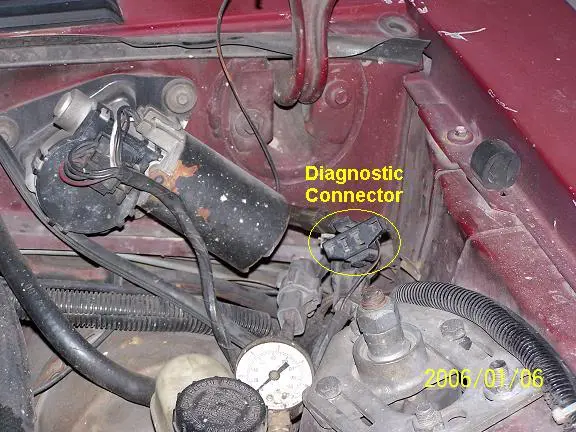
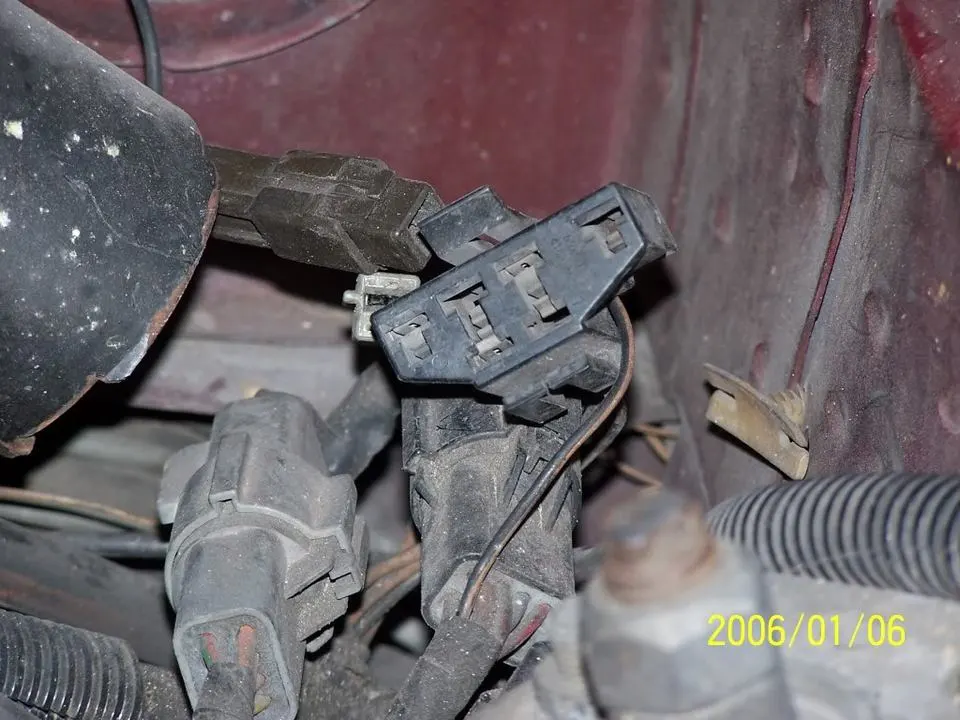
If your car is an 86-88 stang, you'll have to use the test lamp or voltmeter method. There is no functional check engine light on the 86-88's except possibly the Cali Mass Air cars.

The STI has a gray connector shell and a white/red wire. It comes from the same bundle of wires as the self test connector.
89 through 95 cars have a working Check Engine light. Watch it instead of using a test lamp.

The STI has a gray connector shell and a white/red wire. It comes from the same bundle of wires as the self test connector.
WARNING!!! There is a single dark brown connector with a black/orange wire. It is the 12 volt power to the under the hood light. Do not jumper it to the computer test connector. If you do, you will damage the computer.
What to expect:
You should get a code 11 (two single flashes in succession). This says that the computer's internal workings are OK, and that the wiring to put the computer into diagnostic mode is good. No code 11 and you have some wiring problems. This is crucial: the same wire that provides the ground to dump the codes provides signal ground for the TPS, EGR, ACT and Map/Baro sensors. If it fails, you will have poor performance, economy and driveablity problems
Some codes have different answers if the engine is running from the answers that it has when the engine isn't running. It helps a lot to know if you had the engine running when you ran the test.
Dumping the Engine Running codes: The procedure is the same, you start the engine with the test jumper in place. Be sure the A/C is off, and clutch (if present) is pressed to the floor, and the transmission is in neutral. You'll get an 11, then a 4 and the engine will speed up to do the EGR test. After the engine speed decreases back to idle, it will dump the engine running codes.
Trouble codes are either 2 digit or 3 digit, there are no cars that use both 2 digit codes and 3 digit codes.
Your 86-88 5.0 won't have a working Check Engine Light, so you'll need a test light.
See AutoZone Part Number: 25886 , $10
Alternate methods:
For those who are intimidated by all the wires & connections, see Actron® for what a typical hand scanner looks like. Normal retail price is about $30 or so at AutoZone or Wal-Mart.
Or for a nicer scanner see Equus Digital Ford Code Reader (3145) Equus - Digital Ford Code Reader (3145It has a 3 digit LCD display so that you don’t have to count flashes or beeps.. Cost is $22-$36.

coupestang2
Active Member
I think it's the plugs and gap too. Use Autolite with the TFS, and like Mike said, double check with TFS website, to see recommendations.Go to the TFS site and see what plugs they recommend. Do NOT run Champion plugs. I prefer Autolite/Motorcraft.
Your gap is too narrow. Put antisieze on the threads. That is part of your miss.
You did not answer my question about timing. Did you set the timing with the engine warm or cold.
When you say your FP is good- what does that mean. DId you measure it with the vacuum line on or off and capped? Was the engine cold or wamed up.
Run the codes.
Thank all of you for the info. Sorry if this problems been brought up a lot. I'll run the codes this weekend.
Thank you
Thank you

@madspeed why aren't the Surging idle, cranks no start, etc check list a sticky? Maybe pin it under the guess my hp thread where people can find them? That seems like a fair idea but maybe I'm just crazy. @ford blooded an OBD I code reader is a good investment. It's easier than counting flashes and the parts stores these days tend to only have OBD II readers behind the counter for their free check engine light tests.J if you did make a 1$ every time you had to post this...!
Last edited:
@madspeed why aren't the Surging idle, cranks no start, etc check list a sticky? Maybe pin it under the guess my hp thread where people can find them? That seems like a fair idea but maybe I'm just crazy. @ford blooded an OBD I code reader is a good investment. It's easier than counting flashes and the parts stores these days tend to only have OBD II readers behind the counter for their free check engine light tests.
The two mentioned checklists are in the Fox 5.0 Mustang Tech conglomerated sticky called Technical Thread/How-To Index | Mustang Forums at StangNet
Similar threads
- Replies
- 9
- Views
- 359

- Replies
- 6
- Views
- 354
- Replies
- 10
- Views
- 437
- Replies
- 7
- Views
- 318