Piston selection for about 10:1 compr.

Tim65GT

Active Member
Feb 24, 2004
1,149
2
39
West Texas
A little history:
I currently have a '74 short block (D4DE-6015-BA) I did a compression check back in 1999 when I got the car, and it had 125-135psi. It ran OK, but I did remove the engine to replace all the gaskets and seals. I put in a new oil pump and timing set too.

I measured 4.030 bores, it still had a noticeable cross hatch pattern on the cylinders and I pulled a couple main caps just to see how the bearings looked. It has the stock type dished pistons, Rods - D10E and Crank - IC-2M-A SM1D. I decided to leave the rotating assembly alone.

I have only put about 7500 miles on the car since then and now want to get about 300-350 HP (250-300 RWHP?) out of it.

I am planning on getting Edelbrock Performer RPM heads, and Cam or maybe a Comp Cams XE268? I want about 9.8-10.5 compression, so the piston choice is what I'm not sure about. I was thinking this set by Speed Pro?

http://store.summitracing.com/partdetail.asp?part=TRW%2D8KH273CP30&autoview=sku

When I plug the data into a compression calculator it only comes up to around 8.5 assuming .020 deck height and .040 gasket.

Any suggestions? Thanks
 
flattop pistons with 58cc chambers should get you pretty close to 9.5:1 compression with a .053" compressed thickness head gasket. for a little more use a .048" compressed thickness head gasket.
 
Those Speed-pro #273 hyperutectics are low compression plain and simple, and the next cheap alternative is the fcrged speedpros.

The forged units have a 2.7cc relief, and with a 4.030 bore, .039" headgasket (common thickness), zero deck, and 58cc chambers, that's 10.11:1. This is the setup that will be going into my 5.0L build.

With a 650cfm carb, good aluminum heads, low-tension 5.0HO style rings, headers, a ported PerformerRPM, and a windage tray, you MIGHT hit 300rwhp, with a definite 380hp+ at the crank IMO.

The XE268H might be too big, the XE256H is my favorite 289/302 street cam. I'd look into a custom cam, with the advances being made recently. I'd consider a set of AFR165s or something other than the edelbrocks and maybe 10.5:1 compression depending on the cam.
HTH
--Kyle
 
Unless your block has been milled, you're going to have a hard time getting to 10 to 1 with any piston but the old pop-up pistons. The deck height of your block is 8.229. You can have it milled .025 and choose a piston with a 1.610 pin height and get it there. That .029" is costing youcompression by adding a full 6 ccs extra volume. Best compression you'll get with those pistons after a block mill is 9.65 to 1. Milling the heads to 54cc's will get you to 10 to 1 after the deck mill. As it stands, those pistons with a stock deck height yeild 8.98 to 1 with 58 cc heads. Use Felpro's expanded graphite gaskets for the late model 5.0's with it, the compressed thickness is .042, yeilding a 9.5 cc volume for the gasket. I run these on my 331 with Canfield heads sprayed with Kopper-Kote.
 
Thanks for the replies.

I looked at the AFR 165s, but don't they have 2.02 Intake valves? I wanted to go with the 1.90 size to avoid clearance hassles.

OK, I found a couple sites that says the ~73-76 302 has an 8.229 deck height…Damn, no wonder my compression is so low. I was assuming an 8.206 deck height with my previous calculation. How much material is removed with a typical deck mill, .010”? Will a machine shop be able to mill .025”? About how much would that cost?

Trying to get an idea if it's doable, or just try to pick up a junk yard 5.0, which may also need work and parts. :( At least with my current motor, I know what I have...Kinda.
 
.025 is nothing to remove, no harder than a .010 mill. But before milling anything, you or the machinist need to mock up the pistons you're going to use in the block and measure the deck clearance to see how much needs to go to reach zero deck.
 
Another piston alternative are Speed Pro H120's. They have much smaller valve reliefs and a taller deck height of 1.619. The valve reliefs are big enough for larger than stock valves, but there are only two instead of four huge ones (like the 273's have). They also use thinner piston rings, which reduce friction. They're more or less a hypereutectic copy of the forged pistons that Ford used in the 5.0 Mustangs (87-92?). They're more expensive than the H273's, but a nicer piston in several ways.

I would still mill the block for zero deck height, but these pistons may not require a head mill to get the compression where you want it, which probably almost offsets their higher price.
 
.025 is nothing to remove, no harder than a .010 mill. But before milling anything, you or the machinist need to mock up the pistons you're going to use in the block and measure the deck clearance to see how much needs to go to reach zero deck.

Thanks, Hearne. I definetly will be tearing it down and checking everything carefully before ordering anything.

Another piston alternative are Speed Pro H120's. They have much smaller valve reliefs and a taller deck height of 1.619. The valve reliefs are big enough for larger than stock valves, but there are only two instead of four huge ones (like the 273's have). They also use thinner piston rings, which reduce friction. They're more or less a hypereutectic copy of the forged pistons that Ford used in the 5.0 Mustangs (87-92?). They're more expensive than the H273's, but a nicer piston in several ways.

I would still mill the block for zero deck height, but these pistons may not require a head mill to get the compression where you want it, which probably almost offsets their higher price.

I think I looked at the H120s, and might end up getting those even though they cost twice as much. I was only using Summit for piston research, but they don't include all the info. Where do I find the detailed manufacturer specs?
 
Nope, 194/160 valves, that's why I like em...high flow+ small valves = velocity, velocity= tq & HP

Thanks, I found that out after searching more. It'd be worth the extra expense to get the smaller ports for velocity and smaller chambers for compression.

Also everybody is figuring the compression with a 58cc heads, the RPMs are 60cc's, so take that into account too.

Been figuring 60 for the Edelbrocks and 58 for the AFRs. :)

I'll go with milling the deck after I get a good measurement on the deck height. I don't want to have to mill the head surface on brand new heads. With the 1.619 Pistons, I should be almost 2 full points higher than I am now.

Still in the planning stages and weighing my options... but thanks for the replies!
 
I got a chance to sit down and go over the data on the Speed Pro pistons:

This looks like the best bet:

http://store.summitracing.com/partdetail.asp?part=TRW%2DLW2488F30&autoview=sku

There is another very similar (same price):
http://store.summitracing.com/partdetail.asp?part=TRW%2DLW2488F30&autoview=sku

It appears to be about 50 grams lighter. What will that affect? Also is there anything I should do because they are forged? I was hoping to use the Hypereutectic ones (cheaper) and The car will be mostly street use.

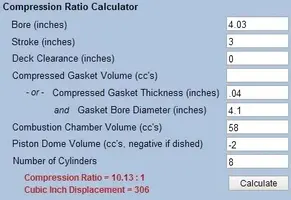
Here is the calculator if I mill to zero deck height:

Compression.webp
 

Attachments

  • Compression.webp
    Compression.webp
    14.4 KB · Views: 622
The links you provided show the same piston.

They look like replacements of the forged Ford 5.0 HO pistons. I doubt that the valve reliefs are large enough for the larger valves of the head's you're planning to use.

I ran into that problem with the forged Speed Pro pistons I have in my 289 (2482F IIRC). They were deep enough, but the diameter was too small, so the 1.94/1.60 valves hit the reliefs on the edge.
 
The links you provided show the same piston.

Oops, here is the other:

http://store.summitracing.com/partdetail.asp?part=TRW%2DL2488F30&autoview=sku

I doubt that the valve reliefs are large enough for the larger valves of the head's you're planning to use.

Thanks for the heads up. I don't know where else I would have found that info. I thought their site was informative. Nothing beats info from someone who has "been there, done that".

If I called the manufacturer, do they have people knowledgable enough to tell you if the piston is right for the application?
 
Another piston alternative are Speed Pro H120's. They have much smaller valve reliefs and a taller deck height of 1.619. The valve reliefs are big enough for larger than stock valves, but there are only two instead of four huge ones (like the 273's have). They also use thinner piston rings, which reduce friction. They're more or less a hypereutectic copy of the forged pistons that Ford used in the 5.0 Mustangs (87-92?). They're more expensive than the H273's, but a nicer piston in several ways.

I would still mill the block for zero deck height, but these pistons may not require a head mill to get the compression where you want it, which probably almost offsets their higher price.

:nice: Glad you dug those up, I wasn't aware of them. That's the big "gotcha" with building a 302, not all the flat tops have the same pin height, they vary from 1.585 to 1.619 That's a .035" difference in deck clearance and about a 9-10cc difference in volume.
 
Tim,

To answer your question about piston weight - perhaps I am oversimplifying, but my understanding is that weight = power, when it comes to internals. If there's one thing 5.0's can do, it's rev. So figure anything that adds weight to the moving parts is going to create a parasitic loss in power.

I'm not certain if the 50gram difference is per set ( 50/8= 6.25 grams less per piston ) or if it is 50 grams less per piston, which seems unlikely. Either way, the lighter pistons should equate to more power and less wear.
 
by Helmantel:
They look like replacements of the forged Ford 5.0 HO pistons. I doubt that the valve reliefs are large enough for the larger valves of the head's you're planning to use.

I ran into that problem with the forged Speed Pro pistons I have in my 289 (2482F IIRC). They were deep enough, but the diameter was too small, so the 1.94/1.60 valves hit the reliefs on the edge.

Thanks. OK, I didn't want to use the more costly forged units anyway.

by Helmantel:
Another piston alternative are Speed Pro H120's. They have much smaller valve reliefs and a taller deck height of 1.619. The valve reliefs are big enough for larger than stock valves, but there are only two instead of four huge ones (like the 273's have). They also use thinner piston rings, which reduce friction. They're more or less a hypereutectic copy of the forged pistons that Ford used in the 5.0 Mustangs (87-92?). They're more expensive than the H273's, but a nicer piston in several ways.

I would still mill the block for zero deck height, but these pistons may not require a head mill to get the compression where you want it, which probably almost offsets their higher price.

I looked into the H120s, and seem like they are the next best thing at a compression height of 1.615 instead of the L2488s 1.619. I can still have the deck milled to zero and with the bigger 5cc (2 valve reliefs) instead of 2cc (4 valve reliefs) I should clear the 1.94 valves and have around 9.7:1 comp ratio.

Anyone using a 8.229" deck (73-77) block with dished pistons? Seems Ideal if you want to turbo or supercharge. (7.8:1) ratio:nice: , But for NA - :notnice:

So, needed steps:

1. Dissassemble engine
2. Look for any reason I shouldn't use my existing block/crank/rods
3. Measure existing Deck Height
4. Order Speed Pro H120 Piston & Ring Set
5. Mock up one to check Deck Height
6. Get Block Decked to zero
7. Order AFR 165 Heads
8. Mock up with Gasket and head
9. Check Piston to Valve Clearance - What's Acceptable .010" - .020"?

AFR Heads Question - I can bolt on any regular manifolds or headers, right?
Any Suggestions? I was thinking ceramic coated tri-ys. But I may want to go with an AOD trans someday.
 
Since you will be decking the block, you will be changing the mounting position of the intake - the intake will sit higher on the heads than with the original deck height. So, when you have the heads on during mock-up, mount the intake with a gasket and torque to about 15 ft/lbs. Check the clearance between the block end rails and the intake surface. There is a chance that the intake will mount flush (no space between block end rails and intake). If this is the case, you must have the intake milled.

Many of us use silicone to seal the end rails and this is especially good if the clearance you have is small (e.g., <0.100"). The cork gasket may sit too proud and not allow the intake to seal against the head if you have little clearance and use the cork gasket. If you have lots of clearance, you can use the cork, plus some silicone to get a good seal.

Ideally, you will mock up the shortblock with at least four pistons - one at each corner. Measure the piston-to-deck height at each corner. This is a good idea because the deck may not be square (i.e., not perfectly parallel to and equidistant from the crank mains). You will want to find the shortest piston-to-deck measurement, tell the machine shop how much you want removed from that height, and then tell them you want the decks squared up on that dimension. Frankly, a zero deck is great, but asking for 0.005" will allow a fudge factor and not affect compression very much.

AFR 165s and 185s have standard exhaust and intake port positions and bolt patterns, so any header and intake made for the factory head will work. Just be careful when tightening the header bolts into that soft aluminum - it will ruin your day if you strip a bolt hole.