First Start up after Head and intake swap!

Jaswir

Member
Mar 31, 2005
578
0
18
Orlando, FL
i can get the car started but it won't stay running!

I think i can't the dizzy right

I bump the starter untill I feel air go past my fingers and then turn the motor to TDC or 0* then put the dizzy in and the rotor points to 11 oclock if ur looking at!?

Am i correct here? Im at a loss.

I have rechecked fireing order and vacumm lines and everything is correct...


Now my plugs are black because or trying... going to have to replace them before i try again!


any ideas??
 
A refresher just in case...

Putting the distributor back in is fairly simple. Pull #1 sparkplug, put your finger in the sparkplug hole,
crank the engine until you feel compression. Then line up the TDC mark on the balancer with the pointer
on the engine block.

The distributor starts out with the #1 plug wire lined up at about 12:00 with you facing it. Align the rotor
to about 11:00, since it will turn clockwise as it slides into place.

Align the distributor rotor up with the #1 position marked on the cap, slide the distributor down into the block,
(you may have to wiggle the rotor slightly to get the gear to engage) and then note where the rotor is pointing.
If it still lines up with #1 position on the cap, install the clamp and bolt. If not, pull it out and turn 1 tooth forwards
or backwards and try again. Put the #1 spark plug back in and tighten it down, put the clamp on the distributor,
but don't tighten it too much, as you will have to move the distributor to set the timing. Note that if it doesn't
align perfectly with #1 position, you can turn the distributor until it does. The only problem is that if you are too
far one way or the other, you can't turn the distributor enough to get the 10-14 degree optimum timing range.

At this point hook up all the wires, get out the timing light and start the engine. Set the timing where your car
runs best. Don't forget to disconnect the SPOUT jumper connector when you set the timing, and plug it back
in when you finish.

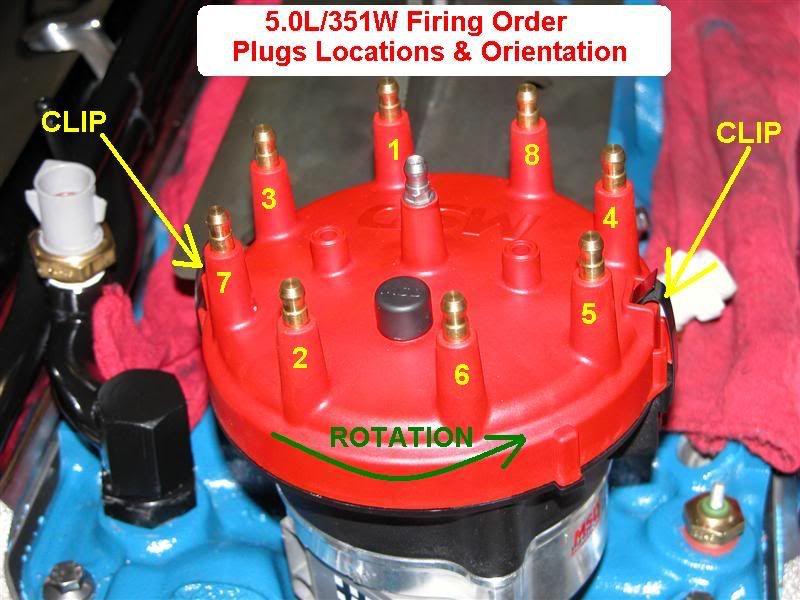
The HO firing order is 1-3-7-2-6-5-4-8.
Non HO firing order is 1-5-4-2-6-3-7-8

attachment.php
 
From SBF Tech.com joel5.0 has the best how-to's

EFI Initial Ignition Timing Calibration and Distributor Installation

This is a question that usually comes up once in awhile, and for the new Ford enthusiast the following procedure will help bumping up that timing and make sure the distributor is installed correctly.

If you have removed the distributor for any type of work, you have to make sure it is installed correctly with #1 cylinder at compression TDC. The following will help you make sure it is installed right.

Tools:

* ½" Combination wrench or the "L" shaped ½" timing wrench
* White Out or liquid paper
* Carburetor cleaner
* Clean rag and/or napkins
* Timing Light


Installing Distributor at #1 Compression:

This is the procedure I always use to make sure #1 cylinder is at compression TDC and not the exhaust cycle or 180° off.

* Remove #1 spark plug.
* Plug the spark plug hole with a piece of rag or a napkin.
* Either have an assistant short click the starter, or use a remote starter switch (a long screwdriver will also work By The Way) to short click the starter solenoid.
* As soon as the napkin/rag is expelled from the cylinder (sign of compression stroke), rotate the engine by hand using a 15/16" socket and handle for the crankshaft bolt, until the TDC mark is aligned with the timing marker. Even though the 10° BTDC mark shows on the pic, you should use the TDC or 0° mark.
* Now it will be a good time to clean the timing scale on the balancer with some carburetor cleaner and a rag, you should also make the necessary marks with white out or liquid paper, it will make it easier to read when you're setting the initial timing later on.

timing_marks2.webp


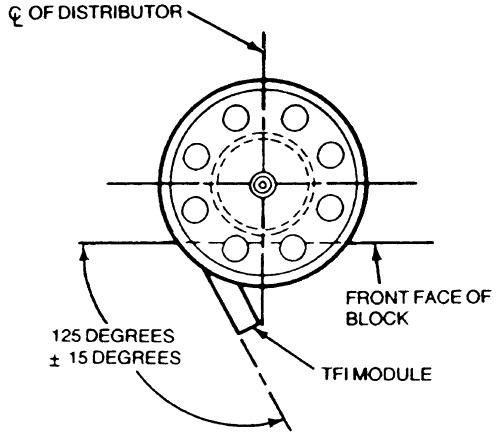
* Install/Stab distributor noting the orientation of the TFI module connector (if it applies) and the direction of the rotor. You could also use the PIP sensor magnet as a guide, as shown in the 1-tooth-off retarded example below. To correct the condition illustrated by the red line, the distributor would have to be re-indexed using the green line as the reference position point.


Dist_index_OK2.JPG

Dizzy_Diagram_Orientation.gif


* The following pics show how a correctly installed distributor looks like. Notice the position to the LH side of the stator magnet (white dot) of the vanes rotor.

TFI_indexed_TDC1.jpg


TFI_indexed_TDC2.jpg


Dist_Index1.jpg


* The spark plug cables should be arranged in the order shown below for a 5.0L HO or 351W, if a regular 302w is the one been worked, simply use the 1-5-4-2-6-3-7-8 firing order instead.

Dizzy_Diagram_FO_CAP.jpg


Initial Timing Calibration:

Now you're ready to start the engine and set initial timing.

* Locate the SPOUT connector, '86-93 Mustangs have it in the TFI module harness near the connector, and '94-'95 Mustangs have it near the MAF, at the RH fenderwell as shown below.


'86 - '93 Mustangs
SPOUT_on.jpg

SPOUT_off.jpg


'94-'95 Mustangs
spout_SN95_1.jpg


* Remove the SPOUT connector jumper plug and secure it.
* Start the engine and bring it to operating temperature.
* Using the timing light, set initial to the setting you would like to test, rotating the distributor CW will advance timing, and CCW will retard timing. 10° BTDC is the stock setting, but you may want to check if 12° BTDC or 14° BTDC will work for more power.
* Tighten distributor base bolt and confirm setting did not change.
* Reconnect the SPOUT jumper plug into the connector.
* Check timing change with the timing light, the reading should be between 20° - 24° BTDC = sign the computer is controlling spark advance.
* You're done....


NOTE:
In the event you misplace or loose the SPOUT connector plug, a simple jumper wire or clip will work fine. The SPOUT plug is simply a jumper used to allow the ECM to control spark advance, or disconnect the ECM from controlling spark advance; and be able to set initial spark.

Testing for Engine Ping

You may want to verify the new initial setting (if you advanced it to a higher setting) does not cause engine ping. To do so, suggest the following procedure.

* Make sure engine is at operating temperature.
* Find a long straightway for the test.
* Increase speed to 25-35 MPH and shift into 4th gear.
* Increase engine load by pressing accelerator pedal ? down at first, and at WOT making sure you DON'T downshift from 4th. gear.
* Notice if engine ping is heard from the engine, if it is, repeat the Initial Timing Calibration, and retard advance 2° from the current setting.
* Repeat this procedure until engine pinging condition is not noticed.


NOW you're done....Phew
 
i bought a used fuel pressure regulator... keeps fouling my plugs up bad! They turn black within a couple trys... i threw away my stock one... so my only guess is it is bad! going to try to replace that! Its getting way tooo much fuel!
 
i bought a used fuel pressure regulator... keeps fouling my plugs up bad! They turn black within a couple trys... i threw away my stock one... so my only guess is it is bad! going to try to replace that! Its getting way tooo much fuel!

how do you know your fpr is bad and causing your plugs to foul? Do you have a shrader valve mounted fuel psi gauge to verify this i hope? Just asking. usually a sign of a bad fpr is that you will have fuel spraying out of the vaccum port due to a bad diaphram but not causing excessive fuel pressure
 
well i replaced the plugs and put a stock fuel pressure reg on... Started up first try! RUNS like crap! but now it runs and will idle...

is it possible that my balancer has spun? its 23 years old allowing me not to stab my dizzy right?

plugs still turn black after awhile?
 
Step 1. Check the grounds as suggested.
Step 2. dump the codes.

Grounds are important to any electrical system, and especially to
computer controlled engines. In an automobile, the ground is
the return path for power to get back to the alternator and battery.


1.) The main power ground is from engine block to battery: it is
the power ground for the starter & alternator.

2.) The secondary power ground is between the back of the
intake manifold and the driver's side firewall. It is often missing or
loose. It supplies ground for the alternator, A/C compressor
clutch and other electrical accessories such as the gauges.
Any car that has a 3G or high output current alternator needs
a 4 gauge ground wire running from the block to the chassis
ground where the battery pigtail ground connects.

The 3G has a 130 amp capacity, so you wire the power side
with 4 gauge wire. It stands to reason that the ground side
handles just a much current, so it needs to be 4 gauge too.

The picture shows the common ground point for the battery & extra 3G
alternator ground wire as described above in paragraph 2. A screwdriver
points to the bolt that is the common ground point.
The battery common ground is a 10 gauge pigtail with the computer ground
attached to it.

Picture courtesy timewarped1972
ground.jpg


Correct negative battery ground cable.
56567d1230679358-positive-negative-battery-cable-questions-86-93-mustang-oem-style-ground-cable.gif


3.) The computer has its own dedicated power ground that comes off the ground pigtail
on the battery ground wire. Due to it's proximity to the battery, it may become
corroded by acid fumes from the battery.
In 86-90 model cars, it is a black cylinder about 2 1/2" long by 1" diameter with a black/lt green wire.
In 91-95 model cars it is a black cylinder about 2 1/2" long by 1" diameter with a black/white wire.
You'll find it up next to the starter solenoid where the wire goes into the wiring harness.


4.) All the sensors have a common separate ground. This
includes the TPS, ACT, EGE, BAP, & VSS sensors.

5.) The O2 sensor heaters have their own ground (HEGO ground)
coming from the computer. This is different and separate from
the O2 sensor ground. It is an orange wire with a ring terminal
on it. It is located in the fuel injector wiring harness and comes out
under the throttle body. It gets connected to a manifold or bolt on
back of the cylinder head.

6.) The TFI module has 2 grounds: one for the foil shield around
the wires and another for the module itself. The TFI module
ground terminates inside the computer.

7.) The computer takes the shield ground for the TFI module and
runs it from pin 20 to the chassis near the computer.

8.) The computer's main power ground (the one that comes from
the battery ground wire) uses pins 40 & 60 for all the things it
controls internally.

See Automotive Test Tools
for help troubleshooting voltage drops across grounds


Extra grounds are like the reserve parachute for a sky diver.
If the main one fails, there is always your reserve.

The best plan is to have all the grounds meet at one central spot
and connect together there. That eliminates any voltage drops
from grounds connected at different places. A voltage drop
between the computer ground and the alternator power ground will effectively
reduce the voltage available to the computer by the amount of the drop.


Dumping The computer diagnostic codes on 86-95 Mustangs

Revised 19-May-2009 to update drawing for dumping the codes on 86-88 Mustangs with no check engine light.

Dump the codes and see what the computer says is wrong…Codes may be present in the computer even if the Check Engine light isn’t on.

Here's the way to dump the computer codes with only a jumper wire or paper clip and the check engine light, or test light or voltmeter. I’ve used it for years, and it works great. You watch the flashing test lamp or Check Engine Light and count the flashes.

Be sure to turn off the A/C, and put the transmission in neutral when dumping the codes. Fail to do this and you will generate a code 67 and not be able to dump the Engine Running codes.

Dumping the Engine Running codes: The procedure is the same, you start the engine with the test jumper in place. Be sure the A/C is off and the transmission is in neutral. You'll get an 11, then a 4 and the engine will speed up to do the EGR test. After the engine speed decreases back to idle, it will dump the engine running codes.

Here's the link to dump the computer codes with only a jumper wire or paper clip and the check engine light, or test light or voltmeter. I’ve used it for years, and it works great. You watch the flashing test lamp or Check Engine Light and count the flashes.

See Troublcodes.net Trouble Codes OBD & OBD2 Trouble Codes and Technical info & Tool Store. By BAT Auto Technical

B.jpg


F.jpg


If your car is an 86-88 stang, you'll have to use the test lamp or voltmeter method. There is no functional check engine light on the 86-88's except possibly the Cali Mass Air cars.

attachment.php


The STI has a gray connector shell and a white/red wire. It comes from the same bundle of wires as the self test connector.

89 through 95 cars have a working Check Engine light. Watch it instead of using a test lamp.

attachment.php


The STI has a gray connector shell and a white/red wire. It comes from the same bundle of wires as the self test connector.


WARNING!!! There is a single dark brown connector with a black/orange wire. It is the 12 volt power to the under the hood light. Do not jumper it to the computer test connector. If you do, you will damage the computer.

What to expect:
You should get a code 11 (two single flashes in succession). This says that the computer's internal workings are OK, and that the wiring to put the computer into diagnostic mode is good. No code 11 and you have some wiring problems.

Codes have different answers if the engine is running from the answers that it has when the engine isn't running. It helps a lot to know if you had the engine running when you ran the test.

Trouble codes are either 2 digit or 3 digit, there are no cars that use both 2 digit codes and 3 digit codes.

Alternate methods:
For those who are intimidated by all the wires & connections, see Actron® for what a typical hand scanner looks like. Normal retail price is about $30 or so at AutoZone or Wal-Mart.

Or for a nicer scanner see Digital Ford Code Reader (3145) – It has a 3 digit LCD display so that you don’t have to count flashes or beeps.. Cost is $30.
 
you can also put it at tdc on cylinder one ther is a notch at the very bottom of the distributor in the block that shows TDC and when its on that it should point to #1 spark plug