68 steering issues

Help

Finally got my car on the road but the steering feels sloppy and wanders slightly. All new parts under neath - arms. tie rods. aligned and new steering ram and hoses.

Is there any adjustments to eliminate the wandering of the car?

Please help

Thanks
 
I have the same issue...


its nothing in your hoses or bushings or anything else....its actually an adjustment. The proportioning valve for the P/S was set pretty loose form the factory, and it you change that setting, it will tighten up. I've not been able to do mine yet, cause the tranny conversion is still in pieces...lol...but I've done it on a 67. same symptoms, new rods, ends, bushings, etc, but you always have to bump one way or another to keep it straight.

careful though, if you set it too tight, it will actually be hard to steer.


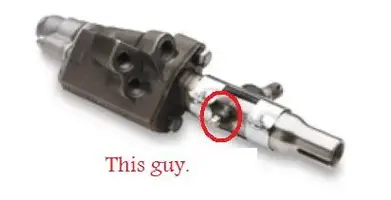
I can't quite recall exactly how you adjust them, and alas my shop manual is MIA. but if i remember, there is a bolt/screw looking thing underneath the P/v (directly underneath the arm that comes from the steering box). that is the guy your after..


could one of the Sr.'s chime in and yes/no my thoughts??
 
guys

Yes an anlignement was completed but done to 68 stang specs. I changed to granada spindles plus 620 springs.

As you mentioned I have to constantly adjust to keep it straight. if i give her gas around a corner it handles great. Its when the car is running straight down the road it tends to wander

I checked out the steeriing box - appears to be a hex nut and screw type adjustment which I can see when looking down into engine bay. Is this the adustment?

When you had the problem did this fix it?

I know the car is old and wont handle like a ferrari but just want to be able to cruise without having to focus on keeping it striaght.

Thanks for you advice

DAve
 
I would have them align it to better specs, even if it's just a daily driver. I dropped my A-arms an inch, then had the shop align it to the typical 3 degrees caster, 1/2 degree negative camber, 1/8" toe in. Mine still has 1968-era parts and it doesn't wander.
 
sent a PM'

just for everyone else'


its not on top of the steering box.

if you look at the steering box, there's an arm that comes out of the (bottom?) that connects to a rod/bolt that comes out of the top of the powersteering control valve. if you move the wheel back and forth with the engine off, that rod sticking out of the top of the control valve will appear loose. thats the way its supposed to be, thats the actual control valve itself moving back and forth.

on the attached picture i've circled the adjustment I'm talking about.

and as zoo mentioned, its very possible that the shop isn't used to working on older cars. The slight change in specs may improve it a little, but mine does the same as yours, and I'm betting this will solve it.
 

Attachments

  • PV.webp
    PV.webp
    4.6 KB · Views: 627
Zookeeper

I will find out what the spec's the alignment was completed to.

What about the steering box adjustment? Should I touch this or wait for alignment?

Dave
So you know what each adjustment does, here's a simplified explanation: negative camber is when the tops of the tires are leaned inwards towards each other, when viewed from the front of the car. Most cars have zero or 1/2 degree positive camber (tops of the tires tilting outwards) so that in a panic cornering situation, the front tires will slide first, which is easier for "Joe Average" to recover from. This also typically causes the outside of the tire to wear out long before the rest of the tire. I routinely get flack from alignment techs when I ask for 1/2 degree of negative camber, but they do it, and it works.
Stock vehicles also are supposed to have 1 degree to 1 1/2 degrees of positive caster, meaning that when viewed from the side, the center axis of the ball joints is leaned back 1 to 1 1/2 degrees. This is for stability in a straight line at highway speeds. More caster increases steering effort, but also increases stability. If my alignment shop could get 4 degrees out of my car, I'd do it, but the max they have been able to get is 3, so that's what it has. FYI, my brother's Model A hot rod has a solid, I beam front axle and it has 9 degrees positive caster, and drives wonderfully.
Toe-in is just what it sounds like and is for stability. When viewed from the top, the fronts of the front tires should be closer to each other than at the rear of the front tires. Street cars seem to behave best with between 1/16" toe in and 1/8" toe in, much more than that and you'll see excessive wear, any less and you'll find it wanders.
There's a lot of variables and exceptions, but they are too many and too wierd to even worry about, but for vintage, street-driven Mustangs, a bit more caster and camber do wonders for the manners with no ill effects.
 
Adjustment

Uh, jlangholzj, the part you have circled on the control valve is the grease fitting. No adjusting there.

There is an adjustment under the aluminum cap on the valve, but it will not tighten up any looseness in the valve. It adjusts the bias the valve has under pressure between left and right turning. If the power assist works the same in both directions, this adjustment does not need to be changed.
 
Uh, jlangholzj, the part you have circled on the control valve is the grease fitting. No adjusting there.

There is an adjustment under the aluminum cap on the valve, but it will not tighten up any looseness in the valve. It adjusts the bias the valve has under pressure between left and right turning. If the power assist works the same in both directions, this adjustment does not need to be changed.


so it is....lol....mine must be a bit different that the one pictured....its got an adjustment down there...ah..oh well...

dang it...now i really want to get this thing done so i can look at it.

there's an adjustment for the steering, not just the bias however.
 
if you look at the steering box, there's an arm that comes out of the (bottom?) that connects to a rod/bolt that comes out of the top of the powersteering control valve. if you move the wheel back and forth with the engine off, that rod sticking out of the top of the control valve will appear loose. thats the way its supposed to be, thats the actual control valve itself moving back and forth.

on the attached picture i've circled the adjustment I'm talking about.

My 68's steering is exactly as you described it above, has slack or play in the wheel just as you have described above. If there is an adjustment for this slack, then I MUST HAVE IT NOW :D Seriously, I just figured this was the way the old steering systems were in these cars and that I would either have to deal with it or do an R&P swap. Please share anymore insight on this adjustment.
 
sent a PM'

just for everyone else'


its not on top of the steering box.

if you look at the steering box, there's an arm that comes out of the (bottom?) that connects to a rod/bolt that comes out of the top of the powersteering control valve. if you move the wheel back and forth with the engine off, that rod sticking out of the top of the control valve will appear loose. thats the way its supposed to be, thats the actual control valve itself moving back and forth.

on the attached picture i've circled the adjustment I'm talking about.

and as zoo mentioned, its very possible that the shop isn't used to working on older cars. The slight change in specs may improve it a little, but mine does the same as yours, and I'm betting this will solve it.

That is not a point of adjustment, that is a grease fitting.

The adjustment is under the cap at the other end of the control valve in the picture, under the silver-colored cap. This is visible below the structural member behind the left front wheel. Here is how to do the adjustment: Take off the dust cap. Loosen the nut on the end of the rod inside the dust cap area. Torque the nut to 10 lb-ft AFTER the movement is taken up. The threaded rod will move about 1/4 turn as the nut is turned. Replace the dust cap, making sure the o-ring for the cap is in place.
 
Some great info on our cars steering systems at Stangerssite.

Here's the snippet regarding adjustment of the control valve. It has nothing to do with slack, so be sure to do some research before you cause yourself more problems:

<TABLE cellSpacing=0 cellPadding=0 width=119 border=0><TBODY><TR vAlign=top><TD>
ADJUSTMENT
</TD></TR></TBODY></TABLE>
<TABLE cellSpacing=0 cellPadding=0 width=951 border=0><TBODY><TR vAlign=top><TD>
New and rebuilt control valves should already come adjusted when you get them and require no further adjustment. The only accessible adustment is found under the aluminum end cap on the far end of the valve. This consists of a nut on a threaded rod and controls the centering of the spool valve inside the valve housing. Many people think this nut should be turned down tight, like most nuts are supposed to be. However, this is an adjustment and is not supposed to be just tightened down.
This adjustment is misunderstood and played with to supposedly correct all sorts of problems associated with the control valve. However, all this adjustment does is center the spool in the housing. If it is misadjusted, the steering tends to provide power assist more in one direction than the other. When severely misadjusted, the wheels may actually turn one direction by themselves due to the imbalance. For this reason it is important not to tamper with this adjustment unless you know how to do it properly.
This adjustment has nothing to do with the tightness or looseness of the ball stud, the play in the valve assembly or the sensitivity of the system. Playing with the adjustment of the centering spring will probably violate your warranty. If you think that some adjustment needs to be made to your valve, always contact the supplier or rebuilder before proceding.​
</TD></TR></TBODY></TABLE>
New and rebuilt control valves should already come adjusted when you get them and require no further adjustment. The only accessible adustment is found under the aluminum end cap on the far end of the valve. This consists of a nut on a threaded rod and controls the centering of the spool valve inside the valve housing. Many people think this nut should be turned down tight, like most nuts are supposed to be. However, this is an adjustment and is not supposed to be just tightened down.
This adjustment is misunderstood and played with to supposedly correct all sorts of problems associated with the control valve. However, all this adjustment does is center the spool in the housing. If it is misadjusted, the steering tends to provide power assist more in one direction than the other. When severely misadjusted, the wheels may actually turn one direction by themselves due to the imbalance. For this reason it is important not to tamper with this adjustment unless you know how to do it properly.
This adjustment has nothing to do with the tightness or looseness of the ball stud, the play in the valve assembly or the sensitivity of the system. Playing with the adjustment of the centering spring will probably violate your warranty. If you think that some adjustment needs to be made to your valve, always contact the supplier or rebuilder before proceding.​
 
As stated, the adjustment for slack is NOT at the control valve; it is at the steering gear box in the engine compartment. After many years there is wear and they need a slight tightening. The nut has to be loosened and the the screw tightened. There is a specific torque setting in the manual, but I don't have it handy. If you over tighten this setting, the steering could lock up on you going down the road, so, use the proper spec from the manual.
 
What about your steering box? If it is the original box, it probably needs a rebuild or you need a new box. Flaming River has brand new box for a decent price. When I rebuilt my steering, I changed everything, including the box and it is tite.