87 5.0 Troubleshooting & Solutions

In a fast curve the oil pressure drops...
It has an appetite for oil. Running 10w30 synthetic.
Warm idle - 13 psi
Max - 25 psi
It never goes above 25 when warm, regardless of rpm!

Is this just the high volume pump?
I think the rear main is leaking or the rear of the pan has broken seal due to front impact. However, it doesn't leave a puddle when parked.

It does smoke a bit but only under heavy acceleration and compression is good.
The pan has been cut slightly to clear the subframe so I'm not comfortable running more oil.

Leak down time.
 
I'm seeing 25 at hot idle. Under rpm it doubles that. Of course a lot of people say that 10psi per 1k rpm is the given standard. If you aren't seeing over 25 you either have a faulty gauge or you have oil pressure issues.

I'm wondering if your pick up is up against the pan or has something blocking it.
 
I agree. I see 40psi warm idle 55+ under acceleration. But my engine is fresh, with tight tolerances. You could try a 20w50 oil and see if it helps.

Is the gauge stock? Is the sender new? Try taking the sender out of the block and see if it is plugged up.
 
Mine is doing the same thing, but since the mechanical oil pressure gauge I have under the hood shows about 20-25 PSI at idle and 50 PSI at 2000 RPM, I don't worry about it. Some day I'll get around to troubleshooting it.

Mechanical oil pressure gauge installation..
1.) Remove old pressure sender. It is located down by the oil filter and has 1 wire on a push on screw connector.
2.) Install ¼” pipe tee fitting with a short ¼” nipple on the place where you removed the oil pressure sender.
3.) Install the original oil pressure sender back in one of the tee ports.
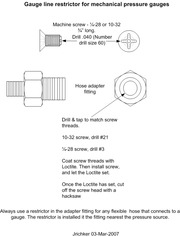
4.) Install the gauge line restrictor in the remaining port of the tee.
5.) Connect the flex tubing or hydraulic hose to the gauge restrictor. Be sure to route the tubing or hose away from the exhaust manifolds. Be sure to either use hydraulic hose or oil and heat resistant flex tubing for the pressure line. Do not use copper tubing for the connection to the gauge restrictor or engine. Over a period of time, the vibration will work harden the tubing and cause it to crack and fail.
6.) If the gauge is going to mount under the hood, connect it to the end of the hose or flex tubing. Use some Tie-wraps to secure the gauge and its plumbing to the wiring harness on the driver’s side inner fender.
7.) If the gauge is going to mount in the passenger compartment you get to find a place to run the tubing through the firewall. I suggest that you pick your spot from the inside since that is the area with the most difficult access. Do not run the tubing through the exact same hole as the steering shaft. It will tangle up with the steering shaft and cause major problems.
8.) Install the gauge inside the car in the location of your choosing. Connect the pressure line to the gauge and secure it out of the way of moving parts with Tie-wraps.
9.) Be sure to ground the gauge lighting wire to clean, shiny bare metal. Connect the other wire from the gauge lighting to a light blue/red wire on the radio wiring harness. There are 2 connectors in the radio wiring harness, but only one of them has the light blue/red wire you need for gauge illumination. Solder the gauge lighting wire to the light blue/red wire on the radio harness and cover the soldered joint with heat shrink.

How to solder like a pro - Ford Fuel Injection » How To Solder Like a Pro a must read for any automotive wiring job.

Be sure to use a gauge restrictor fitting in the pressure line going to the gauge. The restrictor will prevent all of the engine's oil supply from ending up on the pavement before you can stop it if the gauge line fails. I had a gauge line rupture, and the restrictor fitting saved my engine from serious damage.

49295d1172975440-pressure-gauge-line-restrictor-pressure-gauge-flow-restrictor.gif
 

Attachments

  • 49295d1172975440-pressure-gauge-line-restrictor-pressure-gauge-flow-restrictor.gif
    49295d1172975440-pressure-gauge-line-restrictor-pressure-gauge-flow-restrictor.gif
    67.7 KB · Views: 169
I like the sound of that! Got some parts store cleaner but it probably doesn't work as good.

Behind the thermostat looks like Georgia clay. I assume it's from too much water in the antifreeze? I'm pretty sure oil is getting in there too but don't think it causes rust.

IMG_00008997_zpswsdrbrfh.webp
 
I think the white stuff was calcium or lime scale from non-distilled water. Luckily I had a bottle of scale remover that we make (hydrochloric acid with corrosion inhibitors) and worked it off with a toothbrush.

Vinegar is acetic acid, we have 99% so I'll grab some and dilute it for the radiator.

Yes Mike, the 3 day flush is next once I find a small electric pump to circulate the cleaning mixture.

Had some trouble finding a Mr. Gasket thermostat housing gasket but Jegs has it in stock. It's rubber material because screw paper gaskets and sealer! Got the old gasket off with PB blaster and a razor blade, scraping perpendicular.

That gives me an idea, I'll ask the chemists here what can dissolve gasket and sealer without damaging aluminum. There has to be a better way!
 
Hot wire a fuel pump to circulate flush mix?

My walbro 255 flows about 67 gallons /hr around 1 gal/min. Not enough to supply it while running.

I don't want to run the flush mix back into the engine without a way to separate sludge or chunks. I would have to install in line filters before and after the radiator. This might not be to hard.

It would make more sense to hook up an electric motor to drive the engine water pump
 
Last edited:
I think the white stuff was calcium or lime scale from non-distilled water. Luckily I had a bottle of scale remover that we make (hydrochloric acid with corrosion inhibitors) and worked it off with a toothbrush.

Vinegar is acetic acid, we have 99% so I'll grab some and dilute it for the radiator.

Yes Mike, the 3 day flush is next once I find a small electric pump to circulate the cleaning mixture.

Had some trouble finding a Mr. Gasket thermostat housing gasket but Jegs has it in stock. It's rubber material because screw paper gaskets and sealer! Got the old gasket off with PB blaster and a razor blade, scraping perpendicular.

That gives me an idea, I'll ask the chemists here what can dissolve gasket and sealer without damaging aluminum. There has to be a better way!

Meh, just use a felpro thermostat gasket with a light skimcote of right stuff. Install the thermostat into the housing, put the gasket ontop of the thermostat and housing and let it set up with the bolt holes aligned on the gasket and housing. Then you can install it easy peasy. Spring side towards the motor with the arrow facing up.
 
Crap we used to have a pool circulator! That would be perfect. I think I'll just use the fuel pump and not let the engine get hot.

No more paper gaskets no more sealer it's unethical. Crimes against humanity.