air fuel results/adj.fuel pressure reg.

bill302

Active Member
Nov 2, 2005
2,131
1
46
alabama,gadsden
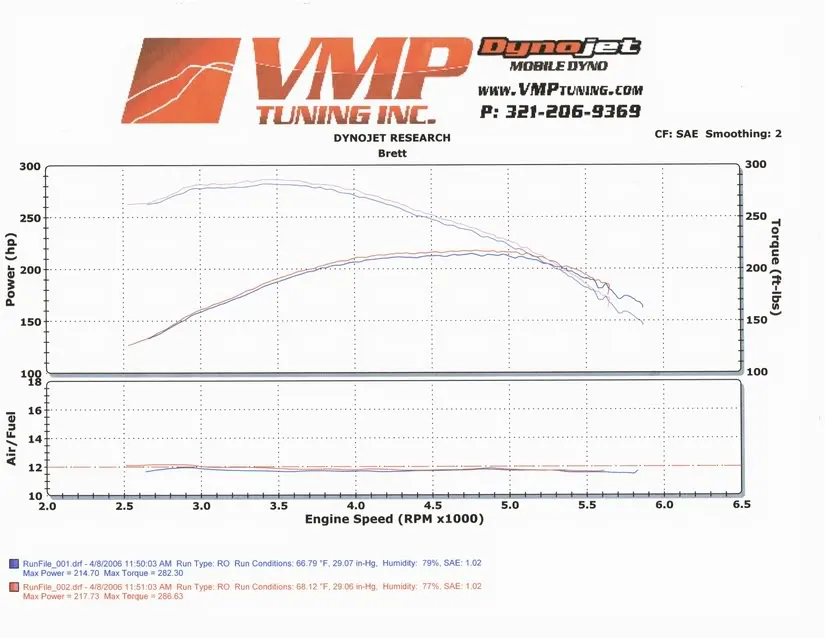
what does the air fuel chart below show. too much air and not enough fuel past 2700 rpms is this correct, this dyno was done with the factory fuel pressure reg. i bought an adj. fuel pressure reg.and guage. i first installed the guage and the guage read 35 psi with old factory regulator then i installed the adj. fuel pressure reg. and adjusted the pressure to 40 psi and i am wondering if that should better my a/f ratio. i'm preparing too install my nitrous kit fri....thanks.
mustangdyno.webp
 

Attachments

  • mustangdyno.webp
    mustangdyno.webp
    38.9 KB · Views: 124
Looks like about 11.8-12.0 to 1

A bit fat for NA

The lean or fat thing as far as fuel ratio goes like this

The ratio is expressed in so many parts of air to so many parts of fuel

The chart above looks like an average of ............

11.9 parts of air to 1.0 part of fuel

Grady
 
final5-0 said:
Looks like about 11.8-12.0 to 1

A bit fat for NA

The lean or fat thing as far as fuel ratio goes like this

The ratio is expressed in so many parts of air to so many parts of fuel

The chart above looks like an average of ............

11.9 parts of air to 1.0 part of fuel

Grady
so i probably need less fuel pressure than the stock fuel regulator was putting out at time of dyno?
 
Ok.. By looking at your graph, as final5-0 pointed out, your average air/fuel ratio happens to be 11.9/1.. Now if we look at this from a chemistry standpoint:

C8H18 + O2 > CO2 + H2O which would yield a balanced oxygen/fuel ratio..

After balancing the equation, we get:

C8H18 +27O > 8CO2 + 9H2O...

We can then calculate the oxygen/fuel ratio by using the atomic weights of Carbon, Hydrogen, and Oxygen, which happen to be 12, 1, and 16, respectively, yielding:

27x16 432
------------ = ---- = 3.79/1 OXYGEN/fuel ratio, not air/fuel...
8x12 + 1x18 114

To find the right AIR/fuel ratio, understand that in our atmosphere, approximately 21% of the air is oxygen, so in order to find the right fuel/air ratio, we need to multiply the oxygen/fuel ratio by 100/21:

100
3.79 x ----- = 18.05/1 air/fuel ratio....
21

Also, your engine is requiring more fuel when under stress, such as WOT or high acceleration, so given a air/fuel ratio of 11.9/1 seems dramatically lean to me... Anybody else follow my calculations and agree? or did I do all the math for nothing?? lol :SNSign:
 
94GTPilot said:
Ok.. By looking at your graph, as final5-0 pointed out, your average air/fuel ratio happens to be 11.9/1.. Now if we look at this from a chemistry standpoint:

C8H18 + O2 > CO2 + H2O which would yield a balanced oxygen/fuel ratio..

After balancing the equation, we get:

C8H18 +27O > 8CO2 + 9H2O...

We can then calculate the oxygen/fuel ratio by using the atomic weights of Carbon, Hydrogen, and Oxygen, which happen to be 12, 1, and 16, respectively, yielding:

27x16 432
------------ = ---- = 3.79/1 OXYGEN/fuel ratio, not air/fuel...
8x12 + 1x18 114

To find the right AIR/fuel ratio, understand that in our atmosphere, approximately 21% of the air is oxygen, so in order to find the right fuel/air ratio, we need to multiply the oxygen/fuel ratio by 100/21:

100
3.79 x ----- = 18.05/1 air/fuel ratio....
21

Also, your engine is requiring more fuel when under stress, such as WOT or high acceleration, so given a air/fuel ratio of 11.9/1 seems dramatically lean to me... Anybody else follow my calculations and agree? or did I do all the math for nothing?? lol :SNSign:


WOW :eek:

I bailed on that first long formula looking thing
and
picked back up at the end

You posted up all that stuff for nothing ... Well ... your math may be right ... but ... your logic ain't.

You may have heard 14.7 to 1 is the ratio the pcm strives for in Closed Loop.

When you go to Open Loop or WOT, the ratio will fall or get fatter as the motor is working harder and needs the additional fuel.

See how with 11.9 parts of air to 1.0 part of fuel

Its fatter than 14.7 to 1.0

Grady
 
I aint Grady or Mr Chemistry (that was a respectful comment - simple component stoichiometry was as far as I got in Chem), but......................

from a computer standpoint, if running that rich, it seems like there's a sensory or tune issue to me (it wouldnt run that fat on its own). Now dont get me wrong Bill - I'd love some of that fatness with my ping-machine. :p

My Point (kinda about Bill's issue, and I think what Jason was saying): the computer should be adjusting the A/F stiochiometry to where it thinks it should be. More fuel pressure would mean that the computer shortens pulsewidth - back at square one. But for some reason you're running rich it seems, so that's what the puter seems to think is right (assuming no limit codes are appearing).

Feel free to tear my post apart - Like I said I aint no Grady or 94GTP. I'm wondering if the whole air-fuel ratio (with oxygen, nitrogen, etc etc incorporated as a whole of the sum) vs oxygen/fuel ratio is throwing a wrench into things. :shrug: You guys are smarter than I am. I need to go find a what gear thread to make my head stop hurting. :D :cheers:
 
Is this the same dyno run that you put of before Bill? It looks to be the same one.

Was this pull performed with the bottle on or off?

I get what the others are saying about the 02 sensors wanting to adjust FP to stoich (14.7 AFR) but that would be only at idle. The fuel tables are set to provide a richer mixture as load and RPM increases at part power.

At WOT, the sensors do not perform this function. Instead, value adjustments to the fuel tables derived from idle and part power settings and stored in KARMFs to either add to or take away from the WOT settings. To make a long story short, if you're showing a 14.7 AFR at WOT throttle then that would definitely indicate a problem.

Turning the fuel pressure down on your new regulator will lean out your mixture at least for a time, depending upon whether the current AFR was within or outside the EEC's ability to adapt (approx 20%).

So... Now that you have the new AFPR installed, you need to clear the computer and drive the car around a while to allow the adpative control to try and do it's thing.

You're going to need to back up the readings if your dyno pull with either another pull or an AFR meter so that you can see what's going on (this will also help to either confirm or deny the accuracy of the AFR reading from your last pull).

Ensuring the health of your sensors is ALWAYS a good idea but at the same time, having no sensor codes (if you've pulled them) is a decent indication of whether or not that system is functioning correctly.

For N/A, I have to agree with these guys. You're a bit fat. If everything is working correctly and you want to lean it out a bit at WOT then turn your FP down a bit and allow adaptive control to do it's thing before checking it again. The trick is to find a nice balance. It's something that I think can be done relatively easily with an AFPR considering the small amount that you're off through your RPM range. You're only looking for one point of AFR basically.

Now... if you adjust the FP and lean out the AFR then codes start popping for the 02 sensors. It's a good bet that one or more of those sensors are skewed and needs to be replaced.

you adjusted the new regulator to 40 psi. That's working inthe opposite direction for what you're trying to achieve. I would start be setting the thing to the factory 35 psi, resetting the computer to clear the KARMFs then driving it around a day or so, to allow it to relearn. If you're still rich, then drop the pressure down another 5 psi. and repeat the other steps. A nice 12.8 - 13.2 in the majaority of your power band would be a nice mix for N/A with the AFR showing a little richer at the top of your RPM range. You'd likely pick up a few HP at the wheels as well.

Much of this is ASSUMING that the AFR readings you got from the dyno are correct! It's a big "if" as I've seen a couple that weren't so accurate. They usually (not always) read a bit lean instead of rich though, because the sniffer is after the catalytic converter.

Later I'll go back and review my post here to see if I was making any sense. hehe
 
thanks for the info...and yes its the same dyno as i posted before and the co2 sensors are a few months old i probably have less than 2000 miles on them, the injectors are stock with 155 liter per hr. walbro fuel pump... and i have been thinking about what ya'll have been saying and i wonder if the jet powertech module has anything to do with the rich condition?
 
Oh geeze... LOL If that thing is going between the EEC and the connector, get rid of it. If it's what it appears to be, then it's likely been your problem the whole time.
 
11.9-12.0 is a bit fat for N/A, most people see the best N/A power at 12.8-13.0:1.

That 11.9-12.0 is not realy that fat as far as being off from what the eec is commanding. IIRC the stock fuel commanded a/f is like 11.8-12.0 so it looks like its just running what the factory settings are in the eec.