another 'vert stiffness thread

Hey guys, my progress has been painfully slow in the last few months. I did however get my floorpan fixed up. I'm hoping to put a 408 stroker in my '65 vert, but i'm a little concerned about the lack of stiffness in the unibody. I want the car to be able to handle about 600 ft lbs of torque (even though it probably won't ever see quite that much).

Currently it has a 4 point rollbar. I'm in the process of adding tin man SFCs which run through the convertible subfloor, and i'm planning on getting the maier export brace / Monte Carlo Bar.

Will this be sufficient for my goals, or do i need to add more bracing? What would you guys recommend?

It's already a little hard to get in and out of the car due to tight clearances between the seat and steering wheel, so i'm hoping not to have to turn my rollbar into a 6 point, but i will if i have to.

-Duke
 
Most of what that kit adds the vets already has so i dont think that will help you could always seal weld all the welds that would help a little and cut down on the rust chances. Make sure you tie the subs in at as many locations as you can.
 
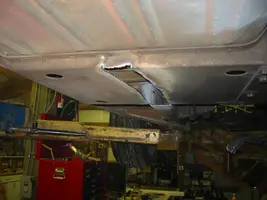
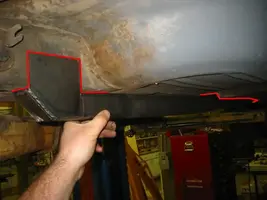
The sub frame connectors will be welded for more than half of their length, and they are close enough to the floorpan that it would not be difficult to add a little metal and have them welded for their full length.

The red in the second picture is where i'm currently planning on welding it. The front of the SFC slides into the back of the front frame rail and then welds in place from holes drilled in the side of the frame rail. the SFCs are made of 2X2X 1/8 bent square tubing.
 

Attachments

  • SFCs 002s.webp
    SFCs 002s.webp
    29.7 KB · Views: 474
  • SFCs 018.webp
    SFCs 018.webp
    26.7 KB · Views: 519
Not quite sure what you are talking about with the weight thing? And what is that garbage about a cheap "secretary's" car? The subframe connectors weigh a HUGE 60 lbs. To add them increases the chassis stiffness which is always good.

The engine may be a little much as the Vert is lighter and you will have no luck with locking up, so I agree with the lower torque, and higher RPM but lets not get too anti power. Cool project by the way. I am in the process of adding the exact same subframe cut in on my 68'. Not quite that kind of power though. Good luck with the project. And as most will tell you here, it's your ride and opinions are like... well we know that everyone has one. :lol: :lol:
 
I would check a couple of things, look at the inside of the rocker panels, they should not be flat on the inside, they should have a piece of C-channel looking peice instead of the typical flat.

090inner_rocker_panel_conv.jpg


If it does not have these then I would add them. Next add your subframe connectors and add a couple pieces of square tubing tieing into the above mentioned rocker panel.

Make sure you have the one piece seat platform.

3647y.jpg


Make sure you roll bar ties into the subframe connecters and if you add door bars, make sure they tie into the rocker panels.

I am not sure if yours came with torque boxes, if not you might want to add some 2X4 or 2X3 rectangluar tubing from the front frame rails to the rocker panel.

IMO if you do all that, you should be good to go...
 
66Runt:

I see where you are coming from, and i generally respect your opinnion. The engine i am planning to build should have the torque levels somewhere in the mid 400s, and i will probably end up with a 351. The reason that i want to build the car to handle 600 ft lbs is that I will be using a TKO 600, and i want to build the car to match in case i end up wanting more power down the road. Even if i don't add more power, it's always nice to have a little safety factor built in.

68 converted:

Thanks for the encouragement! I'm just hoping i have the thing done before the mustang 45th aniversary.

BlackGMC:

My car does have the C channel on the inside of the rocker panels, the one piece seat platform, and the front torque boxes. The rollbar i currently have attaches to the C channel that you mentioned. the SFCs are too far inboard to attach the rollbar to in my opinnion. The C channel is pretty beefy however and it is welded directly to the rocker panels, so i think it should be ok.

I haven't decided yet, but i'm thinking that building in some reinforcements such as the ones on SN65's fire and ice project might be a good idea. It would help to transfer the twisting force to the rocker pannels instead of just relying on the middle portion of the firewall.
06-10-09%20027.webp
<-- stolen from www.sn65.com
 
Since you have the 3 things I mentioned I think you should be just fine with whatever HP levels you are wanting. The Pic from the SN65 project is similar to what I am doing on mine.
 
Not quite sure what you are talking about with the weight thing? And what is that garbage about a cheap "secretary's" car? The subframe connectors weigh a HUGE 60 lbs. To add them increases the chassis stiffness which is always good.

The engine may be a little much as the Vert is lighter and you will have no luck with locking up, so I agree with the lower torque, and higher RPM but lets not get too anti power. Cool project by the way. I am in the process of adding the exact same subframe cut in on my 68'. Not quite that kind of power though. Good luck with the project. And as most will tell you here, it's your ride and opinions are like... well we know that everyone has one. :lol: :lol:

Carroll Shelby always called the Mustang a secretary's car. I'm surprised you've never heard that. It is well publicized.

Also convertibles are always heavier than hard tops. That is true for any car I've ever heard of that has both a vert and a hard top. It takes more metal to build stiffness into a convertible than to do it in a hard top. The roof is very effective at increasing a car's stiffness. It's a lot harder to increase stiffness by adding material into the floors.
 
I run a landscaping company, and I have driven the car onto the scale at the local supply yard and it weighed 3180; a half a tank of gas, with me sitting in it (185 lbs). My buddies coupe 67 was 3100, with full tank, no driver. ??? Unless the scale is totally messed up... I was lighter by my weight. (he had a half of a tank more than me ~80#)

I know that the scale in the yard is not the greatest for accuracy, it usually weighs the materials higher than what I thought they should weigh :rlaugh:

Adding a 100#'s of weight, especially behind the engine, could only help. Shoot, my tired old 302/C4 could break the tires loose. I can't wait to see what the new engine and AOD will do... :nice:

66Runt... Sorry about jumpin' down your throat, had a bad day at work. I always hated the "convertibles are for girls" thing. Just hit a cord with me on Tuesday. :bang:

DukeGnarley- I would like to see what the overall weight of the car will be when you are finished.
 
Gee, I guess I can't install the 408W in mine either? Oh, wait a minute...I'm cutting through the inner fender on the driver's side too...seems that there is some funny looking snail-shell shaped device, with a big ole' black belt on it.

I am sorry I didn't ask permission before screwing around with my secretary's car. Back in '79 when I did cam/mani/carb/headers/duals I KNEW it was too fast. Guess I'm forgetful now that I'm older.

You will be gratified that I will be closer to 500hp in the 2+2, as opposed to the 800 or so in the blown 408.

Weight? You bet! Man, just look at all of the steel in my car. And we're not done. There will be a bar behind the dash, and 2 bars from the firewall to the front of the frame rails. That MII front end isn't the stiffest thing in the world.
 
awhile back i was reading sport compact car( i know i know, but coleman's a stud and they have very good suspension tech, you never know what will cross over) and they talked about a small tuning shop in japan actually welds panels over panels. what i mean is take your floor, then get a repro floor pan, and weld that on top of it. only in select places. it looks stock. you would have to find out what places are flexing the most and apply it where necessary, food for thought.

also some thing they did that i actually will do is fill the rockers and some other hollow areas with structural automotive foam. NOT THE STUFF YOU GET AT HOME DEPOT!!! it is used in lexus and other high end marques for stiffness and rigidity to the unibody.

"Foam-Filling the Chassis
In any high-performance car, it is impossible to make the chassis too stiff. The stiffer the chassis, the higher its natural frequency, making the energy imparted to it by bumps less likely to excite the body's structure. A stiffer chassis enables the use of stiffer springs and shocks without hurting the ride. This is because a stiff, non-flexing chassis transfers more force into the suspension where it can be dissipated by the springs and shocks instead of transferring the force to the occupants. A stiff chassis is also more responsive to roll rate tuning for balancing understeer and oversteer. This is one of the reasons why automotive engineers are continually investigating ways to stiffen chassis without adding weight.

In a final bit of reengineering to stiffen the body, we injected the chassis with catalyzed rigid structural polyurethane foam. Structural foam, in the 2 lb per cubic foot density that we used, can stiffen chassis members up to 40 percent.

Higher densities of foam can increase stiffness by up to 300 percent. Since we cannot retool custom parts to redo the Z's body, we figured that this would be an excellent, low-cost way of greatly increasing chassis stiffness. Injecting foam is not a new technique for chassis stiffening. The Infiniti Q45 uses this sort of foam in some of its chassis members to increase stiffness, as do a few other premium cars. In fact, the foam we chose is the foam recommended to repair damaged Q45s.

To get the correct foam for our project, we contacted Art Goldman, Foamseal's automotive product manager and author of an SAE (Society of Automotive Engineers) paper on the use of structural foam for the stiffening of automotive unibody structures. We used Foamseal's two-component foam kit, p/n 11-22 to fill the main members of the chassis. Like we mentioned earlier, Foamseal is the supplier that I-CAR, a national certification group for quality auto repair, recommends for the repair of damaged, foam-filled chassis. The Foamseal kit uses a two-part catalyzed polyurethane foam, which quickly cures into rigid, waterproof, closed-cell foam. To prep the car, we carefully masked off all painted areas anywhere where the foam could drip. As this sort of foam is a thermosetting catalyzed plastic, we realized it could be icky if it spilled on paint or any part of the car's interior. This foam is nasty stuff. It is impervious to all known solvents and cleaners.

Rubber gloves must be worn. Get some of it on your hands and it will stay there for more than 3 weeks--don't ask how we know. Do not get this stuff on your paint. Wear old clothes; we ruined ours while learning how to handle the product. We injected the foam into the rocker panels and frame rails of Project Z through existing bolt and drain holes. When injected, the foam reacts like shaving cream and quickly expands to fill the empty space. You can judge how much foam to add by watching its expansion progress through some of the holes. Once injected, the foam expands and begins to cure in about a minute so you need to work fast and plan how you inject the foam before you start.

The life of the foam kit is limited to a few hours once the seal is broken. We filled all of the Z's unibody frame members using five foam kits. When foaming a chassis, you must remember the wires and other lines that pass through the chassis must be relocated or they will be entombed forever.

We were amazed at how this simple procedure improved the performance of the car. The chassis now almost feels like it has a roll cage. A sloped driveway can be driven up sideways with nary a creak. Even though the Z already has a pretty tight chassis, it feels more solid. The ride has improved and road noise has been reduced noticeably. We bet that the car will be even more responsive to chassis tuning measures in the future. If you are a slalom racer, a road racer, have a lowered car or even just want a smoother ride; foaming is a worthy, easy-to-do modification. Foamseal has foams in densities as high as 10 lbs per square foot if you desire to make things even stiffer.

Do not--I repeat--do not attempt to use cheap, hardware-store canned foam. This is not the same thing, and if injected into your chassis, will form a gummy mass that won't dry. Foamseal foam is a professional grade foam, which although it is a little unforgiving to cleanup mistakes, has superior mechanical properties and catalytic curing so it will dry even in an enclosed space.

These changes are continually improving and refining Project Z as we eagerly await our motor. We still have some more parts that we will install and review in upcoming issues. Stay tuned, the best is yet to come!"

hope this helps,
matt