Any geometry experts out there?

ForceFed70

That's why they call it "dope"
Founding Member
Dec 6, 1999
4,818
1
69
BC Canada
If so, maybe you can solve this problem for me?

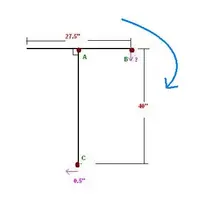
Take a look at this diagram:
attachment.php

Assume that point A is fixed and the diagram is being rotated.
If I want point C to move 0.5" how far would I need to move point B?

Hope it makes sense. Thanks!
 
Yes, I'm an expert. No I don't know how far point B moves....

e-mail me the picture, I'd be glad to help. If you're on AIM my sn is see-dee-jay-arghh-three-two-zero. (All the phonetic spellings are letters and the numbers are just the numerical digits). Email is [email protected] except take out all the (-'s)
 
Take a compass (these are available in your local drug store's school supplies dept.) and use it. Place one point on "A", then adjust it to where the other point (there's a pencil on this end) on "B", draw a curved line with it 1/2" away from "B". Then do the same with "A" and "C"
 
Your sketch is a little ambiguous. Is the distance from A to B 13.75" (half of 27.5")?

Making that assumption, you just set the rotation angles for points B and C about point A equal. Using basic geometry,

s = (theta) x r

where s is the distance traveled - aka 'arc length' (inches)
theta is the rotation angle (radians)
r is the radius (inches)

Set theta equal for points B and C and do a little algebra to get:

s(B) = s(C) x r(B)/r(C)

If my assumption about r(B) being 13.75" is correct, then:

s(B) = 0.5" x 13.75"/40"
s(B) = 0.172"

If it's not, plug in the correct value for r(B) and off you go.

You can do the same math using similar triangles, and you'll get the same answer, just a different approach. Hope that helps.
 
Well I got your email just now and got your answer but it looks like Red65 got to ya first. I'd go with similar triangles, but it's the same idea as arc length. When the sides are in proportion to each other, you use that ratio to find out how much a change in one would affect a change in the other, assuming they will remain in the exact proportions to each other.

With this example you would want to sent your sides AC and AB as the equal sides in the triangle. The ratio of these sides is 13.75/40 as already used in the arc length formula. Just like the arc length formula you know that if it is moved .5 for the whole triangle, then it is moved .5 x ratio for the smaller triangle.

This yields the same answer (obviously since the simplified arc length formula is the same as this) of 0.171875 or 0.172 or if you're using a hacksaw simply .17 :)