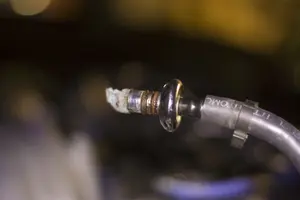
So the car is up and running again after replacing the head gaskets and valve stem seals and a new water pump. Immediately, the idle loped more than it should and the engine has an erratic shake to it. Then I took it for a spin and noticed that anything more than very slight thottle causes the car to chug and surge. It drives just fine if I stick to just touching the throttle to get around. When I do give it more gas, it's super jerky when I let off it. At first I thought the timing was off since it's so touchy at tip-in throttle, so I adjusted it to 10 degrees to no avail.
The last time I had a similar issue, it was a bad fuel pump. My pump has been whining unusually loud this weekend, but it's brand new. I checked my fuel pressure at idle. It's about 82psi with and without vacuum on the FPR Pulling the vacuum line off the FPR has no affect at all. When I pinch the return line, I can see maybe a 1/2 psi bump in pressure.
  With the engine off, it holds almost 40psi for quite awhile. Could the FPR fail in this manner, by basically causing too much pressure all the time? I can hear the injectors ticking away when I have the hood open. That's pretty odd since I usually need the stethoscope to hear them. My other thought was that maybe the return line is clogged somehow?
The last time I had a similar issue, it was a bad fuel pump. My pump has been whining unusually loud this weekend, but it's brand new. I checked my fuel pressure at idle. It's about 82psi with and without vacuum on the FPR
Pulling the vacuum line off the FPR has no affect at all. When I pinch the return line, I can see maybe a 1/2 psi bump in pressure. With the engine off, it holds almost 40psi for quite awhile. Could the FPR fail in this manner, by basically causing too much pressure all the time? I can hear the injectors ticking away when I have the hood open. That's pretty odd since I usually need the stethoscope to hear them. My other thought was that maybe the return line is clogged somehow?