Converting my '88 to 100% electric

I assume this is a compound wound motor - what is it's rating in HP and what is it's peak TQ?

No, it is series wound. Compound wound motors require the use of controllers that are not commonly available. They are usually designed for a specific motor. Series wound motors work with most any PWM current source.

There are not any specs available for this particular GE motor. The performance should be similar to this motor http://www.evsource.com/tls_warp11.php. This is a new motor patterned after the GE design that I have.

Don't be deceived by the numbers, you really cannot compare them directly to ICE numbers.
-enganear
 
Ah - OK. You are going to use PWM control. 135 ft lbs is plenty with the T5 gearing. 135 ft lbs x 3.35 = 452 ft lbs. How - or are you going to control motor speed during shifts? What is the PWM input - 4-20ma or 1-5v or ?? I guess that is what you will control with the "gas" pedal? I am assuming you will be using all 5 speeds of the trans - correct?
 
Ah - OK. You are going to use PWM control. 135 ft lbs is plenty with the T5 gearing. 135 ft lbs x 3.35 = 452 ft lbs. How - or are you going to control motor speed during shifts? What is the PWM input - 4-20ma or 1-5v or ?? I guess that is what you will control with the "gas" pedal? I am assuming you will be using all 5 speeds of the trans - correct?

The controllers work with a 5k ohm potbox actuated by cable from the accelerator pedal.

I will only use 1-2-3 gears. This will give me cruise speeds of 30-50-70 at 4k rpm. Most (maybe all) of my 13 mile commute will be in 2nd gear.

The 135ft-lb figure from the chart is at 72V. I will have 144V available....

Also I have the 2.95 World Class T5, but still plenty of torque...

EVs do well in smoky burnout competitions...
-enganear
 
Success!

From the Ranger forum....

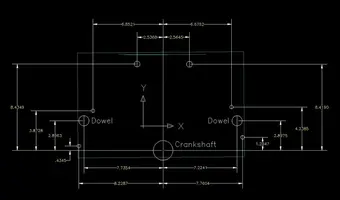
The attached dimensions were taken from a 5.0 block using a Coordinate Measuring Machine (CMM). I can go with this....

I knew SOMEBODY had these dimensions!
-enganear

Note: These dimensions are unconfirmed and the closer I look, the more I question.....
 

Attachments

  • 5LiterV8PatternI.webp
    5LiterV8PatternI.webp
    16.9 KB · Views: 162
I'm curious... How do you work with that much voltage and stay safe from electric shock? I realize it is amperage that is the real concern, but it hasn't been said what kind of amperage you are expecting. With that much voltage, I imagine a short could cause quite a bit of damage...
 
I'm curious... How do you work with that much voltage and stay safe from electric shock? I realize it is amperage that is the real concern, but it hasn't been said what kind of amperage you are expecting. With that much voltage, I imagine a short could cause quite a bit of damage...

The battery pack is isolated from the chassis. You do not use a chassis ground as with a 12V system. This greatly reduces the chance of shock because you would have to touch both + and - of the battery pack to get shocked. 144VDC is lethal and a short can release a tremendous amount of energy in a short period of time. Cruise amperage will be around 100-150 amps, hills and acceleration could require 500+ amps.

In some respects, it is almost as dangerous as gasoline! :D
-enganear
 
It is possible, but time consuming to use a CNC mill to pull dimensions from a known good part.
Might be expensive if you have to pay for mill time, but it worked well for the project I used it for.
I then used the 3D coordinates to build a model in V5...

sounds like your best bet to me.
good luck with it!
jason
 
I got some good news today. My motor rebuilder had told me that the splined shafts on the motor were case hardened and that I would probably have to have them ground to take them down to a straight shaft as I requested. I decided to take a file to the splines as a test and they cut easily, so I will break the motor down and take the rotor to another shop to have the splines turned off on a lathe and a keyway milled. I have to break it down anyway to twist the brush end advancing the brushes to be compatible with the higher voltages I will be using.

And no, there are not any splined couplers available for this particular spline, it is unique to Hyster. Also, since this spline is not hardened, it was designed to run in an oil bath. It will be much better to have a straight shaft, my adapter will be much simpler and cheaper. I should end up with a 1.375" straight shaft after the splines are turned off.

-enganear