

You are using an out of date browser. It may not display this or other websites correctly.
You should upgrade or use an alternative browser.
You should upgrade or use an alternative browser.
Extra breather necessary?
- Thread starter redsn95gt
- Start date


 ...been a long day I must have been thinking about this..hehe
66restocoupe
New Member
- Nov 15, 2011
- 4
- 0
- 1
Sorry to jump in late, but I am about to order valve covers for my project and not sure what to do about breather/pcv option. Ordering a set of Doug Lee Engineuity Valve Covers and he suggested dual breathers and a oil fill cap. After reading up a bit, I am more confused than ever.
Definitely don't want oil in the bay (dual breathers) and not sure if my combo can run traditional PCV setup without getting too much oil in the intake (blow by?). I like the idea of running the catch can setup as shown by Rick, but hate the idea of running two extra lines and a can on the fender/firewall. Also, with the oil can/breather setup, are you still allowing "unmetered air" into the system, just as if you were running straight breathers? Right now I am leaning towards traditional PCV (does that mean breather on one side and PCV the other?). Thanks for any all input.
331 stroker, 10:9:1 compression, Trick Flow Track Heat Intake, should be north of 400 fwhp.
Definitely don't want oil in the bay (dual breathers) and not sure if my combo can run traditional PCV setup without getting too much oil in the intake (blow by?). I like the idea of running the catch can setup as shown by Rick, but hate the idea of running two extra lines and a can on the fender/firewall. Also, with the oil can/breather setup, are you still allowing "unmetered air" into the system, just as if you were running straight breathers? Right now I am leaning towards traditional PCV (does that mean breather on one side and PCV the other?). Thanks for any all input.
331 stroker, 10:9:1 compression, Trick Flow Track Heat Intake, should be north of 400 fwhp.


66restocoupe
New Member
- Nov 15, 2011
- 4
- 0
- 1
One breather should be more than sufficient. That PCV can only suck a little bit of air at a time. If you can run a breather hose back to the inlet like the stock setup, that would be preferrable.
Kurt
Kurt

My intake does not have the provision for a PCV valve ( Edelbrock Victor 5.8 EFI ) So I had been running dual breathers on the valve covers. I had not run that set up like that for very long but while I was everything seemed to be good
Not sure what kind of valve covers you have, but you should be able to put a PCV in one side, and a breather in the other. That would be a lot easier, and a lot less maintenance, as well as better for the engine.
Kurt
Kurt
Ive been confused about the whole PCV thing for awhile. Id like to run something like what rick posted on the previous page.
The setup Rick did on the other page is for a boosted car. It's a compromise you usually make with a boosted engine, due to the fact that the boost from the compressor ends up pressurizing the crank case on a forced induction car. It relies on the blow by from the pistons to very slowly push the gasses out of the crank case. It's no where near as effective as using a PCV setup to suck those nasties out of the engine, and is one of the unfortunate downsides to having a forced induction car. Since your car is naturally aspirated, you are much better off running a PCV setup.
Kurt
You plug a breather into one valve cover, and a PCV valve into the hole on the other valve cover. It's actually better to do it this way then the factory PCV location, because you get complete ventilation through the entire crankcase. All old engines are setup this way. They moved the PCV valve to the back of the intake, because the stock Ford fuel injection intake does not allow enough clearance on the one valve cover to accomodate a breather or a PCV valve. You will probably have to pick up a PCV grommet for the valve cover like the one in the link below. I'm not sure what brand valve covers you have now, and where the provisions are.
http://shop.advanceautoparts.com/we...ve-Mr--Gasket_5020816-P_N3325A_P|GRP2019_____
Kurt
http://shop.advanceautoparts.com/we...ve-Mr--Gasket_5020816-P_N3325A_P|GRP2019_____
Kurt
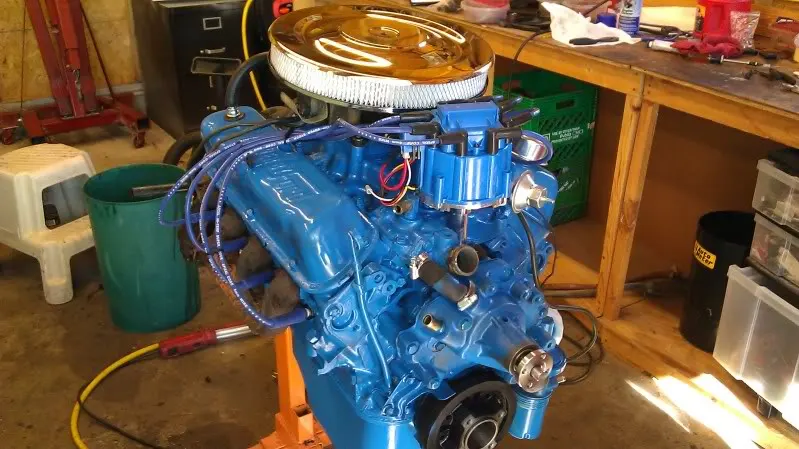
Here is a picture I uploaded from an engine I just did for a customer. This went in an old Ford truck. I put the PCV valve into the passenger side valve cover, and on the driver's side there is a breather oil fill cap. The hose going to this PCV valve is a little crude, I admit but he needed it done as cheaply as possible.
Kurt
Kurt
66restocoupe
New Member
- Nov 15, 2011
- 4
- 0
- 1
OK, so no breathers for me or puke cans, just plain jane pcv. I found this oil fill kit from Trick Flow, would this allow me to only have one hole on the passenger rear location? Keeping the other valve cover nice and unmolested.
IF....I did want to run a puke can, could I run a dual inlet system from the rear of the valve covers and mount it on the firewall somewhere (to reduce the length of lines in the bay)? Something like this?
IF....I did want to run a puke can, could I run a dual inlet system from the rear of the valve covers and mount it on the firewall somewhere (to reduce the length of lines in the bay)? Something like this?
Well, not exactly what I'm talking about. The puke can is for a straight breather with no PCV. The idea is that fresh air enters through the breather on one side of the engine, travels through the engine and gets sucked out the other side of the engine. The breather can either be a breather style filter on the valve cover, or just a hose that goes to the air filter like the stock setup. The idea is circulation. Put it this way. If your wife blows a really nasty beer fart on the couch while you are trying to watch evening television, opening up the front door might let some of that beer fart out. But not enough to keep a little stomach acid from ending up in your mouth. The obvious solution is to open up both the back door and the front door and let the breeze carry the beer fart over to your neighbors house. If you just have a PCV valve in one valve cover, it will just create a little suction in the crankcase, but without a breather to let in fresh air, it's not really doing any good.
The PCV system is designed because of blow by. No matter how new of an engine you have, a little bit of combustion gasses always slip past the piston rings. These nasty combustion gasses contain all kinds of nasty things (beer farts) that can acidify and mess up your engine. The primary problem is carbon. If this carbon isn't sucked out, it ends up in your oil. If you have a catch can, or simple breather with no PCV, then you are going to have to change your oil a lot more frequently to keep it clean. I would say, probably have to change it every 1000 miles instead of every 3000 miles. The only edition to the engine that really helps is an oil seperator. If you really want to keep oil from getting sucked into your intake manifold, then buy an oil seperator like the one in the link below. This one is made by Steeda, and is very easy to install. I have heard of people rigging up air tool water seperators from Harbor Freight to save money. This goes between the PCV valve and the intake manifold so that any excess oil gets seperated out before the air is sucked into the engine. There is no need for a Puke can if you have a PCV valve.
http://www.summitracing.com/parts/SDA-555-3710/
Kurt
The PCV system is designed because of blow by. No matter how new of an engine you have, a little bit of combustion gasses always slip past the piston rings. These nasty combustion gasses contain all kinds of nasty things (beer farts) that can acidify and mess up your engine. The primary problem is carbon. If this carbon isn't sucked out, it ends up in your oil. If you have a catch can, or simple breather with no PCV, then you are going to have to change your oil a lot more frequently to keep it clean. I would say, probably have to change it every 1000 miles instead of every 3000 miles. The only edition to the engine that really helps is an oil seperator. If you really want to keep oil from getting sucked into your intake manifold, then buy an oil seperator like the one in the link below. This one is made by Steeda, and is very easy to install. I have heard of people rigging up air tool water seperators from Harbor Freight to save money. This goes between the PCV valve and the intake manifold so that any excess oil gets seperated out before the air is sucked into the engine. There is no need for a Puke can if you have a PCV valve.
http://www.summitracing.com/parts/SDA-555-3710/
Kurt
66restocoupe
New Member
- Nov 15, 2011
- 4
- 0
- 1
LOL. I usually just go outside after that, no breeze is enough.
Well, after many wasted hours where I should have been working, I have now discovered that my Trick Flow Track Heat Intake has a PCV valve in the lower intake. Problem solved. I had no idea, bought it used and disassembled and it's now being gasket matched to my heads. After speaking with Trick Flow (which basically just outlined the "stock" setup that Rick mentioned, but I couldn't visualize), I now have a better idea of how everything is going to be routed.
1. PCV from lower to upper on the Track Heat
2. Fresh Air (post MAM) from the CAI to the Oil Filler Neck/air inlet tube
3. Fresh Air (post MAM) from the CAI to the TB
4. Nothing on the left VC
Does this sound correct?
Thanks for all the input.
Well, after many wasted hours where I should have been working, I have now discovered that my Trick Flow Track Heat Intake has a PCV valve in the lower intake. Problem solved. I had no idea, bought it used and disassembled and it's now being gasket matched to my heads. After speaking with Trick Flow (which basically just outlined the "stock" setup that Rick mentioned, but I couldn't visualize), I now have a better idea of how everything is going to be routed.
1. PCV from lower to upper on the Track Heat
2. Fresh Air (post MAM) from the CAI to the Oil Filler Neck/air inlet tube
3. Fresh Air (post MAM) from the CAI to the TB
4. Nothing on the left VC
Does this sound correct?
Thanks for all the input.
Ok I get what your saying Kurt. BTW your link did not work it said I needed to be signed in. and a hose to run between the PCV and a breather cap on the other side that has a tip on the end of it to connect the hose to correct? I still have my PCV valve from before but they are cheap and its prob worth it to buy a new one. Also would I need to run the screen/filter with the PCV valve? I still have that as well but I dont see it working w/ the valve cover breather set up.
BTW I have ford racing tall valve covers. Would I need to take a measurement of the inside diameter to know what size PCV grommet to get? I know it came with different size grommet's when I bought them but I dont know if I still have them around or not.
BTW I have ford racing tall valve covers. Would I need to take a measurement of the inside diameter to know what size PCV grommet to get? I know it came with different size grommet's when I bought them but I dont know if I still have them around or not.
Similar threads
- Replies
- 29
- Views
- 813

- Replies
- 0
- Views
- 122
- Replies
- 2
- Views
- 216
- Replies
- 2
- Views
- 117
