
I have a '70 Mach 1 with a 351w that will be stroked to a 393. I expect around 475 to 500 HP at the flywheel. I am using 3.89 rear gears and plan to use both standard radial tires and also drag radials on occasion for the street. I will probably have to run the drag radials mostly so that I can get decent traction. I have a T-5 core which I can buy the G-Force internals for a rebuild or buy Tremecs new TKO 500. Both have received good reviews as far as being able to handle torque. Anyone using either of these trannys? I do not want to use an auto. Please help with the decision. Thanks.
You are using an out of date browser. It may not display this or other websites correctly.
You should upgrade or use an alternative browser.
You should upgrade or use an alternative browser.
G-Force T-5 or Tremecs New TKO 500 Tranny?
- Thread starter wickedmach1
- Start date

SandSprite
Member
The G-Force t5 will be a better fit than the tremec. In general, to get a good driveshaft angle, you need to do some cutting to the tranny tunnel for a tremec (not always the case though). The g-force is supposed to be pretty stout as well. If you don't need OD, maybe consider a toploader.
Fomocohipo
New Member
- Feb 3, 2004
- 128
- 0
- 0
Stock small block toploader is rated at 600 ft/lbs if im not misteaken, and I read somewhere that a c4-> toploader swap runs you in the 800$ range while a T-5 swap is in the $1,500's. Thats a stock t5 not including the g-force kit. But i would say go for the t5 gforce set up mostly because you allredy have the t5 core.
I have not hear good things about G-Force, but I guess there is always something bad to say about every company. For me it comes down to warranty. I ordered my TKO-600 (still on order) from http://www.standardtransmission.com/ and they slap a 1 year warranty on it. I don't think the G-force comes with any warranty, but i could be wrong.
I like the Tremec but do not want to cut up the floor tunnel. How much modification will I need to do on the '70 model? Any ideas from someone who has done this modification? The T-5 is an easier fit but how much strength do I lose going with G-Force?

Route666
Active Member
If you lower the motor a little, an inch or so, you shouldn't need to modify the body. If you cut the spring perches off of the diff, and rotate the diff so the pinion angle is optimised, you won't need to cut the body. Or you could not worry about it like at least one successful StangNet member has done for a while.
Route666
Active Member

SadbutTrue
Founding Member
yeah, i've heard of people getting them (TKOs) into 67/68s unmodified... a 70 should only be easier I would think.
Route666
Active Member
Ok I've been wondering this for a while, and sorry to re-open a dead thread. BUT:
Ronstang, I'm sure in one of these threads, you were saying that a TKO will not fit without major tunnel surgery, and that if you push it up till it hits the tunnel, the output will still be lower than the output of a toploader.
What I'm wondering is: Why is that bad? If it is lower, the driveshaft angle will decrease, as the driveshaft is lower at the diff than at the gearbox, and the diff yoke is aimed at the ground (usually).
Ronstang, I'm sure in one of these threads, you were saying that a TKO will not fit without major tunnel surgery, and that if you push it up till it hits the tunnel, the output will still be lower than the output of a toploader.
What I'm wondering is: Why is that bad? If it is lower, the driveshaft angle will decrease, as the driveshaft is lower at the diff than at the gearbox, and the diff yoke is aimed at the ground (usually).
Ronstang
New Member
Route666 said:Ok I've been wondering this for a while, and sorry to re-open a dead thread. BUT:
Ronstang, I'm sure in one of these threads, you were saying that a TKO will not fit without major tunnel surgery, and that if you push it up till it hits the tunnel, the output will still be lower than the output of a toploader.
What I'm wondering is: Why is that bad? If it is lower, the driveshaft angle will decrease, as the driveshaft is lower at the diff than at the gearbox, and the diff yoke is aimed at the ground (usually).
First of all the driveshaft angle to the ground might be decreased but the angle of the driveshaft to the centerline of the tranny is increased which is not good for phasing, harmonics, durability, or efficiency. I'm not opening this can of worms again because everyone thinks they are doing it the right way so I am just going to let peeple make their own mistakes. Being crucified for having high standards and paying attention to detail is not why I am here.
Secondly the yoke on a rearend never points towards the ground in stock configuration, at least on Mustangs, but would be improper on any car.
Route666
Active Member
Ronstang said:First of all the driveshaft angle to the ground might be decreased but the angle of the driveshaft to the centerline of the tranny is increased which is not good for phasing, harmonics, durability, or efficiency. I'm not opening this can of worms again because everyone thinks they are doing it the right way so I am just going to let peeple make their own mistakes. Being crucified for having high standards and paying attention to detail is not why I am here.
Secondly the yoke on a rearend never points towards the ground in stock configuration, at least on Mustangs, but would be improper on any car.
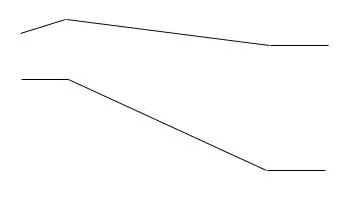
Ok sorry, I'm still not getting you. I've included a mud diagram, I'll explain it.
ok Here, the diff's angle is the horizontal line on the right, and the longer sloping line joining it is the driveshaft angle. The line on the left is the trans output angle.
The top set of lines is if the output of the trans is lower than the bottom set.
Is it the transmission being pushed up higher that effects the angle of the output of the driveshaft?
EDIT: Blah I stuffed the last line. What I mean is:
The transmission being pushed up will tilt the motor/trans centreline upward (at where the driveshaft connects) and thus increase the angle between the gearbox and driveshaft.
That I could understand, but is it necessary to push the gearbox up higher than the original? (other than for ground clearance) Does the crossmember automatically push the trans up, and if so, how does sheetmetal modification / pushing it up higher help?
Attachments
Ronstang
New Member
It is a matter of convention and depends upon how you measure...the true measured angle between the tranny centerline and driveshaft DECREASES as the tranny output shaft is lowered if you measure the angle from the top and increases if you measure from the bottom but the change in angle is more important than the angle itself or how you measure it.
Route666
Active Member
Thanks for replying! So it is about the trans pointing more upward then? This would not be such a bad thing if this was happening at the diff end, as the slip shaft could slide in and out to eleviate some of the forces created by the uni joints.
My above post about lowering the engine would then be wrong, and raising the engine would actually help this problem. I take it raising the engine then requires the trans tunnel to be raised for bellhousing and trans room.
Personally I think I'd lower the trans x-member and lose ground clearance.
Thanks Ronstang. I see it all.
My above post about lowering the engine would then be wrong, and raising the engine would actually help this problem. I take it raising the engine then requires the trans tunnel to be raised for bellhousing and trans room.
Personally I think I'd lower the trans x-member and lose ground clearance.
Thanks Ronstang. I see it all.
Route666
Active Member
Ok, I'm going to reply again, because I just read from http://www.geocities.com/MotorCity/Downs/1966/5speed.html#dhp that the conversion will lower the back of the motor by 1". And I just re-read what you said, and if it increases the angle as measured from below, ie: makes the trans-driveshaft junction straighter, then it will transfer power more efficiently. As long as there is some angle to allow the unis to rotate and not wear in one point, then I see it as a benefit, even if the opposing diff pinion angle isn't the same to compensate for the oscillations caused by the front end of the driveshaft.
Hmmmmm.
EDIT: Ok hang on, this still depends on how the angles are measured. I've been thinking of the angle between the DS and Trans as pivoting from the DS around the bend, to the trans CL (centreline). If in fact what you meant actually had the angles measured as the acute angle between the two centrelines increasing then I'll yet again agree with you.
Ok time for more drawings, I'll be back.
ok

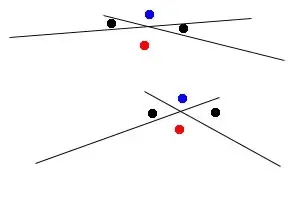
Trans CL is the left line, DS the right. (angles in all drawing exaggerated to emphasise readability)
If the rear of the engine goes down, it would change the angles from the bottom version to the top. Angles at the black dots would DECREASE. Red would INCREASE. The blue angle is basically 360 - red angle, so it includes the two black angles. It would DECREASE.
Red and blue are what I initially thought you (Ronstang) meant in your last post. Is that right? If so, I'm going to have to disagree that it is a bad thing.
I can understand even if the diff pinion and trans pinion angles were equal and opposite (no bind) that you would experience bad vibes from the DS going back and forth (in the direction of the length of the car) IF the angles increased. BUT if they decrease, I believe it would be benefitial, even if the diff pinion and trans pinion angles were slightly different, which most cars probably are.
Well, anyway, thanks for the discussion, I'll have to inspect things when I actually get to do things with my hands.
Hmmmmm.
EDIT: Ok hang on, this still depends on how the angles are measured. I've been thinking of the angle between the DS and Trans as pivoting from the DS around the bend, to the trans CL (centreline). If in fact what you meant actually had the angles measured as the acute angle between the two centrelines increasing then I'll yet again agree with you.
Ok time for more drawings, I'll be back.
ok
Trans CL is the left line, DS the right. (angles in all drawing exaggerated to emphasise readability)
If the rear of the engine goes down, it would change the angles from the bottom version to the top. Angles at the black dots would DECREASE. Red would INCREASE. The blue angle is basically 360 - red angle, so it includes the two black angles. It would DECREASE.
Red and blue are what I initially thought you (Ronstang) meant in your last post. Is that right? If so, I'm going to have to disagree that it is a bad thing.
I can understand even if the diff pinion and trans pinion angles were equal and opposite (no bind) that you would experience bad vibes from the DS going back and forth (in the direction of the length of the car) IF the angles increased. BUT if they decrease, I believe it would be benefitial, even if the diff pinion and trans pinion angles were slightly different, which most cars probably are.
Well, anyway, thanks for the discussion, I'll have to inspect things when I actually get to do things with my hands.
Attachments
wildstang
Founding Member
My feeling is I would lean toward the Gforce trans because it is smaller and I assume it ways less. I don't know the weight of the tko or the Gforce t-5 either so like I said it is just an assumption. But you should also consider the gearing of both to decide which would work better and if you are considering these two options because they have over drive, then the gearing of the over drive may be a factor also. You should be able to find diagrams of both that will give the important physical measurements and from these you could do a test fit of your core t-5 and compare it to the dimensions for the tko to see if you would need to modify you tunnel.
Vrooom, what bad things have you heard about the Gforce transmissions?
Vrooom, what bad things have you heard about the Gforce transmissions?

SadbutTrue said:yeah, i've heard of people getting them (TKOs) into 67/68s unmodified... a 70 should only be easier I would think.
Sure you can get them in but the driveline angle is completely bunked...

Strokedd66
Founding Member
Just a little more fuel for the fire............. 
First place winner of this years Hot Rod Pump Gas Drag Wars was a 600 hp+ Chevelle running a G-Force T5 with road race gears. IIRC, times were in the 9's. Which means he he had to be SLAM'n some serious gears to beat out all the big blocks w/auto’s in the pack!
If/when I toast my "Built" T5z spec, the FIRST and ONLY call will be to G-Force!
IME, when it comes to high performance applications, warranties, don't mean spit.
First place winner of this years Hot Rod Pump Gas Drag Wars was a 600 hp+ Chevelle running a G-Force T5 with road race gears. IIRC, times were in the 9's. Which means he he had to be SLAM'n some serious gears to beat out all the big blocks w/auto’s in the pack!
If/when I toast my "Built" T5z spec, the FIRST and ONLY call will be to G-Force!
IME, when it comes to high performance applications, warranties, don't mean spit.

coolblue65
Founding Member
I have a Tremec 3550 in my '65- no tunnel mods, its been in there for 4 years, I beat on my car regularly and often shift without the clutch- no problems, Tremecs are beasts.
Similar threads
- Replies
- 16
- Views
- 881

- Replies
- 5
- Views
- 1K

- Replies
- 46
- Views
- 3K


- Replies
- 15
- Views
- 7K


- Replies
- 1
- Views
- 949