Electrical MSD Blaster TFI Coil 8227 loud Chirping Noise.

PonyGTrider

5 Year Member
Feb 27, 2019
625
110
63
Mexico
Hi everyone,
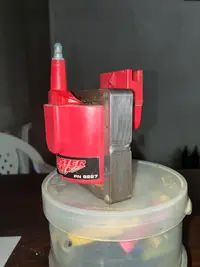
On my 90 GT I have a loud chirping noise out of an MSD Blaster TFI coil 8227. I mean that sucker is loud and I can hear it inside the cabine but loud!!! I heard some other people described as humming but mine is like a cricket but really loud and annoying.
I checked the impedance and is perfect Primary coil = 0.5 Ohms
Secondary coil is 3,000 Ohms. The funny thing is that with the coil on the bench I tap the receptacle where you plug the two wires connector and it sound like the chirping when running but I then tap on the sheet metal pack core and it makes a similar noise so I’m guessing is the sheet metal core pack vibrates when it gets energized or that rectangular connector recess acts like a speaker sort of speak under the vibration created by the electrical windings.

The fact of the matter is that when I install the stock coil there is no noise at all and took an impedance reading and gave me Primary Coil = 0.3 Ohms and Secondary Coil = 6,000 Ohms.

Here I’m not talking about RF noise but a loud chirping almost whistling noise.

If you had the same issue and solved it please share
Thank you
 

Attachments
  • IMG_4762.webp
    IMG_4762.webp
    120.3 KB · Views: 74
Last edited:
Right now I have the stock coil instaled and it works fine but it is so old, I hope it is still delivering close to 38K normal voltaje. That’s why I wanted to use those 44K volts, that’s their claim
Thank you

Just for reference: I use an OEM coil to run a KB blower combo. There is nothing [short] about OEM coils for our cars. Exceptions of course, are the ones made in SlapDickTopia.
 
  • Like
Reactions: PonyGTrider
I bought a screamin demon coil some odd years ago and it failed within a year of putting it on, so put stock coil (30 year old) back on and its still tickin. Stock ignition adequate unless you makin crazy hp

Even then... Our ignition systems provide a very hot, fat spark. Perfect for forced induction.

Common practice in the Fox world is to "improve" on something that requires no improvement.
 
And see noobz, which is why im still ignorant on forced induction. I will have questions though when i get there *wink wink**

I will tell you my answer now and we can kick around the "why" later.

Answer: Regulate power going to the coil. Keep it saturated no matter what the rest of the electrical system is doing.
 
  • Like
Reactions: 89ripper
I bought a screamin demon coil some odd years ago and it failed within a year of putting it on, so put stock coil (30 year old) back on and its still tickin. Stock ignition adequate unless you makin crazy hp
This coil started making that annoying loud chirping since day one brand new, and I’m at a point where I can’t take it anymore
Thank you
 
Last edited:
  • Like
Reactions: 89ripper
Even then... Our ignition systems provide a very hot, fat spark. Perfect for forced induction.

Common practice in the Fox world is to "improve" on something that requires no improvement.
Yeah I agree specially when we’re bored we go trying to do a little better or at least that’s what we think.
I put this out thinking someone had resolved the same issue as mine.
Thank you
 
Yeah I agree specially when we’re bored we go trying to do a little better or at least that’s what we think.
I put this out thinking someone had resolved the same issue as mine.
Thank you

If you get to that point then we'll definitely have a conversation about 12 volt DC power regulators.

I run one for my coil and one for my fuel pump. Both, items that I prefer to be very consistent regardless of RPM, headlights, air, other electrical accessories...


Dudes that run E-fans on straight relays with no buffer for the pump or coil on boosted applications on our 30 year old electrical systems that were barely up to the task at the start... worry me a bit. :D
 
  • Like
Reactions: PonyGTrider
If you get to that point then we'll definitely have a conversation about 12 volt DC power regulators.

I run one for my coil and one for my fuel pump. Both, items that I prefer to be very consistent regardless of RPM, headlights, air, other electrical accessories...


Dudes that run E-fans on straight relays with no buffer for the pump or coil on boosted applications on our 30 year old electrical systems that were barely up to the task at the start... worry me a bit. :D
Do you mean a regulator using a MOSFET? I thought about it but I don’t have too much expertise, I was just reading about that.
On the other hand I run my electric cooling fan with one of those variable speed Delta current controllers made by Brian Baskin so I never see a spike or sudden high current draw and the unit increases and decreases the speed fan slowly based on actual current temperature, on top of that I made a 200 Amp alternator from a 130 Amp 95 GT stock alternator.

It would be interesting to be able to quiet that chirping MSD coil.
Thanks for the ideas.
 
  • Like
Reactions: Noobz347
If you get to that point then we'll definitely have a conversation about 12 volt DC power regulators.

I run one for my coil and one for my fuel pump. Both, items that I prefer to be very consistent regardless of RPM, headlights, air, other electrical accessories...


Dudes that run E-fans on straight relays with no buffer for the pump or coil on boosted applications on our 30 year old electrical systems that were barely up to the task at the start... worry me a bit. :D
Can you share details of one of those regulators you run?
 
Can you share details of one of those regulators you run?


The ones I use are from Kenne Bell:

The Boost-A-Pump allows you adjust the voltage and handles dips and spikes. You can activate/deactivate it a boost switch but that switch is counter productive IMO.

The Boost-A-Spark does the same thing to regulate voltage to the coil.


There are other manufactures that offer the same kinds of things. I recall Holley being one of them. Despite this claim or that claim, they really just beefy 12-15 volt, voltage regulators.


I added the Boost-A-Spark when I was chasing down what I now know, was 'spark blowout'. I found the issue by closing up the plug gaps until the issue went away. I installed the Boost-A-Spark, opened the plugs back up to the recommended gap, and increased voltage to the coil until the issue resolved. I haven't touched the dial since then.

I added the Boost-A-Pump when I saw lean(er) areas on my first dyno and after reading this article in this issue of MM&FF:


This helped me understand the difference and relationship of fuel pressure versus fuel volume in our return style fuel systems.

Needless to say, my next dyno was a [lot] more flat-line. I had found the magic formula to get the right fuel [volume] to the boosted combo... All with a non-adjustable, OEM fuel pressure regulator.
 
  • Like
Reactions: PonyGTrider
Just a reminder:

It's not just Fox alternators that are weak from the factory. It's all the wiring too. O_o

These regulators use the stock wiring as a trigger and pull directly from the battery, taking the load off of factory wires.
 
  • Like
Reactions: PonyGTrider
The ones I use are from Kenne Bell:

The Boost-A-Pump allows you adjust the voltage and handles dips and spikes. You can activate/deactivate it a boost switch but that switch is counter productive IMO.

The Boost-A-Spark does the same thing to regulate voltage to the coil.


There are other manufactures that offer the same kinds of things. I recall Holley being one of them. Despite this claim or that claim, they really just beefy 12-15 volt, voltage regulators.


I added the Boost-A-Spark when I was chasing down what I now know, was 'spark blowout'. I found the issue by closing up the plug gaps until the issue went away. I installed the Boost-A-Spark, opened the plugs back up to the recommended gap, and increased voltage to the coil until the issue resolved. I haven't touched the dial since then.

I added the Boost-A-Pump when I saw lean(er) areas on my first dyno and after reading this article in this issue of MM&FF:


This helped me understand the difference and relationship of fuel pressure versus fuel volume in our return style fuel systems.

Needless to say, my next dyno was a [lot] more flat-line. I had found the magic formula to get the right fuel [volume] by boosted combo... All with a non-adjustable, OEM fuel pressure regulator.
That’s very interesting and it makes a whole sense to maintain constante voltaje to a mínimum of variations.
I’m surprised specially on the fuel system.
I’ll take a look at those regulators,
Thank you much for sharing
That's the way to do it.
Yeah that’s what I thought.
 
  • Like
Reactions: Noobz347
If I ever get around to doing E-fans, I have a DCC controller for that.

So far... for what I use the thing for... The clutch fan is perfect. :nice:

On a side note, I always said that if I were to go to E-fans, that I'd do the water pump too. :shrug:
 
  • Like
Reactions: PonyGTrider
Just a reminder:

It's not just Fox alternators that are weak from the factory. It's all the wiring too. O_o

These regulators use the stock wiring as a trigger and pull directly from the battery, taking the load off of factory wires.
I will look into it.
Thank you
If I ever get around to doing E-fans, I have a DCC controller for that.

So far... for what I use the thing for... The clutch fan is perfect. :nice:

On a side note, I always said that if I were to go to E-fans, that I'd do the water pump too. :shrug:
The FK45 DCC controller is a nice piece paired with a Taurus fan and a Griffin aluminum radiator maintain my coolant temp really happy at ~ 200* + 0* / - 93* under any ambient temperature, and with the ability to adjust the temp up/down via a potentiometer to whatever temp I want.
As I sometimes get stuck on traffic I don’t want to take chances with an electric water pump. With just the electric fan is enough to keep the engine bay nice and clean

Good plans tho