Computer will not go into diagnostic mode on 91-93 model 5.0 Mustangs
How it is supposed to work:
The grey/red wire (pin 46) is signal ground for the computer. It provides a dedicated
ground for the EGR, Baro, ACT, ECT, & TPS sensors as well as the ground to put the
computer into self test mode.
If this ground is bad, none of the sensors mentioned will work
properly. That will severely affect the car's performance. You will have hard starting, low power
and drivability problems. Since it is a dedicated ground, it passes through the computer on its
way to the computer main power ground that terminates at the battery pigtail ground. It should
read less than 1.5 ohms when measured from anyplace on the engine harness with the battery
pigtail ground as the other reference point for the ohmmeter probe.
What sometimes happens is that the test connector grey/red wire gets jumpered to power
which either burns up the wiring or burns the trace off the pc board inside the computer.
That trace connects pins 46 to pins 40 & 60. Only an experienced electronics technician can open
the computer up & repair the trace if it burns up and creates an open circuit.
The STI (Self Test Input ) is jumpered to ground to put the computer into test mode. Jumpering
it to power can produce unknown results, including damage to the computer. The ohm test
simply verifies that there are no breaks in the wiring between the test connector and the computer input.
How to test the wiring :
With the power off, measure the resistance between the computer test ground
(grey/red wire) on the self test connector and battery ground. You should see less than
1.5 ohms.
If that check fails, remove the passenger side kick panel and disconnect the computer
connector. There is a 10 MM bolt that holds it in place. Measure the resistance between
the grey/red wire and pin 46 on the computer wiring connector : it should be less than
1.5 ohms. More that 1.5 ohms is a wiring problem. If it reads 1.5 ohms or less, then the
computer is suspect. On the computer, measure the resistance between pin 46 and pins
40 & 60: it should be less than 1.5 ohms. More that that and the computer’s internal
ground has failed, and the computer needs to be replaced.
See
http://www.stangnet.com/mustang-forums/749974-computer-issue.html#post7490537 for Joel5.0’s fix for the computer internal signal ground.
If the first ground check was good, there are other wires to check. Measure the
resistance between the STI computer self test connector (red/white wire) and pin 48 on
the computer main connector: it should be less than 1.5 ohms. More that 1.5 ohms is a
wiring problem
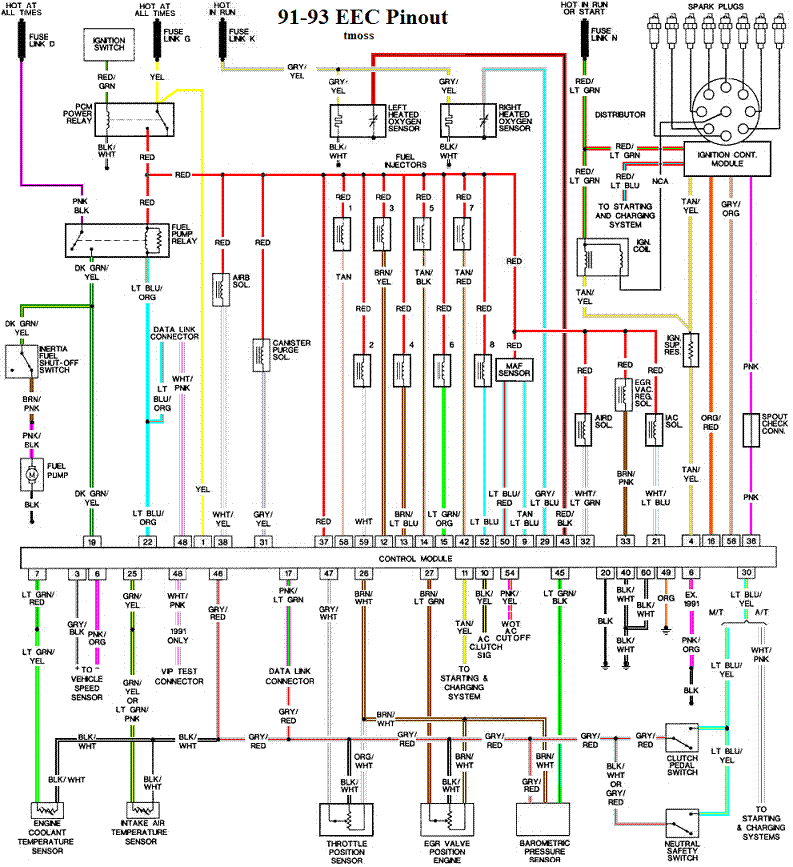
The following is a view from the computer side of the computer connector.
Diagram courtesy of Tmoss & Stang&2birds
Check out the diagram and notice all the places the grey/red wire goes. Almost every
sensor on the engine except the MAF is connected to it.
See the following website for some help from Tmoss (diagram designer) & Stang&2Birds
(website host) for help on 88-95 wiring
Mustang FAQ - Wiring & Engine Info
Fuel Pump Troubleshooting for 91-93 Mustangs
Clue – listen for the fuel pump to prime when you first turn the ignition switch on.
It should run for 5-20 seconds and shut off. To trick the fuel pump into running,
find the ECC test connector and jump the connector in the lower RH corner to
ground.
If the fuse links are OK, you will have power to the pump. Check fuel pressure –
remove the cap from the Schrader valve behind the alternator and depress the
core. Fuel should squirt out, catch it in a rag. A tire pressure gauge can also be
used if you have one - look for 37-40 PSI. Beware of fire hazard when you do this.
No fuel pressure, possible failed items in order of their probability:
A.) Tripped inertia switch – press reset button on the inertia switch. The hatch
cars hide it under the plastic trim covering the driver's side taillight. Use the
voltmeter or test light to make sure you have power to both sides of the switch
B.) Fuel pump Relay:
On 91 cars, it is located under the driver seat.
On 92 and later model cars it is located below the Mass Air Flow meter.
C.) Clogged fuel filter
D.) Failed fuel pump
E.) Blown fuse link in wiring harness.
F.) Fuel pressure regulator failed. Remove vacuum line from regulator and inspect
for fuel escaping while pump is running.
Theory of operation:
Read this section through several times. If you understand the theory of operation,
this will be much easier to troubleshoot. Refer to the diagram below frequently.
Diagram of the fuel pump wiring for 91-93 cars.
The electrical circuit for the fuel pump has two paths, a control path and a power
path.
Remember that the computer does not source any power to actuators, relays
or injectors, but provides the ground necessary to complete the circuit. That
means one side of the circuit will always be hot, and the other side will go to
ground or below 1 volt as the computer switches on that circuit.
The control path consists of the computer, and the fuel pump relay coil. It turns
the fuel pump relay on or off under computer control. The switched power (red
wire) from the ECC relay goes to the relay coil and then from the relay coil to the
computer (light blue\orange wire). The computer provides the ground path to
complete the circuit. This ground causes the relay coil to energize and close the
contacts for the power path. Keep in mind that you can have voltage to all the
right places, but the computer must provide a ground. If there is no ground, the
relay will not close the power contacts.
The power path picks up from a fuse link near the starter relay. Fuse links are like
fuses, except they are pieces of wire and are made right into the wiring harness.
The feed wire from the fuse link (pink/black wire) goes to the fuel pump relay
contacts. When the contacts close because the relay energizes, the power flows
through the pink/black wire to the contacts and through the dark green\yellow
wire to the inertia switch. The other side of the inertia switch with the
brown\pink wire joins the pink/black wire that connects to the fuel pump. The fuel
pump has a black wire that supplies the ground to complete the circuit.
Power path:
Power feed: Look for 12 volts at the pink/black wire (power source for fuel pump relay).
No voltage or low voltage, bad fuse link, bad wiring, or connections. Remember that on 92
or later models the fuel pump relay is located under the Mass Air meter. Watch out for the
WOT A/C control relay on these cars, as it is located in the same place and can easily be
mistaken for the fuel pump relay.
Relay: Turn on the key and jumper the ECC test connector as previously described. Look
for 12 volts at the dark green\yellow wire (relay controlled power for the fuel pump). No
voltage there means that the relay has failed, or there is a broken wire in the relay control circuit.
Inertia switch:
The location for the inertia switch is under the plastic for the driver's side taillight.
There should be a round plastic pop out cover over it, remove it to access the switch button.
With the test connection jumpered and ignition switch in The Run position as described above, check
the brown/pink wire. It should have 12 volts. No 12 volts there, either the inertia switch is open
or has no power to it. Check both sides of the inertia switch: there should be power on the dark
green\yellow (inertia switch input) and brown/pink wire (inertia switch output). Power on the
dark green\yellow wire and not on the brown/pink wire means the inertia switch is open.
Press on the red plunger to reset it to the closed position. Sometimes the inertia switch will
be intermittent or will not pass full power. Be sure that there is 12 volts on both sides of the
switch with the pump running and that the voltage drop measured across the switch is less
than .75 volts.
Pump wiring: Anytime the ignition switch is in the Run position and the test
point is jumpered to ground, there should be at least 12 volts present on the
black/pink wire. With power off, check the pump ground: you should see less
than 1 ohm between the black wire and chassis ground.
Make sure that the power is off the circuit before making any resistance checks.
If the circuit is powered up, your resistance measurements will be inaccurate.
Control path:
Relay: The red wire for the fuel pump relay coil gets its power feed from the ECC relay.
No 12 volts here, and the ECC relay has failed or there is bad wiring or bad connections
coming from it. The ECC relay is located on top of the computer, which is under the passenger’s
side kick panel. It is not easy to get to, you must have small hands or pull the passenger side
dash speaker out to access it.
Relay: The light blue/orange wire provides a ground path for the relay power. With the test
connector jumpered according to the previous instructions, there should be less than .75 volts.
Use a test lamp with one side connected to battery power and the other side to the light blue/orange
wire on the fuel pump relay. The test light should glow brightly. No glow and you have a broken
wire or bad connection between the test connector and the relay. To test the wiring from the
computer, remove the passenger side kick panel and disconnect the computer connector.
It has a 10 MM bolt that holds it in place. Remove the test jumper from the ECC test connector.
With the test lamp connected to power, jumper pin 22 to ground and the test lamp should glow.
No glow and the wiring between the computer and the fuel pump relay is bad.
Computer: If you got this far and everything else checked out good, the computer is suspect.
Remove the test jumper from the ECC test connector located under the hood.
Probe computer pin 22 with a safety pin and ground it to chassis. Make sure the computer
and everything else is connected. Turn the ignition switch to the Run position and observe
the fuel pressure. The pump should run at full pressure.
If it doesn't, the wiring between pin 22 on the computer and the fuel pump relay is bad.
If it does run at full pressure, the computer may have failed.
Keep in mind that the computer only runs the fuel pump for about 2-3 seconds when you turn
the key to the Run position. This can sometimes fool you into thinking the computer has died.
Connect one lead of the test light to power and the other lead to computer pin 22 with a safety pin.
With the ignition switch Off, jumper the computer into self test mode like you are going to dump
the codes. Turn the ignition switch to the Run position. The light will flicker when the computer
does the self test routine. A flickering light is a good computer. No flickering light is a bad computer.
Remove the test jumper from the ECC test connector located under the hood.
See the following website for some help from Tmoss (diagram designer) & Stang&2Birds (website host)
for help on 88-95 wiring
Mustang FAQ - Engine Information
Fuel pump runs continuously:
The fuel pump relay contacts are stuck together or the light blue/orange wire
has shorted to ground. Remove the fuel pump relay from its socket. Then disconnect the computer and use
an ohmmeter to check out the resistance between the light blue/orange wire and ground. You should see
more than 10 K Ohms (10,000 ohms) or an infinite open circuit. Be sure that the test connector isn’t
jumpered to ground.
If the wiring checks out good, then the computer is the likely culprit.
Prior to replacing the computer, check the computer power ground. The computer has its own
dedicated power ground that comes off the ground pigtail on the battery ground wire. Due to
it's proximity to the battery, it may become corroded by acid fumes from the battery. It is a
black cylinder about 2 1/2" long by 1" diameter with a black/lt green wire. You'll find it up
next to the starter solenoid where the wire goes into the wiring harness


 Both doors lock down and stay locked as soon as the battery is connected. Can't unlock them.