Please Explain Bigger Fuel Pump Logic!!

GREYFOX4INCH said:
if the pump does not supply pressure, what does?
when you turn a AFPR up to say?....60lbs, what makes the pressure increase?

say you have 19lb injectors, & a stock pump.
with this setup, at WOT (since the pulse width does not adapt) how much can you turn up the psi before the fuel volume becomes inadequate?
am I confused?

the afpr is what "makes" the pressure. think of it like a valve or like a garden hose, you kink it(restrict the flow) and pressure builds up. the afpr basically just restricts flow more or less, the pump just pumps the gas at a certain rate...but the afpr varies the "restriction" by the vacuum, hence the vacuum line, the less vacuum the more pressure it builds up..at WOT theres no vacuum so there might be 45psi of fp but at idle with 15 inches of vacuum there might be 42psi of fuel pressure, as an example anyways:nice:
 
I'm gonna risk starting an argument here because I am of the opinion that most people don't quite have a complete grasp on the fuel system. Much of what was said is correct and I am by no means an expert but I would like to give a quick rundown on fuel theory and a few common misconceptions. (We had a long thread about fuel theory a couple years ago but it was lost when the servers went down.)

Your basic fuel system has an in-tank pump which pushes fuel through small solid fuel lines direct to either a carburetor or fuel rails. In order to have a clean and efficient burning engine you need to have constant pressure and proper volume. There are hundreds of things which affect the “correct” values of each so we’ll stick with arbitrary numbers.

The pump provides two things: volume and pressure. When you modify your engine to the point where your fuel requirements begin to change, you are forced to alter your pressure and/or volume. For simplicity we’ll stick with EFI applications.

Volume is controlled by the fuel injectors. This is accomplished by varied nozzle size and extended pulse width. A fuel injector is basically a valve attached to a jet nozzle which atomizes the fuel as it sprays into the combustion chamber. The pulse width is just a fancy way of saying how long the nozzle is open.

Pressure is controlled by a fuel regulator. Most vehicles come with pre-set regulators which require replacement if you intend to alter pressures. The regulator basically restricts the flow in order to achieve the desired pressure. Bernoulli’s Theory tells us that a set volume increases speed and decreases pressure as it enters a smaller area. The same theory applies to a fuel regulator.

Example: Let’s pretend that we modify our engine so much that we require 160 lb injectors. When we attempt to run this engine, the injectors try to dump more fuel than is being supplied. Our pump is supplying 50 lbs/hr @ 35 psi so the injectors not only are not supplying the rated volume but they’re not atomizing the fuel either due to the lack of pressure (we see a drop in fuel pressure when large volumes of fuel are consumed with not enough supply).

So now we put a new pump on. This puppy supplies 500 lbs/hr @ 45 psi so we’ll be good now, right? Wrong. The fuel being pushed to the injectors, while almost sufficient in volume, are still lacking in pressure due to our non-adjustable fuel regulator.

Ok, toss in a new fuel regulator and now we’re good? Almost there. Now we have plenty of volume being pushed by the pump and adequate pressure from the regulator but we are still not getting the full 160 lbs/hr of fuel from the injectors and we also still have a drop in fuel pressure at WOT. What gives?

We are experiencing cavitation. When the huge injectors open up and attempt to dump the fuel into the combustion chambers, there is a momentary drop in pressure due to two factors. First, we have a lack of flow in the system. When there is little fuel being used by the injectors, the fuel gets “backed up” in the fuel lines and has a momentary lag when the fuel is suddenly dumped into the engine. This problem is solved by use of a return fuel line which allows the fuel to constantly flow at a relatively constant speed.

Our second problem is the small volume allowed by the fuel lines themselves. No matter how big your pump is, you won’t get enough fuel through those tiny stock fuel lines to supply our injectors. New fuel lines solve this problem. The point at which new fuel lines are needed is commonly debated but I am firm in my opinion that anything over 700 hp needs new lines.

This is pretty much all I can think of for the fuel system at the moment. I realize I wrote a book when I claimed I was just going to graze the surface, this is grazing the surface for me!

Hope it helps.
 
hey im glad you wrote a book. when it comes to the fuel system there are alot of things i dont know, and im sure alot of other people are under educated in this area as well. theres only one thing i dont get still.

it seems to me that when the regulator restricts flow to increase pressure, the volume is going to be less.
like stated above, if you put your thumb over the end of a garden hose you will gain alot of pressure, but it seems like more water is coming out of the hose when it is unrestricted. is this an illusion?? or does it not matter?
(i wonder if the origional poster feels his question was answered?)
 
GREYFOX4INCH said:
it seems to me that when the regulator restricts flow to increase pressure, the volume is going to be less.
like stated above, if you put your thumb over the end of a garden hose you will gain alot of pressure, but it seems like more water is coming out of the hose when it is unrestricted. is this an illusion?? or does it not matter?
(i wonder if the origional poster feels his question was answered?)

That's a very good question (and I'll address the original question while I'm at it).

You are correct in believing it to be an illusion. The volume actually remains the same with or without your thumb on the end of the hose - and therefore equivalent in our fuel regulators.

To bring a little physics into the picture, the following equation shows the relationship of pressures and velocities of a constant fluid flow (i.e. constant volume). The equation we are playing with here is: (P + V^2/2) = (P + V^2/2) Put in English: Pressure plus Velocity squared divided by Two of system one is equal to system two. In other words, the volume before the pressure regulator will remain the same as the volume after the regulator. Obviously though, if we change raise the pressure there will be a corresponding decrease in velocity.

RAGINSTANG said:
whats the difference in running the stock 88lph pump with 24lb injectors at lets say 38 psi of pressure to running a bigger pump maybe 255 lph with 24lb injectors and the same 38 psi of pressure. will I gain anything by doing this?

Will you gain anything? Maybe.

The difference, as I was attempting to show, is the volume of fuel available at the fuel injectors themselves. Let’s find out exactly how much fuel you are needing at the injectors (yet attempt to keep this thread as simple as possible).

Fuel flow (injector size) X duty cycle X # of cylinders = fuel requirement. 24 x .85 x 8 = 164 lbs/hr

Now let’s see what your pumps are supplying. 88 lph = 186 lbs / 8 cylinders = 23 lbs per injector. 255 lph = 539 lbs / 8 cylinders = 67 lbs per injector.

As you can see, while the stock pump is close to being able to provide enough fuel for the injectors, it doesn’t quite get there. This is also assuming 100% flow from the pump, something that is not always available. You are better off using the 85% duty cycle so you have a 15% safety margin.

Hope this helps a little better than the last post!
 
Vipersix

Thanks for the thorough explanation. I have often wondered why you need a new pump with 300% of the volume, for an engine making 40% more HP. This question is raised constantly. And it drives me nuts when the answer is usually......................

"Because a 255lph pump only costs ten bucks more than a 190lph".

That's not a real answer. Thanks again. :nice:
 
Hey guys...Im the original poster and I would like to thank everyone who replied. Especially for the thourough explanation. Yes, my question did get answered when you showed the formula for fuel pump lbs divided by the duty cycle and number of cylinders equaling a certain lb requirement to the injectoers.. just showed that the pump cant supply it and that since more than likely my pump is close to original its probally not even putting out 88lph. so when I can, I will add a bigger pump.. but right now Im dealing with a dang leaking intake manifold that I have replaced about 12 times and it still leakes coolant at the front of the manifold!!! but really.. thanks for all the posts---Mike
 
Mike-
You using the cork gasket on the intake? Try using just a fat bead of ultra black(front and back) and set the intake down on it. Use studs to line up the intake so it drops strait down and doesnt shift forward and back. Also torque the final ~24 lbs. 3 times just to be sure that all of them are holding at the same torque setting. If you only torque it down once the first one you torqued down will be only finger tight at most by the time you finish. Make sure that your surfaces are really clean with no oil on them. Use some sort of solvant to create a good contact area and let the silicon cure for 24 hours.
Kevin
 
Sicarius428 said:
Mike-
You using the cork gasket on the intake? Try using just a fat bead of ultra black(front and back) and set the intake down on it. Use studs to line up the intake so it drops strait down and doesnt shift forward and back. Also torque the final ~24 lbs. 3 times just to be sure that all of them are holding at the same torque setting. If you only torque it down once the first one you torqued down will be only finger tight at most by the time you finish. Make sure that your surfaces are really clean with no oil on them. Use some sort of solvant to create a good contact area and let the silicon cure for 24 hours.
Kevin

I was gonna say the same thing, i always do it more than 3 times...whatever is necessary for every bolt to click. I use a razor blade to get rid of any junk on the mating surface then spray brake cleaner on a rag and wipe it down and its nice and clean and dry...Are you sure its coming from the head/intake mating surface, could be the thermostat, or that small hose coming from the water pump, ive used the cork gaskets plenty of times, i just glued them down with silicone for a few minutes and put more on silicone on the top then put the intake on. Worked fine on all my engines and my friends blown stang pushing 15psi of boost, knock on wood lol

If it is truly leaking from the intake gasket, did u have the heads milled at all? when u mill the heads it offsets the angle on where the intake sits down on.
 
Thanks for the replies. Um, yes I currently am not using any type of gaskets on the front or back.. Im just using silicone..I have sealed it about 5 times now and it still leaks.. using the cork and the felpro rubber style gaskets on the front and back and same results..I am gonna try a few things today and see what I can do..
 
HELP, ANYONE?

:hijack time: on a similar note:
I cant get any replies on a thread I just started,
so I thought maybe someone would answer it in here.....

http://forums.stangnet.com/showthread.php?t=619075

This is HYPOTHETICAL. I just want to know the proper or best way that someone could do this if they so desired. (I already know that a larger intank pump is the best solution)

for EFI
1.) 1gal fuel cell (with 108) mounted in engine bay
2.) a 2nd inline pump for the fuel cell
3.) pump for the fuel cell on a toggle switch(for when N2O is armed only)
4.) both pumps feeding one regulator
5.) both the rear tank, and fuel cell use the factory return to the rear.

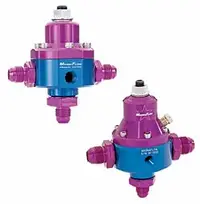
could this setup be accomplished with a AFPR like this one?
665mpefipcu.webp

when 2nd pump is off could air in the fuel cell's line be a problem?
are there flaws in this plan?
 

Attachments

  • 665mpefipcu.webp
    665mpefipcu.webp
    5.4 KB · Views: 138
Well there are a few problems with this setup.

"1gal fuel cell (with 108) mounted in engine bay"

I assume the purpose of this is to push 108 while you race in an effort to increase the octane levels without having to buy an entire tank. The first problem is legality. Depending on which state you live in this quite possibly could be an illegal modification. Second to that, I highly doubt ANY race sanctioning body would allow this modification during a race nor on their track.

"pump for the fuel cell on a toggle switch"

Due to the nature of physics, fuel would still be sucked out of the tank unless you had some sort of a cut-off valve.

"when 2nd pump is off could air in the fuel cell's line be a problem?"

No, see above answer though. However, if the fuel cell ran out of fuel and there was no cut-off valve you could very well suck air into the fuel lines. That would be a MAJOR problem and could very well cost you your engine.

My recommendation is to skip the inventing phase and replace your current fuel pump with either a good in-tank or in-line aftermarket pump. The fact that you did things right will justify the costs of filling the tank with expensive fuel on race day.
 
Vipersix said:
My recommendation is to skip the inventing phase.
the invention phase is my life:p

I know what your saying though, thanks for the input.

I usally put just enough gas to get me to the track then put about $25 of 110 octane(whats that, about half a gallon?) from a gas station near the track.
filling the tank is alot of weight
 
Raginstang... you said you have a coolant leak from the front of the motor, not an oil leak. The coolant only flows through between the head and the intake, rarely will it leak ou the front seal of the intake, whether it be cork or silicon. When you are installing an intake gasket you dont need to load it down with silicon, I put just enough to hold the gasket in place and a very thin ring around the water jackets. Smooth it out until there is barely any there. Let the gasket do its job, you may be putting to much silicon on the gasket, head to intake. Of course build the end oil seals up good but not to much, the last thing you want is silicon down in the oil system.