Remote mount Fuel Pressure Regulator?

69clark

Founding Member
Sep 25, 2002
731
7
18
Ravena, NY
Well I guess I am not 100% sure how to run the lines to the remote mount fuel regulator. The regulator has 2 feed ports (but the instructions say you can cap one off) and 1 return port.

I don't know if I have to run the supply line to the fuels rails first, then back to the regulator (like in the 1st drawing) or if I have to run the supply line to the regulator first, and then to the fuel rails like in the second drawing.

Not sure if I am being clear, but now I am second guessing how I need to run the lines to this thing. And don't laugh at the drawing, thats my Paint skills and I don't care, lol.

Thanks guys.

View attachment 389737
 
Im pretty Sure the regulator just goes on the return line only, off the rail into the regulator, then down the return line to the tank.

So Suppy Into rails->Return off the other side of rails->Regulator->Return line

I hooked up an FMU and it worked that way, so I assume thats how that works.

Im sure someone else can come in and comfrim this but im pretty sure thats how it works.
 
Im pretty Sure the regulator just goes on the return line only, off the rail into the regulator, then down the return line to the tank.

So Suppy Into rails->Return off the other side of rails->Regulator->Return line

I hooked up an FMU and it worked that way, so I assume thats how that works.

Im sure someone else can come in and comfrim this but im pretty sure thats how it works.

Dont quote me on this one..... The reason why so many people ditch the FMU is because of the way it operates.... What it does is it strain yours fuel pump(s) by cutting off the flow of the return line there for making your injectors pump twice as hard hence pumping more fuel especially under boost. With that said, it leads me to believe that you should plum it the exact oopsite of the way of the FMU. When you adjust the fuel pressure, you should adjust it coming from the tank instead of the return line. When you restrict the supply line, the excess fuel that is not forced through your rails then goes back through the return line to the tank. Alot less stress on the pumps because it is more free flowing... Don't quote me on that, but thats how I would do it and if that makes any sence to you then you can determine for yourself...Sorry I couldn't give a definate yah or nay...
 
Agian im unsure on this, but I thought the regulator worked by the fuel pump pressurizing the rails and then the regulator releaves all excess pressure into the return line. idk tho, maybe I missunderstood how it worked.

And btw I ditched the FMU it didnt work too well with tuning lol.
 
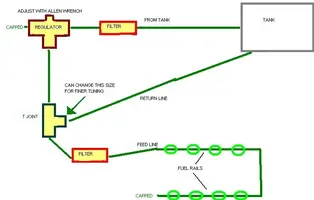
FPR SETUP.webp


This is a setup I did. There are several ways to fine tune the setup such as varying the size of the middle outlet of the T joint going back to the tank. Also using the two filters decreases flow. Hope it helps.
 
Agian im unsure on this, but I thought the regulator worked by the fuel pump pressurizing the rails and then the regulator releaves all excess pressure into the return line. idk tho, maybe I missunderstood how it worked.

And btw I ditched the FMU it didnt work too well with tuning lol.

I'm not 100% sure either on the FPR... Anyone have an input?
I figured this much about the FMU, seeing as you have 42LB squirters, FMU's are netorious for trouble when tuning...
 
Well thats why I feel so dumb right now. I know a decent amount of this stuff and I also usual know how to find out the stuff I don't know.

I think I have a good idea about how to do it, but I would rather plumb it up righ the first time. lol
 
Your first one looks right because the fuel pressure you are reading off the regulator is what your injectors are seeing. If the reg is before the rails it would probably be pretty close but I believe that is how the stock fuel system works.
 
I agree with squeeze......If you had a regulator before the rails, when you womp on it it will prolly lean out for a quick sec before the regulator decides it needs to compensate and increase flow to keep the specified pressure. Running the regulator after the rails will ensure that the pressure stays where you want it as long as the fuel system can keep up with the motor.