Runs great cold

roc-e

New Member
Jun 23, 2008
7
0
0
So my 1991 5.0 runs great cold, but after about 3 minutes of driving (not even really up to temp yet), it will miss/hesitate under load at low rpm. It's easiest to feel by lugging the engine in 5th gear at 1100 rpm and going to wide-open throttle. That's when the miss causes it to buck/shake.

When it's cold, it'll pull evenly and cleanly using the 5th-gear test I mentioned above.

The history: I "cured" a similar problem 6 months ago with a new TFI, so I've tried 2 other TFI modules since then, but still have the problem. Other things I've done include…
Cleaned MAF
Cleaned TB
Cleaned IAC
Replace PCV valve and screen
Replaced 2 upstream oxygen sensors
Replaced TPS (after driving with it unplugged seemed better)
Replaced ECT 6 months ago (got rid of a code 21 but made no difference in driveability)
Tried driving with the EGR unplugged (no difference)
Tried driving with the ECT unplugged (no difference)
Tried driving with BP [MAP] sensor unplugged (no difference)
Tried driving with the MAF unplugged (worse)
Timing was reset a few days ago with the most recent TFI swap.

I'm getting codes 44 & 94 (AIR injection system inop, but I don't think this is the cause) and I now have a new code 21 (ECT reading off).

A warm restart does not temporarily clear the problem--it still hesitates.

Any ideas would be greatly appreciated. I feel like I'm starting to chase my tail on this.
 
Code 21 or 116 – ECT sensor out of range. Broken or damaged wiring, bad ECT sensor.
Note that that if the outside air temp is below 50 degrees F that the test for the
ECT can be in error. This code may go away as the engine warms up, so don't dump the codes
on a cold engine


The ECT sensor has absolutely nothing to do with the temperature gauge. They are
different animals. The ECT sensor is normally located it the RH front of the engine in
the water feed tubes for the heater.

The ACT & ECT have the same thermistor, so the table values are the same

ACT & ECT test data:

Use Pin 46 on the computer for ground for both ECT & ACT to get most accurate
readings.

Pin 7 on the computer - ECT signal in. at 176 degrees F it should be .80 volts

Pin 25 on the computer - ACT signal in. at 50 degrees F it should be 3.5 volts. It is
a good number if the ACT is mounted in the inlet airbox. If it is mounted in the lower
intake manifold, the voltage readings will be lower because of the heat transfer.

Voltages may be measured across the ECT/ACT by probing the connector from
the rear. A pair of safety pins may be helpful in doing this. Use care in doing it
so that you don't damage the wiring or connector.

Here's the table :

50 degrees F = 3.52 v
68 degrees F = 3.02 v
86 degrees F = 2.62 v
104 degrees F = 2.16 v
122 degrees F = 1.72 v
140 degrees F = 1.35 v
158 degrees F = 1.04 v
176 degrees F = .80 v
194 degrees F = .61
212 degrees F = .47 v
230 degrees F = .36 v
248 degrees F = .28 v

Ohms measures at the computer with the computer disconnected, or at the sensor with the sensor disconnected.

50 degrees F = 58.75 K ohms
68 degrees F = 37.30 K ohms
86 degrees F = 27.27 K ohms
104 degrees F = 16.15 K ohms
122 degrees F = 10.97 K ohms
140 degrees F = 7.60 K ohms
158 degrees F = 5.37 K ohms
176 degrees F = 3.84 K ohms
194 degrees F = 2.80 K ohms
212 degrees F = 2.07 K ohms
230 degrees F = 1.55 K ohms
248 degrees F = 1.18 k ohms

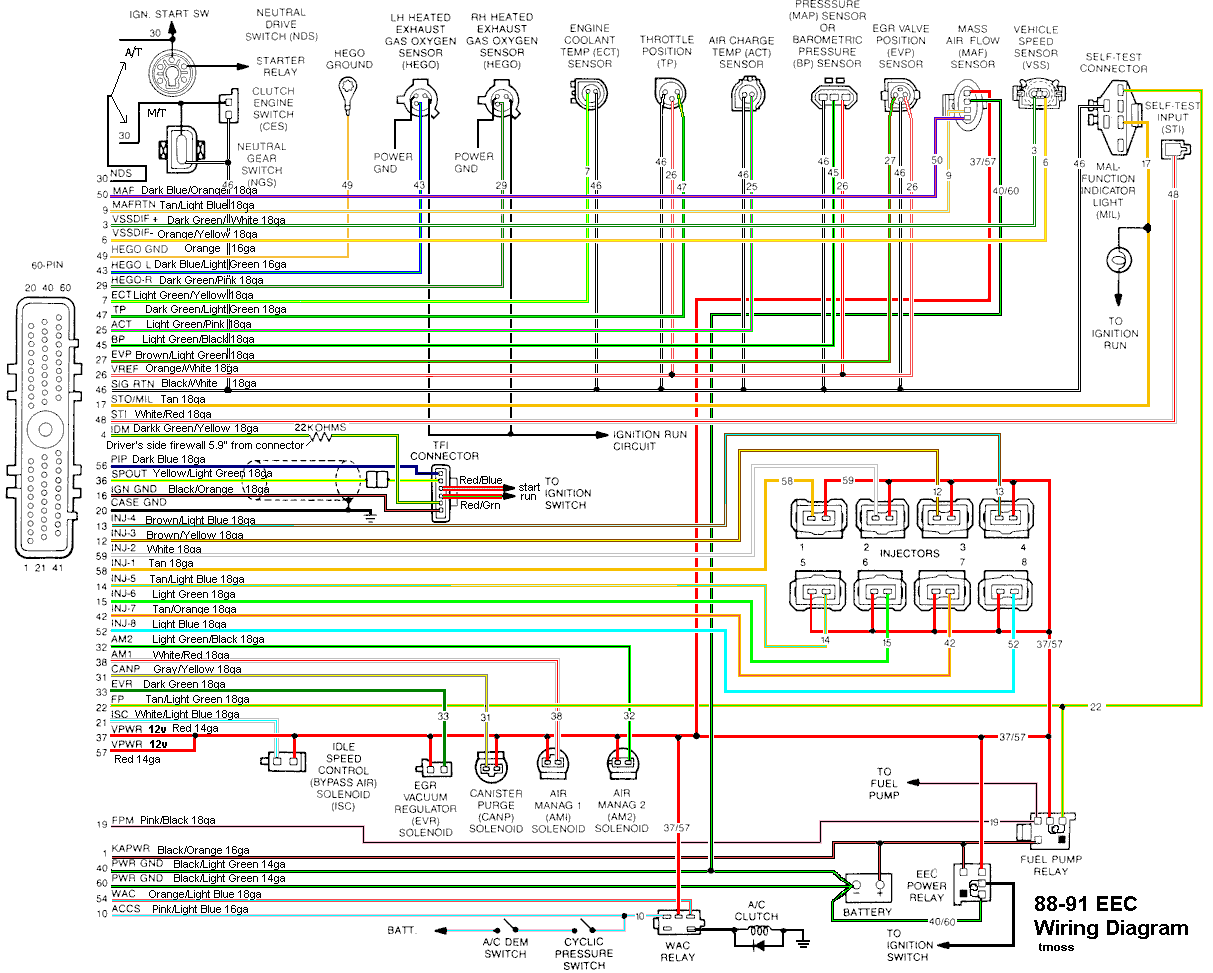
Diagram courtesy of Tmoss & Stang&2birds

88-91_5.0_EEC_Wiring_Diagram.gif


See the following website for some help from Tmoss (diagram designer) & Stang&2Birds
(website host) for help on 88-95 wiring Mustang FAQ - Wiring & Engine Info

Ignition switch wiring
http://www.veryuseful.com/mustang/tech/engine/images/IgnitionSwitchWiring.gif

Fuel, alternator, A/C and ignition wiring
http://www.veryuseful.com/mustang/tech/engine/images/fuel-alt-links-ign-ac.gif

Complete computer, actuator & sensor wiring diagram for 88-91 Mass Air Mustangs
http://www.veryuseful.com/mustang/tech/engine/images/88-91_5.0_EEC_Wiring_Diagram.gif

Vacuum diagram 89-93 Mustangs
http://www.veryuseful.com/mustang/tech/engine/images/mustangFoxFordVacuumDiagram.jpg
 
Thanks, everyone. I cleared the codes by disconnecting my battery overnight.

Temps were in the low 50s this morning. I drove until the miss started (almost exactly 3 minutes), and continued to drive until the engine was warm. Then I checked the codes: I got a code 21 (KOER) code, and a 31 KOEO code - EVP sensor out of range.

I also got a code 95 KOEO (fuel pump open, bad ground or always on), but I think that's becuase I have my fuel pump wired to a separate switch, and have to turn it on (and keep it on) to get the KOEO codes.

Since code 21 is the most prominent, engine-running hard fault that would affect driveability, I'm definitely looking into the ECT sensor this afternoon before anything else.
 
What is your fuel pressure? I had a simular problem with a 95GT that i was working on. Turns out that it was a restriction in the return line. It would climb to 70+psi and the car would act just like your symptoms. It is worth a shot.
 
Replaced the ECT, but that didn't fix the problem--turns out is was an ignition wire boot resting on a header. Ugh, so simple.

Since I've had three different causes over the last couple of years that have led to miss/hesitation issues (and have spent a lot of time on this), I took a few extra minutes to compile the info that I'd gathered together in the hopes of helping someone else out who is experiencing a miss – hesitation – stutter – buck – stumble – sputter – lag – chug …

Possible causes are basically ignition-related, vacuum-related, sensor-related or fuel-related. Causes can include:
1) Bad TFI (especially if the problem occurs after heat-soak)
2) Dirty MAF
3) Dirty TB
4) Unmetered air entering engine through leak in intake ducting (such as a loose clamp) or the IAC
5) Idle not set properly or bad IAC
6) Clogged PCV and/or screen
7) Unsecured ignition wires
8) Ignition arcing (often a bad wire, or arcing from wire to header; sometimes a wire is bad even if it appears okay from the outside—check resistance)
9) Distributor bolt not secure (bouncing the base timing around as the distributor moves while driving)
10) Bad cap or rotor
11) Bad coil
12) Bad ground(s)
13) Vacuum leak(s)
14) Loose pickup in the distributor (PIP) – people often replace the whole distributor if this is bad
15) Possible bad ECT, ACT, MAP/BP, EVP and EGR-related sensors
16) Possible bad 02 sensors or 02 sensor wiring
17) Fuel injector leak
18) Fuel pump or fuel pump relay failing

Likely fixes:
1) Check codes. Clear codes. Drive and check again. Fix/replace based on this first.
2) Clean MAF
3) Clean TB
4) Clean IAC
5) Check TPS voltage
6) Reset idle (unplug the IAC and set the base idle)
7) Check for unmetered air entering TB
8) Check/reset timing
9) Check ignition wires
10) Check plugs
11) Check cap & rotor
12) Check PCV valve & screen
13) Check coil
14) Check fuel pressure
15) Inspect for any vacuum leaks
16) Inspect for bad ground(s)
17) If it happens after a bit of driving (heat-soak), it's likely the TFI
:flag:
YMMV