strange starting problem

i just re-built my motor and it was running great, then about 1500 miles later it developed an overheating problem which i think was a head gasket so i tore the motor down and replaced the HG... i just got it back together and went to time it and it ran for about 1 minute then died as if i hit a kill switch. then it wouldn't start at all unless i floored it and it would run like crap and randomly die again as if i hit a kill switch. if i let it sit for a couple hours it will run great, infact better than it ever has but then die after about one minute... my distributer did get a little wet when it was in my shed, could that be it?? i dried it out and cleaned it up but could this be the TFI module?? i know it has fuel and the firing order is correct because it does initially run. also when it dies, it just hits a wall and stops, it doesn't sputter or anything... im soo pissed off at my car right now i want to sell it but i have too much money into it to make selling it worth it. by the way, the motor is completely stock except for headers, and underdrives.

thanks in advance,
MIKE
 
Find out (when it dies) if it is missing spark, injector pulsing, or both. That will help a lot.

You can look up Jrichker's no start checklist for the end-all write up on diagnosing the system.

Good luck.
 
i just bought a code reader and while performing the tests, my car would kick out.... this was strange to me so i hit the steering wheel (i was pissed off i had to do the test 15 times) and it turned back on.... hmmmmmmmm strange.
well i finally got the tests completed and it turns out that my egr is showing " low airflow and/or voltage" so that would explain the horrible running. so im thinking ignition switch and possibly egr position sensor?? i can't try anything right now as my battery is charging because it died trying to start it!

i'll keep everyone posted on the progress
 
Cranks OK, but No Start Checklist for Fuel Injected Mustangs

1.) Remove push on connector from starter solenoid and turn ignition switch on. Place car in neutral or Park. Remove coil wire from distributor & and hold 3/8” away from engine block. Jumper the screw to the big bolt on the starter solenoid that has the battery wire connected to it. You should get a nice fat blue spark.
Most of the items are electrical in nature, so a test light, or even better, a voltmeter, is helpful to be sure they have power to them.
No spark, possible failed items in order of their probability:
A.) MSD or Crane ignition box if so equipped
B.) Coil
C.) TFI module
D.) PIP sensor in distributor
E.) ECC relay next to computer - look for 12 volts at the fuel injector red wires
F.) Fuse links in wiring harness - look for 12 volts at the fuel injector red wires. All the fuse links live in a bundle up near the starter solenoid.
G.) Ignition switch - look for 12 volts at the ignition coil red/lt green wire. There is a separate blue fuse link for the coil which can open up and rob the coil of power.
H.) Computer

See the following links for wiring diagrams...

http://www.autozone.com/servlet/UiB..._us/0900823d/80/16/71/3c/0900823d8016713c.jsp for 79-88 model cars

http://www.autozone.com/servlet/UiB..._us/0900823d/80/19/59/5a/0900823d8019595a.jsp for 89-93 model cars

http://www.autozone.com/servlet/UiB..._us/0900823d/80/1d/db/3c/0900823d801ddb3c.jsp for 94-98 model cars


2.) Spark at coil wire, pull #1 plug wire off at the spark plug and check to see spark. No spark, possible failed items in order of their probability:
A.) Moisture inside distributor – remove cap, dry off & spray with WD40
B.) Distributor cap
C.) Rotor
D.) Spark Plug wires
E.) Coil weak or intermittent - you should see 3/8" fat blue spark with a good coil

3.) Spark at spark plug, but no start.
Next, get a can of starting fluid (ether) from your local auto parts store: costs a $1.30 or so. Then pull the air duct off at the throttle body elbow, open the throttle, and spray the ether in it. Reconnect the air duct and try to start the car. Do not try to start the car without reconnecting the air duct.
Two reasons:
1.) If it backfires, the chance for a serious fire is increased.
2.) On Mass Air cars, the computer needs to measure the MAF flow once the engine starts.
If it starts then, you have a fuel management issue. Continue the checklist with emphasis of fuel related items that follow. If it doesn’t, then it is a computer or timing issue: see Step 4.

Clue – listen for the fuel pump to prime when you first turn the ignition switch on. It should run for 5-20 seconds and shut off. To trick the fuel pump into running, find the ECC test connector and jump the connector in the lower RH corner to ground. See http://www.mustangworks.com/articles/electronics/eec-iv_codes.html for a description of the test connector. If the relay & inertia switch are OK, you will have power to the pump. Check fuel pressure – remove the cap from the schrader valve behind the alternator and depress the core. Fuel should squirt out, catch it in a rag. Beware of fire hazard when you do this. In pinch you can use a tire pressure gauge to measure the fuel pressure. It may not be completely accurate, but you will have some clue as to how much pressure you have.

No fuel pressure, possible failed items in order of their probability:
A.) Tripped inertia switch – Coupe & hatch cars hide it under the plastic trim covering the driver's side taillight. Use the voltmeter or test light to make sure you have power to both sides of the switch
B.) Fuel pump power relay – located under the driver’s seat in most stangs built before 92. On 92 and later model cars it is located below the Mass Air Flow meter. Look for 12 volts at the Pink/Black wire on the fuel pump relay.
C.) Clogged fuel filter
D.) Failed fuel pump
E.) Blown fuse link in wiring harness. Look for 12 volts at the Orange/Lt Blue wire on the fuel pump relay. The fuse links live in the wiring harness near the starter solenoid.
F.) Fuel pressure regulator failed. Remove vacuum line from regulator and inspect for fuel escaping while pump is running.

Fuel pressure OK, the injectors are not firing.

A.) A Noid light available from Autozone, is one way to test the injector wiring.
B.) I like to use an old injector with compressed air applied to the injector where the fuel rail would normally connect. I hook the whole thing up, apply compressed air to the injector and stick it in a paper cup of soapy water. When the engine cranks with the ignition switch on, if the injector fires, it makes bubbles. Cheap if you have the stuff laying around, and works good too.

a.) Pull an injector wire connector off and look for 12 volts on the red wire when the ignition switch is on.
b.) No power, then look for problems with the 10 pin connecter (salt & pepper shakers at the rear of the upper manifold).
c.) No power and the 10 pin connections are good: look for broken wiring between the orange/black wire on the ECC relay and the red wire for the 10 pin connectors.


4.) Spark & fuel pressure OK.

A.) Failed IAB (no airflow to start engine). Press the throttle ¼ way down and try to start the car.
B.) Failed computer (not very likely)
C.) Engine ignition or cam timing off: only likely if the engine has been worked on recently).
D.) Firing order off: HO & 351 use a different firing order from the non HO engines.
HO & 351W 1-3-7-2-6-5-4-8
Non HO 1-5-4-2-6-3-7-8
E.) No start when hot - Press the throttle to the floor & try starting it if you get this far. If it starts, replace the ECT.
 
just figured out that stupid me sortof unplugged the main harness on the steering column and it was only sortof making a connection... as for the EGR... the car still will not stay running and still runs like crap, so im wondering if egr valves or sensors just go. i'll test the wiring soon hopfully tonight but probably not. are there any test i can do to make sure the egr valve and sensor are working?
 
yeah you can test the EGR and EVR. You will notice a recurring theme here - I again recommend seeing Mr Richker's synopsis on troubleshooting the EGR system.

Simply stated, as you know, you dont want to see EGR gasses introduced at idle. I would check for vacuum being allowed at the valve itself at idle. There should be none. A chunk of carbon can get jammed in the valve and hold it open, causing rough idling and stalling. JR had the thought when the valve is out of the car for cleaning, to blow through the valve to ensure it is seating (I did not think of this the last time I had mine out).

You can also apply 5" hg to the valve and ensure the diaphram has decent movement.

Jrichker's write up covers everything though - this was some random thoughts. Good luck.
 
Post the exact code & I will try to give you some more specific help.

Some basic theory to clarify how things work is in order…

The EGR shuts off at Wide Open Throttle (WOT), so it has minimal effect on performance. The addition of exhaust gas drops combustion temperature, increases gas mileage and reduces the tendency of the engine to ping. It can also reduce HC emissions by reducing fuel consumption.

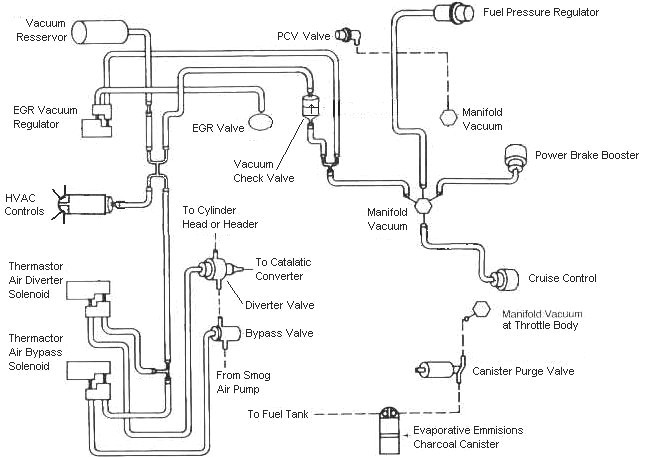
The EGR system has a vacuum source (line from the intake manifold) that goes to the EVR, computer operated electronic vacuum regulator. The EVR is located on the back of the passenger side shock strut tower. The EGR valve and the passages in the heads and intake manifold route exhaust gas to the EGR spacer (throttle body spacer). The computer uses RPM, Load. and some other factors to tell the EVR to pass vacuum to open the EGR valve. The EGR sensor tells the computer how far the EGR valve is open. Then computer adjusts the signal sent to the EVR to hold, increase or decrease the vacuum. The computer adds spark advance to compensate for the recirculated gases and the slower rate they burn at.

Diagram courtesy of Tmoss & Stang&2birds.
mustangFoxFordVacuumDiagram.jpg


The EGR sensor is basically a variable resistor, like the volume control on a radio. One end is 5 volt VREF power from the computer (red/orange wire). One end is computer signal ground (black/white), and the middle wire (brown/lt green) is the signal output from the EGR sensor. It is designed to always have some small voltage output from it anytime the ignition switch is the Run position. That way the computer knows the sensor & the wiring is OK. No voltage on computer pin 27 (brown/lt green wire) and the computer thinks the sensor is bad or the wire is broken and sets code 31. The voltage output can range from approximately .6-.85 volt.

EGR test procedure courtesy of cjones

to check the EGR valve:
bring the engine to normal temp.
connect a vacuum pump to the EGR Valve
apply 5in vacuum to the valve.
if engine stumbled or died then EGR Valve and passage(there is a passageway through the heads and intake) are good.
if engine did NOT stumble or die then either the EGR Valve is bad and/or the passage is blocked.
if engine stumbled, connect vacuum gauge to the hose coming off of the EGR Valve
snap throttle to 2500 RPM (remember snap the throttle don't hold it there).
did the vacuum gauge show about 5in vacuum?

if not, check for manifold vacuum at the EGR vacuum valve.
if you have manifold vacuum then connect vacuum gauge to the EGR valve side of the vacuum valve and snap throttle to 2500 RPM.
should read about 5in vacuum