tweecer guys check this out!

BlackVert

15 Year Member
Oct 3, 2003
5,589
9
98
Bethesda, MD
check this out ... in walt's spreadsheet, when i calculate the injector slope without subtracting the offset, the shape of slope plot is almost the exact mirror of the kamrf graph!

ie:

Cells(j, slope) = 1000 * (60 * 60 * fuel / (Cells(j, pw)))

instead of:

Cells(j, slope) = 1000 * (60 * 60 * fuel / (Cells(j, pw) - offset))

that can't be a coincidence ... what does it mean?
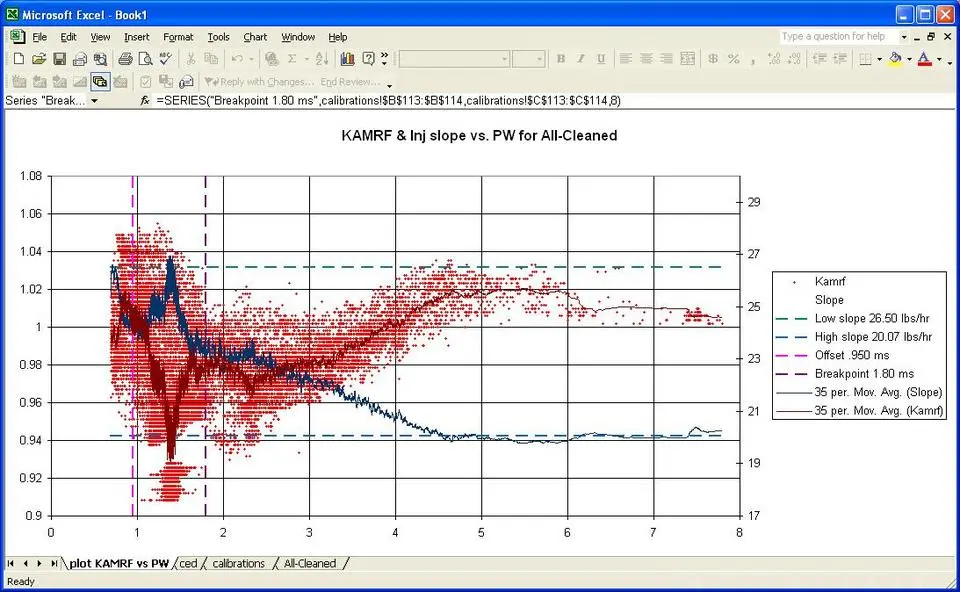
kam-pw-6.webp
 

Attachments

  • kam-pw-6.webp
    kam-pw-6.webp
    59.8 KB · Views: 115
donjohn said:
in a mathematical perspective it just means that your 'offset' is either close to 0 or much smaller than 'Cells(j, pw)'. dunno much about the tweecer but that's what it means in math terms
actually, i removed the 'offset' completely from the calculation
donjohn said:
what is 'offset' and 'Cells(j,pw)'?
they are part of a tuning spreadsheet that walt barnes put together to plot kamrf versus injector pulse width. it helps you figure out what your injector slopes should be.
 
95snoozer said:
it means your flux capacitor is malfunctioing.

fix it and hit 80 mph in the 1/8 and you will go back to 1982


its 88mph! doc:If my calculations are correct, when this baby hits 88 mph. your gonna see some serious ****!
 
I did the Walt thing until I was blue in the face and could only get just so close to getting the K's to 1 and then the whole deal would go too rich or lean.

I knew the concept was sound but I just could not get things to look like I thought they should.

I got a new maf & tb and it just so happened that the EEC Analyzer became available about that time.

With the EA I found out that a pulse width correction should be added and did not know that when using the Walt/Excell thing. Live & Learn I guess.

Dialing in the new tb & maf along with my existing 30# inj's were a snap compaired to the Excell thing.

Another nice thing about the EA program.

Beside crunching datalogs for inj values it does it for things like inj timing based on cam events, tb airflow, wot a/f ratio based on your wide band data and such.

Later
Grady
 
final5-0 said:
I did the Walt thing until I was blue in the face and could only get just so close to getting the K's to 1 and then the whole deal would go too rich or lean.

I knew the concept was sound but I just could not get things to look like I thought they should.

I got a new maf & tb and it just so happened that the EEC Analyzer became available about that time.

With the EA I found out that a pulse width correction should be added and did not know that when using the Walt/Excell thing. Live & Learn I guess.

Dialing in the new tb & maf along with my existing 30# inj's were a snap compaired to the Excell thing.

Another nice thing about the EA program.

Beside crunching datalogs for inj values it does it for things like inj timing based on cam events, tb airflow, wot a/f ratio based on your wide band data and such.

Later
Grady
i have only heard good things about the EA program. the only downside is that it costs $50.

about the pulse width correction thing, are you talking about the values in the "Injector Offset vs. Battery Voltage" function?
 
Black96VertGT said:
i have only heard good things about the EA program. the only downside is that it costs $50.

about the pulse width correction thing, are you talking about the values in the "Injector Offset vs. Battery Voltage" function?

No, the pw values that Tweecer shows in the datalogs need to be corrected by 0.50039 for EEC IV & 1.11191 for EEC V. A search on the Tweecer site will give you more detail.

I know what you mean about having to spend more $$$ to tune but for me I like the fact that Clint's program does the same thing by loading your datalog and just click to see the recommended results as opposed to search through the datalog and use the calculator to crunch all of the data when working with issues like inj timing, tb flow, isc values & such.

As for the offsets, they can change your KAMRF results by a good bit if the voltage dips just ever so slightly :bang:

Later
Grady
 
final5-0 said:
No, the pw values that Tweecer shows in the datalogs need to be corrected by 0.50039 for EEC IV & 1.11191 for EEC V. A search on the Tweecer site will give you more detail.
ah, yes, the .50039 correction. i know about that one.
final5-0 said:
I know what you mean about having to spend more $$$ to tune but for me I like the fact that Clint's program does the same thing by loading your datalog and just click to see the recommended results as opposed to search through the datalog and use the calculator to crunch all of the data when working with issues like inj timing, tb flow, isc values & such.
since i am still mostly stock, i don't need to worry yet about most of that stuff. maybe after i get a new maf/tb or cam, i'll bite the bullet and shell out the $50 for EA too.
final5-0 said:
As for the offsets, they can change your KAMRF results by a good bit if the voltage dips just ever so slightly :bang:
one thing that isn't clear about that function is how it handles voltages that are between the function values. does it:

a) interpolate the offset (adder) based on actual voltage;
b) round to the nearest voltage (13.50-14.49 all round to 14); or
c) chop off the decimal to get the voltage (13.99=13, 14.01=14)
 
Black96VertGT said:
ah, yes, the .50039 correction. i know about that one.

since i am still mostly stock, i don't need to worry yet about most of that stuff. maybe after i get a new maf/tb or cam, i'll bite the bullet and shell out the $50 for EA too.

one thing that isn't clear about that function is how it handles voltages that are between the function values. does it:

a) interpolate the offset (adder) based on actual voltage;
b) round to the nearest voltage (13.50-14.49 all round to 14); or
c) chop off the decimal to get the voltage (13.99=13, 14.01=14)

INTERPOLATE ?

That is one of those $10 words and I'm a $5 kinda guy.

I'll tell you how I think it works based upon what I've seen in my datalogs and if that is what interpolate means then so be it.

Lets say at 13 v your offset is .6 ms and at 12 v your offset is .8 ms. Your at a stoplight at idle and CalCon shows 13 v. You switch on the headlights which causes a v drop to 12.5. You are now working with an offset of .7 ms.

Later
Grady
 
final5-0 said:
INTERPOLATE ?

That is one of those $10 words and I'm a $5 kinda guy.

I'll tell you how I think it works based upon what I've seen in my datalogs and if that is what interpolate means then so be it.

Lets say at 13 v your offset is .6 ms and at 12 v your offset is .8 ms. Your at a stoplight at idle and CalCon shows 13 v. You switch on the headlights which causes a v drop to 12.5. You are now working with an offset of .7 ms.

Later
Grady
yea, that is interpolating. :D thanks