What are these for?

Five04sho

New Member
Apr 3, 2007
11
0
0
Hey guys, I bought this car about a week ago, and the previous owner told me he thought it might have a small vacuum leak because when the engine is cold and you first start the car, it will act like it wants to die, then the RPMS will pick back up then it sputters again. After the car gets warm, this problem goes away??? He said it could be from a vacuum leak but wouldnt it run crappy all the time if it was vacuum? Or could it be that since he doesnt have the fan shroud/overflow bottle on it anymore that it could be the coolant temp sensor thats not there anymore so the car doesnt know that its cold? Im just throwing ideas out there. Anyway I opened the hood up and was looking for possible vacuum leaks and I found a couple of thing that I have NO idea what they do or what they are. I have supplied 2 pics in hopes that someone could tell me if these could be my vacuum problem "if there is one..."

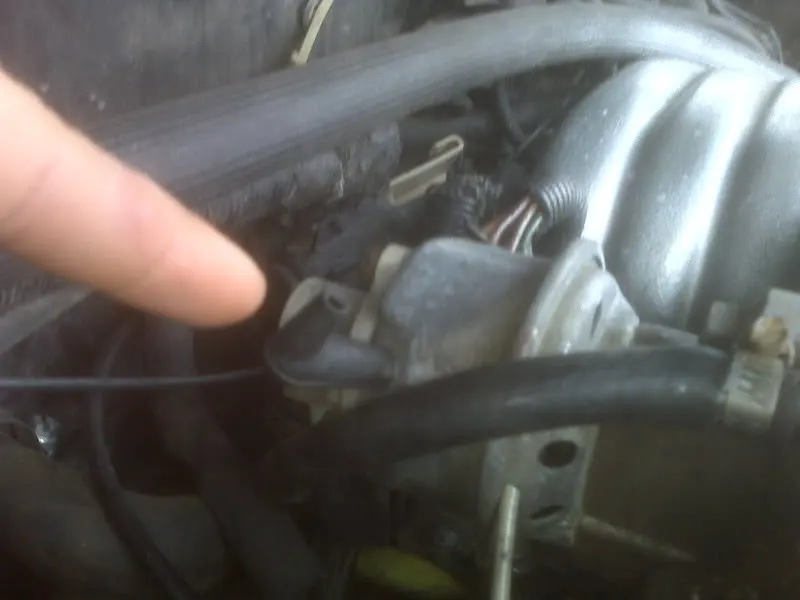
This 1st picture is me pointing at a rubber boot that looks to me like one of these vacuum lines is supposed to plug into. What is this boot for?

IMG00118.webp


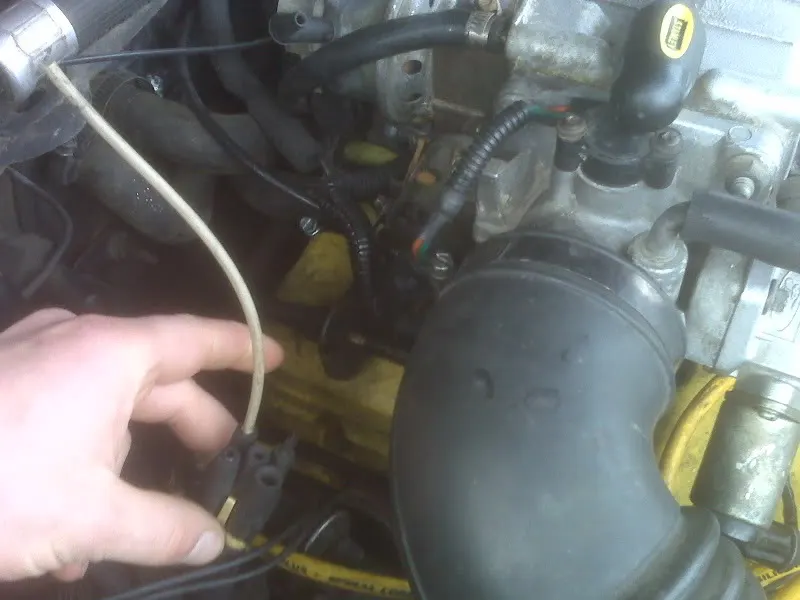
This 2nd picture is my holding a tiny cluster of what looks like small vacuum lines that have been cut. What are these for?

IMG00117.webp


Any help is appreciated! Thanks :nice:
 
That is the EGR valve vacuum line.

Some basic theory to clarify how things work is in order…

EGR System theory and testing

The EGR shuts off at Wide Open Throttle (WOT), so it has minimal effect on performance. The addition of exhaust gas drops combustion temperature, increases gas mileage and reduces the tendency of the engine to ping. It can also reduce HC emissions by reducing fuel consumption. The primary result of EGR usage is a reduction in NOx emissions.

The EGR system has a vacuum source (line from the intake manifold) that goes to the EVR, computer operated electronic vacuum regulator. The EVR is located on the back of the passenger side shock strut tower. The computer uses RPM, Load. and some other factors to tell the EVR to pass vacuum to open the EGR valve. The EGR valve and the passages in the heads and intake manifold route exhaust gas to the EGR spacer (throttle body spacer). The EGR sensor tells the computer how far the EGR valve is open. Then computer adjusts the signal sent to the EVR to hold, increase or decrease the vacuum. The computer adds spark advance to compensate for the recirculated gases and the slower rate they burn at.


attachment.php


Troubleshooting:
There should be no vacuum at the EGR valve when at idle. If there is, the EVR (electronic vacuum regulator) mounted on the backside of the passenger side wheelwell is suspect. Check the vacuum line plumbing to make sure the previous owner didn’t cross the vacuum lines.

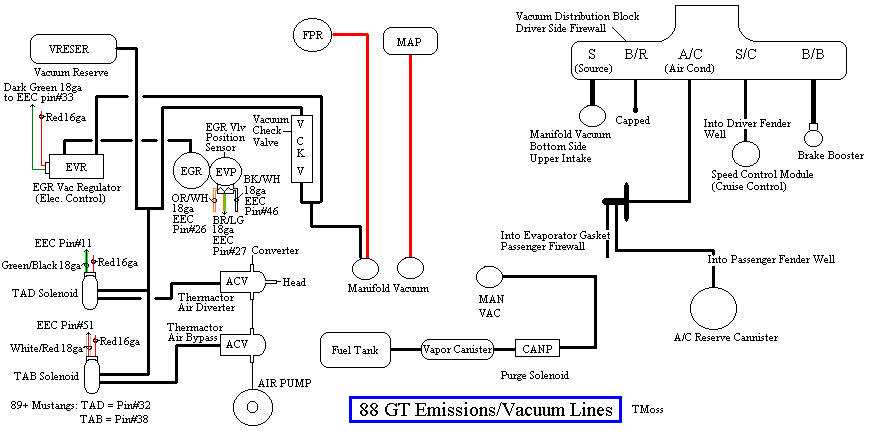
Diagram courtesy of Tmoss & Stang&2birds. (the diagram says 88 GT, but the EGR part is the same for 86-93 Mustangs)
88Stang5.0Vacuum.gif


The EGR sensor is basically a variable resistor, like the volume control on a radio. One end is 5 volt VREF power from the computer (red/orange wire). One end is computer signal ground (black/white), and the middle wire (brown/lt green) is the signal output from the EGR sensor. It is designed to always have some small voltage output from it anytime the ignition switch is the Run position. That way the computer knows the sensor & the wiring is OK. No voltage on computer pin 27 (brown/lt green wire) and the computer thinks the sensor is bad or the wire is broken and sets code 31. The voltage output can range from approximately .6-.85 volt.

The EVR regulates vacuum to the EGR valve to maintain the correct amount of vacuum. The solenoid coil should measure 20-70 Ohms resistance. The regulator has a vacuum feed on the bottom which draws from the intake manifold. The other vacuum line is regulated vacuum going to the EGR valve. One side of the EVR electrical circuit is +12 volts anytime the ignition switch is in the run position. The other side of the electrical circuit is the ground path and is controlled by the computer. The computer switches the ground on and off to control the regulator solenoid.


EGR test procedure courtesy of cjones

to check the EGR valve:
bring the engine to normal temp.
connect a vacuum pump to the EGR Valve
apply 5in vacuum to the valve.
if engine stumbled or died then EGR Valve and passage(there is a passageway through the heads and intake) are good.
if engine did NOT stumble or die then either the EGR Valve is bad and/or the passage is blocked.
if engine stumbled, connect vacuum gauge to the hose coming off of the EGR Valve
snap throttle to 2500 RPM (remember snap the throttle don't hold it there).
did the vacuum gauge show about 2-5 in vacuum?

if not, check for manifold vacuum at the EGR vacuum valve.
if you have manifold vacuum then connect vacuum gauge to the EGR valve side of the vacuum valve and snap throttle to 2500 RPM.
should read about 2-5 in vacuum

To test the computer, you can use a test light across the EVR wiring connectors and dump the codes. When you dump the codes, the computer does a self test that toggles every relay/actuator/solenoid on and off. When this happens, the test light will flicker.

Late Model Restoration has the Ford Racing M-12071-N302 kit with the EGR valve & sensor along with the ACT & ECT sensors for $45. See http://www.latemodelrestoration.com/iwwida.pvx?;item?item_no=M12071N302 1&comp=LRS for more details
 
Thanks for the indepth response! I appreciate it!!! So is this a big problem that he for some reason has these cut? Could it be because something IS bad and instead of trying to figure out and replace what was bad he just cut it out of the equation? One of my pics I posted you can see there is a longer white vacuum line coming out of the cluster. It will reach to the boot in the other pic. Do that need to be plugged in? Sorry Ive never dealt with EGR related issues before and alot of the info posted is in greek for me. LOL Am i hurting my car or it performance any by the way he has it set up now?
 
I noticed that thereis no list of your car's modifications or year. One of the simple things to do in StangNet is to update your sig. The wiring and other things changed several times between 79 & 95. That's why it is a good idea to use the sig under the user control panel (User CP) option. It allows you to post your car year & mods, which help greatly when troubleshooting things.

The line may have broken on its own. The hard vacuum lines are very brittle and over time they will break. Replace the broken lines with common rubber vacuum hose from your local auto parts store.

You may be able to re-connect the white vacuum line by simply pushing it bact into the rubber elbow on the EGR valve.

There are 2 white vacuum lines in that area: one is for the EGR and the other is for the Thermactor Air System (smog pump) diverter control valve. The rubber coupler in your picture has different line colors on each side. Push the plastic cover over the vacuum lines back so that you can see the line color before the rubber coupler. The EGR line will be green. The smog pump diverter control valve line will be white.

Go back and slowly read my EGR theory post several time and it will begin to make sense.

Pay close attention to the vacuum line diagram, since you will need it to reconnect the lines.

If the Check Engine light comes on while the engine is running, the computer is in Emergency Failure Management or Limp mode. This reduces performance and prevents engine damage. When you first turn the ignition switch on in 89-95 Mustangs, the Check Engine light should glow to show that it is working. The 87-88 Mustangs do not have a working check engine light.

Here's a book that will get you started with how the Ford electronic engine control or "computer" works.

Ford Fuel Injection & Electronic Engine Control 1988-1993 by Charles Probst :ISBN 0-8376-0301-3.

It's about $25-$35 from Borders.com see http://www.amazon.com/ . Select boo...en this happens, the test light will flicker.
 
it's definitely not helping performance. A lot of people delete the egr when they put a cobra intake on (because the cobra intakes don't have the egr port). The correct way to delete the egr is by tuning around it. I had a faulty egr sensor and my car ran pretty crappy until I replaced it.

The diagram jrichker posted shows the whole vaccum line things and should show you where everything goes with a little study. Basically the vacuum from the intake goes to the the evr which is on the passenger strut tower, then goes to the black piece which ur white line is coming out of.

So u should connect the white line to the boot.

As the diagram shows there should also be lines connected to the smog stuff, which is the tube that runs under the intake tubing and connects to the back of the heads