Progress Thread French dude with a '79 Fox joins the forum - have less than 2 decades to get running!!

While your starter solenoid is in the pic, it looks like it's missing the cable that runs from there to the starter (which is what I think you meant when you said there is no +).
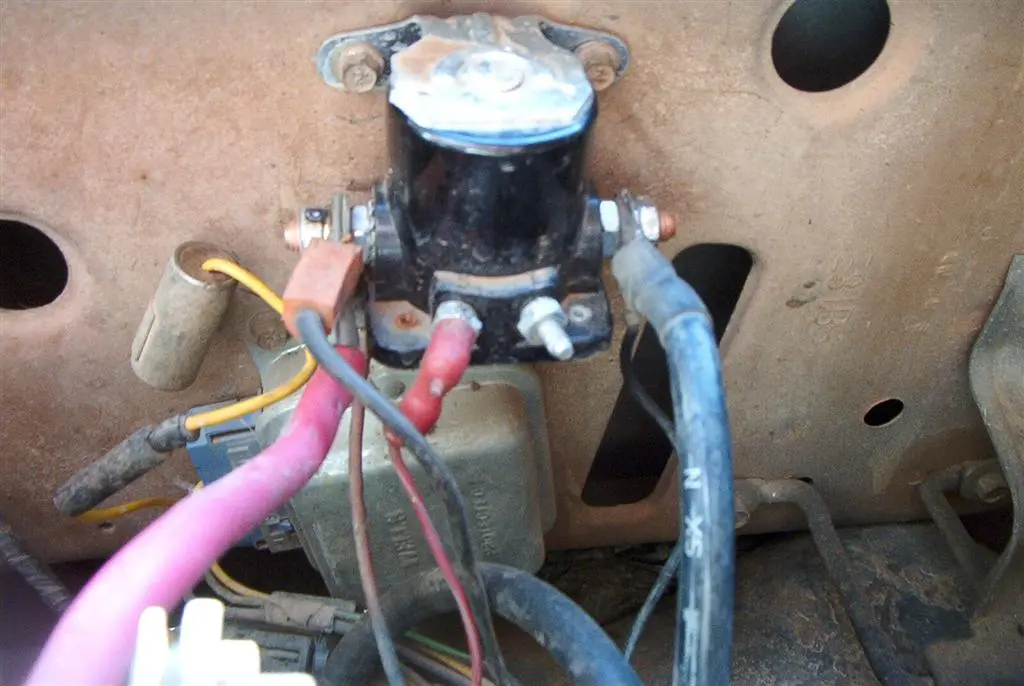
1731887290050.webp


As you can see in the pic above, there is a black wire with a red "box" on it that is connected to the positive terminal that the battery cable is also attached. That is what powers the fuse panel and that "box" is a fusible link. If you're getting warning lights, the chances are that that fusible link is still good. And if the solenoid is clicking, it's working and doing it's job. So you'll need that cable on the right that goes from the solenoid to the starter. If that cable is there and intact, then it could be that the battery has a low charge and isn't producing enough amperage to turn the starter. Or, if the battery is good, it could be a ground issue OR a locked up starter if you were able to turn the engine by hand.


As for the brakes, the sound you hear is the brake booster which sounds like it may be ok. The master cylinder is where the fluid is and should at least be checked to make sure there is fluid in it. Beyond that, I'd take a good look at the hoses to see if they're in horrible shape or if they're ok. You may need to pull the calipers off and take a C clamp to compress the piston to see if they're ok and remove the rotors to have them turned, but if the rotors don't look too rusted I'd just jack the car up and make sure that you're able to both spin the tires and hit the brakes to make sure they work for now. That way you'll be able to get it off the property and home where you're not so pressured to get all of this done, then fully go through the system. Of course we want it safe, but I'm sure you would be a lot more comfortable with everything done in your "back yard" vs being at someone else's house trying to get it out of their hair.

The throttle plates aren't necessarily an indicator of the rest of the engine, and if you were able to turn it by hand it sounds like the engine may not be hurt beyond the point of no return. I know we talked about a new carb vs a rebuild, so if you've purchased a new carb there's not a lot of reason to fuss with that one for now.

So I think if it were me, I'd keep plugging away to see if you could get that little V6 to run, then move on to the brakes and such. If it won't run, then it would be a waste of time to deal with the brakes right now.
 
While your starter solenoid is in the pic, it looks like it's missing the cable that runs from there to the starter (which is what I think you meant when you said there is no +).

1731887290050.webp


As you can see in the pic above, there is a black wire with a red "box" on it that is connected to the positive terminal that the battery cable is also attached. That is what powers the fuse panel and that "box" is a fusible link. If you're getting warning lights, the chances are that that fusible link is still good. And if the solenoid is clicking, it's working and doing it's job. So you'll need that cable on the right that goes from the solenoid to the starter. If that cable is there and intact, then it could be that the battery has a low charge and isn't producing enough amperage to turn the starter. Or, if the battery is good, it could be a ground issue OR a locked up starter if you were able to turn the engine by hand.


As for the brakes, the sound you hear is the brake booster which sounds like it may be ok. The master cylinder is where the fluid is and should at least be checked to make sure there is fluid in it. Beyond that, I'd take a good look at the hoses to see if they're in horrible shape or if they're ok. You may need to pull the calipers off and take a C clamp to compress the piston to see if they're ok and remove the rotors to have them turned, but if the rotors don't look too rusted I'd just jack the car up and make sure that you're able to both spin the tires and hit the brakes to make sure they work for now. That way you'll be able to get it off the property and home where you're not so pressured to get all of this done, then fully go through the system. Of course we want it safe, but I'm sure you would be a lot more comfortable with everything done in your "back yard" vs being at someone else's house trying to get it out of their hair.

The throttle plates aren't necessarily an indicator of the rest of the engine, and if you were able to turn it by hand it sounds like the engine may not be hurt beyond the point of no return. I know we talked about a new carb vs a rebuild, so if you've purchased a new carb there's not a lot of reason to fuss with that one for now.

So I think if it were me, I'd keep plugging away to see if you could get that little V6 to run, then move on to the brakes and such. If it won't run, then it would be a waste of time to deal with the brakes right now.
Thanks!
I have further questions:

-How many cables are supposed to go to the starter? Because there's already one but it looked more like a ground cable.
If I am indeed missing a cable then where does it go on the starter ? Looked around it a bunch but couldn't see any obvious nipple/connector.

-If it's a locked up starter, what kind of mechanic wizardry protip would fix it? Or do I just pull it out, open and clean?

-What would a ground issue be? Just bad/loose connections due to corrosion and other simple things or could there be more to that?
 
Follow the cable from the starter to it's destination, should be the solenoid, don't go by color on positive/negative connections, you need to make sure power goes to the correct place.
If you suspect a starter issue, yank it off, take a set of jumper cables, positive cable from a good battery to the big post on the starter, negative from that good battery to body of starter, be ready, the torque of the starter startup can make that starter dance around, of course it may do nothing but make a bunch of sparks at the connections, in that case buy another starter.
Sounds like maybe you've not had alot of automotive experience so I will caution you when working with automotive batteries, do not have your face over top of a battery when hooking up cables or any connections to the battery, lead acid batteries produce gases inside that can seep out and a spark will cause the top of the battery to leave the party, usually in small pieces all sharp and pointy and the acid bath in the face is not conducive with finding a date for Saturday night!! :nono:
 
Man, it took a bit to find a simple schematic that didn't have a bunch of extra stuff on it to confuse you. :doh: But here's an illustration on how the solenoid should be wired:
1731953806098.webp


So, as the General said, the cable that you see on the starter should run up to the solenoid. Maybe it does and it's just something I didn't see in your picture. But from what I could see, one of the large terminals didn't have a cable connected to it. As you can see above, there needs to be one coming from somewhere. So, if the terminal that is hidden from view has a cable that runs to the starter, then the terminal that looks like there's nothing attached should have the battery cable attached. I was making an assumption that since you had power running to the lights in the car that the battery cable was attached to the solenoid. And, like I said above, there is usually a larger gauge wire with a fusible link attached at the battery terminal on the solenoid that runs to the fuse panel. I don't see that in your pic either, which led me to believe that your positive connection was on the bottom side of the solenoid from that view. But now that you can see how it's supposed to be wired it should be pretty easy to confirm if it's correct.
 
The starter housing grounds to the bellhousing so you are not looking for a ground. the black cable on your starter solenoid is most likely the starter12V+ wire so follow that like the General mentioned and go from there. My guess is the starter is locked up and probably needs to be rebuilt or just get a remanufactured one.

@LILCBRA - you beat me to it!
 
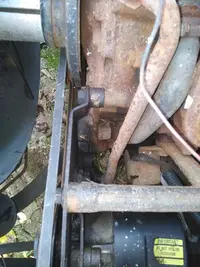
Okay so it's confirmed: The starter did have a cable... that wasn't connected to the solenoid, but was plugged directly to ground for some effin reason
(shown here as the large black lead on the right) :doh:
IMG_20241120_135715.webp

Good news is it works great once it's connected properly.
Engine cranks healthily, oil pressure gage goes all the way up, which is good I guess (?)
Did a quick test with a bit of brake cleaner in the intake and it sounds like it wants to go!

Now the fuel system is the issue. I believe if it worked I'd have fuel spewing out the fuel line after cranking it for a few seconds but I don't.
Just wanna confirm; The fuel pump is under that bracket right?:
IMG_20241120_160940-.webp

Because I don't think I hear anything from it so it might be dead.
Also not only do I not have the trunk key, I don't have the fuel cap key so I can't syphon the tank's old fuel for now.

Is it possible that the fuel lines might be gunked up as well after all this time? If so how do you fix that?

Regarding the carb I bought:
710WtgC3pFL._AC_SL1500_.webp

What's that thing for? It's hitting the valve cover, but it wasn't on the original carb. I'll most likely get rid of it to get it to fit but i'm curious.

I also noticed that grey box, is it the ECU? Thought that was under the dash.
How confident are you that it survived those last 30years?
IMG_20241120_161018.webp
 

Attachments

  • IMG_20241120_160940.webp
    IMG_20241120_160940.webp
    785.3 KB · Views: 77
Sounds like you're well on your way to getting it going - congratulations!

I'll try to answer your questions to the best of my knowledge.

1. I believe the fuel pump is under that bracket but I'm not 100% certain anymore. Hopefully this section of my Haynes manual can help you out! :)

20241121_200855.webp


2. The fuel lines could be gunked up, but they may be just fine too. Your best bet for now would probably be to use compressed air to blow them out, and the best time would probably be if/when you replace the fuel pump - which wouldn't be a bad idea now anyway. Like you said, it's not delivering fuel, there's a pretty good chance that the diaphragm is bad if it's still an original piece. But you'd have the lines disconnected from the pump, all you'd have to do would be disconnect it from the tank and at the carb (which you're going to have off anyway because you're replacing the carburetor....). My suggestion would be to apply the air from the downstream side - so blow from the carb connection to the pump, then from the pump connection to the tank. That way you'd know if there's a blockage anywhere, and if so you'd be able to localize it a little better.

3. I'm not sure what that piece is for. It's possible that it's for an automatic transmission kick down lever, but I can't answer that question with 100% certainty.

4. It's not an ECU but it  is for your ignition. They are sealed pretty well, so it might be ok. But they're also pretty inexpensive if you wanted to replace it to be safe. I've found and downloaded a PDF about testing the module if you're interested in it, I've attached it to this reply.
 

Attachments

The fuel pump on a carb'd SBF is attached to the side of the block under the power steering pump, on the drivers side of the engine but I see you have a V6 now so look at what is suggested by @LILCBRA
That box is the Duraspark ignition box, no ECU on a carb'd car.
The gizmo on the side of the carb is likely a manual choke lever, move it and see if the choke butterfly closes. I didn't look at the pic closely. Two types of chokes, manual and automatic, pic of the passenger (right side) of the old carb may help.
As suggested, disconnect the fuel lines at both ends and blow air through. Might as well replace the fuel pump too,
Carb'd cars are pretty basic.
 
  • Like
Reactions: LILCBRA
Hi everyone!

Thanks for your insights! I'll take the time to ask questions when I'm back at it.
In the meantime I just wanted to update on my situation.
The 2 week limit is no more! :banana:
Basically it was at my friend's grandpa's house, we became good friend so now he doesnt mind if it stays.
I'll still try not to overstay my welcome, though.

Currently I'm roadtripping an '02 Yukon in the US with a friend, to check on some other friends that are doing internships and exchanges.
We're doing Detroit -> LA and we're now in Denver.

I'll be back on the stang (still trying to find a name for it :chin) in a dozen days or so.

Cheers :)
 
Hey everyone, been a while!
Hope you're having a good start for 2025 :)

Priorities switched for a bit but I'm back at it! :banana:

I removed the original fuel pump, like the manual above showed it's was indeed under the power steering on the driver side of the engine.
I got an electric replacement instead of the og mechanical one.
Question is: where do I wire it? I was thinking the starter relay.
Followup question is: Since it doesn't go where the old one did, how do I plug the hole in the engine where the og one was? I was just thinking of putting it back in in the meantime because I can't find specific kits for a full delete.

I also tinkered with the carb, putting parts of the old one on the new one, like the mechanical choke since I don't have the system for an electric one.
There's this which I'm unsure is important:
IMG_20250131_130958.webp


The kickdown lever for the mustang's automatic (I have the Tbar auto since it's a ghia) is the gizmo right above. I guess there's two just so the carb could be compatible with as many cars as possible?

Otherwise I'm fighting with rusted bolts so I can drop the fuel tank and clean the 30 year old vinegar that's at the bottom of it. Any tips for that is welcome.
I'm also hoping it will allow me to remove the fuel cap even though I'm missing the key, if not I'll go screw myself.

Thanks everyone :)
 
  • Like
Reactions: gkomo
Hey everyone, been a while!
Hope you're having a good start for 2025 :)

Priorities switched for a bit but I'm back at it! :banana:

I removed the original fuel pump, like the manual above showed it's was indeed under the power steering on the driver side of the engine.
I got an electric replacement instead of the og mechanical one.
Question is: where do I wire it? I was thinking the starter relay.
Followup question is: Since it doesn't go where the old one did, how do I plug the hole in the engine where the og one was? I was just thinking of putting it back in in the meantime because I can't find specific kits for a full delete.

I also tinkered with the carb, putting parts of the old one on the new one, like the mechanical choke since I don't have the system for an electric one.
There's this which I'm unsure is important:
IMG_20250131_130958.webp


The kickdown lever for the mustang's automatic (I have the Tbar auto since it's a ghia) is the gizmo right above. I guess there's two just so the carb could be compatible with as many cars as possible?

Otherwise I'm fighting with rusted bolts so I can drop the fuel tank and clean the 30 year old vinegar that's at the bottom of it. Any tips for that is welcome.
I'm also hoping it will allow me to remove the fuel cap even though I'm missing the key, if not I'll go screw myself.

Thanks everyone :)
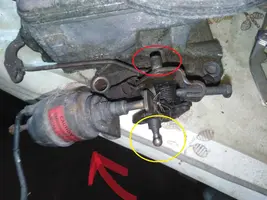
Back in the day I had an '83 V6 automatic with the 2 barrel carb. It had a metal tube bent with flattened ends for the kickdown rod. It was attached to the pin facing the carb in your picture. The other rod with the ball end is for the throttle cable. The solenoid you highlighted is to bump up the idle when needed or control throttle. Can't remember if it is for when the AC kicks on or for cruise control.
 
Back in the day I had an '83 V6 automatic with the 2 barrel carb. It had a metal tube bent with flattened ends for the kickdown rod. It was attached to the pin facing the carb in your picture. The other rod with the ball end is for the throttle cable. The solenoid you highlighted is to bump up the idle when needed or control throttle. Can't remember if it is for when the AC kicks on or for cruise control.

In 1983 it would have been the larger 3.8 Essex, right?
I have the flattened piece of tube you mention, it was connected to that rod with the ball end when I got the car.
If by "the pin facing the carb" you mean the thing in red, it wasn't on the og carb, so my guess would be that it was an addition for the later engines, which would make sense since you had an Essex instead of the Cologne.
If you meant something around the green part, I think that's around where I remember the throttle to be.

All in all I'm pretty sure I can cut the red thing.

710WtgC3pFL._AC_SL1500_-.webp


And okay for the solenoid thing, so it is important.
I'll throw it on the new carb and hope it still works!
 
The ball stud circled in blue is for the throttle, the part circled in red is for the AT kickdown, and the solenoid looking thing bumps the idle when the AC is in use. Or at least that's what I've been told. ;)

So the "red thing" probably shouldn't be cut off if you can help it. I mean you can always manually kick the transmission down into second if need be, but it's nice to not have to do that.

Side note: I just received a Haynes manual for the 79-93 cars, I can take a look in it if you need me to. Othewise, it may not be a bad idea to pick one up for yourself. Here's the Amazon link.


Edit: As for where the wiring for the electric choke goes, I think all it needs is 12v with the key on.... :chin
 
carb linkages.webp

The kickdown rod goes on the straight rod circled in red. It is held on with a snap clip.

The rod with the ball end is for the throttle pedal cable to attach. It snaps on.

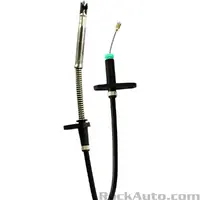
Accelerator cable.webp

Bullet style end goes on the accelerator pedal, the other end onto the domed pin on the carb.

Yes the '83 had a 3.8 V6, but I would bet the carb was the same.

Funny story, when I bought the car it was not running. With a little fiddling we got it to run, sort of. It would start and idle but sounding like it was missing on a couple cylinders. We ended up finding a good used 3.8 and swapped it. When the garage pulled the motor they investigated a bit and found the cam had broken in the middle. The car only had the valve train moving on the front 3.5 cylinders.