
You are using an out of date browser. It may not display this or other websites correctly.
You should upgrade or use an alternative browser.
You should upgrade or use an alternative browser.
5sp Automatic
- Thread starter BlueJoker
- Start date

stanmckinney
10 Year Member
- Mar 30, 2005
- 1,188
- 5
- 49
05Stangster
New Member
hurdlinmasta
New Member
- Dec 25, 2004
- 85
- 0
- 0
umm, im pretty sure alot of your cars have done that. You can only feel it if you are parked on a SLOPE. It rocks back an inch or so, its done that for EVERY SINGLE automatic I have owned. Its done that for my Sentra, GTI, RX300, and it does that for my 05 GX 470. When you shift from D to P, it leaves alittle gap so it will fall into place. If it is annoying you, or you think you will hit the car infront, just use your E-Brake. That will prevent you from going forward.
stanmckinney
10 Year Member
- Mar 30, 2005
- 1,188
- 5
- 49
richardsdd
Founding Member
I'm not sure if the newer setups are like the old classics, but in my 69 I had the same problem. Caused by an out of adjustment lever and worn bushings. This caused the locking pawl to not fall in place when you put it in Park.
Either way, take it to a dealer if you are concerned. Better safe than sorry.
Either way, take it to a dealer if you are concerned. Better safe than sorry.
Yes, it does still does the 'rock back' and click on flat surfaces. I made an appointment for wed to have that looked at along with a fix for my gas tank and cd player. I'll post up what they say then, the E brake solution works for now.
Thanks for the replies,
Thanks for the replies,
BlueJoker said:update:
dealer says 'normal'. So I suppose I'll live with it, the E brake solution works quite well. The dealership is going to replace the gas tank & CD player
Don't take any of that "it's normal" crap. I went through that dealer B.S with my 01 Z28s oil consumption and piston slap problem.
It bothers you, it's not NORMAL, you paid a lot of money for that car make those bastards fix it.
chunkachunk
Banned
- Aug 5, 2005
- 16
- 0
- 0

chunkachunk said:suck my toe
Was this response intended for the 'alignment woes' thread?


Absolutley normal and here is why:
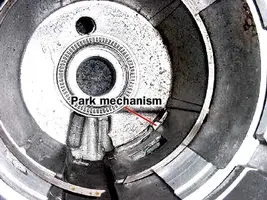
The parking-brake mechanism engages the teeth on the output to hold the car still. This is the section of the transmission that hooks up to the drive shaft -- so if this part can't spin, the car can't move.
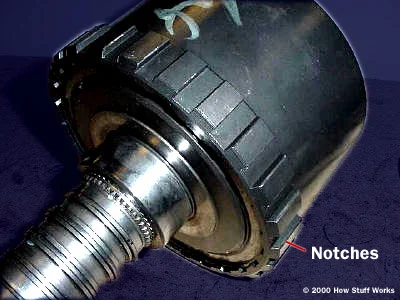
The output of the transmission: The square notches are engaged by the parking-brake mechanism to hold the car still.
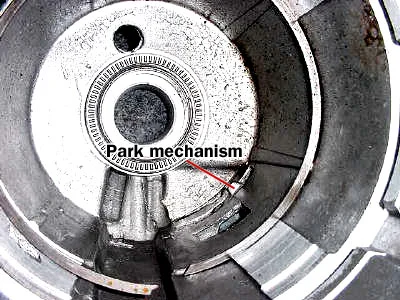
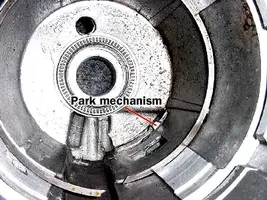
The empty housing of the transmission with the parking brake mechanism poking through, as it does when the car is in park
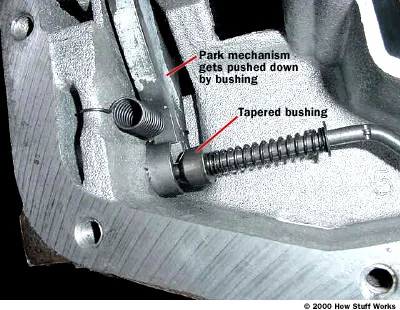
Above you see the parking mechanism protruding into the housing where the gears are located. Notice that it has tapered sides. This helps to disengage the parking brake when you are parked on a hill -- the force from the weight of the car helps to push the parking mechanism out of place because of the angle of the taper.
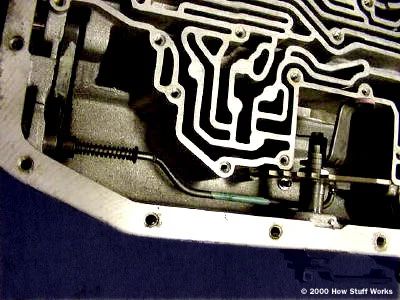
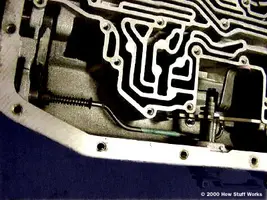
This rod actuates the park mechanism.
This rod is connected to a cable that is operated by the shift lever in your car.
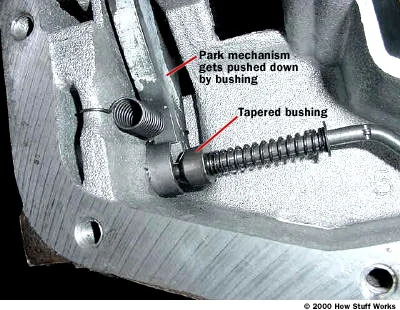
Top view of the park mechanism
When the shift lever is placed in park, the rod pushes the spring against the small tapered bushing. If the park mechanism is lined up so that it can drop into one of the notches in the output gear section, the tapered bushing will push the mechanism down. If the mechanism is lined up on one of the high spots on the output, then the spring will push on the tapered bushing, but the lever will not lock into place until the car rolls a little and the teeth line up properly. This is why sometimes your car moves a little bit after you put it in park and release the brake pedal -- it has to roll a little for the teeth to line up to where the parking mechanism can drop into place.
Hope this helps set your mind at ease. It is the essence of locking the planetary gears in an Automatic Transmission. No worries. Enjoy your Stang!
Jennifer
The parking-brake mechanism engages the teeth on the output to hold the car still. This is the section of the transmission that hooks up to the drive shaft -- so if this part can't spin, the car can't move.
The output of the transmission: The square notches are engaged by the parking-brake mechanism to hold the car still.
The empty housing of the transmission with the parking brake mechanism poking through, as it does when the car is in park
Above you see the parking mechanism protruding into the housing where the gears are located. Notice that it has tapered sides. This helps to disengage the parking brake when you are parked on a hill -- the force from the weight of the car helps to push the parking mechanism out of place because of the angle of the taper.
This rod actuates the park mechanism.
This rod is connected to a cable that is operated by the shift lever in your car.
Top view of the park mechanism
When the shift lever is placed in park, the rod pushes the spring against the small tapered bushing. If the park mechanism is lined up so that it can drop into one of the notches in the output gear section, the tapered bushing will push the mechanism down. If the mechanism is lined up on one of the high spots on the output, then the spring will push on the tapered bushing, but the lever will not lock into place until the car rolls a little and the teeth line up properly. This is why sometimes your car moves a little bit after you put it in park and release the brake pedal -- it has to roll a little for the teeth to line up to where the parking mechanism can drop into place.
Hope this helps set your mind at ease. It is the essence of locking the planetary gears in an Automatic Transmission. No worries. Enjoy your Stang!
Jennifer
Attachments


05Stangster
New Member
05Stangster said:Could you please go into a little more detail on your explanation?
....Smart Azse.... I wish Ford would have little diagrams like this for folks so that they would be educated and feel confident with their purchase. The old "It's Normal" just does'nt give folks that fuzzy-loving satisfied feeling. Jenn
Jenns05Stang said:
Jenn
Excellent explanation.
 I just cringe when I read "dealer says it's normal" I got burned by Volkswagen and General Motors.
"Yes sir 1 quart every 700 miles is normal"
I think the worst case of "it's normal" is what the 350z guys are going through with their tires. I wonder how long it will take Datsun err--Nissan to admit it's not "normal!" The front end has a design flaw in those cars, and they should be recalled. What do they do-- swap tires from side to side "normal procedure"
After the sale service seems to suck now.
05Stangster
New Member
Yup, I was just kidding - thanks for the great explanation. And as far as dealers go, I have arrived at a conclusion:
"It's Normal" = a) didn't hear it during the test drive because we prefer not to hear YOUR problem b) don't want to deal with it until you bug us until we have to deal with YOUR problem c) no TSB or Recall, so it's normal and is YOUR problem ...
"It's Normal" = a) didn't hear it during the test drive because we prefer not to hear YOUR problem b) don't want to deal with it until you bug us until we have to deal with YOUR problem c) no TSB or Recall, so it's normal and is YOUR problem ...

Power Surge
Founding Member
Jenns05Stang said:Absolutley normal and here is why:
The parking-brake mechanism engages the teeth on the output to hold the car still. This is the section of the transmission that hooks up to the drive shaft -- so if this part can't spin, the car can't move.
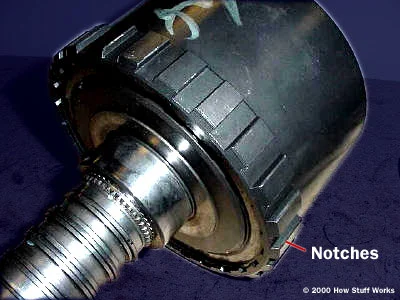
The output of the transmission: The square notches are engaged by the parking-brake mechanism to hold the car still.
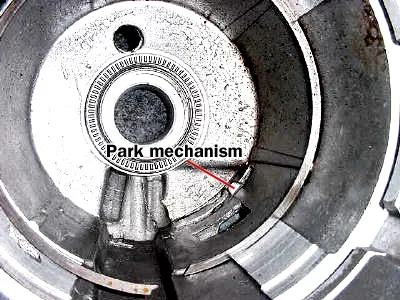
The empty housing of the transmission with the parking brake mechanism poking through, as it does when the car is in park
Above you see the parking mechanism protruding into the housing where the gears are located. Notice that it has tapered sides. This helps to disengage the parking brake when you are parked on a hill -- the force from the weight of the car helps to push the parking mechanism out of place because of the angle of the taper.
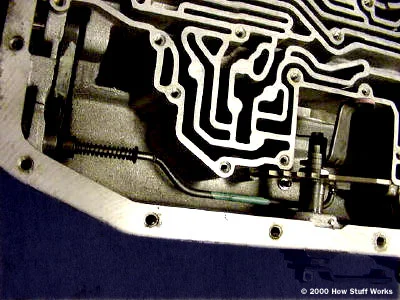
This rod actuates the park mechanism.
This rod is connected to a cable that is operated by the shift lever in your car.
Top view of the park mechanism
When the shift lever is placed in park, the rod pushes the spring against the small tapered bushing. If the park mechanism is lined up so that it can drop into one of the notches in the output gear section, the tapered bushing will push the mechanism down. If the mechanism is lined up on one of the high spots on the output, then the spring will push on the tapered bushing, but the lever will not lock into place until the car rolls a little and the teeth line up properly. This is why sometimes your car moves a little bit after you put it in park and release the brake pedal -- it has to roll a little for the teeth to line up to where the parking mechanism can drop into place.
Hope this helps set your mind at ease. It is the essence of locking the planetary gears in an Automatic Transmission. No worries. Enjoy your Stang!
Jennifer
Jenn, marry me.
Attachments


Similar threads
- Replies
- 10
- Views
- 298

- Replies
- 5
- Views
- 215
- Replies
- 3
- Views
- 300


- Replies
- 11
- Views
- 275
