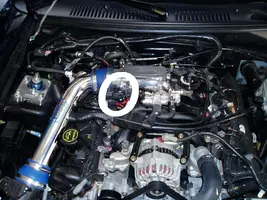
mity2 said:
I got 75mm TB for $60(Many thanks to 03MGT

).
Can someone tell me how to adjust TPS Voltage setting, or anything else I should know!
THROTTLE BODY INSTALLATION INSTRUCTIONS
AND
THROTTLE POSITION SENSOR ADJUSTMENT
Replacing the original throttle body and installing an Accufab throttle body is considered a “bolt-on” modification. In most cases it is an “off with the old and on with the new” process. In some cases, some minor modifications are required. If, for instance, the new throttle body is larger than the inlet hole in the intake manifold, some minor grinding or chamfering of the inlet hole may be required. On the 1996-1998 Cobra installations, the bridge between the dual-hole intake manifold must be ground or cut out so as to permit the installation of the larger single blade Accufab throttle body. All of these tasks are relatively easy to do, however, if any part of a throttle body installation is thought of as being difficult, or if you are uncomfortable with doing it yourself, we recommend getting advice or consultation from a professional.
Adjusting the Throttle Position Sensor (TPS) to the correct voltage is not difficult. It will require you to use a Digital Voltmeter and to have a correctly sized screw driver.
The TPS is in essence, a low voltage potentiometer or resistor. It provides input data to the ECM (“the computer”) regarding the position of the throttle. The TPS supplies a gradually increasing supply of voltage to the ECM as the throttle is gradually opened. How the ECM processes this data depends on other prevailing conditions, including engine speed, load, vehicle speed, engine and ambient temperatures, and so on. The information from the TPS is especially critical for proper start-up and idle, as well as smooth throttle response. An incorrectly adjusted TPS may be most notable by an idle speed that is either too fast or too slow. The proper idle speed should be between 750 and 900 RPM, and will be dependent on different engine combinations, particularly with engines that may have non-stock modifications.
To adjust the TPS, follow these instructions. First, disconnect the ground cable from the battery.
The TPS is a small black plastic device affixed to the throttle body with two screws, and located on the opposite side of the throttle cable linkage. The end of the throttle blade shaft has a blade machined into it that fits into the TPS. The TPS is electrically connected (with a quick disconnect plug) to the main wire harness.
After you have replaced your original throttle body with your new one, remove the TPS from the original throttle body and install it on your new Accufab throttle body. If new screws have been provided in the package from Accufab, use these screws (they are shorter). If not, reuse the original or stock screws. Reconnect the TPS to the wire harness.
You may now reconnect your battery.
You will need to adjust the TPS to get the correct voltage at idle. Changes to the idle speed can ONLY be made by adjusting the TPS. DO NOT ADJUST THE STOP SCREW ON THE THROTTLE BODY UNDER ANY CIRCUMSTANCES. This has been pre-adjusted at the factory to insure a proper “air gap” around the throttle blade in the fully closed position. If by chance this stop screw has been re-adjusted in the field (by those that adjust first and read the instructions last), it will be necessary to return it to Accufab for re-calibration.
The TPS is connected to the main wire harness with three separate, color coded wires. You will see a “gray & red” wire, a “gray & white” wire, and a “brown & white” wire.
The “gray & red” wire is the ground wire (could also be a black wire).
The “gray & white” wire provides the voltage information to the ECM (could also be a green wire).
The “brown & white” wire provides a 5-volt reference signal WITH THE KEY ON (could also be an orange wire).
If you have any problem identifying the different colors or if the wires are different colors from those described, check inside the plastic quick disconnect plug. The plug connection tangs should have an “A”, “B”, and “C” next to each tang. “A” is the “gray & red” wire, “B” is the “gray & white” wire, and “C” is the “brown & white” wire. Because of the different suppliers of TPS’s (and the potential for different wire colors), you may need to “poke around” on the wires in order to determine the positive and negative leads. An easy way to take voltage readings is to stick a safety pin through the individual wires, and then make contact with your Volt Meter probes to the safety pins.
To check voltage, THE IGNITION KEY NEEDS TO BE IN THE ON POSITION BUT THE ENGINE MUST NOT BE RUNNING. With the positive (+) lead from your voltmeter, pierce the “gray & white” wire. With the negative (-) lead from your voltmeter, pierce the “gray and red” wire. The voltmeter should read no less than .98 volts nor more than 1.0 volts. If the voltage is too high, loosen (but do not remove) the two screws holding the TPS to the throttle body, and rotate the unit counter-clockwise, until the voltage is correct. Rotating the unit clockwise will increase the corresponding voltage. When the voltage is correct, retighten the two screws. The only adjustment is the “slop” between the inside diameter of the holes and the outside diameter of the screws, so we are dealing with just a few degrees of rotation.
The Ford ECM’s are very “unforgiving” when it comes to ANY engine modifications from stock. The addition of an Accufab throttle body should not have any negative effect on idle speed, off-idle performance (tip-in) or the RPM returning to idle speed (within a second or two) when the throttle is closed.
If on the other hand, modifications to the stock engine may include additional supercharger boost with the use of different supercharger pulleys (particularly noticeable on supercharged 2003-2004 Mustang Cobra’s) or adding a “re-programming” chip or add-on computer module, the standard TPS voltage readings and other drivability issues may be noticeable, and could include an overly fast idle and a resistance of the ECM to “allow” the throttle to close properly, resulting in a delay between removing your foot from the gas pedal and the engine returning to idle.
These are not throttle body problems. The throttle body is a mechanical device with only one moving part. As long as the throttle body slams shut when you close the throttle (key off, engine not running), the throttle body is functioning correctly. Any other problem is associated with the ECM and the feedback it is receiving, either due to the increased boost at idle (more air supply) or the add-on computer chip sending incorrect (or unknown) data to the ECM.
If you have any questions or if we can be of any assistance, do not hesitate to call Accufab, Inc. at (909) 930-1751 and ask for our Tech Department.