You don't need a voltmeter to pull codes on an 88. All you need is a test lamp. You use the test lamp just like the voltmeter.
I would avoid the May Suddenly Die box. They seem to have their own set of problems.
You have a possible TFI problem, pull it and have it tested. Most larger auto parts stores can do it for free. If it only misses when the engine is warm, use a hair dryer to heat it when it is tested.
Bad grounds could cause a miss. Checking them is a good idea on an older car that has changed owners several times.
Grounds are important to any electrical system, and especially to
computers.
1.) The main power ground is from engine block to battery: it is
the power ground for the starter & alternator.
2.) The secondary power ground is between the back of the
intake manifold and the driver's side firewall. It is often missing or
loose. It supplies ground for the alternator, A/C compressor
clutch and other electrical accessories such as the gauges.
Any car that has a 3G or high output current alternator needs
a 4 gauge ground wire running from the block to the chassis
ground where the battery pigtail ground connects.
The 3G has a 130 amp capacity, so you wire the power side
with 4 gauge wire. It stands to reason that the ground side
handles just a much current, so it needs to be 4 gauge too.
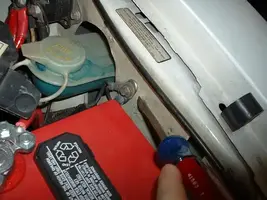
Picture courtesy timewarped1972
3.) The computer has its own dedicated power ground that
comes off the ground pigtail on the battery ground wire. Due to
it's proximity to the battery, it may become corroded by acid
fumes from the battery. It is a black cylinder about 2 1/2" long
by 1" diameter with a black/lt green wire. You'll find it up next to
the starter solenoid where the wire goes into the wiring harness
4.) All the sensors have a common separate ground. This
includes the TPS, ACT, EGE, BAP, & VSS sensors.
5.) The O2 sensor heaters have their own ground (HEGO ground)
coming from the computer. This is different and separate from
the O2 sensor ground. It is an orange wire with a ring terminal
on it. It is located in the fuel injector wiring harness and comes out
under the throttle body. It gets connected to a manifold or bolt on
back of the cylinder head.
6.) The TFI module has 2 grounds: one for the foil shield around
the wires and another for the module itself. The TFI module
ground terminates inside the computer.
7.) The computer takes the shield ground for the TFI module and
runs it from pin 20 to the chassis near the computer.
8.) The computer's main power ground (the one that comes from
the battery ground wire) uses pins 40 & 60 for all the things it
controls internally.
See
http://www.fluke.com/application_notes/automotive/circuit.asp?AGID=1&SID=103#volt
for help troubleshooting voltage drops across grounds
Extra grounds are like the reserve parachute for a sky diver.
If the main one fails, there is always your reserve.
The best plan is to have all the grounds meet at one central spot
and connect together there. That eliminates any voltage drops
from grounds connected at different places. A voltage drop
between the computer ground and the alternator power ground will effectively
reduce the voltage available to the computer by the amount of the drop.