91 mustang fuel pump issues

werd35

New Member
Feb 24, 2010
19
0
1
south bend, IN
First off, I know that this has been a common topic in a lot of threads and every single one leads back to the same fuel pump diagnostic checklist, i have tried nearly everything and still having same issue.

I have a 1991 lx hatch, only engine mods is underdrive pullies. The issue is that the fuel pump will not kick on. When the ignition is turned to the on position the fuel pump does not recieve any power. I have already dropped the tank and hard wired the pump and it pumps fuel out quickly. I have also replaced the fuel pump relay and in the process of replacing the PCM power relay, but I am sceptical that this relay will solve the issue. i have also checked the inertia switch which does not have any power to it. The fuel pump has 3V to one of the hot wires and nothing to any of the others. I have tried to trick the fuel pump into getting power by grounding out the EEC, but this doesnt work either. My car has 70,000 original miles and none of the wires seem to be frayed or worn, so even though I cant be positive I dont think it has a short. Could I be running into an ECU issue?
 
Do the homework...If you read and compreheand electical circuits, this is not difficult. If you don't, how bad do you want to drive the car? Enough to study the troubleshooter and lean how it works?


Fuel Pump Troubleshooting for 91-93 Mustangs

Revised 21-Oct-2011 to Add location of fuel pump relay on 91 model year cars

Clue – listen for the fuel pump to prime when you first turn the ignition switch on.
It should run for 5-20 seconds and shut off. To trick the fuel pump into running, find the ECC test connector and jump the connector in the upper RH corner to ground.

Underhoodpictures007-01.webp


Underhoodpictures010.webp


attachment.php


If the fuse links are OK, you will have power to the pump. Check fuel pressure – remove the cap from the Schrader valve behind the alternator and depress the core. Fuel should squirt out, catch it in a rag. A tire pressure gauge can also be used if you have one - look for 37-40 PSI. Beware of fire hazard when you do this.


No fuel pressure, possible failed items in order of their probability:
A.) Tripped inertia switch – press reset button on the inertia switch. The hatch cars hide it under the plastic trim covering the driver's side taillight. Use the voltmeter or test light to make sure you have power to both sides of the switch

B.) Fuel pump Relay:
On 91 cars, it is located under the driver's seat.
On 92 and 93 cars it is located under the MAF. Be careful not to confuse it with the A/C WOT cutoff relay which is in the same area. See the diagram to help identify the fuel pump relay wiring colors.
Be sure to closely check the condition of the relay, wiring & socket for corrosion and damage.
C.) Clogged fuel filter
D.) Failed fuel pump
E.) Blown fuse link in wiring harness.
F.) Fuel pressure regulator failed. Remove vacuum line from regulator and inspect
for fuel escaping while pump is running.

Theory of operation:
Read this section through several times. If you understand the theory of operation, this will be much easier to troubleshoot. Refer to the diagram below frequently.

Diagram of the fuel pump wiring for 91-93 cars.
attachment.php


The electrical circuit for the fuel pump has two paths, a control path and a power
path.

Remember that the computer does not source any power to actuators, relays or injectors, but provides the ground necessary to complete the circuit. That means one side of the circuit will always be hot, and the other side will go to ground or below 1 volt as the computer switches on that circuit.

The control path consists of the computer, and the fuel pump relay coil. It turns the fuel pump relay on or off under computer control. The switched power (red wire) from the ECC relay goes to the relay coil and then from the relay coil to the computer (light blue\orange wire). The computer provides the ground path to complete the circuit. This ground causes the relay coil to energize and close the contacts for the power path. Keep in mind that you can have voltage to all the right places, but the computer must provide a ground. If there is no ground, the relay will not close the power contacts.

The power path picks up from a fuse link near the starter relay. Fuse links are like fuses, except they are pieces of wire and are made right into the wiring harness. The feed wire from the fuse link (pink/black wire) goes to the fuel pump relay contacts. When the contacts close because the relay energizes, the power flows through the pink/black wire to the contacts and through the dark green\yellow wire to the inertia switch. The other side of the inertia switch with the brown\pink wire joins the pink/black wire that connects to the fuel pump. The fuel pump has a black wire that supplies the ground to complete the circuit.


Power path:
Power feed: Look for 12 volts at the pink/black wire (power source for fuel pump relay).
No voltage or low voltage, bad fuse link, bad wiring, or connections. Remember that on 92 or later models the fuel pump relay is located under the Mass Air meter. Watch out for the WOT A/C control relay on these cars, as it is located in the same place and can easily be mistaken for the fuel pump relay.

Relay: Turn on the key and jumper the ECC test connector as previously described. Look for 12 volts at the dark green\yellow wire (relay controlled power for the fuel pump). No voltage there means that the relay has failed, or there is a broken wire in the relay control circuit.

Inertia switch:
The location for the inertia switch is under the plastic for the driver's side taillight.
There should be a round plastic pop out cover over it, remove it to access the switch button.
With the test connection jumpered and ignition switch in The Run position as described above, check the brown/pink wire. It should have 12 volts. No 12 volts there, either the inertia switch is open or has no power to it. Check both sides of the inertia switch: there should be power on the dark green\yellow (inertia switch input) and brown/pink wire (inertia switch output). Power on the dark green\yellow wire and not on the brown/pink wire means the inertia switch is open.
Press on the red plunger to reset it to the closed position. Sometimes the inertia switch will be intermittent or will not pass full power. Be sure that there is 12 volts on both sides of the switch with the pump running and that the voltage drop measured across the switch is less than .75 volts.

Pump wiring: Anytime the ignition switch is in the Run position and the test point is jumpered to ground, there should be at least 12 volts present on the black/pink wire. With power off, check the pump ground: you should see less than 1 ohm between the black wire and chassis ground.

Make sure that the power is off the circuit before making any resistance checks.
If the circuit is powered up, your resistance measurements will be inaccurate.


attachment.php


Control path:
Relay: The red wire for the fuel pump relay coil gets its power feed from the ECC relay.
No 12 volts here, and the ECC relay has failed or there is bad wiring or bad connections coming from it. The ECC relay is located on top of the computer, which is under the passenger’s side kick panel. It is not easy to get to, you must have small hands or pull the passenger side dash speaker out to access it.

Relay: The light blue/orange wire provides a ground path for the relay power. With the test connector jumpered according to the previous instructions, there should be less than .75 volts.
Use a test lamp with one side connected to battery power and the other side to the light blue/orange wire on the fuel pump relay. The test light should glow brightly. No glow and you have a broken wire or bad connection between the test connector and the relay. To test the wiring from the computer, remove the passenger side kick panel and disconnect the computer connector. It has a 10 MM bolt that holds it in place. Remove the test jumper from the ECC test connector.
With the test lamp connected to power, jumper pin 22 to ground and the test lamp should glow.
No glow and the wiring between the computer and the fuel pump relay is bad.

Computer: If you got this far and everything else checked out good, the computer is suspect.
Remove the test jumper from the ECC test connector located under the hood. Probe computer pin 22 with a safety pin and ground it to chassis. Make sure the computer and everything else is connected. Turn the ignition switch to the Run position and observe the fuel pressure. The pump should run at full pressure.
If it doesn't, the wiring between pin 22 on the computer and the fuel pump relay is bad.
If it does run at full pressure, the computer may have failed.

Keep in mind that the computer only runs the fuel pump for about 2-3 seconds when you turn the key to the Run position. This can sometimes fool you into thinking the computer has died.
Connect one lead of the test light to power and the other lead to computer pin 22 with a safety pin.
With the ignition switch Off, jumper the computer into self test mode like you are going to dump the codes. Turn the ignition switch to the Run position. The light will flicker when the computer does the self test routine. A flickering light is a good computer. No flickering light is a bad computer. Remove the test jumper from the ECC test connector located under the hood.

See the following website for some help from Tmoss (diagram designer) & Stang&2Birds (website host)
for help on 88-95 wiring Mustang FAQ - Engine Information

Fuel pump runs continuously:
The fuel pump relay contacts are stuck together or the light blue/orange wire has shorted to ground. Remove the fuel pump relay from its socket. Then disconnect the computer and use an ohmmeter to check out the resistance between the light blue/orange wire and ground. You should see more than 10 K Ohms (10,000 ohms) or an infinite open circuit. Be sure that the test connector isn’t jumpered to ground.
If the wiring checks out good, then the computer is the likely culprit.

Prior to replacing the computer, check the computer power ground. The computer has its own dedicated power ground that comes off the ground pigtail on the battery ground wire. Due to it's proximity to the battery, it may become corroded by acid fumes from the battery. It is a black cylinder about 2 1/2" long by 1" diameter with a black/lt green wire. You'll find it up next to the starter solenoid where the wire goes into the wiring harness.
 
In need of help!!!!!! My 91 GT is getting about 5.5 volts to the fuel pump in the run position. I'm getting a constant 12 volts on the pink/blue wire, 12 volts on red wire with the key switch on but getting only 5.5 volts when i turn the key to run position. I've checked my ECU in another car and it works fine. Also tried another computer in my car with same results.
 
In need of help!!!!!! My 91 GT is getting about 5.5 volts to the fuel pump in the run position. I'm getting a constant 12 volts on the pink/blue wire, 12 volts on red wire with the key switch on but getting only 5.5 volts when i turn the key to run position. I've checked my ECU in another car and it works fine. Also tried another computer in my car with same results.
Do the homework...If you read and compreheand electical circuits, this is not difficult. If you don't, how bad do you want to drive the car? Enough to study the troubleshooter and lean how it works?


Fuel Pump Troubleshooting for 91-93 Mustangs

Revised 21-Oct-2011 to Add location of fuel pump relay on 91 model year cars

Clue – listen for the fuel pump to prime when you first turn the ignition switch on.
It should run for 5-20 seconds and shut off. To trick the fuel pump into running, find the ECC test connector and jump the connector in the upper RH corner to ground.

Underhoodpictures007-01.jpg


Underhoodpictures010.jpg


attachment.php


If the fuse links are OK, you will have power to the pump. Check fuel pressure – remove the cap from the Schrader valve behind the alternator and depress the core. Fuel should squirt out, catch it in a rag. A tire pressure gauge can also be used if you have one - look for 37-40 PSI. Beware of fire hazard when you do this.


No fuel pressure, possible failed items in order of their probability:
A.) Tripped inertia switch – press reset button on the inertia switch. The hatch cars hide it under the plastic trim covering the driver's side taillight. Use the voltmeter or test light to make sure you have power to both sides of the switch

B.) Fuel pump Relay:
On 91 cars, it is located under the driver's seat.
On 92 and 93 cars it is located under the MAF. Be careful not to confuse it with the A/C WOT cutoff relay which is in the same area. See the diagram to help identify the fuel pump relay wiring colors.
Be sure to closely check the condition of the relay, wiring & socket for corrosion and damage.
C.) Clogged fuel filter
D.) Failed fuel pump
E.) Blown fuse link in wiring harness.
F.) Fuel pressure regulator failed. Remove vacuum line from regulator and inspect
for fuel escaping while pump is running.

Theory of operation:
Read this section through several times. If you understand the theory of operation, this will be much easier to troubleshoot. Refer to the diagram below frequently.

Diagram of the fuel pump wiring for 91-93 cars.
attachment.php


The electrical circuit for the fuel pump has two paths, a control path and a power
path.

Remember that the computer does not source any power to actuators, relays or injectors, but provides the ground necessary to complete the circuit. That means one side of the circuit will always be hot, and the other side will go to ground or below 1 volt as the computer switches on that circuit.

The control path consists of the computer, and the fuel pump relay coil. It turns the fuel pump relay on or off under computer control. The switched power (red wire) from the ECC relay goes to the relay coil and then from the relay coil to the computer (light blue\orange wire). The computer provides the ground path to complete the circuit. This ground causes the relay coil to energize and close the contacts for the power path. Keep in mind that you can have voltage to all the right places, but the computer must provide a ground. If there is no ground, the relay will not close the power contacts.

The power path picks up from a fuse link near the starter relay. Fuse links are like fuses, except they are pieces of wire and are made right into the wiring harness. The feed wire from the fuse link (pink/black wire) goes to the fuel pump relay contacts. When the contacts close because the relay energizes, the power flows through the pink/black wire to the contacts and through the dark green\yellow wire to the inertia switch. The other side of the inertia switch with the brown\pink wire joins the pink/black wire that connects to the fuel pump. The fuel pump has a black wire that supplies the ground to complete the circuit.


Power path:
Power feed: Look for 12 volts at the pink/black wire (power source for fuel pump relay).
No voltage or low voltage, bad fuse link, bad wiring, or connections. Remember that on 92 or later models the fuel pump relay is located under the Mass Air meter. Watch out for the WOT A/C control relay on these cars, as it is located in the same place and can easily be mistaken for the fuel pump relay.

Relay: Turn on the key and jumper the ECC test connector as previously described. Look for 12 volts at the dark green\yellow wire (relay controlled power for the fuel pump). No voltage there means that the relay has failed, or there is a broken wire in the relay control circuit.

Inertia switch:
The location for the inertia switch is under the plastic for the driver's side taillight.
There should be a round plastic pop out cover over it, remove it to access the switch button.
With the test connection jumpered and ignition switch in The Run position as described above, check the brown/pink wire. It should have 12 volts. No 12 volts there, either the inertia switch is open or has no power to it. Check both sides of the inertia switch: there should be power on the dark green\yellow (inertia switch input) and brown/pink wire (inertia switch output). Power on the dark green\yellow wire and not on the brown/pink wire means the inertia switch is open.
Press on the red plunger to reset it to the closed position. Sometimes the inertia switch will be intermittent or will not pass full power. Be sure that there is 12 volts on both sides of the switch with the pump running and that the voltage drop measured across the switch is less than .75 volts.

Pump wiring: Anytime the ignition switch is in the Run position and the test point is jumpered to ground, there should be at least 12 volts present on the black/pink wire. With power off, check the pump ground: you should see less than 1 ohm between the black wire and chassis ground.

Make sure that the power is off the circuit before making any resistance checks.
If the circuit is powered up, your resistance measurements will be inaccurate.


attachment.php


Control path:
Relay: The red wire for the fuel pump relay coil gets its power feed from the ECC relay.
No 12 volts here, and the ECC relay has failed or there is bad wiring or bad connections coming from it. The ECC relay is located on top of the computer, which is under the passenger’s side kick panel. It is not easy to get to, you must have small hands or pull the passenger side dash speaker out to access it.

Relay: The light blue/orange wire provides a ground path for the relay power. With the test connector jumpered according to the previous instructions, there should be less than .75 volts.
Use a test lamp with one side connected to battery power and the other side to the light blue/orange wire on the fuel pump relay. The test light should glow brightly. No glow and you have a broken wire or bad connection between the test connector and the relay. To test the wiring from the computer, remove the passenger side kick panel and disconnect the computer connector. It has a 10 MM bolt that holds it in place. Remove the test jumper from the ECC test connector.
With the test lamp connected to power, jumper pin 22 to ground and the test lamp should glow.
No glow and the wiring between the computer and the fuel pump relay is bad.

Computer: If you got this far and everything else checked out good, the computer is suspect.
Remove the test jumper from the ECC test connector located under the hood. Probe computer pin 22 with a safety pin and ground it to chassis. Make sure the computer and everything else is connected. Turn the ignition switch to the Run position and observe the fuel pressure. The pump should run at full pressure.
If it doesn't, the wiring between pin 22 on the computer and the fuel pump relay is bad.
If it does run at full pressure, the computer may have failed.

Keep in mind that the computer only runs the fuel pump for about 2-3 seconds when you turn the key to the Run position. This can sometimes fool you into thinking the computer has died.
Connect one lead of the test light to power and the other lead to computer pin 22 with a safety pin.
With the ignition switch Off, jumper the computer into self test mode like you are going to dump the codes. Turn the ignition switch to the Run position. The light will flicker when the computer does the self test routine. A flickering light is a good computer. No flickering light is a bad computer. Remove the test jumper from the ECC test connector located under the hood.

See the following website for some help from Tmoss (diagram designer) & Stang&2Birds (website host)
for help on 88-95 wiring Mustang FAQ - Engine Information

Fuel pump runs continuously:
The fuel pump relay contacts are stuck together or the light blue/orange wire has shorted to ground. Remove the fuel pump relay from its socket. Then disconnect the computer and use an ohmmeter to check out the resistance between the light blue/orange wire and ground. You should see more than 10 K Ohms (10,000 ohms) or an infinite open circuit. Be sure that the test connector isn’t jumpered to ground.
If the wiring checks out good, then the computer is the likely culprit.

Prior to replacing the computer, check the computer power ground. The computer has its own dedicated power ground that comes off the ground pigtail on the battery ground wire. Due to it's proximity to the battery, it may become corroded by acid fumes from the battery. It is a black cylinder about 2 1/2" long by 1" diameter with a black/lt green wire. You'll find it up next to the starter solenoid where the wire goes into the wiring harness.
I've read and reread the above post and then followed the above diagnostics from top to bottom with all of the tests returning the expected results.

Original issue was fuel pump not coming on with ignition on. Tested voltage at FP, got 6.8V, replaced ECC and Fuel pump relays, no change.

Jumpered diagnostic harness FP contact to ground and now have 12.6 V at fuel pump and all of the above test come back with good voltages.

Any ideas?

Thinking I'll have the ECC tested next, not sure what else to do.
 
I've read and reread the above post and then followed the above diagnostics from top to bottom with all of the tests returning the expected results.

Original issue was fuel pump not coming on with ignition on. Tested voltage at FP, got 6.8V, replaced ECC and Fuel pump relays, no change.

Jumpered diagnostic harness FP contact to ground and now have 12.6 V at fuel pump and all of the above test come back with good voltages.

Any ideas?

Thinking I'll have the ECC tested next, not sure what else to do.

Check ECC relay output by turning the ignition to Run and looking on the red wire of any fuel injector for 12 volts.

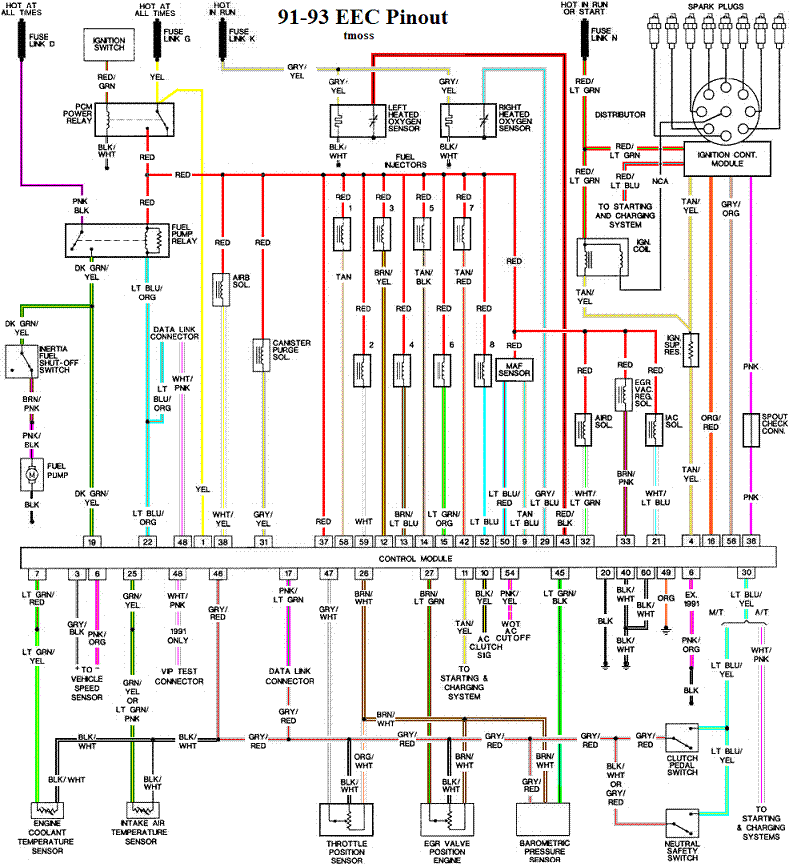
Complete computer, actuator & sensor wiring diagram for 91-93 Mass Air Mustangs.
91-93_5.0_EEC_Wiring_Diagram.gif


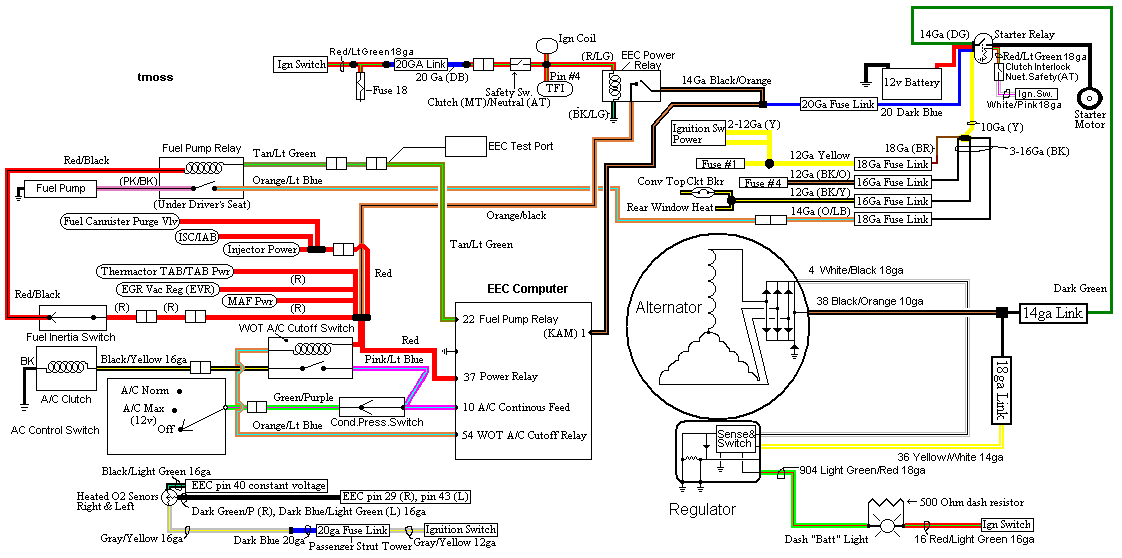
5.0 wiring diagram for Fuel Injectors, Sensors, and Actuators
fuel-alt-links-ign-ac.gif


Note that the ECC relay feeds the computer and injector power and power to the fuel pump relay. A faulty ECC relay or corrosion or damage to the ECC relay or socket can cause low voltage readings.

Check the fuse links for 12 volt (+/-.5 volt) output with the ignition switch in the Run position.

Fuse links at starter solenoid
64326.gif


See the following website for some help from Tmoss (diagram designer) & Stang&2Birds (website host) for help on 88-95 wiring; http://www.veryuseful.com/mustang/tech/engine/ Everyone should bookmark this site.[/b]

TFI module wiring for 94-95 Mustang GT
http://www.veryuseful.com/mustang/tech/engine/images/Mustang-94-95-IgnitionControlModule.gif

Complete computer, actuator & sensor wiring diagram for 94-95 Mustangs

Complete computer, actuator & sensor wiring diagram for 91-93 Mass Air Mustangs

Complete computer, actuator & sensor wiring diagram for 88-90 Mass Air Mustangs

5.0 wiring diagram for Fuel Injectors, Sensors, and Actuators

Main body EFI wiring harness

Ignition switch wiring

O2 sensor wiring harness

Vacuum diagram 89-93 Mustangs

HVAC vacuum diagram

TFI module differences & pin out

Fuse box layout

Mustang 5.0 Lights and Radio schematic, by TMoss:
http://www.veryuseful.com/mustang/tech/engine/images/mustangFoxLights-Radio_diag.gif

87-92 power window wiring

93 power window wiring

T5 Cutaway showing T5 internal parts

Visual comparison of the Ford Fuel Injectors, picture by TMoss:

Convertible top motor wiring http://www.veryuseful.com/mustang/tech/engine/images/mustang88VertTopMotorCkt.gif

Engine mounted fuel injector harness

Location of the TPS, IAB, and the 10-pin connectors on a 5.0, picture by TMoss:

Starter circuit

Alternator diagram for 94-95 Mustangs.
[/img]
 
Last edited:
Wow, lots of info to digest. This is a 5.0 swap into a 65 Mustang Convertible that has worked well for 8 years and now has this fuel pump issue.

I read an interesting comment on a thread, from an eBay vendor that repairs our computers suggesting plugging and unplugging all the connectors multiple times to improve any connection issues. Thinking that may be a possibility. Seems like folks have had different solutions to this issue which is about half the expected voltage arriving at the fuel pump. In my case, its 6.8 volts at the FP and FP relay.

To keep things interesting the USPS seems to have lost my computer in transit to the repair/test shop in New York. :)
 
Wow, lots of info to digest. This is a 5.0 swap into a 65 Mustang Convertible that has worked well for 8 years and now has this fuel pump issue.

I read an interesting comment on a thread, from an eBay vendor that repairs our computers suggesting plugging and unplugging all the connectors multiple times to improve any connection issues. Thinking that may be a possibility. Seems like folks have had different solutions to this issue which is about half the expected voltage arriving at the fuel pump. In my case, its 6.8 volts at the FP and FP relay.

To keep things interesting the USPS seems to have lost my computer in transit to the repair/test shop in New York. :)
Just called the local post office, who let me know that the computer was lost before it even got to the hub in Raleigh, NC and suggested that I initiate a claim. Any recommendations for where to buy a computer? None of the auto parts store show available inventory
 
That sucks Bukkoo! It can be tuff to find an off the shelf ready to go replacement these days. I just did a quick search and didn't find much. You might have to find a used unit on Ebay and just plan to have it rebuilt. Keep in mind that there is a difference in the computer for a car with an auto vs a manual transmission. The other option is to upgrade to a stand alone unit like a Mega Squirt or equivalent. Those can get expensive. You can also post an ad in the classified section of this site letting people know you are looking to buy a computer. I know several of the guys on here have a few of them.

 
A9L's are getting pricey these days. The reason you can't find any at parts stores and such is because there are no cores to be had. Nobody is sending them back, therefor nothing to rebuild.

Unfortuntely, you may have to shell out $250-350 for another ECU, or look into a standalone ecu system like a megaquirt