
Ok I have a 91 Gt mustang and have the smallest miss it's hardly noticeable but at low rpms around 1500- 1800 rpms.sometimes I can hear a poping sound from the intake when it does it.only thing is some days it does it some days it doesn't. When it does miss if you give it more gas it clears up and runs good . Any ideas maybe something I'm not thinking of, so far I replaced cap,button, wires,IAC cleaned, new 75mm mass air meterwhich was just an upgrade but to rule it out I will mention it.it has 70mm throttle body and spacer, bbk longtubes, E303 cam and a bunch of other bolt ons no heads or intake yet.anyway any ideas would be appreciated
You are using an out of date browser. It may not display this or other websites correctly.
You should upgrade or use an alternative browser.
You should upgrade or use an alternative browser.
91gt Small Miss At Low Rpms
- Thread starter bman91gt
- Start date

Check your plug wires. When in doubt replace them just be sure they are suspended and not rubbing on anything, thats where I would start.
Won't hurt to pull codes too.
Won't hurt to pull codes too.

Backfiring out the intake is either a valve stuck open or a lean mixture or spark plug wire(s) connected to the wrong cylinder(s). Check compression on all cylinders and then look for vacuum hoses loose, cracked, or misconnected. Check the line for the vapor recirculation system – it is easy to knock loose and not see it when you connect the air pump plumbing. If the vacuum line for the EGR valve and the air pump are cross connected, some very strange things can happen. Check the mass air flow electrical connection and see that it is tight, the same goes for the fuel injection wiring harness connectors up on top of the manifold near the firewall.
Sticking valves: If a intake valve is bent, has a bad spring or is misadjusted, the engine will sometimes backfire through the intake. Use a vacuum gauge connected to any convenient spot on the intake manifold. Run the engine at 1000 RPM & look for 18-21 inches of vacuum with a steady needle. A problem intake valve will make the vacuum gauge needle sweep 5-10 inches.
Lean fuel mixture breaks out into several sub categories:
A.). Vacuum leaks
B.) Air entering the intake without passing through the MAF on Mass Air cars (89-95 models).
C.) Failure of the MAF, BAP/MAP (Baro or Manifold Air Pressure, same sensor, different name), ACT (air charge temp), or ECT (engine coolant temp). These should set a code in the computer.
D.) O2 sensor problems: one or both O2 sensors with low output or bad O2 sensor heater ground. This should set codes 41/91. The O2 sensor heater ground is an Orange wire in the engine mounted fuel injector harness. Ground it to the back of the head or intake manifold.
E.) Leaking exhaust gases from EGR valve at WOT or EGR opening when it should not be open.
F.) Poor fuel delivery due to bad fuel pump, clogged filter or bad fuel pump wiring. Look for low pressure or fluctuating pressure. Standard injector pressure is 39 PSI at idle, with the vacuum line disconnected from the regulator and capped.
G.) Clogged fuel injectors.- see the cylinder balance test below
H.) Fuel injector wiring problems causing injector not to deliver rated flow (dirty or stuck shut injectors).
I.) Computer problems: (computer problems are not common like sensor problems)
J.). ROM has bad data in fuel or timing table. This should also set a code in the computer.
K.) Failure of one or more of the computer's driver transistors for the fuel injectors. No code set on this one. Use a noid test light to test the injector wiring & injector drivers,
L.) MAF calibration off or mismatched to injectors.
M.) ACT or ECT bad. Sometimes the sensors will be off calibration, but not bad enough to set a code. If they falsely read too high a temp, the engine will back off fuel delivery.
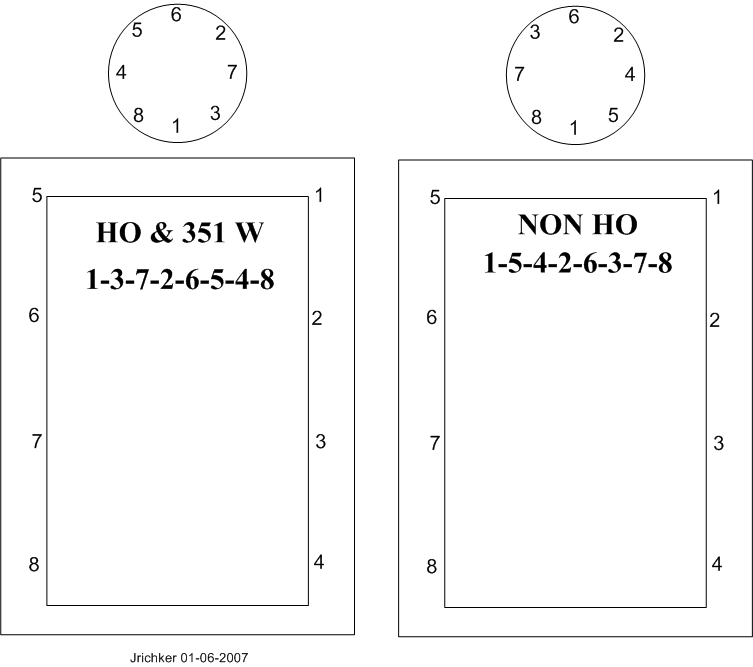
The HO firing order is 1-3-7-2-6-5-4-8.
Non HO firing order is 1-5-4-2-6-3-7-8
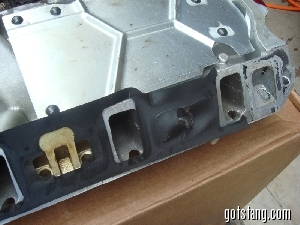
Vacuum leak due to slipped lower intake manifold gasket...
Ask Nicoleb3x3 about the intake gasket that slipped out of place and caused idle and vacuum leak problems that could not be seen or found by external examination. I don't care what you spray with, you won't find the leak when it is sucking air from the lifter valley. It simply isn't possible to spray anything in there with the lower manifold bolted in place.
Cylinder balance test:
See the procedure below to dump the codes and place the computer into diagnostic mode.
Warm the car's engine up to normal operating temperature. Use a jumper wire or paper clip to put the computer into test mode. Start the engine and let it go through the normal diagnostic tests, then quickly press the throttle to the floor. The engine RPM should exceed 2500 RPM's for a brief second. The engine RPM's will increase to about 1450-1600 RPM and hold steady. The engine will shut off power to each injector, one at a time. When it has sequenced through all 8 injectors, it will flash 9 for everything OK, or the number of the failing cylinder such as 2 for cylinder #2. Quickly pressing the throttle again up to 2500 RPM’s will cause the test to re-run with smaller qualifying figures. Do it a third time, and if the same cylinder shows up, the cylinder is weak and isn’t putting out power like it should. See the Chilton’s Shop manual for the complete test procedure
Dump the codes: Codes may be present even if the Check Engine Light (CEL) isn't on.
Dumping the computer diagnostic codes on 86-95 Mustangs
Revised 26-July-2011. Added need to make sure the clutch is pressed when dumping codes.
Codes may be present even if the check engine light hasn’t come on, so be sure to check for them.
Here's the way to dump the computer codes with only a jumper wire or paper clip and the check engine light, or test light or voltmeter. I’ve used it for years, and it works great. You watch the flashing test lamp or Check Engine Light and count the flashes.
Post the codes you get and I will post 86-93 model 5.0 Mustang specific code definitions and fixes. I do not have a complete listing for 94-95 model 5.0 Mustangs at this time.
Be sure to turn off the A/C, and put the transmission in neutral when dumping the codes. On a manual transmission car, be sure to press the clutch to the floor.
Fail to do this and you will generate a code 67 and not be able to dump the Engine Running codes.
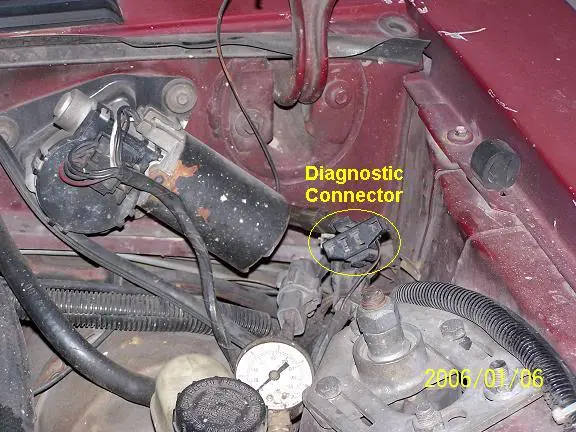
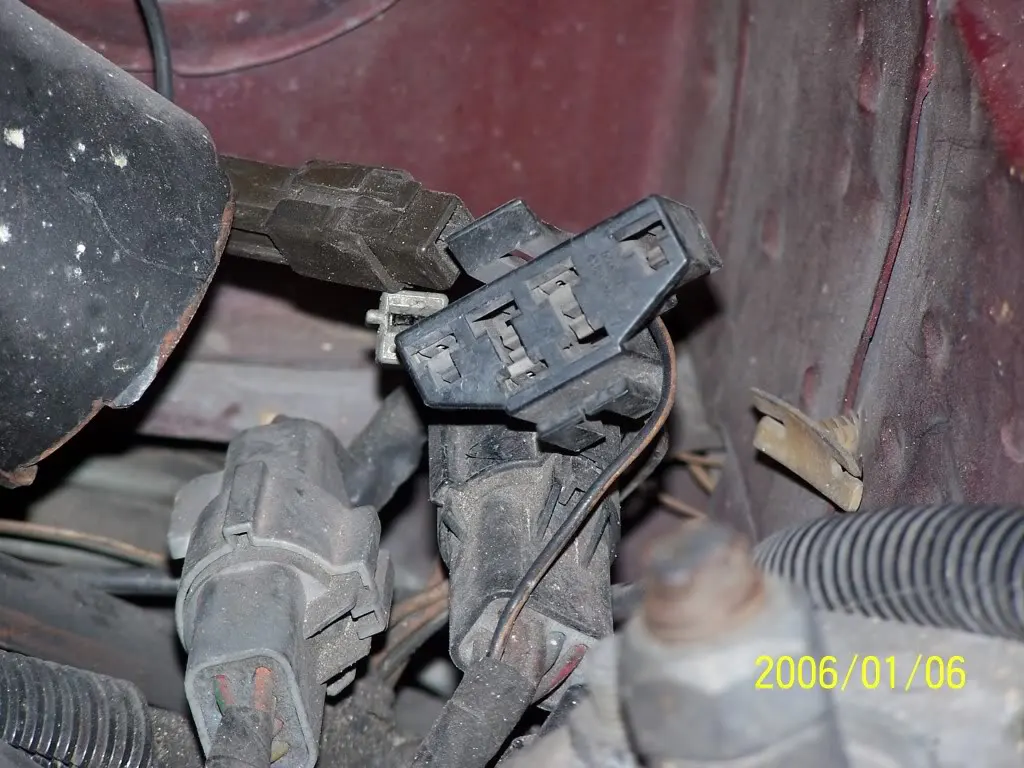
If your car is an 86-88 stang, you'll have to use the test lamp or voltmeter method. There is no functional check engine light on the 86-88's except possibly the Cali Mass Air cars.
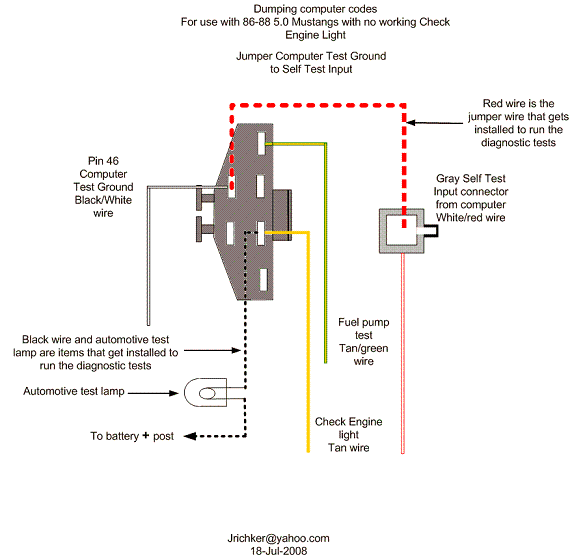
The STI has a gray connector shell and a white/red wire. It comes from the same bundle of wires as the self test connector.
89 through 95 cars have a working Check Engine light. Watch it instead of using a test lamp.
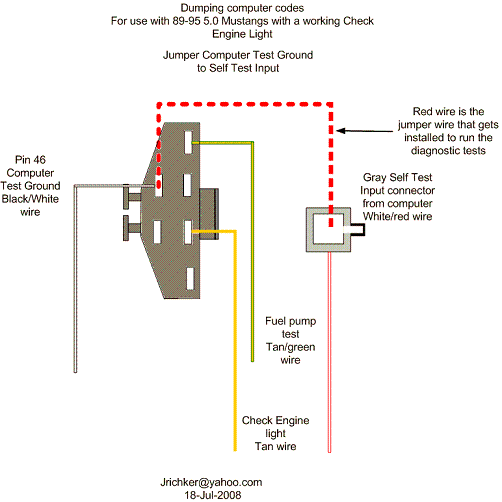
The STI has a gray connector shell and a white/red wire. It comes from the same bundle of wires as the self test connector.
WARNING!!! There is a single dark brown connector with a black/orange wire. It is the 12 volt power to the under the hood light. Do not jumper it to the computer test connector. If you do, you will damage the computer.
What to expect:
You should get a code 11 (two single flashes in succession). This says that the computer's internal workings are OK, and that the wiring to put the computer into diagnostic mode is good. No code 11 and you have some wiring problems. This is crucial: the same wire that provides the ground to dump the codes provides signal ground for the TPS, EGR, ACT and Map/Baro sensors. If it fails, you will have poor performance, economy and driveablity problems
Some codes have different answers if the engine is running from the answers that it has when the engine isn't running. It helps a lot to know if you had the engine running when you ran the test.
Dumping the Engine Running codes: The procedure is the same, you start the engine with the test jumper in place. Be sure the A/C is off, and clutch (if present) is pressed to the floor, and the transmission is in neutral. You'll get an 11, then a 4 and the engine will speed up to do the EGR test. After the engine speed decreases back to idle, it will dump the engine running codes.
Trouble codes are either 2 digit or 3 digit, there are no cars that use both 2 digit codes and 3 digit codes.
Alternate methods:
For those who are intimidated by all the wires & connections, see Actron® for what a typical hand scanner looks like. Normal retail price is about $30 or so at AutoZone or Wal-Mart.
Or for a nicer scanner see Equus - Digital Ford Code Reader (3145) – It has a 3 digit LCD display so that you don’t have to count flashes or beeps.. Cost is $30.
Sticking valves: If a intake valve is bent, has a bad spring or is misadjusted, the engine will sometimes backfire through the intake. Use a vacuum gauge connected to any convenient spot on the intake manifold. Run the engine at 1000 RPM & look for 18-21 inches of vacuum with a steady needle. A problem intake valve will make the vacuum gauge needle sweep 5-10 inches.
Lean fuel mixture breaks out into several sub categories:
A.). Vacuum leaks
B.) Air entering the intake without passing through the MAF on Mass Air cars (89-95 models).
C.) Failure of the MAF, BAP/MAP (Baro or Manifold Air Pressure, same sensor, different name), ACT (air charge temp), or ECT (engine coolant temp). These should set a code in the computer.
D.) O2 sensor problems: one or both O2 sensors with low output or bad O2 sensor heater ground. This should set codes 41/91. The O2 sensor heater ground is an Orange wire in the engine mounted fuel injector harness. Ground it to the back of the head or intake manifold.
E.) Leaking exhaust gases from EGR valve at WOT or EGR opening when it should not be open.
F.) Poor fuel delivery due to bad fuel pump, clogged filter or bad fuel pump wiring. Look for low pressure or fluctuating pressure. Standard injector pressure is 39 PSI at idle, with the vacuum line disconnected from the regulator and capped.
G.) Clogged fuel injectors.- see the cylinder balance test below
H.) Fuel injector wiring problems causing injector not to deliver rated flow (dirty or stuck shut injectors).
I.) Computer problems: (computer problems are not common like sensor problems)
J.). ROM has bad data in fuel or timing table. This should also set a code in the computer.
K.) Failure of one or more of the computer's driver transistors for the fuel injectors. No code set on this one. Use a noid test light to test the injector wiring & injector drivers,
L.) MAF calibration off or mismatched to injectors.
M.) ACT or ECT bad. Sometimes the sensors will be off calibration, but not bad enough to set a code. If they falsely read too high a temp, the engine will back off fuel delivery.
The HO firing order is 1-3-7-2-6-5-4-8.
Non HO firing order is 1-5-4-2-6-3-7-8
Vacuum leak due to slipped lower intake manifold gasket...
Ask Nicoleb3x3 about the intake gasket that slipped out of place and caused idle and vacuum leak problems that could not be seen or found by external examination. I don't care what you spray with, you won't find the leak when it is sucking air from the lifter valley. It simply isn't possible to spray anything in there with the lower manifold bolted in place.
Cylinder balance test:
See the procedure below to dump the codes and place the computer into diagnostic mode.
Warm the car's engine up to normal operating temperature. Use a jumper wire or paper clip to put the computer into test mode. Start the engine and let it go through the normal diagnostic tests, then quickly press the throttle to the floor. The engine RPM should exceed 2500 RPM's for a brief second. The engine RPM's will increase to about 1450-1600 RPM and hold steady. The engine will shut off power to each injector, one at a time. When it has sequenced through all 8 injectors, it will flash 9 for everything OK, or the number of the failing cylinder such as 2 for cylinder #2. Quickly pressing the throttle again up to 2500 RPM’s will cause the test to re-run with smaller qualifying figures. Do it a third time, and if the same cylinder shows up, the cylinder is weak and isn’t putting out power like it should. See the Chilton’s Shop manual for the complete test procedure
Dump the codes: Codes may be present even if the Check Engine Light (CEL) isn't on.
Dumping the computer diagnostic codes on 86-95 Mustangs
Revised 26-July-2011. Added need to make sure the clutch is pressed when dumping codes.
Codes may be present even if the check engine light hasn’t come on, so be sure to check for them.
Here's the way to dump the computer codes with only a jumper wire or paper clip and the check engine light, or test light or voltmeter. I’ve used it for years, and it works great. You watch the flashing test lamp or Check Engine Light and count the flashes.
Post the codes you get and I will post 86-93 model 5.0 Mustang specific code definitions and fixes. I do not have a complete listing for 94-95 model 5.0 Mustangs at this time.
Be sure to turn off the A/C, and put the transmission in neutral when dumping the codes. On a manual transmission car, be sure to press the clutch to the floor.
Fail to do this and you will generate a code 67 and not be able to dump the Engine Running codes.
If your car is an 86-88 stang, you'll have to use the test lamp or voltmeter method. There is no functional check engine light on the 86-88's except possibly the Cali Mass Air cars.
The STI has a gray connector shell and a white/red wire. It comes from the same bundle of wires as the self test connector.
89 through 95 cars have a working Check Engine light. Watch it instead of using a test lamp.
The STI has a gray connector shell and a white/red wire. It comes from the same bundle of wires as the self test connector.
WARNING!!! There is a single dark brown connector with a black/orange wire. It is the 12 volt power to the under the hood light. Do not jumper it to the computer test connector. If you do, you will damage the computer.
What to expect:
You should get a code 11 (two single flashes in succession). This says that the computer's internal workings are OK, and that the wiring to put the computer into diagnostic mode is good. No code 11 and you have some wiring problems. This is crucial: the same wire that provides the ground to dump the codes provides signal ground for the TPS, EGR, ACT and Map/Baro sensors. If it fails, you will have poor performance, economy and driveablity problems
Some codes have different answers if the engine is running from the answers that it has when the engine isn't running. It helps a lot to know if you had the engine running when you ran the test.
Dumping the Engine Running codes: The procedure is the same, you start the engine with the test jumper in place. Be sure the A/C is off, and clutch (if present) is pressed to the floor, and the transmission is in neutral. You'll get an 11, then a 4 and the engine will speed up to do the EGR test. After the engine speed decreases back to idle, it will dump the engine running codes.
Trouble codes are either 2 digit or 3 digit, there are no cars that use both 2 digit codes and 3 digit codes.
Alternate methods:
For those who are intimidated by all the wires & connections, see Actron® for what a typical hand scanner looks like. Normal retail price is about $30 or so at AutoZone or Wal-Mart.
Or for a nicer scanner see Equus - Digital Ford Code Reader (3145) – It has a 3 digit LCD display so that you don’t have to count flashes or beeps.. Cost is $30.

I got a sscanner like I said all systems pass engine off and running haven't tried the cylinder test. It has adjustable fuel pressure regUlster maybe I will try bumping up the fuel pressure a few pounds but it only does it at low rpms I just kinda figured a fuel pressure problem would be at higher engine Rpms but thanks for the advice I will try some things
Ok did some testing with the scanner when I got home engine off code was 11 system pass, engine running code was 92 the first time which is o2 sensor voltage high system rich by my book that came with scanner, ok the second time I did engine running codes I got 94 and 44, 44 being thermactor air system which is gone by previous owner and 94 being air diverter solenoid which I am assuming has something to do with the thermactor system also I did not get code 92 the second time I ran the test with engine running, i did cylinder balance test and got code 90 which is system pass, so those are the codes I got any thoughts, and I also set the fuel pressure to 40psi at idle with hose disconnected and plugged
Last edited:
Backfiring out the intake is either a valve stuck open or a lean mixture or spark plug wire(s) connected to the wrong cylinder(s). Check compression on all cylinders and then look for vacuum hoses loose, cracked, or misconnected. Check the line for the vapor recirculation system – it is easy to knock loose and not see it when you connect the air pump plumbing. If the vacuum line for the EGR valve and the air pump are cross connected, some very strange things can happen. Check the mass air flow electrical connection and see that it is tight, the same goes for the fuel injection wiring harness connectors up on top of the manifold near the firewall.
Sticking valves: If a intake valve is bent, has a bad spring or is misadjusted, the engine will sometimes backfire through the intake. Use a vacuum gauge connected to any convenient spot on the intake manifold. Run the engine at 1000 RPM & look for 18-21 inches of vacuum with a steady needle. A problem intake valve will make the vacuum gauge needle sweep 5-10 inches.
Lean fuel mixture breaks out into several sub categories:
A.). Vacuum leaks
B.) Air entering the intake without passing through the MAF on Mass Air cars (89-95 models).
C.) Failure of the MAF, BAP/MAP (Baro or Manifold Air Pressure, same sensor, different name), ACT (air charge temp), or ECT (engine coolant temp). These should set a code in the computer.
D.) O2 sensor problems: one or both O2 sensors with low output or bad O2 sensor heater ground. This should set codes 41/91. The O2 sensor heater ground is an Orange wire in the engine mounted fuel injector harness. Ground it to the back of the head or intake manifold.
E.) Leaking exhaust gases from EGR valve at WOT or EGR opening when it should not be open.
F.) Poor fuel delivery due to bad fuel pump, clogged filter or bad fuel pump wiring. Look for low pressure or fluctuating pressure. Standard injector pressure is 39 PSI at idle, with the vacuum line disconnected from the regulator and capped.
G.) Clogged fuel injectors.- see the cylinder balance test below
H.) Fuel injector wiring problems causing injector not to deliver rated flow (dirty or stuck shut injectors).
I.) Computer problems: (computer problems are not common like sensor problems)
J.). ROM has bad data in fuel or timing table. This should also set a code in the computer.
K.) Failure of one or more of the computer's driver transistors for the fuel injectors. No code set on this one. Use a noid test light to test the injector wiring & injector drivers,
L.) MAF calibration off or mismatched to injectors.
M.) ACT or ECT bad. Sometimes the sensors will be off calibration, but not bad enough to set a code. If they falsely read too high a temp, the engine will back off fuel delivery.
The HO firing order is 1-3-7-2-6-5-4-8.
Non HO firing order is 1-5-4-2-6-3-7-8
Vacuum leak due to slipped lower intake manifold gasket...
Ask Nicoleb3x3 about the intake gasket that slipped out of place and caused idle and vacuum leak problems that could not be seen or found by external examination. I don't care what you spray with, you won't find the leak when it is sucking air from the lifter valley. It simply isn't possible to spray anything in there with the lower manifold bolted in place.
Cylinder balance test:
See the procedure below to dump the codes and place the computer into diagnostic mode.
Warm the car's engine up to normal operating temperature. Use a jumper wire or paper clip to put the computer into test mode. Start the engine and let it go through the normal diagnostic tests, then quickly press the throttle to the floor. The engine RPM should exceed 2500 RPM's for a brief second. The engine RPM's will increase to about 1450-1600 RPM and hold steady. The engine will shut off power to each injector, one at a time. When it has sequenced through all 8 injectors, it will flash 9 for everything OK, or the number of the failing cylinder such as 2 for cylinder #2. Quickly pressing the throttle again up to 2500 RPM’s will cause the test to re-run with smaller qualifying figures. Do it a third time, and if the same cylinder shows up, the cylinder is weak and isn’t putting out power like it should. See the Chilton’s Shop manual for the complete test procedure
Dump the codes: Codes may be present even if the Check Engine Light (CEL) isn't on.
Dumping the computer diagnostic codes on 86-95 Mustangs
Revised 26-July-2011. Added need to make sure the clutch is pressed when dumping codes.
Codes may be present even if the check engine light hasn’t come on, so be sure to check for them.
Here's the way to dump the computer codes with only a jumper wire or paper clip and the check engine light, or test light or voltmeter. I’ve used it for years, and it works great. You watch the flashing test lamp or Check Engine Light and count the flashes.
Post the codes you get and I will post 86-93 model 5.0 Mustang specific code definitions and fixes. I do not have a complete listing for 94-95 model 5.0 Mustangs at this time.
Be sure to turn off the A/C, and put the transmission in neutral when dumping the codes. On a manual transmission car, be sure to press the clutch to the floor.
Fail to do this and you will generate a code 67 and not be able to dump the Engine Running codes.
If your car is an 86-88 stang, you'll have to use the test lamp or voltmeter method. There is no functional check engine light on the 86-88's except possibly the Cali Mass Air cars.
The STI has a gray connector shell and a white/red wire. It comes from the same bundle of wires as the self test connector.
89 through 95 cars have a working Check Engine light. Watch it instead of using a test lamp.
The STI has a gray connector shell and a white/red wire. It comes from the same bundle of wires as the self test connector.
WARNING!!! There is a single dark brown connector with a black/orange wire. It is the 12 volt power to the under the hood light. Do not jumper it to the computer test connector. If you do, you will damage the computer.
What to expect:
You should get a code 11 (two single flashes in succession). This says that the computer's internal workings are OK, and that the wiring to put the computer into diagnostic mode is good. No code 11 and you have some wiring problems. This is crucial: the same wire that provides the ground to dump the codes provides signal ground for the TPS, EGR, ACT and Map/Baro sensors. If it fails, you will have poor performance, economy and driveablity problems
Some codes have different answers if the engine is running from the answers that it has when the engine isn't running. It helps a lot to know if you had the engine running when you ran the test.
Dumping the Engine Running codes: The procedure is the same, you start the engine with the test jumper in place. Be sure the A/C is off, and clutch (if present) is pressed to the floor, and the transmission is in neutral. You'll get an 11, then a 4 and the engine will speed up to do the EGR test. After the engine speed decreases back to idle, it will dump the engine running codes.
Trouble codes are either 2 digit or 3 digit, there are no cars that use both 2 digit codes and 3 digit codes.
Alternate methods:
For those who are intimidated by all the wires & connections, see Actron® for what a typical hand scanner looks like. Normal retail price is about $30 or so at AutoZone or Wal-Mart.
Or for a nicer scanner see Equus - Digital Ford Code Reader (3145) – It has a 3 digit LCD display so that you don’t have to count flashes or beeps.. Cost is $30.
Backfiring out the intake is either a valve stuck open or a lean mixture or spark plug wire(s) connected to the wrong cylinder(s). Check compression on all cylinders and then look for vacuum hoses loose, cracked, or misconnected. Check the line for the vapor recirculation system – it is easy to knock loose and not see it when you connect the air pump plumbing. If the vacuum line for the EGR valve and the air pump are cross connected, some very strange things can happen. Check the mass air flow electrical connection and see that it is tight, the same goes for the fuel injection wiring harness connectors up on top of the manifold near the firewall.
Sticking valves: If a intake valve is bent, has a bad spring or is misadjusted, the engine will sometimes backfire through the intake. Use a vacuum gauge connected to any convenient spot on the intake manifold. Run the engine at 1000 RPM & look for 18-21 inches of vacuum with a steady needle. A problem intake valve will make the vacuum gauge needle sweep 5-10 inches.
Lean fuel mixture breaks out into several sub categories:
A.). Vacuum leaks
B.) Air entering the intake without passing through the MAF on Mass Air cars (89-95 models).
C.) Failure of the MAF, BAP/MAP (Baro or Manifold Air Pressure, same sensor, different name), ACT (air charge temp), or ECT (engine coolant temp). These should set a code in the computer.
D.) O2 sensor problems: one or both O2 sensors with low output or bad O2 sensor heater ground. This should set codes 41/91. The O2 sensor heater ground is an Orange wire in the engine mounted fuel injector harness. Ground it to the back of the head or intake manifold.
E.) Leaking exhaust gases from EGR valve at WOT or EGR opening when it should not be open.
F.) Poor fuel delivery due to bad fuel pump, clogged filter or bad fuel pump wiring. Look for low pressure or fluctuating pressure. Standard injector pressure is 39 PSI at idle, with the vacuum line disconnected from the regulator and capped.
G.) Clogged fuel injectors.- see the cylinder balance test below
H.) Fuel injector wiring problems causing injector not to deliver rated flow (dirty or stuck shut injectors).
I.) Computer problems: (computer problems are not common like sensor problems)
J.). ROM has bad data in fuel or timing table. This should also set a code in the computer.
K.) Failure of one or more of the computer's driver transistors for the fuel injectors. No code set on this one. Use a noid test light to test the injector wiring & injector drivers,
L.) MAF calibration off or mismatched to injectors.
M.) ACT or ECT bad. Sometimes the sensors will be off calibration, but not bad enough to set a code. If they falsely read too high a temp, the engine will back off fuel delivery.
The HO firing order is 1-3-7-2-6-5-4-8.
Non HO firing order is 1-5-4-2-6-3-7-8
Vacuum leak due to slipped lower intake manifold gasket...
Ask Nicoleb3x3 about the intake gasket that slipped out of place and caused idle and vacuum leak problems that could not be seen or found by external examination. I don't care what you spray with, you won't find the leak when it is sucking air from the lifter valley. It simply isn't possible to spray anything in there with the lower manifold bolted in place.
Cylinder balance test:
See the procedure below to dump the codes and place the computer into diagnostic mode.
Warm the car's engine up to normal operating temperature. Use a jumper wire or paper clip to put the computer into test mode. Start the engine and let it go through the normal diagnostic tests, then quickly press the throttle to the floor. The engine RPM should exceed 2500 RPM's for a brief second. The engine RPM's will increase to about 1450-1600 RPM and hold steady. The engine will shut off power to each injector, one at a time. When it has sequenced through all 8 injectors, it will flash 9 for everything OK, or the number of the failing cylinder such as 2 for cylinder #2. Quickly pressing the throttle again up to 2500 RPM’s will cause the test to re-run with smaller qualifying figures. Do it a third time, and if the same cylinder shows up, the cylinder is weak and isn’t putting out power like it should. See the Chilton’s Shop manual for the complete test procedure
Dump the codes: Codes may be present even if the Check Engine Light (CEL) isn't on.
Dumping the computer diagnostic codes on 86-95 Mustangs
Revised 26-July-2011. Added need to make sure the clutch is pressed when dumping codes.
Codes may be present even if the check engine light hasn’t come on, so be sure to check for them.
Here's the way to dump the computer codes with only a jumper wire or paper clip and the check engine light, or test light or voltmeter. I’ve used it for years, and it works great. You watch the flashing test lamp or Check Engine Light and count the flashes.
Post the codes you get and I will post 86-93 model 5.0 Mustang specific code definitions and fixes. I do not have a complete listing for 94-95 model 5.0 Mustangs at this time.
Be sure to turn off the A/C, and put the transmission in neutral when dumping the codes. On a manual transmission car, be sure to press the clutch to the floor.
Fail to do this and you will generate a code 67 and not be able to dump the Engine Running codes.
If your car is an 86-88 stang, you'll have to use the test lamp or voltmeter method. There is no functional check engine light on the 86-88's except possibly the Cali Mass Air cars.
The STI has a gray connector shell and a white/red wire. It comes from the same bundle of wires as the self test connector.
89 through 95 cars have a working Check Engine light. Watch it instead of using a test lamp.
The STI has a gray connector shell and a white/red wire. It comes from the same bundle of wires as the self test connector.
WARNING!!! There is a single dark brown connector with a black/orange wire. It is the 12 volt power to the under the hood light. Do not jumper it to the computer test connector. If you do, you will damage the computer.
What to expect:
You should get a code 11 (two single flashes in succession). This says that the computer's internal workings are OK, and that the wiring to put the computer into diagnostic mode is good. No code 11 and you have some wiring problems. This is crucial: the same wire that provides the ground to dump the codes provides signal ground for the TPS, EGR, ACT and Map/Baro sensors. If it fails, you will have poor performance, economy and driveablity problems
Some codes have different answers if the engine is running from the answers that it has when the engine isn't running. It helps a lot to know if you had the engine running when you ran the test.
Dumping the Engine Running codes: The procedure is the same, you start the engine with the test jumper in place. Be sure the A/C is off, and clutch (if present) is pressed to the floor, and the transmission is in neutral. You'll get an 11, then a 4 and the engine will speed up to do the EGR test. After the engine speed decreases back to idle, it will dump the engine running codes.
Trouble codes are either 2 digit or 3 digit, there are no cars that use both 2 digit codes and 3 digit codes.
Alternate methods:
For those who are intimidated by all the wires & connections, see Actron® for what a typical hand scanner looks like. Normal retail price is about $30 or so at AutoZone or Wal-Mart.
Or for a nicer scanner see Equus - Digital Ford Code Reader (3145) – It has a 3 digit LCD display so that you don’t have to count flashes or beeps.. Cost is $30.
Last edited:
After testing yesterday with scanner I got nothing that seemed to be a problem, installed a new fuel filter today will post again tomorrow but I doubt fuel filter was the problem I didn't see anything come out of it if it does it tomorrow maybe I will try ECT and ACT sensor other than that only thing left is compression check and vacum check
Backfiring out the intake is either a valve stuck open or a lean mixture or spark plug wire(s) connected to the wrong cylinder(s). Check compression on all cylinders and then look for vacuum hoses loose, cracked, or misconnected. Check the line for the vapor recirculation system – it is easy to knock loose and not see it when you connect the air pump plumbing. If the vacuum line for the EGR valve and the air pump are cross connected, some very strange things can happen. Check the mass air flow electrical connection and see that it is tight, the same goes for the fuel injection wiring harness connectors up on top of the manifold near the firewall.
Sticking valves: If a intake valve is bent, has a bad spring or is misadjusted, the engine will sometimes backfire through the intake. Use a vacuum gauge connected to any convenient spot on the intake manifold. Run the engine at 1000 RPM & look for 18-21 inches of vacuum with a steady needle. A problem intake valve will make the vacuum gauge needle sweep 5-10 inches.
Lean fuel mixture breaks out into several sub categories:
A.). Vacuum leaks
B.) Air entering the intake without passing through the MAF on Mass Air cars (89-95 models).
C.) Failure of the MAF, BAP/MAP (Baro or Manifold Air Pressure, same sensor, different name), ACT (air charge temp), or ECT (engine coolant temp). These should set a code in the computer.
D.) O2 sensor problems: one or both O2 sensors with low output or bad O2 sensor heater ground. This should set codes 41/91. The O2 sensor heater ground is an Orange wire in the engine mounted fuel injector harness. Ground it to the back of the head or intake manifold.
E.) Leaking exhaust gases from EGR valve at WOT or EGR opening when it should not be open.
F.) Poor fuel delivery due to bad fuel pump, clogged filter or bad fuel pump wiring. Look for low pressure or fluctuating pressure. Standard injector pressure is 39 PSI at idle, with the vacuum line disconnected from the regulator and capped.
G.) Clogged fuel injectors.- see the cylinder balance test below
H.) Fuel injector wiring problems causing injector not to deliver rated flow (dirty or stuck shut injectors).
I.) Computer problems: (computer problems are not common like sensor problems)
J.). ROM has bad data in fuel or timing table. This should also set a code in the computer.
K.) Failure of one or more of the computer's driver transistors for the fuel injectors. No code set on this one. Use a noid test light to test the injector wiring & injector drivers,
L.) MAF calibration off or mismatched to injectors.
M.) ACT or ECT bad. Sometimes the sensors will be off calibration, but not bad enough to set a code. If they falsely read too high a temp, the engine will back off fuel delivery.
The HO firing order is 1-3-7-2-6-5-4-8.
Non HO firing order is 1-5-4-2-6-3-7-8
Vacuum leak due to slipped lower intake manifold gasket...
Ask Nicoleb3x3 about the intake gasket that slipped out of place and caused idle and vacuum leak problems that could not be seen or found by external examination. I don't care what you spray with, you won't find the leak when it is sucking air from the lifter valley. It simply isn't possible to spray anything in there with the lower manifold bolted in place.
Cylinder balance test:
See the procedure below to dump the codes and place the computer into diagnostic mode.
Warm the car's engine up to normal operating temperature. Use a jumper wire or paper clip to put the computer into test mode. Start the engine and let it go through the normal diagnostic tests, then quickly press the throttle to the floor. The engine RPM should exceed 2500 RPM's for a brief second. The engine RPM's will increase to about 1450-1600 RPM and hold steady. The engine will shut off power to each injector, one at a time. When it has sequenced through all 8 injectors, it will flash 9 for everything OK, or the number of the failing cylinder such as 2 for cylinder #2. Quickly pressing the throttle again up to 2500 RPM’s will cause the test to re-run with smaller qualifying figures. Do it a third time, and if the same cylinder shows up, the cylinder is weak and isn’t putting out power like it should. See the Chilton’s Shop manual for the complete test procedure
Dump the codes: Codes may be present even if the Check Engine Light (CEL) isn't on.
Dumping the computer diagnostic codes on 86-95 Mustangs
Revised 26-July-2011. Added need to make sure the clutch is pressed when dumping codes.
Codes may be present even if the check engine light hasn’t come on, so be sure to check for them.
Here's the way to dump the computer codes with only a jumper wire or paper clip and the check engine light, or test light or voltmeter. I’ve used it for years, and it works great. You watch the flashing test lamp or Check Engine Light and count the flashes.
Post the codes you get and I will post 86-93 model 5.0 Mustang specific code definitions and fixes. I do not have a complete listing for 94-95 model 5.0 Mustangs at this time.
Be sure to turn off the A/C, and put the transmission in neutral when dumping the codes. On a manual transmission car, be sure to press the clutch to the floor.
Fail to do this and you will generate a code 67 and not be able to dump the Engine Running codes.
If your car is an 86-88 stang, you'll have to use the test lamp or voltmeter method. There is no functional check engine light on the 86-88's except possibly the Cali Mass Air cars.
The STI has a gray connector shell and a white/red wire. It comes from the same bundle of wires as the self test connector.
89 through 95 cars have a working Check Engine light. Watch it instead of using a test lamp.
The STI has a gray connector shell and a white/red wire. It comes from the same bundle of wires as the self test connector.
WARNING!!! There is a single dark brown connector with a black/orange wire. It is the 12 volt power to the under the hood light. Do not jumper it to the computer test connector. If you do, you will damage the computer.
What to expect:
You should get a code 11 (two single flashes in succession). This says that the computer's internal workings are OK, and that the wiring to put the computer into diagnostic mode is good. No code 11 and you have some wiring problems. This is crucial: the same wire that provides the ground to dump the codes provides signal ground for the TPS, EGR, ACT and Map/Baro sensors. If it fails, you will have poor performance, economy and driveablity problems
Some codes have different answers if the engine is running from the answers that it has when the engine isn't running. It helps a lot to know if you had the engine running when you ran the test.
Dumping the Engine Running codes: The procedure is the same, you start the engine with the test jumper in place. Be sure the A/C is off, and clutch (if present) is pressed to the floor, and the transmission is in neutral. You'll get an 11, then a 4 and the engine will speed up to do the EGR test. After the engine speed decreases back to idle, it will dump the engine running codes.
Trouble codes are either 2 digit or 3 digit, there are no cars that use both 2 digit codes and 3 digit codes.
Alternate methods:
For those who are intimidated by all the wires & connections, see Actron® for what a typical hand scanner looks like. Normal retail price is about $30 or so at AutoZone or Wal-Mart.
Or for a nicer scanner see Equus - Digital Ford Code Reader (3145) – It has a 3 digit LCD display so that you don’t have to count flashes or beeps.. Cost is $30.
Still have same problem
Is the miss consistent at idle? Put a vacuum gauge on it, it should be steady.
It may be a good idea to run a compression test too, I am still leaning towards a bad plug wire.
It may be a good idea to run a compression test too, I am still leaning towards a bad plug wire.
Is the miss consistent at idle? Put a vacuum gauge on it, it should be steady.
It may be a good idea to run a compression test too, I am still leaning towards a bad plug wire.
Not consistent it's intermittent comes and goes some days it runs good some days it misses sometimes it's cold when it misses sometimes it's hot when it misses i changed plugs,rotor button, cap even changed out distributor, new fuel filter new act, ect, sensor swapped wire sets but they werent new still the same problem, plugs look good when i looked at them haven't done compression or vacum test but no vacum leaks that I can find
What sort of vacuum reading did you get?
What do you have for a Mass Air Meter? Did the sensor come with the housing or did you use some sensor you already had the and the new housing?
What do you have for a Mass Air Meter? Did the sensor come with the housing or did you use some sensor you already had the and the new housing?
What sort of vacuum reading did you get?
What do you have for a Mass Air Meter? Did the sensor come with the housing or did you use some sensor you already had the and the new housing?
Haven't done vacum test I have to get guage and I haven't done compression check,it just kinda seems like a compression problem would be there all the time maybe I'm wrong, it's a pro m 75mm mass air meter ,
Similar threads
- Replies
- 16
- Views
- 1K
- Replies
- 57
- Views
- 14K
- Replies
- 41
- Views
- 7K
- Replies
- 13
- Views
- 6K
