Beehive valve springs (comp cams 26918) on AFR165's? Dave?

rockin_rick

Member
Oct 9, 2003
968
1
17
What's the deal with beehive valve springs for AFR165's? Dave is the only one I know running them, maybe he could fill me in. Dave, why did you choose these? I've checked into them a bit, and it seems that the main benefit is better surge control and higher rpm capability due to their light weight. Here's a web page - http://www.babcox.com/editorial/ar/eb50354.htm

Dave, I read your post before when you showed a pic of them compared to AFR 8015 springs. Not sure why you decided these were better. :shrug: What did you set the installed height to? What is the seat pressure of them installed? Did you stick with the .050 over length valves (part of the 8032 upgrade)? What is the seat pressure recommended on your cam sheet? Are you worried of spring breakage, then valve droppage, and ultimately piston hittage since these don't have a damper or second spring? I also seen a thread where Ed Curtis shuned them, and recommended a standard spring. Was this for a specific application, not necessarily comparable? I know that Dave did his homework before deciding on these!


Thanks,
Rick
 
Wow, lots of questions all at once :).

1. I got the new springs because I was trying to solve a problem with a very noisy lifter that seemed to be bleeding down under the heavy load from the upgraded AFR springs. Probably just a bad lifter, I replaced the lifters and the valvetrain is much quieter now.

2. I based my decision in large part on that article you posted, although I saw it in MM&FF. David Vizard has an excellent reputation. So does Ed, but I'm not trying to compare them.

3. I kept the installed height as it was with the AFR upgraded springs -- it was just a tad bit longer (like 0.1 inch or less, as I remember off the top of my head) than the "standard" installed height in the specs for the 26918 springs.

4. Seat pressure is stated at 130#. Mine is slightly under that do to the extra installed height.

5. I did keep the same valves.

6. Recommended seat pressure from FTI was 135#. That's for standard springs.

7. I'm not really worried about spring breakage -- a lot of people run these springs without incident, and Comp Cams makes very high quality stuff. The upgraded AFR springs were single w/damper, and I don't think the damper would have been enough to save the valve if a spring had broken. So I don't feel any more risky with this setup.

8. I'm not sure why Ed doesn't like the beehive springs. I think his cams are actually ground at Comp Cams :shrug: (I could be wrong, of course ... but my cam came in a Comp Cams box :)). I would like to hear why he doesn't like them.

I don't know that the springs helped performance one bit. I spent a lot of time trying to figure out what the hell was wrong with my engine, because it was low on horsepower and high on noise (right before I replaced the lifters, one of them was so noisy I was embarassed to be driving the car on the road... it sounded like the engine was going to fall apart at any second :rlaugh: ). Unless you're having problems you think new valve springs will solve, I wouldn't spend the money. Altogether I think I blew around 500 bucks. At least I know my valvetrain is a *lot* lighter now! Even the steel retainers for beehive springs weigh less than titanium retainers for standard springs.

Dave
 
Dave,

I’d caution you to recheck your seat pressure with those springs. 0.1” is a very large change in installed height for a valve spring. Given only that you could be .1” more IH than the CC springs are rated at you could have less than 100# of seat pressure. That pressure may work seem to work fine for your car but I would suspect that you are pushing the limits of what those springs are capable of at that pressure. Even with the “benefits” of the beehive springs you should not run pressures that low in a performance application.

I have used a couple different beehive springs including the 26918’s and found the limits to what I could do with them. I realize that you may not be intending to rev your motor past ~6k but at some point you may want to or do so by mistake. I caution you that by 6200 you will be floating valves with those springs and ~115# of seat pressure and that at some point you are risking failure. That’s not to say that yours will fail but IMO you could be taking the risk of failure.
 
The reason we don't recommend them was dead-on, if they break, you are gonna be pissed. Even though the flat damper isn't going to control a valve at high RPM, having it float is better then having it in your cylinder.

If there was a damper I would probably recommend them, if you were to use them with a titanium retainer you can say bye-bye to excess valvetrain weight.

I am in total agreement with TMC, you need to shim them up to there correct height, not install them at our height, VERY bad day may come about. Good luck
 
TMC said:
I’d caution you to recheck your seat pressure with those springs. 0.1” is a very large change in installed height for a valve spring.
See, that's what I get for pulling numbers out of my ass and spouting them :rlaugh:. I was off an order of magnitude (0.01" not 0.1").

Here goes, with real numbers this time :). I know we worked out the math, and we did take measurements, it's just been several months and my memory doesn't last past about a week with any accuracy :lol:.

AFR 8015: 140 lb @ 1.790, 350 lb/in rate, coil bind @ 1.100.

CC 26918: 135 lb @ 1.800, 313 lb/in rate, coil bind @ 1.085.

So by installing the 918's with shims for the 8015's, we increased the seat pressure to 138 lb, and gave up 0.01" in available height (but coil bind occurs later with the 918's, and my cam does not produce anywhere near enough lift to be a problem with either spring).

Dave
 
Also, I think the only way you're going to drop a valve all the way into the cylinder is if you break *everything* off, 'cause otherwise it'll only get so far before it catches up on something (worst case the valve guide). So you'll ram a piston into the valve and cause some damage. But the 8015 springs are single spring as well, and if the spring brakes you'll just have a damper, and you're still going to float the valves in that situation (since I think it's most likely to break at higher RPM). So it still rams a piston, you still do some damage, you still get to tear off the head and do some cleanup. :shrug: I don't see the big risk with 918's.

Dave
 
Dave - Thanks for ALL the answers! I figured that I'd just avoid the back and forth Q&A and get it all out in 1.

The reason I asked about spring breakage is that I had a 8015 break on me within 100 miles of new (see pic). I believe the damper did keep it off the piston. I had never taken it above 4000 rpms (tweecer limited) - I was still just breaking in the motor (new shortblock and everything) and it broke while cruising along at 30 mph and 1600 rpms - although, after looking at the datalog, it may have broke on a downshift (1600 - 2200 rpms). I limped it home, not knowing what was wrong. Neither the valve edge or piston shows signs of rubbage or scrapage. I may (unnecessarily or not) more concerned than average.

Tony at AFR quoted me an installed height of 1.820" for the 8015's on my 1402's. I wonder if yours are actually installed to 1.820" and reducing your seat pressure. I saw your new dyno graph, and you wondered about the warble at 5800+ ...wonder if your seat pressure is less than you thought? Maybe Jason could verify? AFR has given me kinda conflicting data- I was told 1.820" and 140#-145# seat, and their valve spring specifications on their website lists the 8015's as having 140# @ 1.790". BUT it doesn't say that they are installed at 1.790", that would make the 1.820" less than 140#. :shrug:

You didn't use a spring cup, just the shim that came with the heads for the 8015's? Is this acceptable? I was under the impression that the springs needed located. Am I wrong? :shrug:

Rick
 

Attachments

  • broken spring2.webp
    broken spring2.webp
    65.5 KB · Views: 594
rockin_rick said:
The reason I asked about spring breakage is that I had a 8015 break on me within 100 miles of new (see pic). I believe the damper did keep it off the piston.
Interesting, I haven't seen many broken valve springs. Not sure who AFR uses for springs, I assume they don't make their own. I know they did have an issue a while back with rocker studs breaking (I even had one of mine break, replaced them all with ARP after that). I guess it's always a risk. I know someone who had a brand new timing chain stretch and cause the entire top end of his motor to get fubared. It's rare, but **** does happen.

I may (unnecessarily or not) more concerned than average.
Sounds like you had reason to be concerned. I think that if it's the spring that breaks, odds are you are not going to drop the valve -- look at the picture you have, the spring was broken but still holding up the valve. I imagine it's that way with any spring, single, double, or dampened. What screws you over is when the tip of the valve stem breaks off and the whole valve drops in... BOOM.

Tony at AFR quoted me an installed height of 1.820" for the 8015's on my 1402's. I wonder if yours are actually installed to 1.820" and reducing your seat pressure.
If they're installed at 1.820, then their specs are wrong -- the spring is listed as 140# at 1.800. Assuming the worst, that could mean my 918's are only showing 124# on seat. I don't think that would be any problem given how superior the beehive springs are.

I saw your new dyno graph, and you wondered about the warble at 5800+ ...wonder if your seat pressure is less than you thought?
That's lack of timing. My whole curve on the top end was really wavy like that above 5000 RPM, like the ignition was cutting out -- we gave it a few degrees of timing and it smoothed right out (and went up 10 or 15). With the current timing table, my highest RPM setting for spark is 5000 RPM -- I think I could use another degree of timing above 5500, because it looks like it's still breaking up a little. I routinely rev to 6200 (500 rpm higher than in my dyno graph) without any float.

BUT it doesn't say that they are installed at 1.790", that would make the 1.820" less than 140#. :shrug:
I find that suspicious too. I bought the upgrade to get 140# springs since Ed was recommending 135#. Installing them at 1.820 would make them 129.5# on seat.

You didn't use a spring cup, just the shim that came with the heads for the 8015's? Is this acceptable? I was under the impression that the springs needed located. Am I wrong? :shrug:
Nope, you're absolutely right. I used a spring locator designed for the 918 springs (the AFR springs are kept located by the cup cut into the head itself). All together I needed new retainers, keepers, and the spring locators, in addition to the valve springs themselves.

Dave
 
HairyCanary said:
Sounds like you had reason to be concerned. I think that if it's the spring that breaks, odds are you are not going to drop the valve -- look at the picture you have, the spring was broken but still holding up the valve. I imagine it's that way with any spring, single, double, or dampened. What screws you over is when the tip of the valve stem breaks off and the whole valve drops in... BOOM.

Yeah, I know what you mean - valve in = really bad, valve up = not SO bad! :D . The damper did keep the valve up higher that the spring itself - IOW without the damper the spring would have let the valve sit lower and possibly hit the piston then. But I think more importantly, it didn't allow the spring to 'seperate' from itself and allowed it to coil into itself and stay there. I'm not sure if a damperless single coil would do this - it seems more likely that it would boing all goofy! I don't know :rolleyes:

Not trying to scare you or talk you out of these!

HairyCanary said:
Assuming the worst, that could mean my 918's are only showing 124# on seat. I don't think that would be any problem given how superior the beehive springs are.

This is really the only thing I don't really understand. Is it that your cam (and mine) needs 135 seat pressure and part of it is for the valvetrain and the other part is for the spring (spring control)? Then since the beehive is superior, the spring itself needs less of that equation, resulting in the cam actually needing less than specified (since it was assuming 'normal' springs)? Something like the spring needs 35# and the rest needs 100# adding up to 135#. While the beehive only needs 15# and the rest needs 100# totaling 115#. :shrug:

Is there a way to accurately determine this?
 
Rick, I like your posts because they make you (us) think. I like this kind of tech. stuff.

I personally don't put too much emphasis on seat pressure. It's my opinion that valve seat pressure is not overly important, and here is my (probably screwed up) logic:

At the seat, the valve is being held by the retainer/keeper, not the spring; and I believe this is evidenced by your situation, to an extent. Valve springs stop the retainer for traveling too far by using force. The force in this case is pressure. However, when they keep the valve from traveling too far, this is where the open pressure takes over, not the seat pressure.

Now, you are probably thinking, "Well, why do cam guys, or most people for that matter, talk about pressure on the seat?"

Well, again, I am no expert, but I believe that seat pressures and open pressures have a linear relationship (to an extent) especially when talking about hydraulic lifters. People recommend a very high seat pressure because this usually means that there will be more than an acceptible amount of open pressure.

Ed recommends 140# on the seat for Dave's cam, and lets pretend that he wants to see 340# open pressure. My theory is that Dave could run a spring with 115-120# of seat pressure and 340# of open pressure and have no problems assuming everything is installed correctly.

As I stated before, I'm learning along with everyone else, and these are my opinions. I could be 100% wrong and I'd love to hear why. I'm not saying I'm right until someone agrees with me :D.

Remember that everything I said above, I mean "in moderation". Of course you couldn't run 25# on the seat and assume everything is OK.

Just my screwed up way of thinking....:)

Joe
 
I think the reason Ed recommends a healthy spring is because the ramp rates are somewhat steep (for a hydraulic roller lifter street engine, that is). Not enough pressure and it doesn't follow the cam profile, and you get valve float. Not enough seat pressure and the valve will bounce (yes, steel has some elasticity and it will bounce). Any significant bouncing means a noticable loss of horsepower.

The beehive springs are trying to eliminate the harmonics as much as possible, to keep the valves under control. Ford was kind enough to make beehive-style springs standard issue for the modular engines.

Dave
 
Hey, Rick


if you are interested in purchasing a set of those springs i have a set........ I bought them and cannot use them. So i would like to sell them as i could use the money..........just seen the thread so i though i would add that .........they have about 10 miles on them....car wasn't getting adquate lift with the rocker and valve combination that was in the heads........


my e-mail is [email protected] if you are iterested


sorry for the hijacking
 
I decided to go for the beehives. Hey Dave, did you use the 774 retainers, 601 keepers, and 4705 locators?

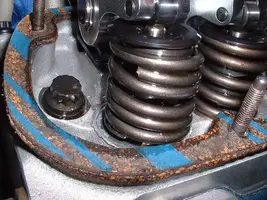
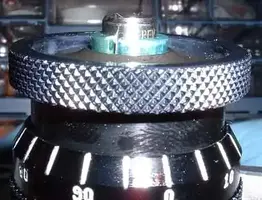
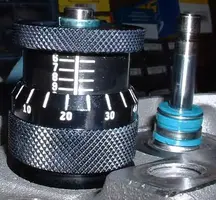
When I put the valve spring install height mic to measure the installed height of the AFR 8032 package and found it to be right near 1.820". I then put on the 774 retainers with the 601 keepers and didn't change the shim pack and got a measurement of 1.600". The retainer sits a lot lower than the AFR retainer does. (see the pic) Does your's sit that low?

I then removed all the shims except the 1 seat (.060") and remeasured. I came up with 1.772". If you look in the other pic, it says 1.922". You have to subtract .150" due to the (small) retainer sitting on the inner step of the mic. The reading is for the very top, not the step inside. I kept the (1) .060" shim as that is what Comp cams guessed the locator thickness to be (they wern't sure it being such a new part). Soooo, the highest that I could get these installed at would be 1.772.

What did you come up with?

Thanks,
Rick

BTW- Jason (not @ AFR), thanks for the offer, but I just buy new parts.
 

Attachments

  • 774 retainer sittin low.webp
    774 retainer sittin low.webp
    21.1 KB · Views: 397
  • 774 installed height.webp
    774 installed height.webp
    33.9 KB · Views: 429
I talked to someone at Comp today, he thinks that I have the wrong retainer. He said I sould run the 787 retainer. I'm not sure if he really knew, or if he just suggested the other retainer that they have for that spring. Someone else there first told me to use the 774... :doh: We'll see...

Rick
 
rockin_rick said:
I talked to someone at Comp today, he thinks that I have the wrong retainer. He said I sould run the 787 retainer.
That sounds more correct to me. I don't have the part numbers handy for what I got for retainers, keepers, and locators, but 787 rings a bell more than 774. I bought all the parts from different places, so it's unfortunately not as easy as calling up my Summit history :D. I just used the part numbers from the MM&FF article by David Vizard.

Dave