Big Problem with booster installation, search in forum doesnt helped me... PLZ help!

PM 65

Active Member
Nov 2, 2005
72
0
26
Austria (Europe)
Sorry for the next braking thread but I searched the Forum for answers but I cant find nothing which helps me with my problem…

I´ve installed a Brake Booster from NPD for MT / 4 Wheel Disc (it has original Front Disc and the rear end was changed to a 76 Lincoln with Discs on it). The Car is a Mustang Coupe 1965 with Holly Carburettor.
Before the Booster installation there was a dual MC and a combination valve build in. Maybe 65ShelbyClone knows more specific details about this MC, it`s his ex Car. I wasn’t sure if the old MC fits with the new booster so I buyed a complete Set with MC and Booster.
The Part Number from NPD is 2005-20FB, see Pic!
In the Description from the Booster stands that nothing else need to be changend… So I installed it and wired the brake lines to the new MC similar as to the old one and by the the test driving the big disappointning… It doesn’t brake any better than before… Damm!

So I checked everything which I could think of:

*The Vacuum pressure (which I take from the carburettor) is ok,
*The valve on the booster (on which the vacuum line is) is also ok
*I bleeded the brake lines, so no air is in the system
*With switched off engine I pumped the brake pedal 6-8times, keep the foot pressuring on it and then I started the Engine, the pedal moves ca. 1 Inch in, so I guess the booster Is working a little bit and its not broken…
*I measured if the booster keeps the vacuum when I turn off the engine… yes it does..
*The Booster makes no swooshing sound so i think the diaphragm is right.

When I drive and then push the brake pedal it goes the first inch like normal and then the brake pedal is hard as a rock! I can step on it like hell to get the car stopping. Just like it was before Booster installation. So it cant be that the booster is working correctly or at its full power!

The only thing I can think of what could be the failure is that the booster don’t get enough atmosphere pressure when I step on the brake pedal. The atmosphere pressure gets into the booster in the section where the push rod, which is connected to my brake pedal, goes in… Is that right?

Isnt there any kind of valve I can check? There must be something, otherwise the vacuum pressure couldn’t be on both sides of the diaphragm during normal driving.

Sorry for the long thread but I tried to give you all information which I had and I hope you can help me to solve the problem…

Big thanks Mario

PS: there is also one thing that bothers me...

Originally Posted by 66Runt
"""...1/2" more clearance and better access to fill the rear brake reservoir (closest to front of car). """

Is the rear brake reservoir that one which i marked on the other Picture? Or did i understand this wrong???
 
PM 65 said:
Sorry for the next braking thread but I searched the Forum for answers but I cant find nothing which helps me with my problem…

I´ve installed a Brake Booster from NPD for MT / 4 Wheel Disc (it has original Front Disc and the rear end was changed to a 76 Lincoln with Discs on it). The Car is a Mustang Coupe 1965 with Holly Carburettor.
Before the Booster installation there was a dual MC and a combination valve build in. Maybe 65ShelbyClone knows more specific details about this MC, it`s his ex Car. I wasn’t sure if the old MC fits with the new booster so I buyed a complete Set with MC and Booster.
The Part Number from NPD is 2005-20FB, see Pic!
In the Description from the Booster stands that nothing else need to be changend… So I installed it and wired the brake lines to the new MC similar as to the old one and by the the test driving the big disappointning… It doesn’t brake any better than before… Damm!

So I checked everything which I could think of:

*The Vacuum pressure (which I take from the carburettor) is ok,
*The valve on the booster (on which the vacuum line is) is also ok
*I bleeded the brake lines, so no air is in the system
*With switched off engine I pumped the brake pedal 6-8times, keep the foot pressuring on it and then I started the Engine, the pedal moves ca. 1 Inch in, so I guess the booster Is working a little bit and its not broken…
*I measured if the booster keeps the vacuum when I turn off the engine… yes it does..
*The Booster makes no swooshing sound so i think the diaphragm is right.

When I drive and then push the brake pedal it goes the first inch like normal and then the brake pedal is hard as a rock! I can step on it like hell to get the car stopping. Just like it was before Booster installation. So it cant be that the booster is working correctly or at its full power!

The only thing I can think of what could be the failure is that the booster don’t get enough atmosphere pressure when I step on the brake pedal. The atmosphere pressure gets into the booster in the section where the push rod, which is connected to my brake pedal, goes in… Is that right?

Isnt there any kind of valve I can check? There must be something, otherwise the vacuum pressure couldn’t be on both sides of the diaphragm during normal driving.

Sorry for the long thread but I tried to give you all information which I had and I hope you can help me to solve the problem…

Big thanks Mario

PS: there is also one thing that bothers me...

Originally Posted by 66Runt
"""...1/2" more clearance and better access to fill the rear brake reservoir (closest to front of car). """

Is the rear brake reservoir that one which i marked on the other Picture? Or did i understand this wrong???


It sounds like you have covered most of the power related issues.

Could it be possible that one of your calipers has "frozen" pistons? The stock front 4 piston discs brakes are know to cause the same symptoms as you describe. Also, what are the condition of the rubber hoses that go to the brakes. They can "ballon" when the pedal is pushed.

The front of the MC, where the arrow is pointing, is normally for the rear of the vehicle. A normal disc brake system will be connected to the largest reservoir.
 
some questions:

1. do the brakes behave well at higher rpms but become problematic at lower rpms?

2. what are the specs on your camshaft?

3. how much vacuum are you pulling from the booster at idle and at higher rpm?
 
First, thanks for the answers... I dont think that i have a frozen piston because when i push the car per hand (the engine off) and then a friend of mine step on the brake very hard and the car stops and he let go off the brake i can push it right away and there is no noise from the brake pads slipping on the disk. Or is this wrong to check the free movement of the brake piston?

I checked the ruber hoses and they seem all alright to me, even they werent alright the pedal should not be so hard when they would "ballon" (Thats a funny word!) :D

jerry S (and all others :) )

1) The brake is bad on all RPMS...

2)The camshaft is a Performance Automotive Warehouse... I dont know the specs from the camshaft because i wasnt the person who build it in. That was like i writted above: shelbyclone65.

3) The vacuume Pressure is about 5 psi or lb/sq in! low RPMS... at high RPMS i dont measuered it. The most vacuum pressure is produced at low RPMS (please correct me and explain when this is not right!!!) and so i tested on slowly driving at low RPM and fast driving with push on the clutch, waiting until the RPM is low and then tried to brake full power... always the same bad braking...

Im real tired today at working (now here it is 15:34 and i should be working :nono: ) because i was testing and thing the half night to solve the problem...

Thanks for your efforts, greetz Mario
 
PM 65 said:
1) The brake is bad on all RPMS...

2)The camshaft is a Performance Automotive Warehouse... I dont know the specs from the camshaft because i wasnt the person who build it in. That was like i writted above: shelbyclone65.

3) The vacuume Pressure is about 5 psi or lb/sq in! low RPMS... at high RPMS i dont measuered it. The most vacuum pressure is produced at low RPMS (please correct me and explain when this is not right!!!) and so i tested on slowly driving at low RPM and fast driving with push on the clutch, waiting until the RPM is low and then tried to brake full power... always the same bad braking...

Assuming you have correctly installed it, your booster is most likely defective. You are not pulling enough vaccum for the booster to properly work at lower rpms. You need at least 16 inches for the booster to properly work at any rpm level. If your brakes worked well at higher rpms but not at lower rpms, then it could have been that your cam is too big for the booster to work at lower rpms. But since it is not working at any rpm, then, assuming you have properly installed the booster, then the booster is defective. Before arriving at this determination, see how much vacuum you pull through the booster at higher rpms. Is the booster push rod adjustable?
 
Mmmh, it seems that i calculate with the wrong factor. I searched the net for a calculator witch calculates bar in inch and i hope this is the right one... Now the result is: 14,765 Inch (Zoll) of Hg (32 °F) and with the other one 14,08 Inch (Zoll) of Hg (60 °F)

But that seems not enough... Is my thinking about the biggest vacuum is at the lowest rpm right? At higher rpm the vacuum must be lower i think...

I dont think that the booster push rod is adjustable. I can take the booster a little bit up and down. I ad a picture which has the same princip as mine...

greetz and big thanks Mario
 
5 psi vacuum is not enough to power a booster. However, unless that is a very radical cam, I doubt you have only 5 psi. If you've got a fairly smooth idle and the idle speed is 900 rpm or less, I would expect you to have sufficient vacuum.

Where are you measuring vacuum? I would just pull the hose off the booster and measure it there. Where did you attach the vacuum hose on the engine? You should use the big port at the back of the intake, that opens directly into an intake runner.

Vacuum at anything above idle is pretty irrelevant to braking, unless you don't take your foot off the gas when braking.

The usual causes of a hard pedal are a master cylinder with a diameter that's too big in comparison to the volumes of the slave cylinders it's operating, or a pedal that's "too short," i.e., the pushrod that actuates the booster is located too close to the pedal/too far from the pivot.

My guess is you should change the pickup point for the booster hose. Or if you've really only got 5 psi vacuum at idle, you should forget about power brakes.
 
Let me note a few things. Your vaccuum needs to come from the intake manifold, not the carb. This is Part # 2A047-1A ($14.95 u.s.); it is hose and manifold kit. Also for 65-66 cars, they list a bellcrank boot assembly not included in kit, part# 2A021-1A ($34.95 u.s.). Finally, if that doesn't solve the problem ,they have a combination valve that is a proportioning valve and distribution block all in one that you could try. My best guess is that you need to take the vaccuum from the manifold with the correct size hose to get the proper operation of the booster.
 
You provided a ton of information with your question, this is very helpful. But I couldn't see wether or not you stated you replaced the brake pedal with a power brake pedal or still running the manual pedal. This would make a difference, although may not be the only problem here. As others have pointed out, your vaccum is very low and needs to be corrected first.
 
PM 65 said:
Mmmh, it seems that i calculate with the wrong factor. I searched the net for a calculator witch calculates bar in inch and i hope this is the right one... Now the result is: 14,765 Inch (Zoll) of Hg (32 °F) and with the other one 14,08 Inch (Zoll) of Hg (60 °F)

But that seems not enough... Is my thinking about the biggest vacuum is at the lowest rpm right? At higher rpm the vacuum must be lower i think...

I dont think that the booster push rod is adjustable. I can take the booster a little bit up and down. I ad a picture which has the same princip as mine...

greetz and big thanks Mario

14-15 inches of vac is not enough for the powre brakes to work well. This measurement is the amount of vaccum the booster is pulling, correct? FYI, your car will pull more vacuum at higher rpm than at lower rpms.

Replacing the pedal is necessary.

When I did my power conversion, I added an electric vacuum pump because my cam is so big and the pump was supposed to pull 21 inches of vacuum when vacuum to the booster dropped below that level. The electric pump was defective and I never got more than 14 inches. As a result, the pedal was hard as hell and my brakes were much worse after the conversion than when I had only manual brakes. I disconnnected the pump and ran the line from the manifold to the booster and it solved my problems (at least at higher rpms. Still bad brakes at low rpms).

test the amount of vac from the manifold at idle and high rpm and compare it to the amount of vac. from the booster at idle and high rpm. If your booster never pulls more than 14 inches, then you have a leak in the booster and it is defective.
 
please verify your calculation of vacuum, if it is in fact 14 inches of mercury that is quite low.
also check the plastic elbow connection where the hose connects at the booster, most often that elbow is a one way check valve. maybe the vacuum is not staying inside the booster,
I also noticed you are in Austria... at what elevation, because the higher you are above sea level, the less vacuum your engine will create. which will be compounded by an aggressive camshaft
Gord:canada:
 
180 Out (@All) what do you mean by that is a radical cam? Do you have Specs for this cam or know where to find it? Do you mean by radical that the valve opening and closing time is very short and the time when the valve is “full” open is long?
The Idle Speed is fairly and as you say around 900 RMP`s.

I will change the vacuum hose from the carburettor to the manifold with the Sets that mustangdave has mentioned.
But I have to both Sets a question to the hose and manifold kit:
I´ve a Weiand single plane high rise manifold and i`m not sure that the fitting on the hose (from the set) will fit into the hole and the thread of screw. (Yes, I know that’s the problem when you buy a already modificated car. :) ) The problem is, its nearly impossible to get correct fittings in Austria! I needed one for the master cylinder and I asked in 12!!! shops which sells car / brake parts and no one (I swear its true!!!) had that fitting which I needed! With a large amount of luck I found a guy which also have an old American Oldtimer and he selled me the fitting! So, is the threaded hole in the manifolds a standard or could it be that’s is differently on others or the original Ford Mustang manifold? The fitting and hose on the picture in the cataloc looks so small… The diameter of the hole in the manifold is about 0,47 – 0,55 Inch…

Question to the second Set: I looked on the pic in the cataloc and I don’t understand for what I need the BOOT ASSY, PB Bellcrank… where to build that on and what is the function of this component?

I will buy these two sets and I will also buy a new vacuum pressure measure unit (the one I measured with is old and now I don’t trust that thing any more!) and then I will check the pressure and the braking again.
This will take some time because yesterday I took the car to the paint shop and the painting will take two / three weeks… But it`s okay when I order the parts from NPD it will take one or two weeks until they arrive in Austria…

@jcode68/jerry s (@ALL) Why is it so important to change the brake pedal to a power brake pedal? I didn’t change the manual brake pedal. In the part describtion from the brake booster set they writted: no pedal modification necessary. Isn`t this correct? I searched in the cataloc for the power brake pedal and I only found a Support , Brake Pedal… But I don’t think this is the right part… (please see second Pic) Does the power brake pedal has a different design than the manual brake pedal? What is the difference? When there is a little chance that I need the part I will buy it anyway because the shipping cost and the toll for each order are so high that I can always calculate the cataloc prices with the factor 2,2!!! In Austrian / Germany Online Shops you can order too but they have prices … *CRAZY*

gtss (@ALL) I checked the plastic elbow connection and it’s a one way valve. The Booster keeps its vacuum. So I think the part is ok…
At home I`m about 0.248548 Miles about sea level… Do you think that’s so significant?

Reading all your answers and suggestions I really think (hope) when I take the hose from the manifold to the booster it will work correctly and I have enough vacuum pressure!

So thank you all for your old and new coming answers, i`m really glad I found a forum with so much helpfully and knowledge people.

friendly greetz Mario

PS: i hope you can read the text fluently because i`m working with 2 dictionary`s to make and read the texts!
 
I think your pedal is good; that kit is made to use the original pedal. The fitting might be different. You will have to order it and see. I don't know the purpose of the bellcrank part either. You should call N.P.D. at one of their toll free phone numbers and ask them about these two parts. Your english is pretty good considering you have to use two dictionaries. I think the vaccuum kit will be a good start to solving your problem.
 
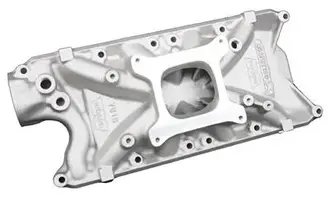
Before swapping out pedals or doing anything else, switch the vacuum hose from the carburetor to the intake manifold. Unless you're using "ported" vacuum from the carb this probably won't make any difference, but it's worth a try. Here's a photo of a single plane Weiand intake:

wnd-7515.webp


Look at the upper right hand bolt hole in the carburetor mounting flange. If your intake manifold looks like this one, the vacuum port that you want to use is just to the right of that bolt hole in this photo.

These ports are called "pipe fittings," or "NPT threaded." What that means is that they're slightly conical, not cylindrical like a regular bolt. The conical shape makes a fitting fit tighter as it's screwed in. My guess is you need a 3/8 NPT nipple fitting. In the U.S. we can walk into any hardware store and buy one, because these brass NPT fittings are commonly used for home heating gas lines.

As far as what is a radical cam, the relevant measurements of a cam are how long does each valve stay open, expressed in crankshaft degrees; the maximum lift of each valve; and the lobe separation angle ("LSA") between the two valves. LSA is also sometimes referred to as lobe displacement angle ('LDA"). The LSA is how many degrees of camshaft rotation separate the maximum lift of the exhaust valve and the maximum lift of the intake valve.

The duration and lift specs for a "radical" cam depend on how big the engine is. For a 302, I would say that radical begins at about 230/230 degrees at 0.050" lift, and at about 0.500" maximum lift. For duration and lift, bigger numbers are more "radical." A "radical" LSA begins at about 110 degrees, with smaller numbers being more "radical."

LSA has the most effect on vacuum. The lower the number, the more overlap between exhaust and intake. It's the piston going down in the hole on the intake stroke that makes the vacuum. With high overlap, the exhaust valve is still open as the piston is going down, so some of that vacuum is applied to the exhaust port, leaving less to act the intake side.

The fact that you have a single plane intake suggests that your cam is on the radical side. However, it might be a mismatch too, since you say it idles steadily at 900 rpm.

As far as the brake pedal, it's my understanding that the '65-'66 had no "power brake pedal." That is, the factory used the same pedal for both assisted and unassisted systems. I could be wrong about this. But even if there were two different pedals for the two different systems, it would be more logical for the manual one to have the higher mount for the actuator shaft, since the higher the mount the greater the leverage. You would want to decrease the leverage when switching to power, to increase the pedal effort, so you wouldn't go flying through the windshield every time you touched the brake pedal. Since your problem is too much pedal effort, you would be going in the wrong direction to move the attachment point for the actuator shaft further away from the pivot, as I would expect a "power" pedal to do.

Master Power Brakes' web site has a lot of good brake troubleshooting advice. Here's a link to a FAQ page about boosters: http://www.mpbrakes.com/mpfaqboost.htm . Here's what MPB says about vacuum:

"How much vacuum is needed to operate a booster properly?

"For a power booster to function properly you will need at least 18" of vacuum at idle in park. Anything lower will give you a hard pedal.

"What happens if the vacuum is too low?

"If your vacuum level is too low you will experience a hard pedal and it will feel like the vehicle won't stop."

I'm really worried that, if your cam matches your intake, that you have too little vacuum to operate the booster. But if that is the case, then MPB has "the fix": an electric vacuum pump that they claim will deliver 21" vacuum. There's a link to this item from the booster FAQ page.
 

Attachments

  • wnd-7515.webp
    wnd-7515.webp
    7.5 KB · Views: 179
Today i was working outside near the paintshop where my car is located at this time and i visit them shortly to look at my manifold and make some pictures. Looks pretty the same as the picture from 180 Out! Very good… I will write NPD and order the needed parts. Send them some pics from the manifold, and ask him for the right fittings… So I will be sure that the right parts arrive.

Can anybody explain for what the bellcrank part is?

Thanks for the explanation from the radical cam. It`s very good to understand! The Link to the FAQ page is also very helpful and I already put it to my favorites in my webbrowser.

So now is time to wait until the parts arrive and my stang is back from the paintshop. Than I will install the new parts and we will see the result. Also I will post the result in this thread!

Thanks to all :hail2: !

Greetz Mario