

You are using an out of date browser. It may not display this or other websites correctly.
You should upgrade or use an alternative browser.
You should upgrade or use an alternative browser.
Can I use a UV kit to find out where all my coolant is going???
- Thread starter jaymac
- Start date

Michael Yount
Mustang Master
Standard pump should work just fine jaymac...even in AZ...it's the heat rejection side (rad/fan) that really gets worked over in places like Phoenix in August with a/c on high (might as well not even have other fan speeds out there).
Michael Yount
Mustang Master
...and JT's right - I'm more confined; but I've worked on water pumps/front cover/cam degreeing with Stangs before, and I always like having more room. ESPECIALLY if a slipped wrench or dropped tool or part can damage a radiator core/fin tube.....
Wihile we're talking about it, is it possible to have TOO good of a cooling system?
My buddy (obsol3te) has a 331 pushing only about 318 hp off the bottle, and he runs a stock water pump, elec. fan, and Griffin two row (I believe) alum. rad. w/ 180* t-stat.
He says now in this weather, his car will only reach 135-140* for a LONG time, until he jumps on it HARD, then the temp gauge will rise and the car will run smoother and nicer. Until then his idle is horrible (nasty cam as well), the car will even stall occasionally whle warming up.
He says he's not had to use his fan in more than 2 weeks. Yes, this is a stock gauge, but even when we've done the
meat thermometer" test, it has been pretty accurate, about 145*.
My guess for him was a faulty T-stat.
Any other ideas?
My buddy (obsol3te) has a 331 pushing only about 318 hp off the bottle, and he runs a stock water pump, elec. fan, and Griffin two row (I believe) alum. rad. w/ 180* t-stat.
He says now in this weather, his car will only reach 135-140* for a LONG time, until he jumps on it HARD, then the temp gauge will rise and the car will run smoother and nicer. Until then his idle is horrible (nasty cam as well), the car will even stall occasionally whle warming up.
He says he's not had to use his fan in more than 2 weeks. Yes, this is a stock gauge, but even when we've done the
meat thermometer" test, it has been pretty accurate, about 145*.
My guess for him was a faulty T-stat.
Any other ideas?
Michael Yount
Mustang Master
Yeah - your buddy's t'stat isn't working correctly -- it's sticking open. My guess is your guess. It's not possible to have too good of a cooling system. The t'stat takes care of it. Imagine those cars WAY up north (Canada, Scandivavia, Alaska) dealing with ambients of 10-20-30 below -- they have the same size rads as everyone else - their t'stats just don't spend too much time open.
cool, thanks for your second vote! I'll spread the good word!
I also asked him if it was a Mr. Gasket, and he said "no", just the Pep Boys Cheapie....
"real good, drop 7 grand on a motor and throw a $2 T-stat in it....there's your problem!"
Thanks again~
I also asked him if it was a Mr. Gasket, and he said "no", just the Pep Boys Cheapie....
"real good, drop 7 grand on a motor and throw a $2 T-stat in it....there's your problem!"
Thanks again~
Well, we swapped out his T-stat yesterday...turns out the kid put a 160* in there the first time (supposedly under the impression it was a 180*...), so there's half his problem... However, we put both the t stats in boiling water, and they both opened exactly when they're supposed to; 160 and 180, so the 160 didn't seem defective...
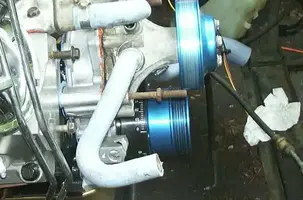
However, it still took his car upwards of 25 minutes to warm up @ idle to reach the 2nd thin line of the stock gauge and settle into a quasi-decent idle. I think his tune is WAY off. The problem is/was is that the shop could never actually set initial timing, as the "pointer" that came with the new (ATI?) damper does not actaully have "point", but rather a round-shaped protrusion - has anyone ever seen this? I'll try to get him to post a pic if he can.
So they don't even know what his initial timing is, Iwhich I would think could explain some of his warm-up problems.
However, after we let it warm up for 30 min., we took it for a drive and it went right to the half-way point on the gauge and stayed there with no problems, hich it wouldn't do before. So, the 180* helped somewhat, and he said it was driving alot smoother. Now we just have to figure out why it takes so long to generate heat and find a liveable idle and temp...
Any ideas?
However, it still took his car upwards of 25 minutes to warm up @ idle to reach the 2nd thin line of the stock gauge and settle into a quasi-decent idle. I think his tune is WAY off. The problem is/was is that the shop could never actually set initial timing, as the "pointer" that came with the new (ATI?) damper does not actaully have "point", but rather a round-shaped protrusion - has anyone ever seen this? I'll try to get him to post a pic if he can.
So they don't even know what his initial timing is, Iwhich I would think could explain some of his warm-up problems.
However, after we let it warm up for 30 min., we took it for a drive and it went right to the half-way point on the gauge and stayed there with no problems, hich it wouldn't do before. So, the 180* helped somewhat, and he said it was driving alot smoother. Now we just have to figure out why it takes so long to generate heat and find a liveable idle and temp...
Any ideas?
Michael Yount
Mustang Master
A 'real' temperature gauge/sender will help immensely in diagnosing cooling system issues; use a positive stop to find actual #1 tdc -- and then fabricate a pointer that's accurate.
Michael Yount said:A 'real' temperature gauge/sender will help immensely in diagnosing cooling system issues;
 That's EXACTLY what I told him would be the first piece of advice he would get from Stangnet regarding his cooling system, which I agree with...
Good ideaMichael Yount said:use a positive stop to find actual #1 tdc -- and then fabricate a pointer that's accurate.
 what would you recommend to use to fabricate a pointer? Attach something to the original? JB Weld-type approach or something a little more involved/(dare I say better)?
Again, thanks for your help

Michael Yount
Mustang Master
The whole thing about the word 'fabricate' is you two have to figure out how you want to do it. Anything that 'points' at the tdc mark on the balancer when #1 is actually at tdc will work. Beyond that it's up to you guys.
Here's how you can fabricate a positive stop and use it to find tdc:
Obtain an old spark plug for the Ford engine – most of us have at least one laying around. Put it in your vice, and with a tool of destruction you deem appropriate – cut off the ground tip and bust up the ceramic around the center electrode. Keep pounding to get the ceramic and center electrode removed so you’ve got a good ¾” or so of hollow space inside what used to be the ‘business’ end of the spark plug. If you happen to break the ceramic on the other end of the spark plug, don’t worry about it. Once you’ve got a nice hollow space in the tip of the plug, take a 5/16” tap, and cut threads inside that end of the plug. I found that diameter to go right in without any drilling required. Once you’ve cut threads, screw in a 5/16" bolt about 1.5” to 2” long. Then take your hack saw and cut the head off the bolt. Wouldn’t hurt to take your file/grinder and dress up the freshly cut surface so no sharp edges or shrapnel enter the combustion chamber. Also clean up the threads on the plug so that it easily screws into and out of the plug hole.
Determining TDC – remove the passenger side valve cover. Remove rockers from the intake and exhaust valves on the #1 cylinder. Rotate the engine (socket on crank bolt) until the #1 piston is down the cylinder on the intake stroke. Unscrew the spark plug in that cylinder, and replace it with the positive stop you just made. Only screw the positive stop in hand tight. Install your cam degree wheel and pointer (no easy task in some cases as harmonic balancer and other accessories will have to be removed). You may want to remove all spark plugs at this point because it will make it easier to smoothly turn the engine over in small increments. GENTLY rotate the engine clockwise until the piston comes to rest against the stop. Note the degree wheel reading. GENTLY rotate the engine in the opposite direction until the piston comes to rest against the stop. Note the degree wheel reading. TDC is exactly half way between these readings. Calculate where that position is on the degree wheel, remove the piston stop from the cylinder, and rotate the engine to TDC as you calculated it.
Once you've done that, reinstall your balancer, and fabricate your pointer so that it's pointing at tdc on the balancer markings. Then set your timing.
Here's how you can fabricate a positive stop and use it to find tdc:
Obtain an old spark plug for the Ford engine – most of us have at least one laying around. Put it in your vice, and with a tool of destruction you deem appropriate – cut off the ground tip and bust up the ceramic around the center electrode. Keep pounding to get the ceramic and center electrode removed so you’ve got a good ¾” or so of hollow space inside what used to be the ‘business’ end of the spark plug. If you happen to break the ceramic on the other end of the spark plug, don’t worry about it. Once you’ve got a nice hollow space in the tip of the plug, take a 5/16” tap, and cut threads inside that end of the plug. I found that diameter to go right in without any drilling required. Once you’ve cut threads, screw in a 5/16" bolt about 1.5” to 2” long. Then take your hack saw and cut the head off the bolt. Wouldn’t hurt to take your file/grinder and dress up the freshly cut surface so no sharp edges or shrapnel enter the combustion chamber. Also clean up the threads on the plug so that it easily screws into and out of the plug hole.
Determining TDC – remove the passenger side valve cover. Remove rockers from the intake and exhaust valves on the #1 cylinder. Rotate the engine (socket on crank bolt) until the #1 piston is down the cylinder on the intake stroke. Unscrew the spark plug in that cylinder, and replace it with the positive stop you just made. Only screw the positive stop in hand tight. Install your cam degree wheel and pointer (no easy task in some cases as harmonic balancer and other accessories will have to be removed). You may want to remove all spark plugs at this point because it will make it easier to smoothly turn the engine over in small increments. GENTLY rotate the engine clockwise until the piston comes to rest against the stop. Note the degree wheel reading. GENTLY rotate the engine in the opposite direction until the piston comes to rest against the stop. Note the degree wheel reading. TDC is exactly half way between these readings. Calculate where that position is on the degree wheel, remove the piston stop from the cylinder, and rotate the engine to TDC as you calculated it.
Once you've done that, reinstall your balancer, and fabricate your pointer so that it's pointing at tdc on the balancer markings. Then set your timing.
Michael Yount
Mustang Master
Michael Yount said:The whole thing about the word 'fabricate' is you two have to figure out how you want to do it.
 Yeah, I figured as much......
Thanks for all your helpful info, though!!!
For a real quick and crappy pointer, you can get it to TDC and use muffler strap (it being very mallable makes it easy to shape). If wanting to use this again, recreate it in something stronger (that wont deform). Or just make something from cardboard and then recreate it in alum, etc.
Or just buy a pointer.
Good luck.
Or just buy a pointer.
Good luck.
I asked him a little more about the pointer, and he said it appeared to be part of the timing cover, not bolted on. He also said he thought it might be an older-style cover, as he had to buy a mech. fuel pump block off plate seperately... whether that means anything or not....
So, I don't know if he could bolt one up even if he wanted to...
So, I don't know if he could bolt one up even if he wanted to...
Similar threads
- Replies
- 5
- Views
- 1K

- Replies
- 9
- Views
- 794
- Replies
- 26
- Views
- 3K
- Replies
- 21
- Views
- 2K

