EGR question, ive searched..nothing.

I found alot of info. on the EGR valve and just about everything to
do with it. My question is simple. Will the valve even work if there
is no EVR or vacuum connection hooked up to it? Im pretty sure
it won't but just being sure. The electrical connection is still
hooked up to it. Im wanting to block the port of in the lower manifolds
to keep heat out of my manifold, so i was just going to take it
off and block the ports on the TB spacer. Any help is greatly appreciated.
 
Some basic theory to clarify how things work is in order…

The EGR shuts off at Wide Open Throttle (WOT), so it has minimal effect on performance. The addition of exhaust gas drops combustion temperature, increases gas mileage and reduces the tendency of the engine to ping. It can also reduce HC emissions by reducing fuel consumption.

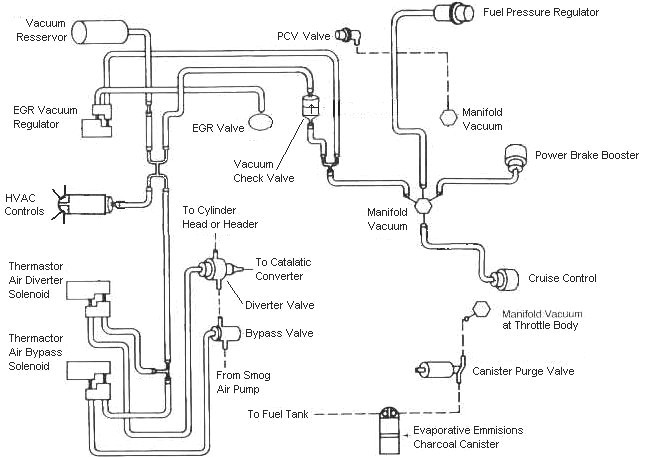
The EGR system has a vacuum source (line from the intake manifold) that goes to the EVR, computer operated electronic vacuum regulator. The EVR is located on the back of the passenger side shock strut tower. The EGR valve and the passages in the heads and intake manifold route exhaust gas to the EGR spacer (throttle body spacer). The computer uses RPM, Load. and some other factors to tell the EVR to pass vacuum to open the EGR valve. The EGR sensor tells the computer how far the EGR valve is open. Then computer adjusts the signal sent to the EVR to hold, increase or decrease the vacuum. The computer adds spark advance to compensate for the recirculated gases and the slower rate they burn at.

Diagram courtesy of Tmoss & Stang&2birds.
mustangFoxFordVacuumDiagram.jpg


The EGR sensor is basically a variable resistor, like the volume control on a radio. One end is 5 volt VREF power from the computer (red/orange wire). One end is computer signal ground (black/white), and the middle wire (brown/lt green) is the signal output from the EGR sensor. It is designed to always have some small voltage output from it anytime the ignition switch is the Run position. That way the computer knows the sensor & the wiring is OK. No voltage on computer pin 27 (brown/lt green wire) and the computer thinks the sensor is bad or the wire is broken and sets code 31. The voltage output can range from approximately .6-.85 volt.

EGR test procedure courtesy of cjones

to check the EGR valve:
bring the engine to normal temp.
connect a vacuum pump to the EGR Valve
apply 5in vacuum to the valve.
if engine stumbled or died then EGR Valve and passage(there is a passageway through the heads and intake) are good.
if engine did NOT stumble or die then either the EGR Valve is bad and/or the passage is blocked.
if engine stumbled, connect vacuum gauge to the hose coming off of the EGR Valve
snap throttle to 2500 RPM (remember snap the throttle don't hold it there).
did the vacuum gauge show about 5in vacuum?

if not, check for manifold vacuum at the EGR vacuum valve.
if you have manifold vacuum then connect vacuum gauge to the EGR valve side of the vacuum valve and snap throttle to 2500 RPM.
should read about 5in vacuum
 
88Stangboy said:
I found alot of info. on the EGR valve and just about everything to
do with it. My question is simple. Will the valve even work if there
is no EVR or vacuum connection hooked up to it? Im pretty sure
it won't but just being sure. The electrical connection is still
hooked up to it. Im wanting to block the port of in the lower manifolds
to keep heat out of my manifold, so i was just going to take it
off and block the ports on the TB spacer. Any help is greatly appreciated.

The electrical connection is a sensor, not an actuator. The vac is needed for functionality.
To really keep all of the exhaust heat out of the intake you will want to block off the passages at the head. It is pretty simple for a machine shop to thread it and install a plug. I am assuming that the passages are round on the stock heads. I did the above on my TF heads

jason
 
See i was just wondering because mine has never had an EVR or a vacuum hose hooked up to it. So, i was going to block the ports in the head off to keep my manifold cooler( not to mention cleaner). And i was just curious about this. I personally think the whole concept of a EGR valve is the work of the devil. Polluting nice, clean intake air with exhaust gas, i dont care if its only just a little bit, its still exhaust gas in the intake charge. :angry:
 
88Stangboy said:
See i was just wondering because mine has never had an EVR or a vacuum hose hooked up to it. So, i was going to block the ports in the head off to keep my manifold cooler( not to mention cleaner). And i was just curious about this. I personally think the whole concept of a EGR valve is the work of the devil. Polluting nice, clean intake air with exhaust gas, i dont care if its only just a little bit, its still exhaust gas in the intake charge. :angry:
Go back and read my post. It is evident you don't understand the theory of operation.
 
I understand it perfectly. I would just preferr it not be on there. It clutters the engine bay up and it is an emissions device. It didn't even work on my car in the first place. So im going to block the ports off on the heads, it does in fact allow heat to rise into the intake and if im not mistaken, that is a bad thing. On a carb'd engine you would block the heat riser ports off if you didn't live in a cold climat. Yes i understand it cuts off at WOT, but unless the intake manifold cools off in about a 1/4 of a second, i don't want the ports open and allowing heat into my intake.
 
88Stangboy said:
I understand it perfectly. I would just preferr it not be on there. It clutters the engine bay up and it is an emissions device. It didn't even work on my car in the first place. So im going to block the ports off on the heads, it does in fact allow heat to rise into the intake and if im not mistaken, that is a bad thing. On a carb'd engine you would block the heat riser ports off if you didn't live in a cold climat. Yes i understand it cuts off at WOT, but unless the intake manifold cools off in about a 1/4 of a second, i don't want the ports open and allowing heat into my intake.

This emissions device does not hurt performance, at all. Also, there is some gain in fuel economy (although this is arguable) when running egr.

I think you are mistaken.

Heat is actually what hp is. Without heat there is no expansion of any of the intake charge in the combustion chamber. Yes, cooler air is denser. BUT, there is a trade off. The intake air/fuel needs to be heated to combustion temps before ignition can occur. The colder the charge is, the more heat you lose from the cylinder walls/heads/pistons. Obviously there is a trade-off, but by bringing in cold air you are actually decreasing the thermal efficiency of the motor. Too hot = bad. Too cold = just as bad.

I have hooked a voltmeter up to my ACT sensor so that I could witness real time changes in the output of this sensor. You would be amazed at how quickly the air charge drops temp.

It would probably be easier and cheaper to simply repair the EGR instead of trying to do some hack job to remove it. I removed mine several years ago, and have since come to regret it.
 
Well thats understandable, but the chances that my intake temps will get so low as to hurt performance is a long way off. And anyways, it didn't work, there is no EVR, or vacuum lines and i don't really care to replace any of it. My car is eventually going to be an all track car. Trust me when i say that my engine produces more than enough heat to make power, im actually trying to loose heat now. Not alot, im just trying to keep my intake cooler. Right now if i touched it after a good drive it will burn the piss out of me. That much heat is, to some degree killing a small amount of power. And doesn't compression bump heat up in the chamber to combustion temps? I want a cooler denser charge. And common sense tells me when i burn my hand on the intake it's getting a little to hot. Isn't that also the point of some spacers? To keep heat from the intake? And to tell you the truth, im not to concerned with the EGR. valve, it doens't work, my car runs fine without it and im taking it off. I've got the block off plate and im going to block the ports in the intake to. And i spend most of the time driving in the mid-range power band, thats where most of my driving takes place. Even if my EGR did work, wouldn't that be where it dumps the exhaust into the intake? My car makes all top end. I have little to no bottom end, i don't care about replacing an EGR. It's cheaper and easier for me to not put it back on. My car doesn't run lean, i've had no idle probs. If i thought it would hurt my engine, i would leave it on. Thanks to everyones replies.
 
Alright a couple simple questions;

When it was hooked up...

Did it help my performance?

Did it hurt my performance?

If neither of the above, then why in the hell is it on my car? And i dont need a definition of how it works and what it does, im fully aware of it's function. Im just wondering if it doesn't hurt my performance whats so ever, and it does not help my performance whats so ever...then why not take it off if it's not going to hurt anything? For one thing its ugly and rusty.
 
When you find out that your car pings badly at cruse, you'll understand why we said to fix it properly. I have the ping problem and am steadliy chasing down the electrical gremlin that is the cause of it. Playing with the timing and 93 octane gas won't fix it either.

The best way to disable it is to get a custom chip burned that turns the EGR function off in the computer. That way you don't get the ping from a lean cruse mixture and extra timing added for the lean mixture.
 
I've put 10,000 miles on the engine since i converted my 2.3 to a 5.0 and the EGR was never hooked up. I got a computer and wiring harness from a 90' 5.0. I never hooked the EGR up and i've never had detonation. I made sure of that when i first converted over. And to i have a 1988 LX notch. It's painted 2003 Cobra Blue. I only posted this thread to ask if i didn't have any vacuum hoses hooked up or a EVR, would the EGR valve even function. I was just making sure it wouldn't before i took it off. Everyone said it wouldn't, so im taking it off and blocking the ports that let the exhaust and heat to get into my manifold.
 
88Stangboy said:
Alright a couple simple questions;

When it was hooked up...

Did it help my performance?

Did it hurt my performance?

If neither of the above, then why in the hell is it on my car? And i dont need a definition of how it works and what it does, im fully aware of it's function. Im just wondering if it doesn't hurt my performance whats so ever, and it does not help my performance whats so ever...then why not take it off if it's not going to hurt anything? For one thing its ugly and rusty.

EGR doesn't hurt performance as it's not functional at idle or WOT hence no track performance hurt.

The EGR is in the car in order to reduce NOX formations from higher combustion chamber temperatures. The EGR actually reduces combustion chamber temperatures but being less volatile. The down side is since the EGR gases aren't as easily burned, the computer kicks up the timing in order to compensate for the presence of the gases, so if you "delete" EGR without turning the EGR function inside of the computer, the computer will stick add timing when there are no gases to compensate for creating a lean condition. This can lead to detonation, which is not always audible and is always bad for your engine. I "deleted" EGR on my '95 and it pinged like crazy at part throttle under load until I hooked up the Fox EGR when I did the Fox TB conversion.

Bottom line is EGR doesn't hurt performance, is an emissions component which will fail a visual inpsection if removed when the car is inspected (if applicable) and prevents detonation. All pluses in my book.
Tim