Failing EVR? or not enough manifold vacuum?

kpack5982

Yeah, it was pretty stiff, but eventually a buddy
Jul 13, 2005
325
1
19
Granger, IA
Got codes 33 and 41 and was wondering if maybe that is why the car is running hot as well. I took the small hard vac line off the egr and didn't feel any vacuum, so I went and checked the vac from the manifold. Very little from that. So I'm wondering if I put a T off like the bigger tube going to the carbon canister, could I go about that to get the egr working better? Any othere ideas? :shrug:
 
See JRichker's posts about those codes. The EGR and charcoal cannister are unrelated. The EGR does not see manifold vac - the car would stall constantly if it did.

The code for the EGR should have made the EGR function in the computer shut off. However, if it didnt and/or you hear pinging, that can cause high operating temperatures.

JR's testing procedure is very specific and easy to follow (so much so that even I can do it. :) ).

Good luck.
 
I already went through to check the egr but it just doesn't want to open like it should. There is no vacuum to the egr at all. I mean the vacuum from the manifold goes to the EVR and then is supposed to go to the EGR, right? so the egr is controled by the regulator. So the EVR is supposed to see SOME vacuum, correct? Isn't that how it opens and works? I put a vaccum tester on the tube from the manifold and saw only 2 lbs of vac max from the little manifold place. So thats why i was wondering if the vacuum regulator got more vac that it could use it to open the egr more efficiently

God I feel like such a damn idiot I've been troubleshooting these same damn issues about a hudred times, I've taken off the upper intake and put a new u/l gasket on, replaced all the vac lines and spent the last 2 weeks, with combined time over 80 hours with the car in the same state it's in. Talk about frustrating. I'm actually losing sleep over it.
 
I gotcha - I didnt understand what you had done before. You're doing good. :nice:
Most of this has probably been done, but just to cover the bases:

Look for constant manifold vac going into the EVR. It should read around 15-20" hg at idle. If you don't have that, then the EVR might be working okay but it doesnt have the manifold vac behind it to actuate the EGR valve itself.

Have you used a vacuum pump connected directly to the EGR valve (to ensure it's not frozen or has a bad diaphram)? Alternatively, you can hook a hose up to the nipple on the EGR valve and suck on it - it doesn't take much suction to move the EGR (I dont like to hook manifold vac directly to the EGR valve because it really slams it open hard).

It sounds like you dont even have decent 'source vacuum' to the EVR. I'd try another source (something on the intake itself - the charcoal cannister vac is pulling in fuely air at times. Not good).
Jeremy (V8 only) recently had an issue with a bad vac port on his GT40 top end - IIRC it turned out he had one port that was blocked. He can provide more info if needed. I'd definitely try a [different] vac port that shows proper manifold vac on your vac gauge - your issues might be fixed.

Again, apologies for my not quite understanding what you meant in your opening post. You've got the stuff down. :nice:
 
First thing I checked was with a vac pump and egr works fine, opens and all and I sucked on it too just to make sure :D . But yeah, not seeing good vaccum at all, maybe I will try another vac line, problem is that the explorer intake I have only has a few vac connections. One large to the pcv, one to the vac tree on the driverside firewall, then three small ones with the hard hoses, connected to them. one going to the charcoal canister, one to the fuel pressure regulator and one to the egr vac regulator. Thanks for the info though, I'll check all the manifold vaccum tomorrow and see what I come up with. Sorry, I wasn't really clear. I get to typin and my train of thought disrails, as my hands can only keep up so much with da brain.

Does anyone know how much vaccum needs to be at each separate source of vaccum from the manifold? Should they all be the same? I figure while I'm checking, migh as well make sure i'm getting all the vac I need
 
All the vacuum lines should have the same vacuum. The auto parts stores sell plastic tee fittings to help you provide multiple vacuum sources using an existing working vacuum line. Splice in the tee and plug in whatever else you have that needs vacuum. The EGR system doesn't use large volumes of vacuum, so you should be able to splice the tee into any line except the one for the fuel pressure regulator.
 
The computer should have already shut off the EGR function with your code (if the EGR valve isn't leaking). That said, some (ahem, even whom have posted on this thread) have had differing experiences and would beg to differ with the above statement.

Did a new vac source not help with getting the EVR/EGR to work properly?
 
newp, used one that had a lot more vaccum, but still nothing. I applied vacuum from a pump onto the egr and the car stumbled. So I know the passage isn't blocked. But I went ahead and took the upper intakake off... again.... and retorqued the lower to 25ft/lbs. I think I only did 22 before So maybe I had a manifold leak. Then I put the upper back on and checked all vac lines again. Everything looks good so I'll try to get her up and running tomorrow (too late tonight for the neighbors:rolleyes: ) But I may try to switch the vac lines to the evr. But I believe I have it right with the vac direct from the manifold going to the bottom and the line back to the erg at the top. If I'm wrong there let me know.
 
if you have an egr code present the EVR will not operate and will not apply vacuum to the valve. clear codes and drive around for approx 20 minutes. check codes and if no EGR code is present than everything is operating correctly, no need to check vacuum. if you feel that you must check vacuum at the EVR, be aware that the EGR only operates at part throttle and under load (vacuum will only be present at EVR at part-throttle while driving around), not at idle, not in neutral...and not with any EGR code present. hope this helps

edit: BTW, the code 41 is the one you should be concerned about IMO. the 33 will cause no driveability problems.
 
I'm probably a little late on this, but on some explorer intakes (such as mine) there is a DEAD vacuum port coming off of the front of it...It's the big vacuum port in the middle of the intake, front, the right port...mine was a big round port with two smaller ports coming off of it....It was dead, completely. No vacuum.... I troubleshooted this bull**** for a year, and I won't even get into this right now, other than I had no vacuum to my speed density map sensor and couldn't figure it out forever....

it's quite possible you have an intake like this, and your egr is connected to that bogus port.
 
This may be a repeat, but here goes...

Some basic EGR theory to clarify how things work is in order…

The EGR works at part throttle cruse only, it shuts off at Wide Open Throttle (WOT), so it has minimal effect on performance. The addition of exhaust gas drops combustion temperature, increases gas mileage and reduces the tendency of the engine to ping. It can also reduce HC emissions by reducing fuel consumption. The primary result of EGR usage is a reduction in NOx emissions. A custom tune & chip are needed to disable the EGR functions in the computer.

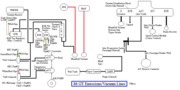
The EGR system has a vacuum source (line from the intake manifold) that goes to the EVR, computer operated electronic vacuum regulator. The EVR is located on the back of the passenger side shock strut tower. The computer uses RPM, Load. and some other factors to tell the EVR to pass vacuum to open the EGR valve. The EGR valve and the passages in the heads and intake manifold route exhaust gas to the EGR spacer (throttle body spacer). The EGR sensor tells the computer how far the EGR valve is open. Then computer adjusts the signal sent to the EVR to hold, increase or decrease the vacuum. The computer adds spark advance to compensate for the recirculated gases and the slower rate they burn at.

There should be no vacuum at the EGR valve when at idle. If there is, the EVR (electronic vacuum regulator) mounted on the backside of the passenger side wheelwell is suspect. Check the vacuum line plumbing to make sure the previous owner didn’t cross the vacuum lines.

Diagram courtesy of Tmoss & Stang&2birds. (the diagram says 88 GT, but the EGR part is the same for 86-93 Mustangs)
88Stang5.0Vacuum.gif


The EGR sensor is basically a variable resistor, like the volume control on a radio. One end is 5 volt VREF power from the computer (red/orange wire). One end is computer signal ground (black/white), and the middle wire (brown/lt green) is the signal output from the EGR sensor. It is designed to always have some small voltage output from it anytime the ignition switch is the Run position. That way the computer knows the sensor & the wiring is OK. No voltage on computer pin 27 (brown/lt green wire) and the computer thinks the sensor is bad or the wire is broken and sets code 31. The voltage output can range from approximately .6-.85 volt.


EGR test procedure courtesy of cjones

to check the EGR valve:
bring the engine to normal temp.
connect a vacuum pump to the EGR Valve
apply 5" vacuum to the valve.
if engine stumbled or died then EGR Valve and passage(there is a passageway through the heads and intake) are good.
if engine did NOT stumble or die then either the EGR Valve is bad and/or the passage is blocked.
if engine stumbled, connect vacuum gauge to the hose coming off of the EGR Valve
snap throttle to 2500 RPM (remember snap the throttle don't hold it there).
did the vacuum gauge show about 2"-5" vacuum?

if not, check for manifold vacuum at the EGR vacuum valve.
if you have manifold vacuum then connect vacuum gauge to the EGR valve side of the vacuum valve and snap throttle to 2500 RPM.
should read about 2"-5" vacuum

Dumping the codes without the engine running results in the EVR being toggled by the computer. When the computer starts test mode, it toggles all the actuators and relays. You can hear the very distinctive sound made as everything turns on and off. A voltmeter or test light applied across the two EVR control wires should flicker on and off.
 

Attachments

  • 88Stang5.0Vacuum.gif
    88Stang5.0Vacuum.gif
    14.3 KB · Views: 177
So I finally got the egr code to go away but it still is running code 41 and it will afterfire if I floor it, well not completely, but push about 3/4 throttle. Just changed cap, rotor, and plugs on that side as well as retorqued down the upper and lower. Any other advice? Maybe check to make sure the fuel lines are firing right?
 
Code 41 or 91 - O2 indicates system lean. Look for a vacuum leak or failing O2 sensor.

The computer sees a lean mixture signal coming from the O2 sensors and tries to compensate by adding more fuel. Many times the end result is an engine that runs pig rich and stinks of unburned fuel.

The following is a Quote from Charles O. Probst, Ford fuel Injection & Electronic Engine control:
"When the mixture is lean, the exhaust gas has oxygen, about the same amount as the ambient air. So the sensor will generate less than 400 Millivolts. Remember lean = less voltage.

When the mixture is rich, there's less oxygen in the exhaust than in the ambient air , so voltage is generated between the two sides of the tip. The voltage is greater than 600 millivolts. Remember rich = more voltage.

Here's a tip: the newer the sensor, the more the voltage changes, swinging from as low as 0.1 volt to as much as 0.9 volt. As an oxygen sensor ages, the voltage changes get smaller and slower - the voltage change lags behind the change in exhaust gas oxygen.

Because the oxygen sensor generates its own voltage, never apply voltage and never measure resistance of the sensor circuit. To measure voltage signals, use an analog voltmeter with a high input impedance, at least 10 megohms. Remember, a digital voltmeter will average a changing voltage." End Quote

Testing the O2 sensors
Measuring the O2 sensor voltage at the computer will give you a good idea of how well they are working. You'll have to pull the passenger side kick panel off to gain access to the computer connector. Remove the plastic wiring cover to get to the back side of the wiring. Use a safety pin or paper clip to probe the connections from the rear. The computer pins are 29 (LH O2 with a dark green/pink wire) and 43 (RH O2 with a dark blue/pink wire). Use the ground next to the computer to ground the voltmeter.

Testing the O2 sensor wiring harness
Most of the common multimeters have a resistance scale. Be sure the O2 sensors are disconnected and measure the resistance from the O2 sensor body harness to the pins on the computer.

Note that all resistance tests must be done with power off. Measuring resistance with a circuit powered on will give false readings and possibly damage the meter. Do not attempt to measure the resistance of the O2 sensors, it may damage them.

The O2 sensor ground (orange wire with a ring terminal on it) is in the wiring harness for the fuel injection wiring. I grounded mine to one of the intake manifold bolts