Fuel Pump And Relay

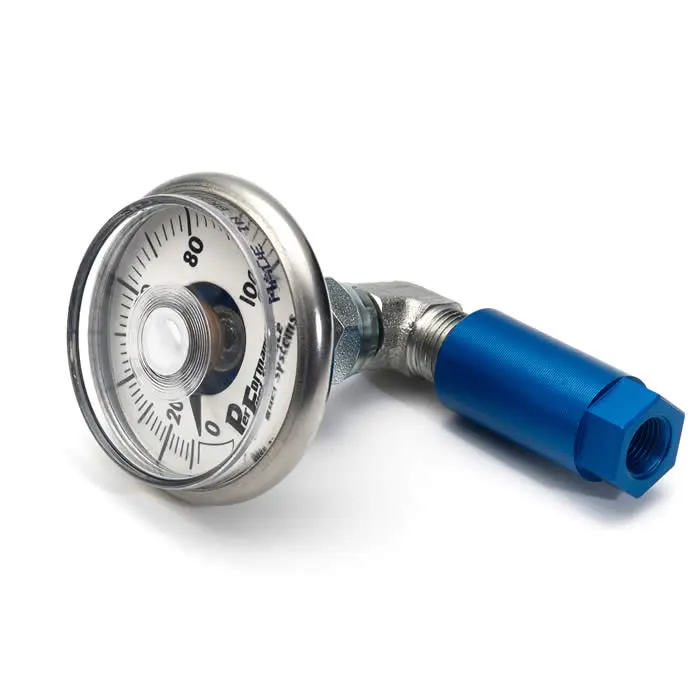
I have a gauge attached to the Schrader valve all the time.

Adapter fitting which simply screws onto the vehicles fuel system service port Schrader valve on the fuel rail. The adapter fitting automatically activates the service ports internal valve mechanism so there is no need to remove the port’s internal release valve.
16_1104_Algis76872copy.webp
 
I have a gauge attached to the Schrader valve all the time.

Adapter fitting which simply screws onto the vehicles fuel system service port Schrader valve on the fuel rail. The adapter fitting automatically activates the service ports internal valve mechanism so there is no need to remove the port’s internal release valve.
16_1104_Algis76872copy.webp

What about the cracks induced by a bobweight on the end of a vibrating pipe. That's what you have there...

A better solution is to mount the gauge at the end of a 1/4" SS braided hose. See below for details...

Fuel pressure gauge adapter fittings:
http://www.holley.com/products.asp?product=17945NOS AN 4 to 1/16” pipe
http://www.holley.com/products.asp?product=16785NOS 1/16” male pipe to 1/8” female pipe

Or
See http://www.autometer.com/cat_accessorieslist.aspx?pid=10

I made my own pressure gauge and holder. I bought the NOS or Autometer adapter that you screw into the place on the fuel line where the schrader valve goes. You have to remove the Schrader valve, but save it, since you will reuse it. I ran a piece of SS (stainless steel) braided hose to a 1/8” pipe brass tee fitting that I mounted on the fender well by the MAF. I made a mount bracket out of aluminum angle I got from Home depot and bolted it to the fender well. Then I mounted the brass tee to it with some machine screws and a plate. I sandwiched the brass tee between the aluminum angle and a flat piece of aluminum that I trimmed off the extra aluminum angle. Three screws laid out in a triangle pattern go through both pieces of aluminum to clamp the tee in place. Put the Schrader valve in the spare port of the brass tee. I used a cheap industrial gauge from MSC Direct (http://www1.mscdirect.com/ P/N 56468499). It works great and was cheaper than (less than $8) anything Summit had.

If you look through the MSC Direct catalog, you can find any type of gauge you want, including liquid filled. You only need a liquid filled gauge if you mount it directly on the engine. The liquid filling dampens out the vibrations. .However there are a couple of people who have had nasty engine fires when the gauge or the fuel injector rail broke due to vibration because of the gauge directly mounted on the fuel injector rail.

You can buy the Autometer Stainless Steel braided hose for like $60. Or a local shop that makes hydraulic hose assemblies can make it for you at a cheaper price. Ordinary low pressure hydraulic hose can be used in place of the Stainless Steel braided hose, the Stainless Steel braided hose just looks nice. I got mine for $4 at a place that sells industrial and military surplus parts of all kinds. The Stainless Steel braided hose goes for about $4+ a foot and the fittings are probably about $6-$10 each. You can make your own and save some $$$, the shops may have a setup or labor charge to fabricate the hose assembly.


FP Gauge 1.webp
FP Gauge 2.webp
FP Gauge 3.webp
FP Gauge 4.webp
FP Gauge 10.webp
FP Gauge 11.webp


Safety device to prevent major fuel loss in the event of a failure of the hose, fittings or gauge...

attachment.php?attachmentid=49295&d=1172975440.gif
 
Last edited:
When I went from my stock 88lph pump to a 190lph pump, I had to readjust my Kirban FPR.

39psi with the stock 30-year old pump became 43psi with the 190lph pump after swapping it out. A quick adjustment and I was back down to 39psi. Fairly stock setup (for now) and no idle issues. I have a cowl mounted mechanical fuel pressure gauge. (Which has actually been more useful there than you'd think)

I often wondered if that would cause issues if someone put a 255 on a stock engine with stock fpr. The physics behind the reason why the pressure would be higher makes sense but I wondered if the stock fpr could compensate
 
Last edited:
I have the Kirban attached now. The return port is much larger than the factory FPR, therefore, it would be no better. I wrote the measurements down somewhere, a few years back.

I've tried adjusting the Kirban as low as it will go (no spring pressure), 39 is about it. A small amount of spring pressure is 40.
IMG_1116.webp
IMG_1122.webp
IMG_1123.webp
 
Unsure if I can go below 39psi. I dropped it from 43 and simply stopped when I hit 39 and didn't try to go further.

Since it's 6 degrees out, not something I'll experiment with any time soon. I'm only running a 190lph.

But, I swapped out my original 30 year pump just a couple months ago and distinctly remember the pressure jump from 39psi with the 88lph pump to 43psi with the new 190lph. Still idled fine but I dropped it to 39 a week or so later.
 
Unsure if I can go below 39psi. I dropped it from 43 and simply stopped when I hit 39 and didn't try to go further...
But, I swapped out my original 30 year pump just a couple months ago and distinctly remember the pressure jump from 39psi with the 88lph pump to 43psi with the new 190lph. Still idled fine but I dropped it to 39 a week or so later.
39 psi with the vacuum line on, or off & plugged?
It will be different with the engine on & engine off because voltage is higher when engine is on.
I had a 20 year old 155lph with a T-Rex 80gph in-line pump. With the 255, don't need the in-line any more.