Help with trouble codes

crazy98gt

New Member
Dec 24, 2005
17
1
3
Hey guys,
i just recently finished rebuilding the engine in my 86 mustang gt. i threw in a few extras while i had it apart such as an e303 cam, 24lb injectors, maf conversion, ac delete & smoge removal, and underdrive pullies. it runs great but im having some drivability issues. the car LOVES to stall out whenever i push the clutch in to come to a stop or take a slow turn especially if it was higher in the rpm range when the pedal is pressed. it does it almost every time. I pulled trouble codes this morning and this is what i found:

Codes 81, 18, 33, 66, 96 (81 was an O code while the rest were CM codes)

81 - Secondary Air Diverter Circuit Failure (O)
18 - Spark Out (SPOUT) Circuit Open (R), Loss Of Ignition Diagnostic Module Input To PCM/SPOUT Circuit Grounded (CM)
33 - EGR Valve Opening Not Detected (CM,R)
66 - MAF signal below minimum test voltage of .4vdc (O,CM,R), Transmission Fluid Temperature Circuit Grounded (CM,O)
96 - Fuel Pump Circuit Open-Battery To PCM (CM,O)


I've looked up what these codes mean but im not sure i understand some of them. 18 for instance, what is the IDM circuit? Code 66 worries me especially because i just converted using a brand new MAF

If anyone could shed some light on how to go about testing and fixing each of these issues i would greatly appreciate it.
 
Code 66 MAF below minimum test voltage.
Insufficient or no voltage from MAF. Dirty MAF element, bad MAF, bad MAF wiring, missing power to MAF. Check for missing +12 volts on this circuit. Check the two links for a wiring diagram to help you find the red wire for computer power relay switched +12 volts. Check for 12 volts between the red and black wires on the MAF heater (usually pins A & B). while the connector is plugged into the MAF. This may require the use of a couple of safety pins to probe the MAF connector from the back side of it.

There are three parts in a MAF: the heater, the sensor element and the amplifier. The heater heats the MAF sensor element causing the resistance to increase. The amplifier buffers the MAF output signal and has a resistor that is laser trimmed to provide an output range compatible with the computer's load tables.

The MAF element is secured by 2 screws & has 1 wiring connector. To clean the element, remove it from the MAF housing and spray it down with electronic parts cleaner or non-inflammable brake parts cleaner (same stuff in a bigger can and cheaper too).

Changes in RPM causes the airflow to increase or decease, changing the voltage output.. The increase of air across the MAF sensor element causes it to cool, allowing more voltage to pass and telling the computer to increase the fuel flow. A decrease in airflow causes the MAF sensor element to get warmer, decreasing the voltage and reducing the fuel flow.

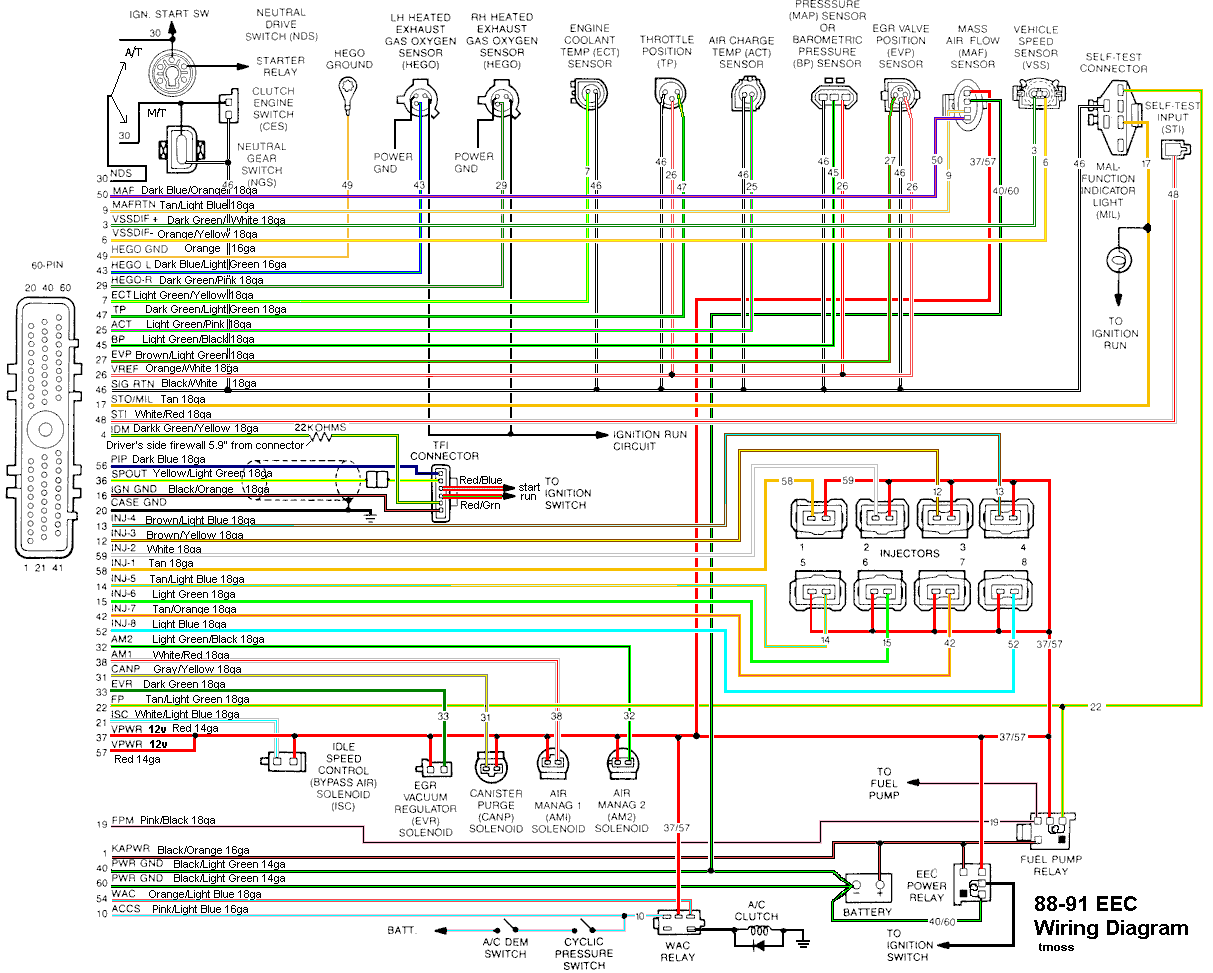
Measure the MAF output at pins C & D on the MAF connector (dark blue/orange and tan/light blue) or at pins 50 & 9 on the computer. Be sure to measure the sensor output by measuring across the pins and not between the pins and ground.

At idle = approximately .6 volt
20 MPH = approximately 1.10 volt
40 MPH = approximately 1.70 volt
60 MPH = approximately 2.10 volt

Check the resistance of the MAF signal wiring. Pin D on the MAF and pin 50 on the computer (dark blue/orange wire) should be less than 2 ohms. Pin C on the MAF and pin 9 on the computer (tan/light blue wire) should be less than 2 ohms.

There should be a minimum of 10K ohms between either pin C or D on the MAF wiring connector and pins A or B. Make your measurement with the MAF disconnected from the wiring harness.


See the following website for some help from Tmoss (diagram designer) & Stang&2Birds (website host) for help on 88-95 wiring http://www.veryuseful.com/mustang/tech/engine/

Ignition switch wiring
http://www.veryuseful.com/mustang/tech/engine/images/IgnitionSwitchWiring.gif

Fuel pump, alternator, ignition & A/C wiring
http://www.veryuseful.com/mustang/tech/engine/images/fuel-alt-links-ign-ac.gif

Computer,. actuator & sensor wiring
http://www.veryuseful.com/mustang/tech/engine/images/88-91_5.0_EEC_Wiring_Diagram.gif

Fuse panel layout
http://www.veryuseful.com/mustang/tech/engine/images/MustangFuseBox.gif

Vacuum routing
http://www.veryuseful.com/mustang/tech/engine/images/mustangFoxFordVacuumDiagram.jpg

Code 18 - SPOUT out or wiring fault - look for short to ground in the SPOUT wiring going
back to the computer. Possible bad TFI.

This code can disable spark advance and reduce power and fuel economy.

Remove the passenger side kick panel and disconnect the computer connector.
There is a 10 MM bolt that holds it in place. Disconnect the TFI module connector
from the TFI and the measure the resistance between the yellow/lt green wire and ground.
You should see greater than 100 K (100000) ohms.
Next measure the resistance between the yellow/lt green wire on the TFI module connector and
Pin 36 on the computer connector. With the SPOUT plug in place, you should see less than 2 ohms.

The following is a view from the computer side of the computer connector.
eec04.gif


Diagram courtesy of Tmoss & Stang&2birds

http://www.veryuseful.com/mustang/tech/engine/images/88-91_5.0_EEC_Wiring_DiaUnfortunately]
i don'taway faccesse on my wife's laptop. Unfortunatley, I don't have acccess to my trouble code library at home. The fastest way to get a good answer on codes is to search on user name jrichker and use "code xx" where xx is the code number. Use " " double quote marks to do a specific search just like you would do on Google.
 
thanks for the info, anybody know anything about codes 81 or 96? also, could any of these codes be the reason the car stalls every time i push the clutch?
 
Code 81 – Secondary Air Injection Diverter Solenoid failure AM2. The solenoid valve located on the back side of the passenger side wheel well is not functional. Possible bad wiring, bad connections, missing or defective solenoid valve. Check the solenoid valve for +12 volts at the Red wire and look for the Lt Green/Black wire to switch from +12 volts to 1 volt or less. The computer controls the valve by providing a ground path on the LT Green/Black wire for the solenoid valve.

With the with the ignition on, look for 12 volts on the red wire on the solenoid connector. No 12 volts and you have wiring problems.

With the engine running, stick a safety pin in the LT Green/Black wire for the solenoid valve & ground it. That should turn the solenoid on and cause air to flow out the port that goes to the pipe connected to the cats. If it doesn't, the valve is bad. If it does cause the airflow to switch, the computer or wiring going to the computer is not signaling the solenoid valve to open.

Putting the computer into self test mode will cause the solenoid valve to toggle. If you listen carefully, you may hear it change states.

If you don't have cat coverters, you can ignore this code. If you do, you need to fix it.


Thermactor Air System
Some review of how it works...

The Thermactor air pump (smog pump) supplies air to the heads or catalytic converters. This air helps break down the excess HC (hydrocarbons) and CO (carbon monoxide). The air supplied to the catalytic converters helps create the catalytic reaction that changes the HC & CO into CO2 and water vapor. Catalytic converters on 5.0 Mustangs are designed to use the extra air provided by the smog pump. Without the extra air, the catalytic converters will clog and fail.

The Thermactor air pump draws air from an inlet filter in the front of the pump. The smog pump puts air into the heads when the engine is cold and then into the catalytic converters when it is warm. The Thermactor control valves serve to direct the flow. The first valve, TAB (Thermactor Air Bypass) or AM1 valve) either dumps air to the atmosphere or passes it on to the second valve. The second valve, TAD (Thermactor Air Diverter valve or AM2 valve) directs it to the heads or the catalytic converters. Check valves located after the TAB & TAD solenoids prevent hot exhaust gases from damaging the control valves or pump in case of a backfire. The air serves to help consume any unburned hydrocarbons by supplying extra oxygen to the catalytic process. The computer tells the Thermactor Air System to open the dump valve at WOT (wide open throttle) minimizing engine drag. The dump valve reduces the parasitic drag caused by the smog pump to about 2-4 HP at WOT. The dump valve also opens during deceleration to reduce or prevent backfires.

attachment.php


Computer operation & control for the Thermactor Air System
Automobile computers use current sink technology. They do not source power to any relay, solenoid or actuator like the IAC, fuel pump relay, or fuel injectors. Instead the computer provides a ground path for the positive battery voltage to get back to the battery negative terminal. That flow of power from positive to negative is what provides the energy to make the IAC, fuel pump relay, or fuel injectors work. No ground provided by the computer, then the actuators and relays don't operate.

One side of the any relay/actuator/solenoid in the engine compartment will be connected to a red wire that has 12-14 volts anytime the ignition switch is in the run position. The other side will have 12-14 volts when the relay/actuator/solenoid isn't turned on. Once the computer turns on the clamp side, the voltage on the computer side of the wire will drop down to 1 volt or less.

In order to test the TAD/TAB solenoids, you need to ground the white/red wire on the TAB solenoid or the light green/black wire on the TAD solenoid.

For 94-95 cars: the colors are different. The White/Red wire (TAB control) is White/Orange (Pin 31 on the PCM). The Green/Black wire (TAD control) should be Brown (pin 34 at the PCM). Thanks to HISSIN50 for this tip.

To test the computer, you can use a test light across the TAB or TAD wiring connectors and dump the codes. When you dump the codes, the computer does a self test that toggles every relay/actuator/solenoid on and off. When this happens, the test light will flicker.
 
so after some work the only code i'm left with that worries me is code 18. has anybody dealt with that one before? my spout connector is plugged in and was working correctly when i had initially set the timing. im not sure what i should be checking because all the wiring seems to look fine to me. can anybody point me in the right direction?
 
I am having the same issue with my car. It may be the TFI module from some of the research I've done. I haven't tried it yet though, as it's getting prepped for paint right now. Something to consider anyways. Hope you get it worked out; it's quite a frustrating issue.
 
Code 18 - SPOUT out or wiring fault - look for short to ground in SPOUT wiring going
back to the computer. Possible bad TFI.

This code can disable spark advance and reduce power and fuel economy.

Remove the passenger side kick panel and disconnect the computer connector.
There is a 10 MM bolt that holds it in place. Disconnect the TFI module connector
from the TFI and the measure the resistance between the yellow/lt green wire and ground.
You should see greater than 100 K (100000) ohms.
Next measure the resistance between the yellow/lt green wire on the TFI module connector and
Pin 36 on the computer connector. With the SPOUT plug in place, you should see less than 2 ohms.

The following is a view from the computer side of the computer connector.
eec04.gif


Diagram courtesy of Tmoss & Stang&2birds

88-91_5.0_EEC_Wiring_Diagram.gif
 
how do i check the harness? is that part of what is described in the procedure above?

Go back and re-read the test path. In it you will find the instructions for doing the testing. You may have to extend the test leads on your meter: if you are neat and do a good job, it will not affect the results.


Code 96 – KOEO- Fuel pump monitor circuit shows no power - Fuel pump relay or battery power feed was open - Power / Fuel Pump Circuits. The fuel pump lost power at some time while the ignition switch was in the run position. The main power feed to the pump is what is losing power.

Look for a failing fuel pump relay, bad connections or broken wiring. The fuel pump relay is located under the passenger seat. On Mass Air Conversions, the signal lead that tells the computer that the fuel pump has power may not have been wired correctly.
See http://www.stangnet.com/tech/maf/massairconversion.html

attachment.php

Look for power at the fuel pump - the fuel pump has a connector at the rear of the car with a pink/black wire and a black wire that goes to the fuel pump. The pink/black wire should be hot when the test connector is jumpered to the test position. . To trick the fuel pump into running, find the ECC test connector and jump the connector in the lower RH corner to ground.
attachment.php


86-90 Models:
Using the diagram, check the red/black wire from the fuel pump relay: you should see 12 volts or so. If not, check the inertia switch: on a hatch it is on the drivers side by the taillight. Look for a black rubber plug that pops out: if you don't find it, then loosen up the plastic trim. Check for voltage on both sides of the switch. If there is voltage on both sides, then check the Pink/black wire on the fuel pump relay: it is the power feed to the fuel pump. Good voltage there, then the fuel pump body to tank wiring harness connector is the likely culprit since it is getting power. No voltage there, check the Orange/Lt blue wire, it is the power feed to the fuel pump relay & has a fuse link in it. Good voltage there & at the Pink/black wire, swap the relay.

Keep in mind that the relay wiring and socket can also cause intermittent problems. Clean the relay socket with non-flammable brake parts cleaner or electrical contact cleaner. If you find damaged wiring at the relay socket, replacement pigtail socket assemblies are available at the auto parts stores. Be sure to solder the wires and cover the solder joints with heat shrink tubing if you replace the relay socket.


attachment.php
 
fixed it! my problem ended up being that the 22k ohm resistor in the IDM circuit was blown and that's what was throwin code 18. i just replaced the resistor and the code went away. thanks for all the help.
 
fixed it! my problem ended up being that the 22k ohm resistor in the IDM circuit was blown and that's what was throwin code 18. i just replaced the resistor and the code went away. thanks for all the help.
Thanks for the reply. The information you provided helps me to improve the tech notes and code definitions.
 
no problem. it can be very irritating searching for solutions to problems. lots of people post their problems and suggestions on how to fix them but half the time they don't come back and post what they actually did to solve the problem or if they even fixed it at all...
 
  • Like
Reactions: jsw81
fixed it! my problem ended up being that the 22k ohm resistor in the IDM circuit was blown and that's what was throwin code 18. i just replaced the resistor and the code went away. thanks for all the help.
I went to look for this resistor today and cannot find it. Can you tell me or show me in a picture where it is exactly? I am thinking that it's blown like yours was.
 
Did you get the same code 18 as he did? If not, then keep on looking.
I did get the code 18. I finally found the resistor as well. I ended up replacing it since it was a cheap fix. I also swapped the tfi with another I had laying around. I read the codes again and still got the 18 and my stalling issues were still there. Then as a last resort I thought I would try clocking the maf 45 degrees since I have the C&L and I know it can be picky. Well that ended up fixing my stalling issues! Idles better also.

I may not have cleared the code 18 correctly, so it might be gone. I will check it again at another time. I am in the middle of paint with the car so it's not nearby for me to troubleshoot.
 
Codes can be cleared by disconnecting the battery for 10 minutes and turning on the headlights. That erases everything in the computer's volatile memory, including any learned settings. You may experience some rought running unti the computer "re-learns" all the settings

Or you can disconnect the code reader once the codes start to dump. Some scanners have a button to clear the codes. If you use the test jumper & check engine light setup that I often post, just pull the test jumper out once the codes start to dump.