I think this would be cool.

Imagine a classic 65 66 Stang running 12's and not using a drop of fuel. This would pretty cool in my book. It will never replace the rumble and smell of a classic, but I see a day I cannot afford fuel and this may just be an option that allows us to keep driving the classics.

Oregon Field Guide — Electric Drag Racing Oregon Public Broadcasting


Wouldn't do a classic with an all-electric engine. But I would consider a hybrid setup if someone could retrofit a system that could handle 400 hp and install without too much trouble. Initially I was a bit skeptical but hybrid setups are getting better all the time and they have one powerful/strong enough to stand up in a 3 ton, 400 hp Escalade...

I had even thought up some basic schemes for hybrid retrofit kits for classic cars, I think someone could start a business doing that. I have no doubt that some people would pay a ton of money to ride a classic car that gets 50 mpg but still sounds/smells/runs like a classic.

Besides, I think hybrids are going to be used to enhance performance of faster cars in 5 years or so... As batteries slim down and they get better with the motors, the weight cost won't be too much. Meanwhile, an electric motor will basically let you run a more aggressive camshaft profile (the electric motor will keep it drivable at lower speeds/rpms, and give you the grunt you need to get the motor into its powerband). Could be relaly cool :shrug:
 
Thats a whole other conversation Dodgestang.

Don't get me wrong I love my classic 67 more than any car I have and would never take it apart to build something of this nature. That said I might take an old 6 cylinder car or a Fox and experiment. It's just drive train not something you can't change back. What about a Dynacorn body?


Cal that could be interesting for sure on the Hybrid to assist in running huge cams.

Didn't want to ruffle any feathers but I for one am always looking for a way to make things better and to do that you have to experiment or wait for someone else to do it.
 
maybe I misunderstand the operation of hybrid cars? My understanding was there is(are) a(an) electric motor(s) that runs the vehicle at low speed under low acceleration....then the gas engine only kicks on when there is a larger power demand than the small electric motor(s) can handle(IE....acceleration above something like 30% throttle) now while you could "idle" with the electric motors...I'm not sure that a radical cammed engine would really be helped out too much by this...since as soon as the TPS goes over 30%(or whatever the actual number is) it would need to start the gas engine....I dont know abut you...but most engines I have built with aggresive camshafts and other power adding mods dont exactly start super-smoothly....and cold starts make it even worse...I can just imagine driving 15 miles on a winter day on the electric motor and then hitting the gas and it trying to kick on a cammed motor fast enough for it to respond to quick throttle input(besides, heavy acceleration on a cold engine isnt good for it anyway) but then, I dont really know anything about hybrids, so I probably dont understand the way they function correctly....I guess I just cant see a smooth trouble free transition...however, a hybrid motor with a manual switch could have better "cruising" potential....
 
the first hybrids worked where the electric motor supplemented the gas engine for power. that way they could turn in really good mileage figures on the EPA dyno. the current hybrids now use the electric motor as power for low speed operation, and as supplemental power as needed at higher power levels. they way hybrids SHOULD have been built is like the current diesel electric locomotives. the gas engine only turns a generator to maintain the charge in the batteries, and to run the accessories. that is the way the plans mother earth news sells do it. they use a large electric motor/generator from a DC10, and a small 5hp gas engine to run a generator, and several batteries. imagine using the stock gas tank to feed a 5hp motor. you could literally drive from LA to new york before you needed to refill the tank.
 
The technology still isn't there. Having to plug in after each 1/4 mile pass... not for me.

If/when better battery technology is available, I might be game...Probably wouldn't do the mustang tho. Would make myself a little electric daily driver.
 
you know, if yo want full electric...Tesla makes their modified Lotus Elise that is all electric....pretty good performance numbers too....almost as good as a supercar....all for the measley price of $80,000.....I think they claimed 200 miles on a charge and a top speed of over 200MPH if I remember correctly...I forget what it did in the quarter, but it was impressive....only issue....the battery costs $20,000....a bit pricey to replace if it ever goes out
 
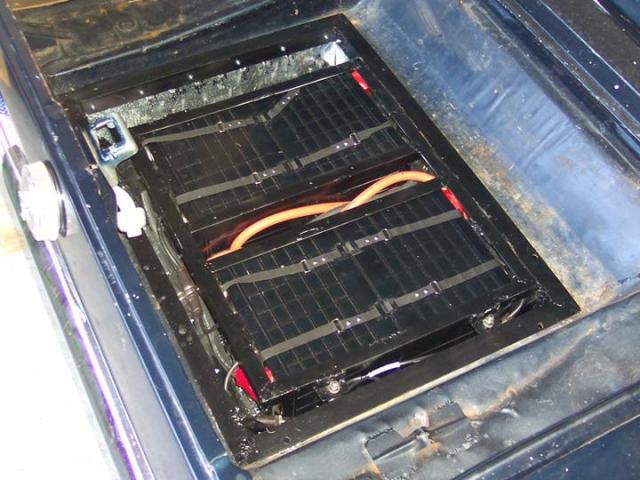
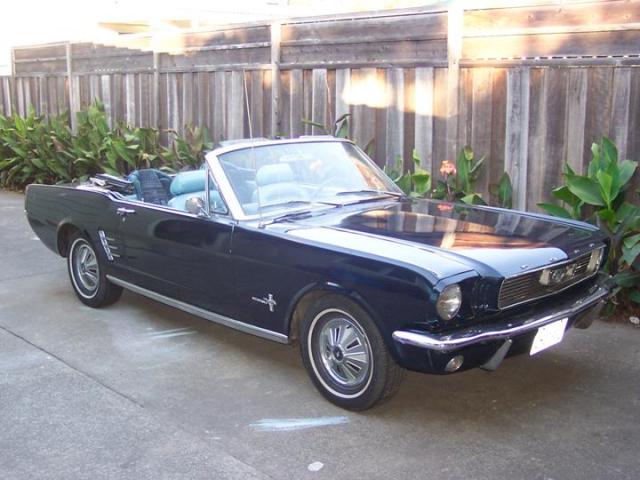
An ALL-electric classic Mustang? Been there, done that.

My coworker has a '66 convertible with 40 mile range. My Fastback still wins the drag race though.

I'm currently working on making a tachometer for him. Right now, we have no way of gauging exactly what rpm the motor is spinning at. With no coil, distributor, or cam gear, it gets kinda tricky. But, we're engineers for spectrum analyzers and radios that go up 70GHz, so I'm not too worried.

Here's his website:
Chris Jones' 1966 Ford Mustang

733a.webp
733c.webp
radiator_plate.jpg
733d.jpg
733b.jpg
ac_adapters.jpg


Chris Jones' 1966 Ford Mustang
 

Attachments

  • 733a.webp
    733a.webp
    31.1 KB · Views: 119
  • 733c.webp
    733c.webp
    46.9 KB · Views: 120
I'll stick with my pre-historic small block, thanks. I drove the thing when premium was $5 a gallon and I'll drive it if it gets that high again. I don't drive it to get from point A to point B, I drive it because it makes me feel good. A Mustang with all the mechanical appeal of a golf cart doesn't thrill me, I don't care if it runs in the 5's at 300 mph.
 
on the idea of electric motors powered by a 5HP gasoline generator....its an interesting idea...not sure if 5HP is enough to turn however many alternators would be required to power the electric motors....but however many HP it ended up being....GM is working on a device to replace the alternator, which generates electricity using exhaust gasses....a thermal converter so to say....so even the exhaust could be used....I'm thinking it would create backpressure(could be wrong) which of course would cause more heat...so more energy potential....using multiple converters could remove all the heat from exhaust gasses.....in any case....the technology is there for super efficient cars....they wouldnt be a whole lot of fun from the enthusiasts point of view...unless they used electric motors as powerful as those on the Tesla car....but a good idea for commuting
 
Not sure what motor the Toyota has but 11.5 on Electric is pretty impressive.

My electric comes from Water and Wind here in Okie land. hehe.

You should see all the diesel trucks scurrying about with the Wind mill parts on them. lol
 
There are many large dams to utilize the water of the Arkansas and Red river systems as a source of energy for electricity. Among Oklahoma’s largest hydroelectric dams are Tenkiller Dam on the Illinois River, Denison Dam on the Red River, Keystone Dam on the Arkansas River, and Pensacola Dam on the Grand River. Most hydroelectric dams have been built since the 1940s.
 
on the idea of electric motors powered by a 5HP gasoline generator....its an interesting idea...not sure if 5HP is enough to turn however many alternators would be required to power the electric motors....but however many HP it ended up being....GM is working on a device to replace the alternator, which generates electricity using exhaust gasses....a thermal converter so to say....so even the exhaust could be used....I'm thinking it would create backpressure(could be wrong) which of course would cause more heat...so more energy potential....using multiple converters could remove all the heat from exhaust gasses.....in any case....the technology is there for super efficient cars....they wouldnt be a whole lot of fun from the enthusiasts point of view...unless they used electric motors as powerful as those on the Tesla car....but a good idea for commuting

you dont need to turn several alternators, you just need to run one generator that puts out about 1000-1500 watts to maintain battery charge, and many of those are 2hp generators. that is enough to run the generator, the electric motor to power the car, and an electric motor to run the a/c-heat system.
 
just to clear up confusion on my part....using a 5HP gasoline engine to run a 2HP electric generator(assuming like they used before alternators came along)? or are you saying use a 5HP generator to maintain the battery charge as well as the other electrical accesories?(though most generators put out 120v, so you would have to step it down) any idea how much an electric motor to turn the wheels would run? I would assume you would want something with about 100HP to get some decent acceleration....i suppose you could also un a elay to turn the generator on and off when the battery charge fell below a certain amount....its an interesting idea and one worth trying in a nice light car....maybe an old VW bug....


CalPolyMustang....I was reading an article online where the guy said he made a tach for an electric motor by using a hall effect sensor to pick up RPM

"After building the motors I noticed that the spinning magnets on the rotor could be used for calculating the speed in revolutions per minute. To assist in finding the rpm value I used another reed switch. The signals from the second reed switch were sent to specially built 3-digit electronic decade counter. Last year I improved this counter replacing the reed switch with a Hall effect switch and adding an extra decade for easier measurements."

I personally dont understand much of what he is saying, but here is the link....this guy built a lot of his own motors....its worth a read
Experiments and Applications


on another note....it would be simple to read RPM if you can acess the motor shaft....you can stick a certain type of magnet on it and use a cam position sensor like most OHC engines use....finding one small enough to fit on an electric motor shaft might be tricky though....I think thats pretty much what this guy did anyway...though a different way i am sure
 
just to clear up confusion on my part....using a 5HP gasoline engine to run a 2HP electric generator(assuming like they used before alternators came along)? or are you saying use a 5HP generator to maintain the battery charge as well as the other electrical accesories?(though most generators put out 120v, so you would have to step it down) any idea how much an electric motor to turn the wheels would run? I would assume you would want something with about 100HP to get some decent acceleration....i suppose you could also un a elay to turn the generator on and off when the battery charge fell below a certain amount....its an interesting idea and one worth trying in a nice light car....maybe an old VW bug....

generally when you talk about generators, the stand alone kind anyway, you talk about two numbers, horsepower and wattage output. the horsepower figure is how much power the engine that runs the generator makes, and the wattage output is how much electricity the generator itself puts out. thus a 2hp 1000 watt generator uses a 2hp motor to put out a maximum of 1000 watts of power. this would be quite compact. and yes the voltage output is generally 110v, but since most battery chargers run off 110v, and since the most efficient small electric motors for running a compressor are also 110v motors, there is no problem. you would have one battery that is 12v for your electrical accessories that is charged at the same time as the batteries that run the main electric motor, yet kept separate from the main battery pack. the electric motor that mother earth news specs out is the starter motor/generator from a DC10. as the cost of that motor, i dont know.
 
There are many large dams to utilize the water of the Arkansas and Red river systems as a source of energy for electricity. Among Oklahoma’s largest hydroelectric dams are Tenkiller Dam on the Illinois River, Denison Dam on the Red River, Keystone Dam on the Arkansas River, and Pensacola Dam on the Grand River. Most hydroelectric dams have been built since the 1940s.

:shrug:In all my travels up there in Okie country I never realized there was enough water for hydro power.:rlaugh: