
You are using an out of date browser. It may not display this or other websites correctly.
You should upgrade or use an alternative browser.
You should upgrade or use an alternative browser.
Is there a difference ?
- Thread starter Mike Dawg
- Start date
TheUser
Active Member
it probably won't have the holes tapped in the lifter valley to bolt down the spider, so you'll have to tap them or have them tapped. My block is from a truck, and that's all I had to do if I remember correctly.
TheUser
Active Member
Are you sure it's an HO motor? If not, the firing orders are different on non-ho and HO motors.
Make sure you're using the correct firing order and go Counter-clockwise on your distributer cap.
Are you sure you're getting fuel to the cyclinders that you think are not working?
If you're getting spark to all of them, then really all that's left is timing and fuel.
Make sure you're using the correct firing order and go Counter-clockwise on your distributer cap.
Are you sure you're getting fuel to the cyclinders that you think are not working?
If you're getting spark to all of them, then really all that's left is timing and fuel.
Yes cuz when I pull the plugs there wet and while its running I pull the spark plug wire and I can see spark . Im so confused .what u think? would the comp. make a difference ? maybe injector timing ? yeah its a H.o motor and the firing orders right 13726548 ccw
TheUser
Active Member
have you rotated the crank to make sure all of the valves are opening and closing?
What is the timing set at? 10* BTDC is stock on a 5.0 HO
EDIT: If you didn't get the dogbones and/or spider back in to keep the lifters from turning, maybe some are turning and causing problems.
What is the timing set at? 10* BTDC is stock on a 5.0 HO
EDIT: If you didn't get the dogbones and/or spider back in to keep the lifters from turning, maybe some are turning and causing problems.

yes the distributor came out during the change over but its in right . the motor ran good when it came out of the van . and all that I did was change intake manifolds and exhaust . Ive even swapped dist. and the same thing . I got code 22. would the spiderback make that happen?
Mike Dawg said:yes the distributor came out during the change over but its in right . the motor ran good when it came out of the van . and all that I did was change intake manifolds and exhaust . Ive even swapped dist. and the same thing . I got code 22. would the spiderback make that happen?
Code 22 is for the MAP/BP Out of Self-Test Range
double check that all the vac hoses are connected. It sounds like something was left off, causing the code 22?
I don't care to admit how many times I had trouble starting a motor, just to find out that I dropped the dizzy in wrong.
It is VERY easy to get the dist 180 out.
Pull plug 1
rotate the engine til air is being pushed out cyl 1.
Set piston to TDC
Then install the dizzy.
I have done a lot of engines, and I am embarrassed how many times I have sworn I had this right, but was actually off 180.
Worth double checking.
jason
took ur advice and double checked and its right on TDC compression stroke
I took the plugs out of the cylinders that were cold and they were black and wet i cleand them and reinstalled and when i fired it up and let it idle it sounds like it trying to fire in those cylinders but nothing Im completly baffled anymore ideas? I appreciate ur help
Mike
I took the plugs out of the cylinders that were cold and they were black and wet i cleand them and reinstalled and when i fired it up and let it idle it sounds like it trying to fire in those cylinders but nothing Im completly baffled anymore ideas? I appreciate ur help
Mike
TheUser
Active Member
If you're getting spark, maybe the spark plug has went bad? Maybe try new plugs in those cyclinders? Maybe the plug wires aren't giving a good enough spark? I've never had a problem with crossing spark plug wires, but maybe the wires crossing and messing up the spark

Tools needed: Noid light, Mulitmeter (volts & ohms), 10 MM socket &
extension, & ratchet.
Note: Do all of the steps and do them in order. The results of the
subsequent tests are based on the prior tests being sucessfully passed.
Some basics about the computer:
Remember that the computer does not supply power for any actuator or
relay, but provides the ground necessary to complete the circuit. That
means one side of the circuit will always be hot, and the other side will go
to ground or below 1 volt as the computer switches on that circuit.
1.) Get a noid light form AutoZone or other auto parts store, or even better
a set of them

This set is from http://www.toolking.com/ProductInfo.aspx?productid=12492 and costs $12.
2.) Use the noid light to determine that the injector pulses and isn’t
stuck in the on position. It you have a set of them install all of them and
compare the pulse intensity. A light that doesn’t pulse and stays on has a
short to ground in the computer side of the circuit. That can be either a
wiring fault or a failed computer. If this is the case, remove the passenger
side lick panel and disconnect the computer connector. There is one 10
MM bolt holding it in place. Pull the connector all the way out of the
computer so that you can see the computer side pins.

Use the list from the graphic below to find the fuel injector pins for the
injectors that didn’t turn the noid light off.
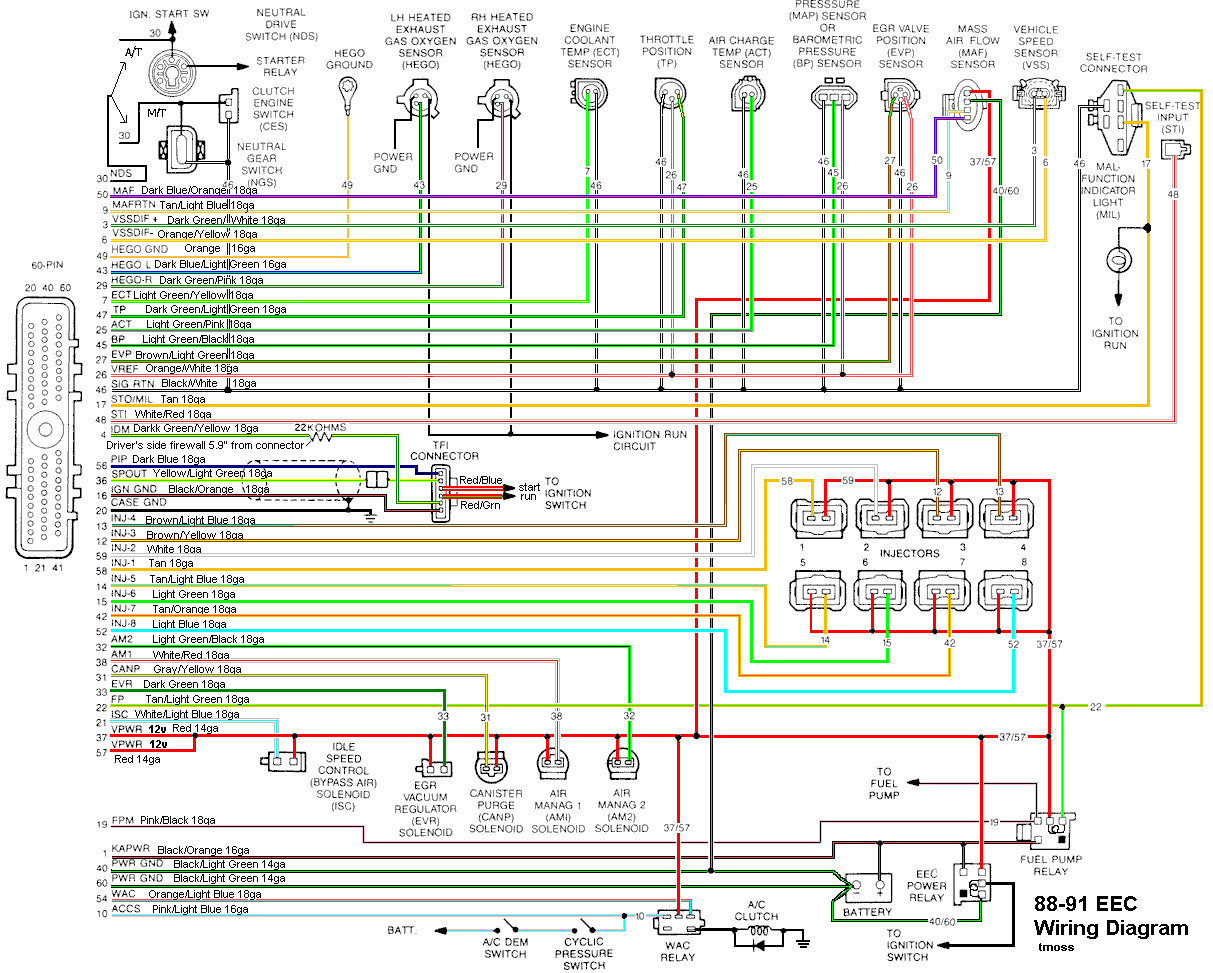
3.) Set the multimeter to low scale Ohms and measure between the
computer ground located below the computer and the suspect fuel injector
pins. You should see greater than 100 K Ohms resistance. If you see less
than 100 Ohms, the wiring between the injector and the computer has a
short to ground and needs service. Check the harness and look for damage,
kinks or frayed spots.
4.) A light that never turns on is either a wiring fault, or a failed
computer. Either the injector has no DC power or the computer has failed
and cannot switch the injector circuit to ground. Determine if the injector
has power by using the multimeter to check for 12 volts on the red wire on
the suspect injector connector. No 12 volts and you have a wiring fault.
Check the harness and look for damage, kinks or frayed spots. Check the 10
pin salt & pepper shaker connectors for bent pins, corrosion and damage.
Next Check the fuel injector wiring end to end. Each fuel injector has a red
wire (power) and an non-read wire (computer controlled ground). Set the
multimeter to low ohms and measure each non red fuel injector wire from
the fuel injector connector to the matching pin on the computer connector.
You should see less than 2 Ohms. More than that means a bad connection
or bad wiring.
See the graphic for the location of the 10 pin connectors:
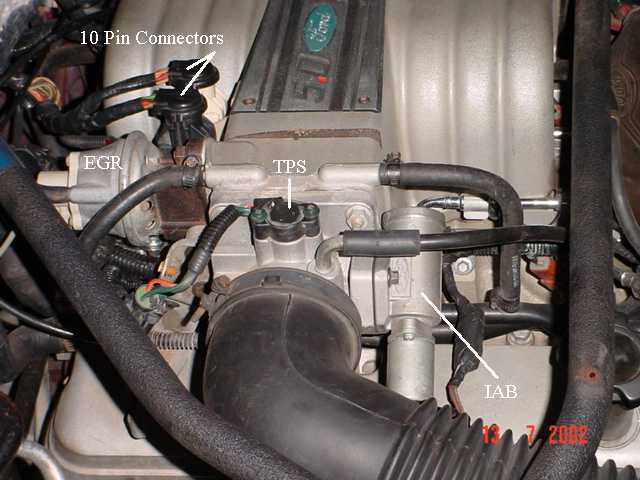
See the graphic for the 10 pin connector circuit layout.

Once you have determined that the suspect injectors have good power and
good wiring, the computer is the likely suspect, since a ground is required
to complete a circuit and make it function. The computer provides the
ground: if doesn’t, then the noid light will not flash.
5.) If you have gotten this far, then the problem is likely ignition
related. Remember the noid test using all of the noid lights? All of them
were supposed to be equally bright. Since you have already tested all the
electrical side of the fuel injector circuit, the one remaining common item is
the pip sensor inside the distributor. A failing pip sensor, damaged shutter
wheel or bent distributor shaft could all cause the pulse delivered to the
injectors to be faulty.
6.) Spark plugs indicate one or more cylinders not firing: use the
multimeter to measure the resistance of the spark plug wires. The wires
should measure 2000 ohms perfoot of length. A 2 foot wire would be 4000
ohms and a 3 foot wire would be 6000 ohms. Some Taylor and Accel wires
have metal cores and will measure much less: that’s OK.
Next examine the spark plug wires very carefully for burn spots, cracks and
damaged insulation. One good thing to try is to start the engine while the
car is a very dark area, open the hood and look for sparks or blue glow.
They indicate the electricity is leaking out of the spark plug wires.
Thanks to Tmoss & Stang&2birds at
www.veryuseful.com/mustang/tech/engine/
for some of the graphics
Thanks also to www.fordfuelinjection.com for some of the graphics.
extension, & ratchet.
Note: Do all of the steps and do them in order. The results of the
subsequent tests are based on the prior tests being sucessfully passed.
Some basics about the computer:
Remember that the computer does not supply power for any actuator or
relay, but provides the ground necessary to complete the circuit. That
means one side of the circuit will always be hot, and the other side will go
to ground or below 1 volt as the computer switches on that circuit.
1.) Get a noid light form AutoZone or other auto parts store, or even better
a set of them
This set is from http://www.toolking.com/ProductInfo.aspx?productid=12492 and costs $12.
2.) Use the noid light to determine that the injector pulses and isn’t
stuck in the on position. It you have a set of them install all of them and
compare the pulse intensity. A light that doesn’t pulse and stays on has a
short to ground in the computer side of the circuit. That can be either a
wiring fault or a failed computer. If this is the case, remove the passenger
side lick panel and disconnect the computer connector. There is one 10
MM bolt holding it in place. Pull the connector all the way out of the
computer so that you can see the computer side pins.
Use the list from the graphic below to find the fuel injector pins for the
injectors that didn’t turn the noid light off.
3.) Set the multimeter to low scale Ohms and measure between the
computer ground located below the computer and the suspect fuel injector
pins. You should see greater than 100 K Ohms resistance. If you see less
than 100 Ohms, the wiring between the injector and the computer has a
short to ground and needs service. Check the harness and look for damage,
kinks or frayed spots.
4.) A light that never turns on is either a wiring fault, or a failed
computer. Either the injector has no DC power or the computer has failed
and cannot switch the injector circuit to ground. Determine if the injector
has power by using the multimeter to check for 12 volts on the red wire on
the suspect injector connector. No 12 volts and you have a wiring fault.
Check the harness and look for damage, kinks or frayed spots. Check the 10
pin salt & pepper shaker connectors for bent pins, corrosion and damage.
Next Check the fuel injector wiring end to end. Each fuel injector has a red
wire (power) and an non-read wire (computer controlled ground). Set the
multimeter to low ohms and measure each non red fuel injector wire from
the fuel injector connector to the matching pin on the computer connector.
You should see less than 2 Ohms. More than that means a bad connection
or bad wiring.
See the graphic for the location of the 10 pin connectors:
See the graphic for the 10 pin connector circuit layout.
Once you have determined that the suspect injectors have good power and
good wiring, the computer is the likely suspect, since a ground is required
to complete a circuit and make it function. The computer provides the
ground: if doesn’t, then the noid light will not flash.
5.) If you have gotten this far, then the problem is likely ignition
related. Remember the noid test using all of the noid lights? All of them
were supposed to be equally bright. Since you have already tested all the
electrical side of the fuel injector circuit, the one remaining common item is
the pip sensor inside the distributor. A failing pip sensor, damaged shutter
wheel or bent distributor shaft could all cause the pulse delivered to the
injectors to be faulty.
6.) Spark plugs indicate one or more cylinders not firing: use the
multimeter to measure the resistance of the spark plug wires. The wires
should measure 2000 ohms perfoot of length. A 2 foot wire would be 4000
ohms and a 3 foot wire would be 6000 ohms. Some Taylor and Accel wires
have metal cores and will measure much less: that’s OK.
Next examine the spark plug wires very carefully for burn spots, cracks and
damaged insulation. One good thing to try is to start the engine while the
car is a very dark area, open the hood and look for sparks or blue glow.
They indicate the electricity is leaking out of the spark plug wires.
Thanks to Tmoss & Stang&2birds at
www.veryuseful.com/mustang/tech/engine/
for some of the graphics
Thanks also to www.fordfuelinjection.com for some of the graphics.
Similar threads
- Replies
- 7
- Views
- 208

- Replies
- 9
- Views
- 349

- Replies
- 10
- Views
- 442
- Replies
- 2
- Views
- 32

- Replies
- 12
- Views
- 457
