
You are using an out of date browser. It may not display this or other websites correctly.
You should upgrade or use an alternative browser.
You should upgrade or use an alternative browser.
Mustang II conversion
- Thread starter bswor
- Start date


1970 slantroof
Founding Member
That Minus 2.53 degrees compares favorably with the rough mechanical plot I did which showed just under 3 degrees negative at 4" jounce and about 1/2 neg. with 3" rebound. By lowering the upper control arm inner pivot 1/2" the jounce number goes to just over 4 Deg. - and the rebound number goes from 1/2 neg to over 2 pos. which is a good thing.
Of course changing that pivot point also effects the front roll center. Nothing is free.
Howard
Of course changing that pivot point also effects the front roll center. Nothing is free.
Howard
Body roll specs:
1.00" roll: -1.03 camber outside tire .96 camber inside tire
2.00" roll: -2.13 camber outside tire 1.86 camber inside tire
3.00" roll: -3.30 camber outside tire 2.69 camber inside tire
4.00" roll: -4.55 camber outside tire 3.45 camber inside tire
Roll center changes:
1.00" dive -1.52
2.00" dive -2.58
3.00" dive -3.56
4.00" dive -4.39
Roll center changes with .50 drop in frame pivot point of upper A-arm
1.00" dive -1.00
2.00" dive -2.08
3.00" dive -3.06
4.00" dive -3.88
You can see here that the stock upper A arms pivot point is higher then the balljoint. By lowering the pivot point it actualy decreases RC change per inch dive.
1.00" roll: -1.03 camber outside tire .96 camber inside tire
2.00" roll: -2.13 camber outside tire 1.86 camber inside tire
3.00" roll: -3.30 camber outside tire 2.69 camber inside tire
4.00" roll: -4.55 camber outside tire 3.45 camber inside tire
Roll center changes:
1.00" dive -1.52
2.00" dive -2.58
3.00" dive -3.56
4.00" dive -4.39
Roll center changes with .50 drop in frame pivot point of upper A-arm
1.00" dive -1.00
2.00" dive -2.08
3.00" dive -3.06
4.00" dive -3.88
You can see here that the stock upper A arms pivot point is higher then the balljoint. By lowering the pivot point it actualy decreases RC change per inch dive.
What is the ideal rollcenter with a live axle in a 65 Mustang?
Without a panhard bar is it not the center of the axle on a leafsprung car?
Where do you want the front rollcenter relative to the rear rollcenter? If lower by how much to make the car well balanced?
It almost seems to me with the MII suspension the RC is lower then stock. Is this a correct assumption?
Without a panhard bar is it not the center of the axle on a leafsprung car?
Where do you want the front rollcenter relative to the rear rollcenter? If lower by how much to make the car well balanced?
It almost seems to me with the MII suspension the RC is lower then stock. Is this a correct assumption?

Red Barchetta
Founding Member
Maybe I'm reading this wrong, but are you saying that you gain negative camber on the outside wheel with body roll?Sundance said:Body roll specs:
1.00" roll: -1.03 camber outside tire .96 camber inside tire
2.00" roll: -2.13 camber outside tire 1.86 camber inside tire
3.00" roll: -3.30 camber outside tire 2.69 camber inside tire
4.00" roll: -4.55 camber outside tire 3.45 camber inside tire
...
Red Barchetta
Founding Member
What software are you getting these numbers from? The reason I ask is normally, when a car rolls, the tires usually roll with the car. In other words, when your car rolls left, the left tire rolls left as well, developing positive camber in relation to the ground. Also, you do not always experience dive when cornering.Sundance said:Yes, that is what I'm saying.
When the body rolls it rolls to the outside due to inertia. Therefore the outside tire is compressed more then the inside tire. The more dive on the tire the more negative camber.
Those figures were without any dive.
If the weight of the car goes to the outside of the turn more weight is over the outside wheel and less is over the inside wheel. If you add weight to a spring it compresses. The outside wheel is compressed during body roll. Look at the jounce/dive figures I gave you. The more dive the more negative camber. There is always more dive in a turn on the outside wheel and less on the inside wheel than when the car is static. (inertia)
The tires do not roll with the car. That is the point of negative camber gain. You actualy want the wheels to remain perpendicular with the road, if not more to compensate for scrub. The stock Mustang suspension actualy gains camber in turns as you describe. Which is not good for handling at all. That is why most people do the Shelby drop, to correct the positive camber gain on the outside tire.
I realy can't think of any other way to explain it to you. Look at some pictures of cars in turns. Look at production cars to see this exagerated. I doubt that a car built for handleing performance will experience 4" dive or 4" of roll in all but the most extreme cases anyway.
If the weight of the car goes to the outside of the turn more weight is over the outside wheel and less is over the inside wheel. If you add weight to a spring it compresses. The outside wheel is compressed during body roll. Look at the jounce/dive figures I gave you. The more dive the more negative camber. There is always more dive in a turn on the outside wheel and less on the inside wheel than when the car is static. (inertia)
The tires do not roll with the car. That is the point of negative camber gain. You actualy want the wheels to remain perpendicular with the road, if not more to compensate for scrub. The stock Mustang suspension actualy gains camber in turns as you describe. Which is not good for handling at all. That is why most people do the Shelby drop, to correct the positive camber gain on the outside tire.
I realy can't think of any other way to explain it to you. Look at some pictures of cars in turns. Look at production cars to see this exagerated. I doubt that a car built for handleing performance will experience 4" dive or 4" of roll in all but the most extreme cases anyway.
Red Barchetta
Founding Member
Let me explain why the tire does roll with the car. When a car leans, where does the outside upper control arm move in relation to the lower control arm? As the body leans, the outside upper control arm moves outward. The lower control arm moves as well, but since it it mounted lower, body roll does not have as much of an effect. Since the upper control arm moves more, this causes the tire to lean outward as well, loosing camber. How much depends on the roll center height. The lower the roll center, the more this will affect camber.Sundance said:Those figures were without any dive.
If the weight of the car goes to the outside of the turn more weight is over the outside wheel and less is over the inside wheel. If you add weight to a spring it compresses. The outside wheel is compressed during body roll. Look at the jounce/dive figures I gave you. The more dive the more negative camber. There is always more dive in a turn on the outside wheel and less on the inside wheel than when the car is static. (inertia)
The tires do not roll with the car. That is the point of negative camber gain. You actualy want the wheels to remain perpendicular with the road, if not more to compensate for scrub. The stock Mustang suspension actualy gains camber in turns as you describe. Which is not good for handling at all. That is why most people do the Shelby drop, to correct the positive camber gain on the outside tire.
I realy can't think of any other way to explain it to you. Look at some pictures of cars in turns. Look at production cars to see this exagerated. I doubt that a car built for handleing performance will experience 4" dive or 4" of roll in all but the most extreme cases anyway.
Fire up your suspension software and give the car 1* of roll. You will see that with everything else left alone, the outside tire will develop positive camber while the inside tire will develop negative camber. This is the exact opposite of what we'd like to see.
Now, why do we care? Well because the claim you made that "There is always more dive in a turn on the outside wheel and less on the inside wheel than when the car is static. (inertia)" is not completely true. It could be, but that would mean that you complete turning before trying to accelerate.
If you look at the above numbers that I already "fired up" it shows 1" roll with the outside wheel experiencing -1.03 degrees camber. That is with 0 static camber. I feel your using the stock Mustang suspention as your template for comparison. If that is the case, the outside wheel does experience positive camber gain. It all depends on your suspension design. You do not want to have positive camber gain on the outside wheel in a turn.
Red Barchetta
Founding Member
I'm really interested in knowing what kind of suspension will produce additional negative camber on the outside wheel when the body rolls. Just so you know, I wasn't just referring to the Mustang suspension. Just about all suspensions produce positive camber with body roll. But since you have more suspension software experience than I do, care to comment on this?Sundance said:If you look at the above numbers that I already "fired up" it shows 1" roll with the outside wheel experiencing -1.03 degrees camber. That is with 0 static camber. I feel your using the stock Mustang suspention as your template for comparison. If that is the case, the outside wheel does experience positive camber gain. It all depends on your suspension design. You do not want to have positive camber gain on the outside wheel in a turn.
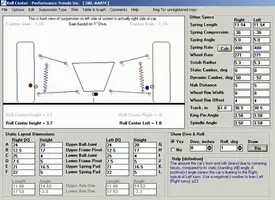
It's a double a-arm setup, similar to the MII. Why is it that with one degree of roll, it's producing .50 degrees of positive camber on the outside wheel and -.52 degrees of camber on the inside wheel? How is the MII setup you're reffering to so different than this one?
Attachments
1970 slantroof
Founding Member
If you increase the angle of the upper control arm, it will increase the negative camber caused by spring compression and body roll. Visualize the arc of the upper control arm as the spring compresses. If the arm has an upward angle from the pivot point up to the ball joint, the arc of that control arm will pull the top of the spindle inward, increasing negative camber. Many racecar spindles have a large threaded stud on the top of the spindle that sticks thru a spherical bearing on the end of the control arm. Putting spacers on that stud under the control arm changes the control arm angle to change the camber curve. Sometimes they even shorten the upper control arm to make that arc shorter.
Howard
Howard
Red Barchetta
Founding Member
We all agree, as the suspension travels in jounce, due to the shorter upper control arm, negative camber is produced. That is not the issue at hand. The issue is the claim that body roll increases negative camber on the outside wheel.
Can anyone address this comment I made in my previous post?
If you won't believe my explanation, then what about the example from the Performance Trends software that I posted above?
Can anyone address this comment I made in my previous post?
How is my explanation incorrect?Let me explain why the tire does roll with the car. When a car leans, where does the outside upper control arm move in relation to the lower control arm? As the body leans, the outside upper control arm moves outward. The lower control arm moves as well, but since it it mounted lower, body roll does not have as much of an effect. Since the upper control arm moves more, this causes the tire to lean outward as well, loosing camber. How much depends on the roll center height. The lower the roll center, the more this will affect camber.
If you won't believe my explanation, then what about the example from the Performance Trends software that I posted above?
Now I see where the confusion is comming from.
In your suspension model it does show a positive camber gain on the outside tire. This is correct because the upper A-arm pick up point is moveing outward relative to center. In this case the movement of the upper A-arm is less then the amount of negative camber gain. Your numbers show this. What your software isn't factoring in is center of gravity movement of the car in roll. Your diagram shows no compression on the outer wheel, just chassis twist for lack of a better term. The outer wheel will experience dive (spring compression) in a turn on the outside wheel. That is the whole reason for a shorter upper control arm and can be seen in camber/dive measurements.
Your previous statement about front end lift while accelerating out of a turn is correct. That is why a car can go from oversteer to understeer in a turn due to changes in weight distribution. Depending on how the car is setup effects this. There are many factors to consider in suspension design. Unfortunately most people dwell on A-arm lengths and spring movement. Both are worth consideration, but not necessarily more so then how the rest of the suspension design works as a unit.
In your suspension model it does show a positive camber gain on the outside tire. This is correct because the upper A-arm pick up point is moveing outward relative to center. In this case the movement of the upper A-arm is less then the amount of negative camber gain. Your numbers show this. What your software isn't factoring in is center of gravity movement of the car in roll. Your diagram shows no compression on the outer wheel, just chassis twist for lack of a better term. The outer wheel will experience dive (spring compression) in a turn on the outside wheel. That is the whole reason for a shorter upper control arm and can be seen in camber/dive measurements.
Your previous statement about front end lift while accelerating out of a turn is correct. That is why a car can go from oversteer to understeer in a turn due to changes in weight distribution. Depending on how the car is setup effects this. There are many factors to consider in suspension design. Unfortunately most people dwell on A-arm lengths and spring movement. Both are worth consideration, but not necessarily more so then how the rest of the suspension design works as a unit.
1970 slantroof
Founding Member
Red,
I see no hole in the logic of the comment you made. On body roll, the upper pivot will move toward the outside of the turn. This will at least attempt to induce positive camber.
Howard
I see no hole in the logic of the comment you made. On body roll, the upper pivot will move toward the outside of the turn. This will at least attempt to induce positive camber.
Howard
Red Barchetta
Founding Member
First off, I spoke with someone who is infinitely more experienced in this area than I am. Essentially, we do not know all of the variables in order to correctly calculate dynamic camber change. In short, this is what he said:Sundance said:Now I see where the confusion is comming from.
In your suspension model it does show a positive camber gain on the outside tire. This is correct because the upper A-arm pick up point is moveing outward relative to center. In this case the movement of the upper A-arm is less then the amount of negative camber gain. Your numbers show this. What your software isn't factoring in is center of gravity movement of the car in roll. Your diagram shows no compression on the outer wheel, just chassis twist for lack of a better term. The outer wheel will experience dive (spring compression) in a turn on the outside wheel. That is the whole reason for a shorter upper control arm and can be seen in camber/dive measurements.
Your previous statement about front end lift while accelerating out of a turn is correct. That is why a car can go from oversteer to understeer in a turn due to changes in weight distribution. Depending on how the car is setup effects this. There are many factors to consider in suspension design. Unfortunately most people dwell on A-arm lengths and spring movement. Both are worth consideration, but not necessarily more so then how the rest of the suspension design works as a unit.
With that said, all the numbers regarding camber in this thread are incomplete, as they do not represent dynamic camber change in real world situations.Without going into all the details associated with the PT software, the output data can be very confusing at times.
“Dive” (as used in the PT software) is simply pure compression (“jounce”) of the suspension. The vehicle doesn’t know (or care) if it results from brake dive or chassis roll. The only difference is that 2” of dive will result in 2” of compression of the suspension on both front tires, whereas roll will result in essentially equal and opposite jounce/rebound of the two front tires (jounce on the outside tire and rebound on the inside tire).
It’s worth mentioning that you are not including steer angles into your analysis, and short of huge crosswinds, it’s pretty difficult to generate roll angles without steering input. Obviously caster and steering axis inclination (SAI) will both have an effect upon the dynamic camber of a steered tire.
The actual dynamic camber angle of the outside tire will be the sum of the static camber, plus a small additional amount resulting from the use of positive caster, plus the kinematic portion resulting from the compression of the suspension. Subtracted from this will be the loss of camber resulting from steering axis inclination, as well as the roll angle of the body/chassis relative to the road surface.
Without completely understanding how all of the other variables apply, I feel that attempting to continue to discus dynamic camber gain on my part would be erroneous as it is beyond my current knowledge.
1970 slantroof
Founding Member
Here is what I did with my Mustang II setup. I modified the upper control arm mount to lower it 1/2" from stock. Not the spring perch or shock mount, just the control arm mount area. My mechanical plot showed this would be an improvement in the camber curve.
I can find a twistie road and check the tire temps across the tread with a pyrometer and see if the tire is laying flat on the pavement dynamically. I can shim the control arms back up to the stock height in any increment if necessary. The mount cannot be lowered more than 1/2" because the slope for the anti dive will not allow control arm clearance to the frame above 1/2".
I know experience is an unpopular term here but it works for me.
Howard
I can find a twistie road and check the tire temps across the tread with a pyrometer and see if the tire is laying flat on the pavement dynamically. I can shim the control arms back up to the stock height in any increment if necessary. The mount cannot be lowered more than 1/2" because the slope for the anti dive will not allow control arm clearance to the frame above 1/2".
I know experience is an unpopular term here but it works for me.
Howard
shelbyseven
Founding Member
i just want to know how a MII fronted mustang drives.my 67 with everything new or rebuilt(before flaming river boxes) drives like s%$t.i don't need a road racer,just a car that doesn't make ya nervous on the interstate...anyone here have a driver equipped with a MII front end?
Similar threads
- Replies
- 3
- Views
- 311


- Replies
- 5
- Views
- 125
- Replies
- 0
- Views
- 190
- Replies
- 1
- Views
- 206

