nitrous?

I have a 2003 gt with bolt ons and full exhaust with long tubes h pipe and flows 40. What is the highest shot i could go with on it? I want to get a 125 shot which I think it can handle up to a 150 shot max, but i would want to hear from yall what you think. Thank you.
 
Get a plate kit. Most of the people I have talked to who have nozzle kit's wish they would have went with a plate.

I am running a Nitrous Express 2v plate kit and absolutely love it.

On top of a basic nitrous kit, I would recommend getting a purge, MSD digital window switch, and a bottle heater.

As far as shot goes, a 150 shot is the safe limit on the stock plastic intake. I have seen people spray more than that, but 150 seems to be the "safest".

If you are looking for a basic nitrous kit tho, and just want something to spray every now and then, look in the ZEX stuff. They are very user friendly and easy to wire up.
 
Stumbaugh stated that a 150 shot is probably the safe limit. The fact is, it depends on the tune. Run a 150 shot on 91 octane and the stock tune and you will soon be building a new short block. You'll need to tune for that hard of a hit. Nitrous helps the combustion process to proceed more quickly, so you should pull out some timing to run safely (and faster). You'll also want to check the AFs to make sure your fuel pump is keeping up, and the jetting is close enough. Long as your tune is safe and the power is kept to around 425whp, you should be fine...
 
I stated a 150 shot is the safe limit for the plastic intake. A tune will have nothing to do with the safe limit of the intake, because the intakes have a problem of fuel puddling after a 150 shot and like to back fire.

You can run a 100 shot on the stock tune, for a 125 shot, take out 1 degree, for a 150 shot, take out 2 degree's.

Something I just remember, you need to buy some NGK TR6 spark plugs, or something equivilant that is 1 heat range colder than stock.

If you decide to go above a 100 shot, you really need to step up to a SVT Focus pump.
 
I have absolutely no safety features on my nitrous kit lol. I think they're kinda a waste of money. No offense. If im banging gears, im not going to miss them. And no, theres never going to be that "one time"


But, i say the 100 shot seems best, ive heard some bad stories about pushing more, but, i cannot really say because im not pushing that much nitrous. But if you're in debate, just get it, its f****N fun.
 
Stock 4.6 2V longblocks can handle roughly around 400rwhp. There are a few running 400-450rwhp on their stock blocks but you're really risking the longevity of the motor. So, with you mods you should be in the area of about 275rwhp give or take. I wouldn't go bigger than a 125-shot.
 
You can say you wont miss gears and there wont be that one time all you want. You are going to miss a gear at some point or another and when that intake blows into pieces, you are going to wish you had spent that $120 on a window switch.
 
Stock 4.6 2V longblocks can handle roughly around 400rwhp. There are a few running 400-450rwhp on their stock blocks but you're really risking the longevity of the motor. So, with you mods you should be in the area of about 275rwhp give or take. I wouldn't go bigger than a 125-shot.

It's actually torque down low that is the cause for blowing these motors up, not the horsepower up top. There are a hand full of Centri/nitrous cars making 500+rwhp on the stock short block. The nitrous cars are waiting until a little over 4000rpm to spray, and centri cars are known to not make very much torque down low, but make a lot of power up top. So this allows them to push the envelope farther than say a Kenne bell or Tork Tech car could.
 
It's actually torque down low that is the cause for blowing these motors up, not the horsepower up top. There are a hand full of Centri/nitrous cars making 500+rwhp on the stock short block. The nitrous cars are waiting until a little over 4000rpm to spray, and centri cars are known to not make very much torque down low, but make a lot of power up top. So this allows them to push the envelope farther than say a Kenne bell or Tork Tech car could.

Wow, of the many many years that I been spending learning about Mustangs, I have never heard that concept. Interesting.
 
You can say you wont miss gears and there wont be that one time all you want. You are going to miss a gear at some point or another and when that intake blows into pieces, you are going to wish you had spent that $120 on a window switch.

agreed

It's actually torque down low that is the cause for blowing these motors up, not the horsepower up top. There are a hand full of Centri/nitrous cars making 500+rwhp on the stock short block. The nitrous cars are waiting until a little over 4000rpm to spray, and centri cars are known to not make very much torque down low, but make a lot of power up top. So this allows them to push the envelope farther than say a Kenne bell or Tork Tech car could.

and agreed!

If you want it to be safe, get an rpm window switch.

Like Stumbaugh said, get some colder plugs, a better fuel pump if your gonna spray more than 100 shot, pull timing on anything above a 100 shot, and get a window switch.

FWIW, I've been spraying a 125 shot for 3+ years now without any troubles. Just be sure to change your fuel filter and spark plugs regularly.
 
It's actually torque down low that is the cause for blowing these motors up, not the horsepower up top. There are a hand full of Centri/nitrous cars making 500+rwhp on the stock short block. The nitrous cars are waiting until a little over 4000rpm to spray, and centri cars are known to not make very much torque down low, but make a lot of power up top. So this allows them to push the envelope farther than say a Kenne bell or Tork Tech car could.

Is it "torque down low" that causes the failure, or just torque in general (as in, peak torque)? The amount of torque a motor makes is directly related to the cylinder pressure. The cylinder pressure is highest at peak torque, which would make me think that the most stress on internal engine components is whenever the car is producing peak torque. But I don't know. Maybe I'm missing something here. Educate me.

And on top of that, the fact that it takes extra power to turn a positive displacement blower, versus much less for a centri and none for nitrous/turbo, puts extra stress on the internal components.

For example, a 400 rwhp nitrous or turbo car is making (400 hp + [whatever is lost in the drivetrain]) at the motor, which is probably in the 450 bhp range.

For a 400 rwhp PD blower car, the engine is making (400 hp + drivetrain loss + what it takes to turn the supercharger). And I've read before that that number is in the 50ish hp range for 10 psi of boost. So that particular car would actually be making over 500 hp at the motor.

And 50 extra brake horsepower when you are ALREADY close to double what the stock components were designed for is significant.
 
Peak torque on a nitrous car using a "wet" kit will be the moment the nitrous system activates. So in that sense, the torque down low = peak torque.

Yea, that's what I figured the overall meaning of that comment was.

So just for future reference: 450 ft-lbs of torque at 2500 rpm isn't going to stress anything any more than 450 ft-lbs of torque at 5000 rpm?
 
Is it "torque down low" that causes the failure, or just torque in general (as in, peak torque)? The amount of torque a motor makes is directly related to the cylinder pressure. The cylinder pressure is highest at peak torque, which would make me think that the most stress on internal engine components is whenever the car is producing peak torque. But I don't know. Maybe I'm missing something here. Educate me.

And on top of that, the fact that it takes extra power to turn a positive displacement blower, versus much less for a centri and none for nitrous/turbo, puts extra stress on the internal components.

For example, a 400 rwhp nitrous or turbo car is making (400 hp + [whatever is lost in the drivetrain]) at the motor, which is probably in the 450 bhp range.

For a 400 rwhp PD blower car, the engine is making (400 hp + drivetrain loss + what it takes to turn the supercharger). And I've read before that that number is in the 50ish hp range for 10 psi of boost. So that particular car would actually be making over 500 hp at the motor.

And 50 extra brake horsepower when you are ALREADY close to double what the stock components were designed for is significant.

It's just like Tim said. I applogize, I worded it wrong. It would be considered the peak torque and not so much the torque down low as I said before.

What you brought up about the Power train lose with a supercharger is what a lot of people do not seem to consider, I'm glad you are one of the few who actually take that into consideration.
 
Wow, of the many many years that I been spending learning about Mustangs, I have never heard that concept. Interesting.


HP is nice to talk about, but if you want to broke things :D talk about torque.

If you go to the Tremec web site you will see that they rate our 5 speed by torque capacity.

TTC: TREMEC Transmissions

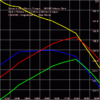
Computer simualtion of 260 HP 4.6l with 100 shot

Stan
 

Attachments

  • ab-nit10.gif
    ab-nit10.gif
    13.8 KB · Views: 154
I run a 125 shot on my car as well with the Harris Speed Works plate kit. I love it, and would never consider going nozzle.

I run mine bare bones, no window switch, purge, etc. So far so good, and that does include a few missed shifts finding the limiter. It's backfired out the exhaust every time, not the intake.

I use Autolite 103 copper plugs, 1 step colder than stock. I have about 2* WOT timing pulled and added in a decent amount of WOT fuel. I'm also running a stock fuel pump, which, like the bone stock engine, has about 153k miles on it.


Clutch won't hold it, but everything else seems to be doing fine. I've ran 6-7 bottles through the car, last time I ran most of the bottle through in one track session on the 125 shot. I expected it to pop, but it kept on doing its thing.


I ran a buddies GT, Vortech supercharged, ported heads, Trick Flow cams, 3.73 gears, etc. and we were both shocked at the outcome. He could not pull away from me until I ran out of gear at the end of 4th... it's the instant nitrous torque vs the slower building of boost found in centri cars. He was pissed...:lol: I also ran within 1/100th of a buddies H/C/I/geared LS1 Z/28 6 speed on the 1/8th mile track when I was running the 100 shot.

Point is... nitrous works, it's not the devil, and it's stupid fun. Nothing like smacking it in 3rd and having the tires brake loose at 55-60mph.
 
It's actually torque down low that is the cause for blowing these motors up, not the horsepower up top. There are a hand full of Centri/nitrous cars making 500+rwhp on the stock short block. The nitrous cars are waiting until a little over 4000rpm to spray, and centri cars are known to not make very much torque down low, but make a lot of power up top. So this allows them to push the envelope farther than say a Kenne bell or Tork Tech car could.

I copied this directly off the kenne bell website.

Centrifugal people say that high boost from the Kenne Bell at low rpm can damage my engine and drivetrain. Is this true? That's a good one. I know of a lot of engine builders who would find this hilarious. I was always under the impression that popping the clutch at 4000-6000 rpm and revving the engine through the gears to get the boost up was a little rougher on the engine and drivetrain than punching it at 2000 or 3000 rpm - but as Dennis Miller always says "I could be wrong." Let's get real! No one ever blows up an engine at 2000, 3000 or 4000 rpm. They blow at 6000-7000. Always remember that the inertia loads on the bearings, rods and piston go up with the square of the rpm increase - another reason why supercharging has become so popular. Supercharging with the Kenne Bell does not require high rpm and high loads to make horsepower as it pressurizes the cylinders throughout the entire rpm range.Think about this scenario. The driver determines that his car needs 400 ft. lbs. of torque for a good launch. The Kenne Bell makes 400 ft. lbs. at 3000 rpm, but Supercharger "B" requires 6000 rpm to produce 400 ft. lbs. Now which has the best chance of damaging the drivetrain?
 
I copied this directly off the kenne bell website.

Centrifugal people say that high boost from the Kenne Bell at low rpm can damage my engine and drivetrain. Is this true? That's a good one. I know of a lot of engine builders who would find this hilarious. I was always under the impression that popping the clutch at 4000-6000 rpm and revving the engine through the gears to get the boost up was a little rougher on the engine and drivetrain than punching it at 2000 or 3000 rpm - but as Dennis Miller always says "I could be wrong." Let's get real! No one ever blows up an engine at 2000, 3000 or 4000 rpm. They blow at 6000-7000. Always remember that the inertia loads on the bearings, rods and piston go up with the square of the rpm increase - another reason why supercharging has become so popular. Supercharging with the Kenne Bell does not require high rpm and high loads to make horsepower as it pressurizes the cylinders throughout the entire rpm range.Think about this scenario. The driver determines that his car needs 400 ft. lbs. of torque for a good launch. The Kenne Bell makes 400 ft. lbs. at 3000 rpm, but Supercharger "B" requires 6000 rpm to produce 400 ft. lbs. Now which has the best chance of damaging the drivetrain?

Yes, the load and forces on the bearings, crankshaft, etc. go up as the RPM goes up, but those aren't the things that normally break first on these motors. It's the pistons and rods, which normally go due to high cylinder pressures. The cylinder pressure is directly related to the torque; doesn't matter where it's at in the RPM range (we established this earlier). They even said so themselves, "as it pressurizes the cylinders throughout the entire rpm range. And that cylinder pressure is what shatters rings.

So while Kenne Bell is correct in saying that engine damage is more likely at upper rpms, that margin over low RPM is small, and doesn't really help prove their point.

And I've said it before numerous times, but I'll say it again anyway. Kenne Bell will shoot you a load of crap in a heartbeat. While they do have some good info, you need to remember that they are still trying to sell a product. If they want to get technical about it, the low end torque (generally speaking) has nothing to do with how fast a car is at the track. A properly setup car will have a high HORSEPOWER motor (at whatever RPM range) and will make the TORQUE on the wheels through proper gearing.