no. 7 cylinder not firing

ok, my no. 7 cylinder isn't firing. I have spark at the plug when the plug is removed, so i am asuming that its sparking in the cylinder. i have good fuel pressure on my fuel rail. at first i thought it was my injector, which was brand new but you never know. so i swapped the no. 7 and no. 5 injectors and no change. my compression in the cylinder is around 140 ish. whats the deal. i think that it might be between the injector and my computer. i did a speed density to mass air conversion and hooked up all the wires, but i just cant seem to figure this cylinder problem out. :shrug: help!!!!
 
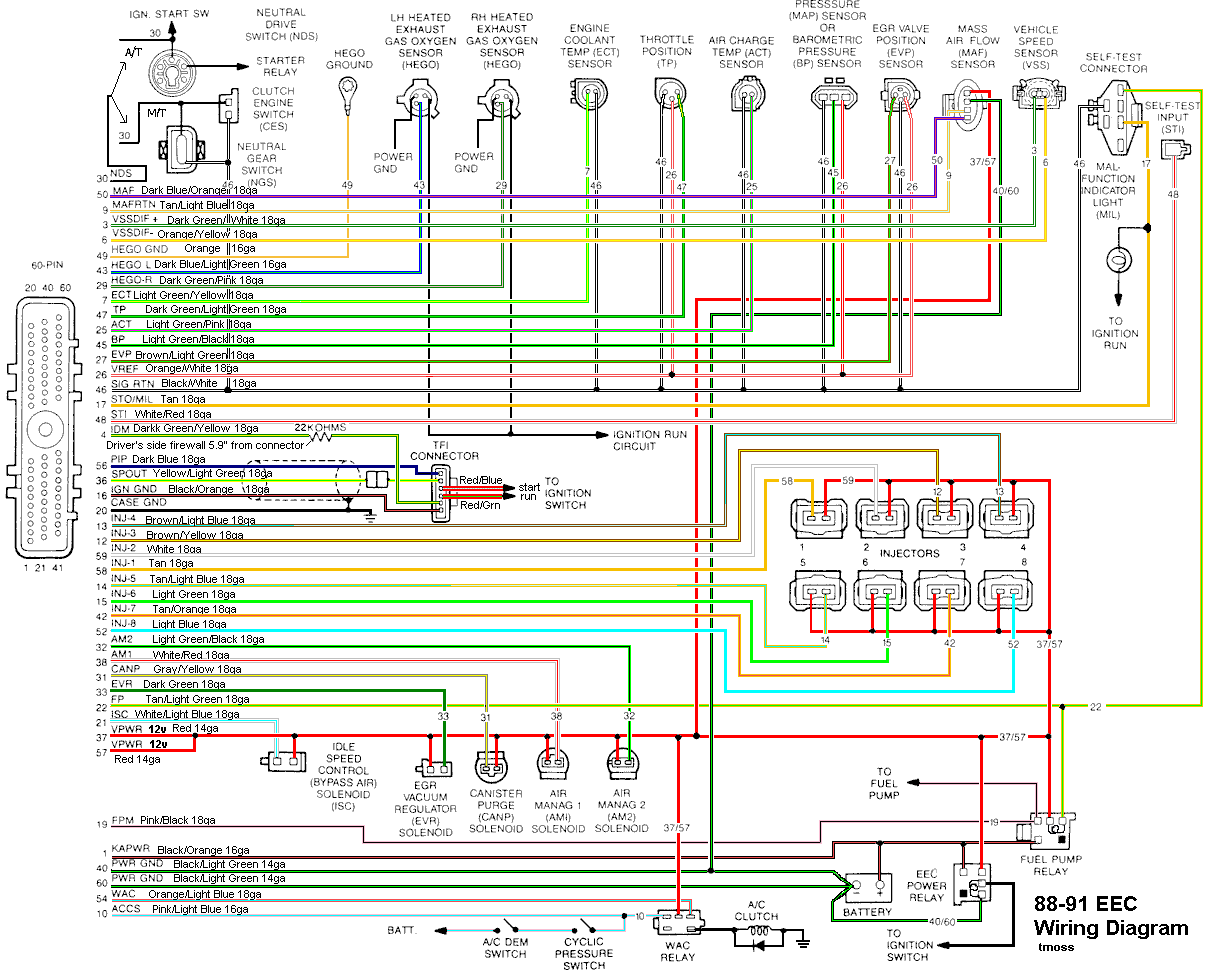
it could be getting spark when its outside the cylinder because its a lot easier to spark in the atmosphere as opposed to a compressed cylinder. check that wire with an ohm meter and see if its way off from the other wires. other than that check the power and ground from the injector connector to the computer connector. power comes from pin 37 and ground is pin 42. here is the wiring diagram if you want to check it out. the red wire at the connector should have constant voltage with the key on or with the engine running and the ground wire should have continuity to the computer. just make sure you unplug the computer when you do your continuity test
 
bullitstang1313 said:
You can get a noid light to check and see if the computer is sending the signal to the injector. You can pick up a noid light at a parts store or I think even radio shack carries them. How do you know that number 7 is not firing? Did you perform the cylinder balance test?


thats a good point. do a cylinder balance test to see if it is that cylinder. you can always just pull the spark plug wire when the engine is running and see if the rpm drops. just use a plug wire puller so it doesnt shock the crap out of you
 
Cylinder not firing - start with the easy stuff.

1.) Bad spark plug
2.) Bad spark plug wire
3.) Bad distributor cap
(rotor is not the problem as it would affect more than one cylinder)

4.) Bad fuel injector
5.) Bad fuel injector wiring
6.) Bad computer (fuel injectors get the signal to energize the injector from the computer). Rare possibility, that's why it is last in this group

7.) No compression on bad cylinder. Do a compression test if you get this far.
a.) Blown head gasket
b.) Bad valve(s) - bent valve stem, bad valve seats, damaged valve head, bad valve spring(s).
c.) Damaged piston or rings
d.) Cracked cylinder head
e.) Cracked block into the water jacket - not likely, but possible if there was a severe failure of piston or rod. The engine wouldn't run very long if this is the problem, and would have all sorts of shakes, bumps and noises.

Cylinder balance test:
Warm the car's engine up to normal operating temperature. Use a
jumper wire or paper clip to put the computer into test mode. Start
the engine and let it go through the normal diagnostic tests, then
quickly press the throttle to the floor. The engine RPM should exceed
2500 RPM's for a brief second. The engine RPM's will increase to about
1450-1600 RPM and hold steady. The engine will shut off power to each
injector, one at a time. When it has sequenced through all 8 injectors,
it will flash 9 for everything OK, or the number of the failing cylinder
such as 2 for cylinder #2. Quickly pressing the throttle again up to
2500 RPM’s will cause the test to re-run with smaller qualifying figures.
Do it a third time, and if the same cylinder shows up, the cylinder is
weak and isn’t putting out power like it should. See the Chilton’s Shop
manual for the complete test procedure

Here's the link to dump the computer codes with only a jumper wire
or paper clip and the check engine light, or test light or voltmeter.
I’ve used it for years, and it works great.

Here's the link to dump the computer codes with only a jumper wire or paper clip and the check engine light, or test light or voltmeter. I’ve used it for years, and it works great.

attachment.php


See http://www.troublecodes.net/Ford/
OR
See http://www.mustangworks.com/articles/electronics/eec-iv_codes.html

IF your car is an 86-88 stang, you'll have to use the test lamp or voltmeter method. There is no functional check engine light on the 86-88's except possibly the Cali Mass Air cars.

For those who are intimidated by all the wires & connections,
see http://www.actron.com/product_detail.php?pid=16153 for what a
typical hand scanner looks like. Normal retail price is about $30 or so
at Walmart.

Or for a nicer scanner see http://www.midwayautosupply.com/detailedproductdescription.asp?3829 – It has a 3 digit LCD display so that you don’t have to count flashes
or beeps.. Cost is $33.

Do a compression test on all the cylinders.
Take special note of any cylinder that shows up as weak in the cylinder
balance test. Low compression on one of these cylinders rules out the
injectors as being the most likely cause of the problem. Look at cylinders
that fail the cylinder balance test but have good compression. These
cylinders either have a bad injector, bad spark plug or spark plug wire.
Move the wire and then the spark plug to another cylinder and run the
cylinder balance test again. If it follows the moved wire or spark plug,
you have found the problem. If the same cylinder fails the test again,
the injector is bad. If different cylinders fail the cylinder balance test,
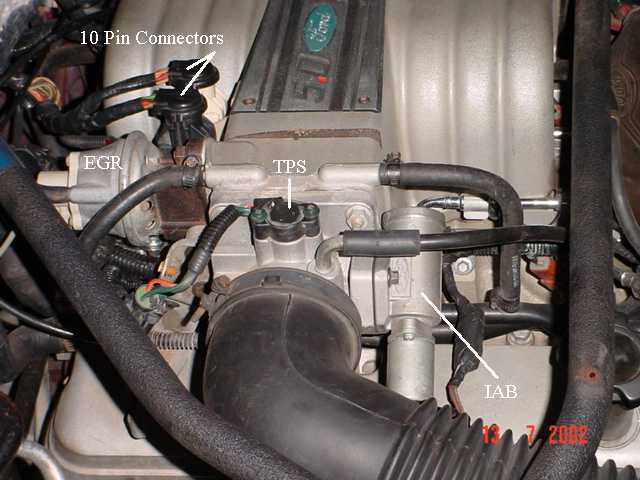
you have ignition problems or wiring problems in the 10 pin black &
white electrical connectors located by the EGR.

How to do a compression test:
Only use a compression tester with a screw in adapter for the spark
plug hole. The other type leaks too much to get an accurate reading.
Your local auto parts store may have a compression tester to rent.
If you do mechanic work on your own car on a regular basis, it would
be a good tool to add to your collection.

With the engine warmed up, remove all spark plugs and prop the
throttle wide open, crank the engine until it the gage reading stops
increasing. On a cold engine, it will be hard to tell what's good &
what's not. Some of the recent posts have numbers ranging from
140-170 psi. If the compression is low, squirt some oil in the cylinder
and do it again – if it comes up, the rings are worn. There should be
no more than 10% difference between cylinders. Use a blow down
leak test (puts compressed air inside cylinders) on cylinders that
have more than 10% difference.
 
thanks for the input

Ok, here's the scoop.

The spark on the No. 7 cylinder looked pretty good. It was in the daylight so it didn't look real bright, but good. I know its the No. 7 cylinder and this was determined by adding a new upper and lower intake manifold and after running it a few times and noticing a miss the intake runner for the No. 7 cylinder was clean just like when I installed it. All the other runners had color (other than new). I did not perform the cylinder balance test, up to this point didn't know it existed. As far as my plug wire, they are Taylor 10.4mm and they were new with intake. I have also swapped the No. 8 wire and the No. 7 wire to see if this made a differance and no change. So I don't think that thats the problem.
I have tried 2 or 3 plugs in that cylinder-no change. My injectors are fairly new, very low miles on them, but just to be sure I swapped the No. 7 and No. 5 injector to see if the problem would move and- no change. I have not checked the injector wiring to ECU, on my to do list. As far as compression it was about 140 ish. Don't remember exactly.

Here's my car: (maybe you can see something that i skipped that might be causing the problem)

1988 hatch, miles 87,000. Holley Sytemax 2 kit I put 1.6 roller rockers on the heads. New pushrods. i did not work to the bottom end. When i had the motor out i cleaned up the block and checked the pistons/cylinder walls and everything looked good. I put 36 lb. injectors switched to mass air, in the process picked up a procharger. I bought a used A9L and the speed density to mass air conversion kit just for the wiring harness. That has all been installed. Taylor wires, mallory ignition. Tremec TKO 600 tranny. and some other little bolt-on's. Throttle body blah blah blah.
My idea so far: I think its in the wiring. either the injector is open all the time or not opening at all.
 
Tools needed: Noid light, Mulitmeter (volts & ohms), 10 MM socket &
extension, & ratchet.

Note: Do all of the steps and do them in order. The results of the
subsequent tests are based on the prior tests being sucessfully passed.


Some basics about the computer:
Remember that the computer does not supply power for any actuator or
relay, but provides the ground necessary to complete the circuit. That
means one side of the circuit will always be hot, and the other side will go
to ground or below 1 volt as the computer switches on that circuit.


1.) Get a noid light form AutoZone or other auto parts store, or even better
a set of them
big22132.jpg

This set is from http://www.toolking.com/ProductInfo.aspx?productid=12492 and costs $12.

2.) Use the noid light to determine that the injector pulses and isn’t
stuck in the on position. It you have a set of them install all of them and
compare the pulse intensity. A light that doesn’t pulse and stays on has a
short to ground in the computer side of the circuit. That can be either a
wiring fault or a failed computer. If this is the case, remove the passenger
side lick panel and disconnect the computer connector. There is one 10
MM bolt holding it in place. Pull the connector all the way out of the
computer so that you can see the computer side pins.
eec04.gif


Use the list from the graphic below to find the fuel injector pins for the
injectors that didn’t turn the noid light off.

88-91_5.0_EEC_Wiring_Diagram.gif


3.) Set the multimeter to low scale Ohms and measure between the
computer ground located below the computer and the suspect fuel injector
pins. You should see greater than 100 K Ohms resistance. If you see less
than 100 Ohms, the wiring between the injector and the computer has a
short to ground and needs service. Check the harness and look for damage,
kinks or frayed spots.

4.) Check the injector resistance by measuring across the two injector connector pins: it should range between 13.5-16 ohms. Check each injector individually.

5.) A light that never turns on is either a wiring fault, or a failed
computer. Either the injector has no DC power or the computer has failed
and cannot switch the injector circuit to ground. Determine if the injector
has power by using the multimeter to check for 12 volts on the red wire on
the suspect injector connector. No 12 volts and you have a wiring fault.
Check the harness and look for damage, kinks or frayed spots. Check the 10
pin salt & pepper shaker connectors for bent pins, corrosion and damage.

Next Check the fuel injector wiring end to end. Each fuel injector has a red
wire (power) and an non-read wire (computer controlled ground). Set the
multimeter to low ohms and measure each non red fuel injector wire from
the fuel injector connector to the matching pin on the computer connector.
You should see less than 2 Ohms. More than that means a bad connection
or bad wiring.

See the graphic for the location of the 10 pin connectors:
TPS_IAB_Pic.jpg


See the graphic for the 10 pin connector circuit layout.
harness02.gif


Once you have determined that the suspect injectors have good power and
good wiring, the computer is the likely suspect, since a ground is required
to complete a circuit and make it function. The computer provides the
ground: if doesn’t, then the noid light will not flash.

6.) If you have gotten this far, then the problem is likely ignition
related. Remember the noid test using all of the noid lights? All of them
were supposed to be equally bright. Since you have already tested all the
electrical side of the fuel injector circuit, the one remaining common item is
the pip sensor inside the distributor. A failing pip sensor, damaged shutter
wheel or bent distributor shaft could all cause the pulse delivered to the
injectors to be faulty.


7.) Spark plugs indicate one or more cylinders not firing: use the
multimeter to measure the resistance of the spark plug wires. The wires
should measure 2000 ohms per foot of length. A 2 foot wire would be 4000
ohms and a 3 foot wire would be 6000 ohms. Some Taylor and Accel wires
have metal cores and will measure much less: that’s OK.
Next examine the spark plug wires very carefully for burn spots, cracks and
damaged insulation. One good thing to try is to start the engine while the
car is a very dark area, open the hood and look for sparks or blue glow.
They indicate the electricity is leaking out of the spark plug wires.

Thanks to Tmoss & Stang&2birds at www.veryuseful.com/mustang/tech/engine/ for some of the graphics

Thanks also to www.fordfuelinjection.com for some of the graphics.