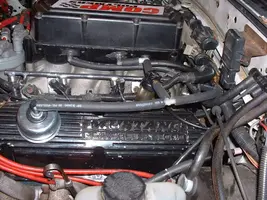
Oil in manifold

stevesLX

Member
Nov 12, 2006
373
0
16
cincinnati
O.K. guys I give up I am about 5 seconds short of just selling this car to a junk yard. I dont know what else to do. I have oil getting into my manifold. I dont know from where though. I checked the pcv line and it is dry as can be. The hose from the vacum tree to the back of the manifold has oil in it though. Everytime I pull it off the back of the manifold it fhas oil that comes dripping out. This is a Edelbrock 5.0 performer intake and manifold. When I pull the front cover off the manifold it is always got oil laying in it. Every runner inside it has oil in it. Ihope this is what is also causing my blowby. When I start it up it has some blue smoke and if a get on it hard it has some that shoots out also. I have done compression test and every cylinder is at 150 except cylinder 4 is at 143 and these numbers dont change with or without oil. I have done a leak down test and the leakage needle on the leakage guage didn't budge off zero. I am clueless and fed up. This motor was just rebuilt and the thing seems like it has more issues now than it did before I had the lower end and heads redone. Something else I dont know if this could be causing any problems or not but the hose that goes from the vacum tree to the back of the manifold doesn't have a hose clamp on it where it slides onto the tube coming off the manifold. Should it have one or not.
 
O.K. but if I had brand new seals just put in thesae at the machine shop. Less than a 1000 miles on them. They said the guides were bfine. Wouldnt it go straight out the exhaust if it was getting past either one of those anyways and not up into my manifold. And when I say oil in the manifold I am not just talking a spot here and there. When you take off the front cover of the manifold as soon as you break the seal on ity oil starts dripping out. There's a boat load of it in there. The manifold itself is dry up at the TB. The gasket is wet that sits between the manifold and the intake with oil.
 
check the routing for all of the lines to the vacuum tree, make sure it's correct.
I had a similar problem after I did my intake swap... there's an oil baffel for the pcv valve that needs to be transfered from the orginal intake...
without it oil gets sucked into the intake...
do you have stock or aftermarket vale covers?
 
You know I dont know if there is a baffle in the intake or not. I know it didn't have a screen when I bought the car. I have since installed one. How can I tell if it has a baffle or not? I have stock covers and the hose from the cover to the TB is dry. The hoses on my vacum tree are all hooked mup correct.
 
I am going to go to Lowes and pick up a air/water seperator to try to reroute this oil that keeps getting into my manifold. I just need a basic understanding of what exactly I all need to get and how I go about hooking this thing up.
 
You should be able to tell if the lower intake baffle is in place by removing the pcv and using a mirror/flashlight to look down the pcv hole.
This is 'In theory' though, as just seeing the pcv can be tough with a long runner intake.


I am going to go to Lowes and pick up a air/water seperator to try to reroute this oil that keeps getting into my manifold. I just need a basic understanding of what exactly I all need to get and how I go about hooking this thing up.

It is pretty straight forward...

The separator just goes in the pcv line.
Be sure to remove the plastic filter piece in the separator, as some oils seem to plug them up.
Make sure you have it installed in the right direction; there is an inlet and outlet on the separator.

I'll see if I can find a pic of my last setup.
Here is a pic of my setup with a secondary pcv...
PCVSetup2.webp


jason
 

Attachments

  • PCVSetup2.webp
    PCVSetup2.webp
    104.3 KB · Views: 137
So this may be a stupid question but just want to make sure I get it right. The line from the PCV woulg go in the inlet side and then I would run another line from the outlet side to the manifold where the PCV line was hooked up at?
 
O.K. I got the seperator hooked up and guess what I drove the car about 1 mile and got on it hard 2 or 3 times and the container is full. So now what. I got the seperator from Lowes it was 12.00. Its not very big but I have to drive 40 miles one way to work. What happens when this thing fills up long before I get to work?
 
When the separator gets full, the oil will continue to flow into the intake.

The separator itself is not a permanent solution, but it allows you to verify that oil is coming in from the pcv.
You now know where the oil is coming from, so you can move on to figuring out 'Why' the oil is coming from the pcv.

First verify that the pcv baffle, screen, and pcv itself are all in place and functioning properly.
That would be step one.

Hopefully it is something simple...

jason
 
ok well im not tryinmg to hijack the tread but i have a brand new 347 in my car and im having the same problem, just my sepertaor doesnt fill up that fast but the only thing is i am running the intake off my old motor that did the same thing (pull oil up through the intake and soak the runners )i am assuming my pcv is working bc it rattels, but would the screen under it cause this to happen if it had gotten soaked from the old motor it had allmost 150 thousand on it but it was replaced b4. my hole tbody is soaked with oil allso now if i do not have a baffle on my valve cover would tis make it do this i just pulled it out to clear my 1.7 with the new motor
 
The PVC should be baffled, and have the mesh screen installed if it is in the stock location. The screen acts to condense the oil out of the air being sucked through the PVC. The oil then drips back into the lifter valley. If the screen is dirty, or semi-plugged up, the air velocity flowing through it is increased, and will eventually flow so fast that it will pull the oil through the valve and into the intake instead of allowing it to drip.
A thorough cleaning, or a new screen, might be in order.
I remember reading a post recently about running 2 PCV valves in seperate locations that are plumbed into one line before entering the plenum. This reduces the air velocity by 1/2 and might be a possible fix for you.
I agree that the seperator is just a temporary band-aid/diagnostic method.
Good luck, and let us know how it turns out.