

You are using an out of date browser. It may not display this or other websites correctly.
You should upgrade or use an alternative browser.
You should upgrade or use an alternative browser.
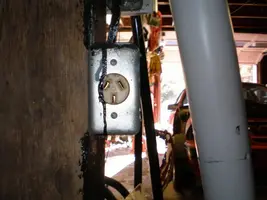
Outlet. What voltage? Pics
- Thread starter bynummustang
- Start date
iwashmycar
20+ Year Stangneter 

You likely need a new socket.
Also check to see the breaker in the panel, and see if the amperage matches up with your welder.
The welder should have a plate on it that says something along the lines of "minium circuit ampacity".
It should be a 2 pole (2 breakers connected by a bar).
Also check to see the breaker in the panel, and see if the amperage matches up with your welder.
The welder should have a plate on it that says something along the lines of "minium circuit ampacity".
It should be a 2 pole (2 breakers connected by a bar).

The socket shown is typical of a 220 volt 30 amp circuit used for clothes dryers. It should power a small welder (150-180 amps) without any problems. Check the breakers to make sure that is the rating.
I was thinking of the welder output. The welder's output current is many times greater than its input since it uses a step down transformer to decrease the voltage and increase the current.2000xp8 said:J, you got the first half right, but not sure where you are coming up with 150-180 amps, lol.
An entire house normally never exceeds 200amps, and most are less than that.
A lincoln mig welder #2472-1 uses 220 volt 20 amp AC input to get 180 amp at 20 DC volts output.
Check out http://www.mylincolnelectric.com/Catalog/lecobrowse.asp?locale=1033 for more information
jrichker said:I was thinking of the welder output. The welder's output current is many times greater than its input since it uses a step down transformer to decrease the voltage and increase the current.
A lincoln mig welder #2472-1 uses 220 volt 20 amp AC input to get 180 amp at 20 DC volts output.
Check out http://www.mylincolnelectric.com/Catalog/lecobrowse.asp?locale=1033 for more information
I think that is what I was thinking about. I know it plugs into a 220V outlet. The welder is a Lincoln 225AC ARC welder. I'm picking it up for under $150.
My point is when you are plugging in something that has a transformer built into it, the converted power means nothing as far as installation goes.
As a licensed electrician here in NJ, i would never even make mention of that number, since all it does is confuse homeowners for no reason.
The little Stainless steel nameplate is all that matters in an install situation.
As a licensed electrician here in NJ, i would never even make mention of that number, since all it does is confuse homeowners for no reason.
The little Stainless steel nameplate is all that matters in an install situation.
??? I don't follow your train of thought.2000xp8 said:My point is when you are plugging in something that has a transformer built into it, the converted power means nothing as far as installation goes.
As a licensed electrician here in NJ, i would never even make mention of that number, since all it does is confuse homeowners for no reason.
The little Stainless steel nameplate is all that matters in an install situation.
The welder uses 220 volt, 20 amp input, and has a 20 volt 180 amp output. The 220 volt, 30 amp circuit should be fine for powering a welder with those input specs.

90
Active Member
****by the looks of the wire goin in, im gonna say 110. 15amps at most... a dryer receptical is typicaly larger then that.. Read the wire, if its 14-2 its 15 amp (110 vols)...if its 14-3 is 15amp(110volts) if its 12-2 its 20 amp (120volts)... it doesnt look like 6-8 wire to be a 30-50 amp .... sorry jrichker not to bump heads that is my profession.. 2 1/2 years in the trade!
it looks like 14-2 (white) because 12-2 is yellow... but older wire ive seen 12-2(white)... it cant be 6-8 wire... My vote is 110 no where near 30 amp!
it looks like 14-2 (white) because 12-2 is yellow... but older wire ive seen 12-2(white)... it cant be 6-8 wire... My vote is 110 no where near 30 amp!
jrichker said:??? I don't follow your train of thought.
The welder uses 220 volt, 20 amp input, and has a 20 volt 180 amp output. The 220 volt, 30 amp circuit should be fine for powering a welder with those input specs.
My train of thought is that the welders output has nothing to do with anything as far as installation. It may describe how good of a welder it is, but as i said that means nothing as far as hooking it up. Everything has some type of power supply that converts the power, but as long as you can plug it in, there is no need to be bothered with it's output.
Input matters, not output.
90mustang, the wire's amperage rating is what matters.
And sinces it was used for an electric dryer, it's at least rated for 30 amps.
Which would make it #10 wire.
So if this welder is for normal use, that wire should do.
My point with possibly changing the breaker, would be to make it smaller if necessary. So if the welder only calls for say 17.5 amps @220v, you don't want a 2 pole 30 on it, because if something goes wrong, the breaker is far less likely to trip.
90
Active Member
2000xp8 said:90mustang, the wire's amperage rating is what matters.
And sinces it was used for an electric dryer, it's at least rated for 30 amps.
Which would make it #10 wire.
well with what looks like tar all over the wire, it doesnt look like 10 wire.. but you are correct as far as 30amps go, if it were to be 10wire.. but if it were 17.5 amp draw... you could put it on a 2pole 20 amp breaker! as well if it were 10-3, which it would most likey be if it were a dryer receptical... if it were 10-2 you could use a 20amp single pole breaker at 17.5 amp.. is long as the MAX AMP.. are under 20! like 17.5.
There were dryers back in the day, that only used a 10-2 with ground, same with ovens.
Now they use a 10-3, meaning they have a neutral also, which is more than likely not needed with the welder.
So you can still use a 2 pole breaker even though the wire is 10-2.
Now they use a 10-3, meaning they have a neutral also, which is more than likely not needed with the welder.
So you can still use a 2 pole breaker even though the wire is 10-2.
90
Active Member
you could use a 2pole, but if breaker space is unavailable a single pole breaker would work... being old i recommend a 20 amp GFI (Ground Fault indicator).. i think thats what it means.)breaker that makes it safe for the user and the house hold... lets just pray its no a fuse box instead of breakers. that would be a world of problems!
You can only use a single pole if the welder has an option inside to swap wires to make it run on 110v.
And you can always use tandem breakers, depending on the panel type it can be cheap or expensive.
If it's fuses, don't hook anything up.
A gfi protected circuit may not work, heavy loads tend to trip gfi breakers.
They are almost only used in situations that have normal outlets by water or something that can get wet.
And you can always use tandem breakers, depending on the panel type it can be cheap or expensive.
If it's fuses, don't hook anything up.
A gfi protected circuit may not work, heavy loads tend to trip gfi breakers.
They are almost only used in situations that have normal outlets by water or something that can get wet.
90
Active Member
well a welder in a garge would fall in that cat;. thats why theres a code for garages kitchens bathrooms basements attic space which are all consider'd wet location... bed rooms get afci breakers..
Single outlets DON'T fall under the gfci rules.90mustang_GT5.0 said:well a welder in a garge would fall in that cat;. thats why theres a code for garages kitchens bathrooms basements attic space which are all consider'd wet location... bed rooms get afci breakers..
Items like dryers, sump pumps, garbage disposals and anything else that gets a dedicated circuit don't fall in that category, including welders.
Not trying to bust your balls, or prove you wrong, but i own an electrical contracting business so i know for sure.
90
Active Member
i never said they did... i said those locations get GFI plugs... i simply recomended a GFI breaker for a welder with that old wiring job! your not busting my balls on an opinion.. im glad to hear that you own an electrical company... and you are 100% correct about the above! it was opinionated thats all! old wire jobs that didnt required codes, which you can tell its not knob and tube.. but id much rather be safe then sorry! all i said was a garage is a wet location.. requiring a gfi plug, no the welder does not need to be protected but in his case i would. i only have 2 1/2 years on my tool belt, so i dont always no the answers... but i would start talken if i wasnt 95% sure of what i am saying!
Similar threads
- Replies
- 1
- Views
- 47


- Replies
- 2
- Views
- 249
- Replies
- 7
- Views
- 192
- Replies
- 30
- Views
- 991
