Peculiar Fuel Gauge Problem?

horseballz

10 Year Member
Sep 30, 2009
824
19
49
Las Vegas, NV
Hey All,
88 Mclaren/5.0/AOD/Convertible. Fuel gauge works with key on/engine off. Gauge goes to empty after car is key on/engine running. I did a search and found nothing on this particular issue. This car is my brother's winter driver for when he flies into Vegas to escape the snow, so it only gets driven once or twice a month when he's not here.
Short History:
>A couple months back I filled with fuel (with car running, like an idiot) and went to drive away, car stalled and started hard, then seemed ok. Went on a 150 mile round trip involving a run through semi high altitude over a small mountain each way. While going up the mountain on the first leg of the trip (fairly steep long grade/heavy throttle/mostly out of overdrive/65-75-ish MPH) a driver behind me pulled me over to tell me that I was pouring raw gas out the rear of the car. Upon a quick inspection, in the middle of nowhere, I found the cavity around the fuel cap filled with gas. I proceeded to drive at a reduced speed until reaching my destination on the other side of the hill. Fuel had stopped spewing and all seemed ok.
>On the way back, fuel gauge dropped to empty and I though I was screwed, but then it started to read again, then empty, then fuel, etc. and I was pretty sure I wasn't empty.
>Shortly before this trip, I started having what I found to be ignition switch issues, such as turn signals and/or A/C not coming on (likely other accessories too) at different times and found I could correct it by turning the key a bit one way or the other and things would come back on. This problem continued to get worse while I was putting off the chore of replacing the ignition switch as car is rarely driven and I assumed/hoped that once the ignition was replaced it would cure not only the accessory issue but fuel gauge as well.
>Yesterday, I did a search here for info on replacing ignition switch and found that the car qualified for the ignition switch recall (COOL):nice: and the dealer had the car in and out in an hour. Everything else seems ok but the fuel gauge is still an issue.
>I pulled codes just before taking the car in even though I realized that it may throw some odd codes with a faulty ignition switch. I will pull codes again later today, but here is what I got yesterday, a little confusing:
>Key on/Engine off
......1-1 pause 1-1 pause 1-3 pause 1-3 pause 1
The pauses were short enough that it may have been:
......1-1 pause 1-1 pause 1 pause 3-1 pause 3-1
Not sure, but 13 doesn't really seem related to my current issue or others that I've recently encountered especially with key off. 31 does seem related.
Key on/Engine running
.......Only code appears to be 9-1. I forget what it read before the 9-1, but it definitely seems related. I seem to have lost my link to all of the particulars of what I should be seeing as far as codes before the actual error sequences and how to view continuous stored codes and such. Any and all help is appreciated.
TIA,
Gene
 
Gene, have you checked the EVAP system? Do you have any leaking or egregious fuel smell coming from the charcoal canister (in plain view in the front passenger fender/bumper area)? The venting system might be clogged.
 
HISSIN50,
I was going to address one issue at a time and thought the fuel gage might not be related to the EVAP system, but.... The car has other issues, like not much a$$, my brother thinks partially plugged catalytic converters. Is there a way to check them other than removing them? The EVAP canister and it's related sensors and vacuum switches sounded logical for the fuel spewing issue. Can an improperly working EVAP system make the car run poorly? A few hundred miles ago, I serviced the EGR spacer and valve by removing the plate and cleaning it and replacing the valve. It turned out that the original valve was actually still ok after freeing it up from caked on black gunk, but I replaced it with a brand new unit from a bone yard for $5 and kept the old on for a spare. Just thinking about it, it seems that if any part of this whole set of systems is "F"ed up it could cause other parts/systems to fail. I guess I'm on a mission. Plenty of questions to come.:eek:
Thanks,
Gene
 
Looks like codes 13, & 31 followed by a 91.

Code 13 - Key on Engine off - ISC did not respond properly (extends to touch throttle then retracts for KOEO) – ISC

Key on Engine running - Idle Speed Control motor or Air Bypass not controlling idle properly (generally idle too high)

If your idle is above 725 RPM, the computer will set this code. Normal idle speed is 650-725 RPM. Higher than that means that someone has mechanically set the idle speed by use of the idle speed screw, and has effectively disabled to computer’s ability to control idle speed.


CODE: 31 (KOEO) - EVP circuit below minimum voltage. Vref (5 volt reference voltage supplied by the computer) missing or broken wire or bad connection in circuit. Use a DVM to check for 5 volts on the orange/white wire. If it is missing, look for +5 volts at the orange/white wire on the TPS or MAP sensor located on the firewall near the center of the car. Use the black/white wire for the ground for the DVM.
With the sensor removed from the EGR and still connected, press the plunger and watch the voltage change on the brown/lt green wire. Pull the passenger side kick panel and measure the voltage at the computer. You will need to remove the plastic cover over the wires and probe them from the backside. A safety pin may prove very useful for this task. Use pin 27, EVR input (brown/lt green wire) and pin 46, signal ground (black/white wire) to measure the voltage. The orange/white wire is Vref and should always be 5 volts -/+ .25 volt. Be sure to measure Vref at the EGR sensor to rule out any broken wires or bad connections.
Measuring the voltage at the computer helps you spot broken wiring and intermittent connections.

Some basic theory to clarify how things work is in order…

EGR System theory and testing

The EGR shuts off at Wide Open Throttle (WOT), so it has minimal effect on performance. The addition of exhaust gas drops combustion temperature, increases gas mileage and reduces the tendency of the engine to ping. It can also reduce HC emissions by reducing fuel consumption. The primary result of EGR usage is a reduction in NOx emissions.

The EGR system has a vacuum source (line from the intake manifold) that goes to the EVR, computer operated electronic vacuum regulator. The EVR is located on the back of the passenger side shock strut tower. The computer uses RPM, Load. and some other factors to tell the EVR to pass vacuum to open the EGR valve. The EGR valve and the passages in the heads and intake manifold route exhaust gas to the EGR spacer (throttle body spacer). The EGR sensor tells the computer how far the EGR valve is open. Then computer adjusts the signal sent to the EVR to hold, increase or decrease the vacuum. The computer adds spark advance to compensate for the recirculated gases and the slower rate they burn at.


attachment.php


Troubleshooting:
There should be no vacuum at the EGR valve when at idle. If there is, the EVR (electronic vacuum regulator) mounted on the backside of the passenger side wheelwell is suspect. Check the vacuum line plumbing to make sure the previous owner didn’t cross the vacuum lines.

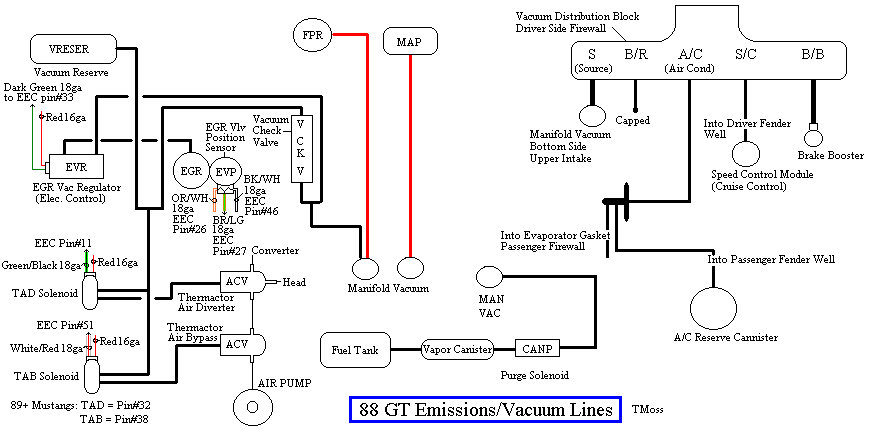
Diagram courtesy of Tmoss & Stang&2birds. (the diagram says 88 GT, but the EGR part is the same for 86-93 Mustangs)
88Stang5.0Vacuum.gif


The EGR sensor is basically a variable resistor, like the volume control on a radio. One end is 5 volt VREF power from the computer (red/orange wire). One end is computer signal ground (black/white), and the middle wire (brown/lt green) is the signal output from the EGR sensor. It is designed to always have some small voltage output from it anytime the ignition switch is the Run position. That way the computer knows the sensor & the wiring is OK. No voltage on computer pin 27 (brown/lt green wire) and the computer thinks the sensor is bad or the wire is broken and sets code 31. The voltage output can range from approximately .6-.85 volt.

The EVR regulates vacuum to the EGR valve to maintain the correct amount of vacuum. The solenoid coil should measure 20-70 Ohms resistance. The regulator has a vacuum feed on the bottom which draws from the intake manifold. The other vacuum line is regulated vacuum going to the EGR valve. One side of the EVR electrical circuit is +12 volts anytime the ignition switch is in the run position. The other side of the electrical circuit is the ground path and is controlled by the computer. The computer switches the ground on and off to control the regulator solenoid.


EGR test procedure courtesy of cjones

EGR test procedure courtesy of cjones

to check the EGR valve:
bring the engine to normal temp.

connect a vacuum pump to the EGR Valve or see the EGR test jig drawing below. Connnect the test jig or to directly to manifold vacuum.

Do not connect the EGR test jig to the EVR (Electronic Vacuum Regulator).


apply 5in vacuum to the valve. Using the test jig, use your finger to vary the vacuum

if engine stumbled or died then EGR Valve and passage(there is a passageway through the heads and intake) are good.

if engine did NOT stumble or die then either the EGR Valve is bad and/or the passage is blocked.

if engine stumbled, connect EGR test jig to the hose coming off of the EGR Valve.
Use your finger to cap the open port on the vacuum tee.
snap throttle to 2500 RPM (remember snap the throttle don't hold it there).
did the vacuum gauge show about 2-5 in vacuum?
if not the EVR has failed

EGR test jig
attachment.php


To test the computer and wiring to the computer, you can use a test light across the EVR wiring connectors and dump the codes. When you dump the codes, the computer does a self test that toggles every relay/actuator/solenoid on and off. When this happens, the test light will flicker. If the test light remains on the computer or the wiring is suspect.

To check the EVR to computer wiring, disconnect the EVR connector and connect one end of the Ohmmeter to the dark green wire EVR wiring. Remove the passenger side kick panel and use a 10 MM socket to remove the computer connector from the computer. Set the Ohmmeter to high range and connect the other ohmmeter lead to ground. You should see an infinite open circuit indication or a reading greater than 1 Meg Ohm. If you see less than 200 Ohms, the dark green wire has shorted to ground somewhere.

Late Model Restoration may still have the Ford Racing M-12071-N302 kit with the EGR valve & sensor along with the ACT & ECT sensors for $45. See http://www.latemodelrestoration.com/iwwida.pvx?;item?item_no=M12071N302 1&comp=LRS for more details


Code 41 or 91 Three digit code 172 or 176 - O2 sensor indicates system lean. Look for a vacuum leak or failing O2 sensor.

Revised 22-Jun-2009 to include 3 digit code and wiring for 94-95 5.0 Mustangs

Code 41 is a RH side sensor,
Code 91 is the LH side sensor.

Code 172 is the RH side sensor
Code 176 is the LH side sensor

The computer sees a lean mixture signal coming from the O2 sensors and tries to compensate by adding more fuel. Many times the end result is an engine that runs pig rich and stinks of unburned fuel.

The following is a Quote from Charles O. Probst, Ford fuel Injection & Electronic Engine control:
"When the mixture is lean, the exhaust gas has oxygen, about the same amount as the ambient air. So the sensor will generate less than 400 Millivolts. Remember lean = less voltage.

When the mixture is rich, there's less oxygen in the exhaust than in the ambient air , so voltage is generated between the two sides of the tip. The voltage is greater than 600 millivolts. Remember rich = more voltage.

Here's a tip: the newer the sensor, the more the voltage changes, swinging from as low as 0.1 volt to as much as 0.9 volt. As an oxygen sensor ages, the voltage changes get smaller and slower - the voltage change lags behind the change in exhaust gas oxygen.

Because the oxygen sensor generates its own voltage, never apply voltage and never measure resistance of the sensor circuit. To measure voltage signals, use an analog voltmeter with a high input impedance, at least 10 megohms. Remember, a digital voltmeter will average a changing voltage." End Quote

Testing the O2 sensors 87-93 5.0 Mustangs
Measuring the O2 sensor voltage at the computer will give you a good idea of how well they are working. You'll have to pull the passenger side kick panel off to gain access to the computer connector. Remove the plastic wiring cover to get to the back side of the wiring. Use a safety pin or paper clip to probe the connections from the rear. The computer pins are 29 (LH O2 with a dark green/pink wire) and 43 (RH O2 with a dark blue/pink wire). Use the ground next to the computer to ground the voltmeter. The O2 sensor voltage should switch between .2-.9 volt at idle.


Testing the O2 sensors 94-95 5.0 Mustangs
Measuring the O2 sensor voltage at the computer will give you a good idea of how well they are working. You'll have to pull the passenger side kick panel off to gain access to the computer connector. Remove the plastic wiring cover to get to the back side of the wiring. Use a safety pin or paper clip to probe the connections from the rear. The computer pins are 29 (LH O2 with a red/black wire) and 27 (RH O2 with a gray/lt blue wire). Use pin 32 (gray/red wire) to ground the voltmeter. The O2 sensor voltage should switch between .2-.9 volt at idle.


Note that all resistance tests must be done with power off. Measuring resistance with a circuit powered on will give false readings and possibly damage the meter. Do not attempt to measure the resistance of the O2 sensors, it may damage them.

Testing the O2 sensor wiring harness
Most of the common multimeters have a resistance scale. Be sure the O2 sensors are disconnected and measure the resistance from the O2 sensor body harness to the pins on the computer.

The O2 sensor ground (orange wire with a ring terminal on it) is in the wiring harness for the fuel injection wiring. I grounded mine to one of the intake manifold bolts

Make sure you have the proper 3 wire O2 sensors. Only the 4 cylinder cars used a 4 wire sensor, which is not compatible with the V8 wiring harness.

Replace the O2 sensors in pairs if replacement is indicated. If one is weak or bad, the other one probably isn't far behind.

If you get only code 41 and have changed the sensor, look for vacuum leaks. This is especially true if you are having idle problems. The small plastic tubing is very brittle after many years of the heating it receives. Replace the tubing and check the PVC and the hoses connected to it.
A secondary problem with only a code 41 is for cars with an intact smog pump and cats. If the tube on the back of the heads clogs up the driver’s side, all the air from the smog pump gets dumped into one side. This excess air upsets the O2 sensor calibration and can set a false code 41. The cure is to remove the crossover tube and thoroughly clean the insides so that there is no carbon blocking the free flow of air to both heads.
 
If one wants to check for exhaust restrictions, a vacuum gauge or exhaust pressure tester are needed. For the former, hold the throttle at 2500 RPM or so and look for the vacuum reading to start to drop after a short bit.

I'd at least take a quick look at the EVAP system. Ensure the vent plumbing at the tank is not pinched. Look for the charcoal cannister to be soaked. Ensure the purge solenoid functions properly.
 
Thanks for the tips. I'm going to disconnect the battery to clear the codes, then drive it for 25-30 miles to get it fully warmed up and then pull the codes again, just to see if the new ignition switch changed anything. I'l then proceed to check the EVAP and EGR stuff. Still wondering, what about the stupid fuel gauge? Which code list should I use? Is this system "EEC-IV/OBD2?
Thanks Again,
Gene
 
All the charts/list I can find seem to say they are for EEC-IV/OBD-2 but maybe there are some of the codes crossing over or the lists just aren't labeled correctly. Like this list that doesn't specify year or engine:

Troublcodes.net Trouble Codes OBD & OBD2 Trouble Codes and Technical info & Tool Store. By BAT Auto Technical

I'm assuming once you click on EEC-IV/OBD-2, the 2 digit codes are OBD-1 and the 3 digit codes below are the OBD-2?
Thanx,
Gene

You lost me Gene. OBD-I can be comprised of two or three digit codes, depending upon the model year. In Mustangs, they did not go to three digits till the 94 V8 cars (those are the 3 digit references made in Jrichker's post).
 
Post the code results you get from your 86-93 5.0 Mustang and I will give you 5.0 Mustang specific answers. I haven't heard of any place else on the web that can make that statement.