

You are using an out of date browser. It may not display this or other websites correctly.
You should upgrade or use an alternative browser.
You should upgrade or use an alternative browser.
rear seat belts...
- Thread starter hotrodredneck
- Start date

BullittStangV8
Founding Member
3 point? or simple lap belts? I have 3 lap belt sets bolted in, with the belts running inbetween the top and bottom seat cusions.

dennis112
15 Year Member
If you have standard seat belts (not deluxe) and have a common color, I would try to find a set of belts from a 66' which should match your fronts.
The aftermarket makes some types that simulate the 60's look. These belts are new and the webbing is probably much safer than the 40 year old stock items.
If you remove your rear seat, you may find the factory mounting points (if yours is so equiped.) If there are none, you drill holes through the rear of the floor board (after it starts up to clear the rear axle) and use bolts to retain the seat belts. Big washers should be added to the underside of the floor when you but the nuts on to keep the nut from pulling through the floor board.
The aftermarket makes some types that simulate the 60's look. These belts are new and the webbing is probably much safer than the 40 year old stock items.
If you remove your rear seat, you may find the factory mounting points (if yours is so equiped.) If there are none, you drill holes through the rear of the floor board (after it starts up to clear the rear axle) and use bolts to retain the seat belts. Big washers should be added to the underside of the floor when you but the nuts on to keep the nut from pulling through the floor board.
BullittStangV8
Founding Member
Thats exactly what I did. The rear seatbelts that I used match the front. I can get you a picture by the 15th if you would like. (Im at college) Also, I would suggest using a good, high grade bolt/washer set up, as you dont want those bolts snapping in the case of a crash (god forbid it happened).

Tim65GT
Active Member
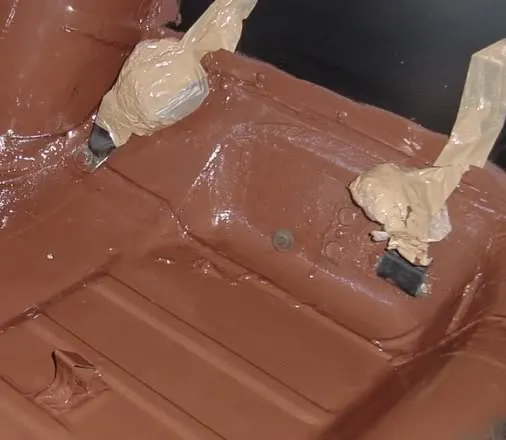
I put 3 pt belts in the front and used my old ones to mount in the back. They are covered in plastic in the pic, but ya can kinda make out where and how they are fastened. Be careful when drilling the driver side - the fuel and brake lines are behind there...ask me how I know... 
Attachments

dennis112
15 Year Member
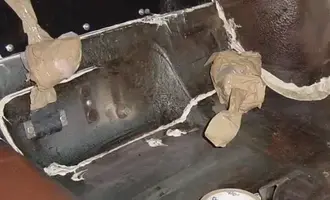
65/66 Mustang Trivia: What 2 items in Tim's pic prove that his car was originally equipped with dual exhaust?
(Please disregard his mentioning it is a GT)
Nice pic Tim. Keep this one around for when people are trying to authenticate if there car originally had dual exhaust from the factory or might possibly be a GT.
Attachments

BullittStangV8
Founding Member
Tim65GT
Active Member

65ShelbyClone
Founding Member
I'm a little confuzzled. I had a '65 notchback that had what appeared to be factory rear lapbelts. It also had factory front discs and a 4-speed.....I hope it wasn't a GT. 
were they called notch backs back then?...I thought it was either coupe, fasback or convertable.
dennis112
15 Year Member
The bolts? The firewall?I dont see much more there then that!
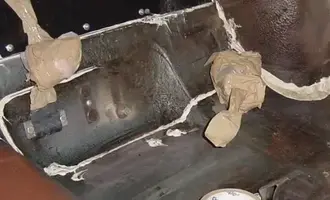
The differences are:
1. The little bracket that has the 2 round heads in it. Notice there was one in each picture--that is a support to hold another bracket for the dual exhaust. Not found on either side of a "common" single exhaust car (which will have a transverse muffler.}
2. An additional sheet metal panel is added to double the thickness of the floor to help support the bracket mentioned in #1-- Part of its outline is the "C" shaped area outline by seam sealer in the below pic.
Attachments
dennis112
15 Year Member
I'm a little confuzzled. I had a '65 notchback that had what appeared to be factory rear lapbelts. It also had factory front discs and a 4-speed.....I hope it wasn't a GT.
Seat belts were optional in 65, or at least late 65. The late 65 cars had the holes for the rear belts pre-mounted, even if the car wasn't optioned as such. One panel fit all.
The GT package was strictly a performance and outside appearance group--something more than a normal car and yet less than a Shelby.
Disc brakes and 4 speed are not really rare options--just checks on an order sheet. It takes a lot more than that to make a GT.
65/66 GT's had heavy duty suspension with a larger front sway bar, fast ratio steering, disc brakes, dual exhaust with trumpets that exited out holes in the rear valence, side strips, fog lights, M-U-S-T-A-N-G spelled out with individual letters in those side strips, and a 66' type gauge panel which includes an amp guage. A 4289 with a 4 bbl carb was also mandatory (A or K code.) An A code would probably have a 3.00 rear gear ratio, which is part of its option package.
GT's could be 3 speeds, 4 speeds, or automatics. Luxury (pony) interiors were not part of the GT group, but a GT (or any Mustang) could be ordered as such. No special steering wheel or console either. Any of these could be checked on an order sheet. Many of the GT features could be checked too and yet you wouldn't have GT.
Another way to get full gauges in 65 was to order the Luxury interior, which was a more common option than the GT equipment group.
The best way to ID a true GT is by checking the exhaust. It should have the supports mentioned on the rear floor panel and it will have special support found inside the rear frame rails to support the rear of the exhaust.
65ShelbyClone
Founding Member
Thnaks for all the extra info.  The car had been through so much in its life that I couldn't tell what was original and what wasn't. The heads had press-in studs, but mismatching pistons, so who knows if anything was original. I never looked too closely under the back seat. The doors were from another car and I didn't know to look elsewhere for a VIN. Maybe I'll email the guy that has it now and find out. He's in Austria, though.
The term notchback is interchangable with coupe. Fastbacks, at least for the '65 and '66 model years, were called 2+2s, not "fastbacks". I'm not sure about '67-68, but they might have been 2+2s also.
The car had been through so much in its life that I couldn't tell what was original and what wasn't. The heads had press-in studs, but mismatching pistons, so who knows if anything was original. I never looked too closely under the back seat. The doors were from another car and I didn't know to look elsewhere for a VIN. Maybe I'll email the guy that has it now and find out. He's in Austria, though. were they called notch backs back then?...I thought it was either coupe, fasback or convertable.
The term notchback is interchangable with coupe. Fastbacks, at least for the '65 and '66 model years, were called 2+2s, not "fastbacks". I'm not sure about '67-68, but they might have been 2+2s also.
Similar threads
- Replies
- 5
- Views
- 230


- Replies
- 2
- Views
- 152
- Replies
- 3
- Views
- 143

- Replies
- 1
- Views
- 185
