Rear suspension

Route666

Active Member
Aug 16, 2003
1,652
6
39
Brisbane, Australia
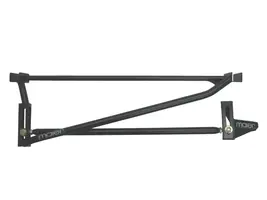
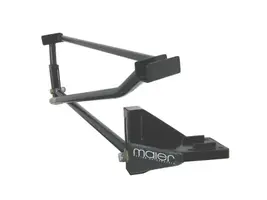
I was looking at Maier Racing's lineup of goodies, and must say their panhard bar setup looks nice.

I was wondering, does a panhard cancel the necessity for a sway bar? If you set it high enough, it stops body roll, like a sway bar, but I assume the weight distribution on the tyres is better with a sway bar. Would having caltracs with a sway bar or with a panhard be better? I know caltracs with the Maier panhard setup would require some welding, to combine one caltrac mount and the panhard.

I feel though, that a twisty bit of metal (sway bar) constrains the suspension's freedom. Am I wrong with this thought? (Especially considering the rear is solid, not independant anyway) Would having both be better? I assume so, as even my Celica (bless its dear little heart) has a panhard and a sway bar. (rear coils and a 4-link setup I might add too :p)

Please discuss all this rear suspension jiggery-pokery.

Also, Maier have these springs that are layered toward the front to stiffen them like having caltracs, but it makes it look flimsy as suspension, as the rear half of the spring is longer, and has less leafs on it.
 
Ok...
The purpose of a panhard bar is to locate the rear axle laterally. By design, this also defines the point about which the rear suspension will rotate (roll center). It is completely independent of the sway bar. The sway bar's function is to transfer the downward vertical force from the inside tire to effectively push the outside tire down as well (or vice versa). So.. it transfers weight from inside to outside tire. The sway bar's constrain of the suspension's movement is almost negligible if the bump seen is equal in all respects to each tire, left and right. The sway bar will simply rotate in its mounts. However, when the bump/dip is different from left to right, you will see "some" suspension bind because there will be some torsional load on the bushings. Not enough to worry about however.

No one can say if you "need" a sway bar, after you install the panhard bar. Its simply a tuning device.

The purpose of the added leafs in front of the axle are to resist the axle torque reaction. Instead of adding more "full" leaves to the spring, you can add them only to the front for this benefit, while still maintaining a lower overall spring rate.
 
You can adjust the over/under steer of your car by sizing the rear stabilizer bar (or not installing one). I've heard bad things about how some aftermarket rear sway bars screw into some thin sheet metal under the car and end up tearing loose. I recommend carefully considering whether the sway bar will improve your car's performance and not installing one unless you decide it's necessary.

A rear stabilizer bar will make your car more likely to push, or understeer. The bigger/stiffer a bar you put in, the more this effect is exaggerated.

So when you're out road racing, does your car oversteer or understeer? If your car oversteers, a rear stabilizer bar could help balance the car. Of course, Mustangs from the factory are set up to understeer, so a rear swaybar would make cornering performance worse in that situation.


And a panhard bar works to prevent the axle from moving sideways under load. You want the panhard to be as long as possible, because the you will notice the arc that the panhard forces the rear end to travel when the rear suspension moves up and down.

try this book: Chassis Engineering by Herb Adams. It's easy to get through and has some good information about your options.

Hopefully Opentracker or Historic will weigh in on this. I'm interested in what they use.
 
Mosse said:
Hack said it all... and Corner-carvers is a good place to search... Not post..:)
:rlaugh: :lol:

Yeah they totally have no mercy if you ask a question that might have already been answered in another thread. They really abuse the new people. I feel lucky that my name says "Fresh Meat" by it still, rather than newby retard or some such. :D

There's some good info there, but I've been disappointed in what I have found regarding older Mustangs. Most people there seem to run Foxes or Bimmers. It's mostly stuff like, "go bolt on Griggs or whatever, they make a good product". I guess I hoped to find more analysis.

But then most people who road race vintage stuff probably either just bolt something on or leave it alone. I'm more interested in fabricating something.
 
I use what I call adjustable leaf springs. I build my own packs out of two or more sets of used leafs. Sometimes I will cut the ends off a main leaf and use it as the second leaf of the set I'm working on. If you look at the racing springs on the market, some have two full length springs then on from there depending on the ride height and spring rate needed. I don't use lowering blocks. I will rebuild springs to change ride height by as little as 1/4". I can spend more time getting the car to sit right than it takes to change motors.
turn104.jpg

Springs and sway bars are a deal where it's the track and driver that dictate what to use. We use soft springs on our cars. My daily driver has stock rate springs (rebuilt rear leafs and cut front coils), 1" drop on the upper arms,1 1/8" front and 7/8" rear sway bars, KYB shocks, roller bearing spring perches, lower arms with a spherical bearing inside pivot, roller bearing idle arm, 225/60/15 front 245/60/15 rear tires. It drives a lot like the track car but not as harsh. The track car has much the same set up but Koni shocks, and a bit more power and safety equipment. I think a street car could use a panhard bar to hold the rear end in place so the tires didn't rub. I would also use a sway bar on the front and rear of a street car for to reduced body roll on the off ramps. I see no reason why you can't use a panhard bar and a sway bar.


John
 
Hack said:
You can adjust the over/under steer of your car by sizing the rear stabilizer bar (or not installing one). I've heard bad things about how some aftermarket rear sway bars screw into some thin sheet metal under the car and end up tearing loose. I recommend carefully considering whether the sway bar will improve your car's performance and not installing one unless you decide it's necessary.

A rear stabilizer bar will make your car more likely to push, or understeer. The bigger/stiffer a bar you put in, the more this effect is exaggerated.

Sorry, this is incorrect. A rear stablizer bar has the opposite effect of what Mr. Hack has posted. An oversized rear sway bar would tend to make the car oversteer. The reason these cars came from the factory without a rear sway bar, is it is generally believed an understeering car is safer for the general driving public. Shop around. I've never seen one of these bars attach to sheet metal. The 3/4" rear sway bar I used for my '70 actually mounted to the frame rails above the axle. The bad news is I had to cut the tailpipes out of the way.

Steve C.
 
Thanks all for replies, haven't been on for a couple of days, been having some... unpleasantness with work.

With regards to panhards and watts linkages. Being a man who analyses the qualities of things, I see how a panhard is defeated by a watts linkage, but if you have the mounting points as far from each other as possible (I'm guessing in the plane of each suspension travel), it won't make any real discernable difference to handling. True? Not true?
 
Well, discernable is up to you to decide. Without knowing the length of the Maier panhard, it's impossible to say how much the rear axle will move side to side given a certain range of vertical motion. Using some geometry, you can calculate the horizontal displacement the axle will move for its vertical range. Off the top of my head, on a fox mustang, the MM bar with a length of 38" constrains the axle to move .0527" horizontally given a 2" vertical motion(in either direction).

Do you know the length of the Maier panhard bar? Also important is its range of adjustment. The above example is given that the bar is parallel to the ground, if the bar cannot be located as such, it will allow a greater horizontal movement.

It really comes down to how much and what (time) you are willing to spend on the setup.

Hope that helps.
 
70XR7ConvertCat said:
Sorry, this is incorrect. A rear stablizer bar has the opposite effect of what Mr. Hack has posted. An oversized rear sway bar would tend to make the car oversteer. The reason these cars came from the factory without a rear sway bar, is it is generally believed an understeering car is safer for the general driving public. Shop around. I've never seen one of these bars attach to sheet metal. The 3/4" rear sway bar I used for my '70 actually mounted to the frame rails above the axle. The bad news is I had to cut the tailpipes out of the way.

Steve C.
Steve is correct. Oops. I was referring to Herb Adams' Chassis Engineering when I posted, but I still messed up. Thanks for the help Steve. :nice:

edit. Mr. Hack.. :D I got a kick out of that one! :rlaugh:
 
I made a watts link for one of our cars. I was going to make a thread about it after I got some more photos but I had a request so here is what I have so far.

My watts link on a pig of a car. I bet there is 20lbs of dirt on this car.
wattslink.jpg

The tubes are not adjusted in this photo.

Side shot.
wattson1.jpg

The tubes are adjusted better in this photo.

A close up of the double shear pivot. All of the hardware is grade 8.
wattspivot.jpg


The main piece on the kitchen floor. It is a bolt in unit for now. I may weld it in or try it on another car.
wattsonfloor.jpg

It will get bolts through the gas tank lip and frame mount. The sway bar bolts were the first thing I thought of. I may not use them at all.


I made the axle mounts from stock car parts from AFCO.
wattsaxle.jpg


The pivot is 3/8" plate with a sealed bearing pressed in.
wattspvot.jpg


The car I designed my watts after. It's a racing Shelby clone.
wattscar.jpg


I have a little under $300 in parts and untold hours in it. If you can cut and weld send me a email and I'll be glad to help. I've been told it's too heavy and it should be made out of alum. I was told by one guy that it won't work at all with the pivot on the chassis, so any comments are welcome. I haven't had a chance to run it on the track yet. Soon I hope.


John
 
The axle mounts do seem a bit too heavy... being made of steel they would add a lot of unsprung weight. Having the Watts linkage attached to the chassis is fine. However from the looks of your photos it would be more effective if you dropped the double shear pivot location so as to make your links parallel with the ground.

david
 
I take that back, now when I look at the photos, I think it would be more optimal to bring your pivot locations closer to one another vertically on your main piece.
Anyway the goal should be to make your links parallel with the ground and each other. Nevertheless you've done a nice job with your fabrication. Looks like a lot of time and energy went into it.

david
 
nice work, John. You have put a lot of fine fabrication work in there :nice:

Is that compatible with the stock fuel tank, or will it necessitate a cell?

We really appreciate your willingness to share all this fine suspension work with us :flag: Thanks for all the super info!
 
70XR7ConvertCat said:
Shop around. I've never seen one of these bars attach to sheet metal. The 3/4" rear sway bar I used for my '70 actually mounted to the frame rails above the axle. The bad news is I had to cut the tailpipes out of the way.

Steve C.
http://forums.stangnet.com/showthread.php?t=455698&highlight=rear+sway

There's a thread I was thinking about where someone had the rear sway rip out. I don't know whether it's rare or not. I've seen a few posts where people state that the material the sway mounts to is very thin (may be part of the frame, but thin metal). It may be different for different years of Mustang, not sure.

Do they really tear out just from the car being towed or some wheel hop under acceleration? It may be that there are just one or two poor aftermarket designs out there.
 
Is that compatible with the stock fuel tank, or will it necessitate a cell?


The third photo shows the stock fuel tank in place with the my watts link. A fuel cell would be nice. I thought the axle mounts could be made a bit lighter. I could use a U bolt in place of the rear clamp?


John
 
Maier has two styles of panhard bars. This is a link to the new version: http://www.maierracing.com/pnms2202a.html

From the illustration, it appears the panhard bar is ~40" based on the fact that it resides inside the spring perches which are spaced at 43". The axle mount replaces the right side spring perch (it is a bolt on unit). The double adjustable bar can also be raised and lowered which I believe can have an affect on roll center. I don't totally understand all of the geometry involved in this.

Cost is $339 and would also require turn downs or side exhaust. It can also be used in conjunction with a rear sway bar.

View #1
largepnms2202a1.webp


View #2
largepnms2202a2.webp
 

Attachments

  • largepnms2202a1.webp
    largepnms2202a1.webp
    7.6 KB · Views: 110
  • largepnms2202a2.webp
    largepnms2202a2.webp
    8.1 KB · Views: 133