Code 15 - No Keep Alive Memory power to PCM pin 1 or bad PCM (Memory Test
Failure). The voltage to the Keep Alive Memory (KAM) is missing (wiring problem)
or the KAM is bad. The KAM holds all of the settings that the computer "learns" as
it operates and all the stored error codes that are generated as a result of
something malfunctioning while the engine is running. Use a voltmeter to check
the voltage to the pin 1 on the computer - you should always have 12 volts. No
constant 12 volts = bad wiring. If you do always have the 12 volts, then the KAM is
bad and the computer is faulty.
If the computer has to "relearn" all the optimum settings every time it powers up,
the initial 5-30 minutes of operation may exhibit surges, poor low speed performance,
and rough idle.
Note that some aftermarket chips will cause code 15 to set. Remove the chip,
clear the codes and retest.
Before replacing the computer, remove the battery ground cable for about 20
minutes. This will clear all the codes. Retest after several days of running. If the 15
code is gone, then don't worry about it. If it is still there, then you get to do some
troubleshooting.
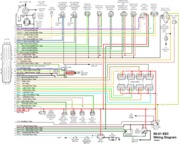
Wiring diagrams for the proper model years are next…
For 86 models see
http://www.autozone.com/images/cds/gif/large/0900823d80167158.gif
For 87 models see
http://www.autozone.com/images/cds/gif/large/0900823d8016715e.gif
For 88 models see
http://www.autozone.com/images/cds/gif/large/0900823d80167162.gif
For 89-90 models see
http://www.autozone.com/images/cds/gif/large/0900823d8019595f.gif
For 91-93 models see
http://www.autozone.com/images/cds/gif/large/0900823d80195960.gif
See the following website for some help from Tmoss (diagram designer) & Stang&2
Birds (website host) for help on 88-95 wiring
http://www.veryuseful.com/mustang/tech/engine/
Diagram courtesy of Tmoss & Stang&2birds
http://www.veryuseful.com/mustang/tech/engine/images/IgnitionSwitchWiring.gif
http://www.veryuseful.com/mustang/tech/engine/images/fuel-alt-links-ign-ac.gif
http://www.veryuseful.com/mustang/tech/engine/images/88-91_5.0_EEC_Wiring_Diagram.gif
CODE: 31 (KOEO) - EVP circuit below minimum voltage. Vref (5 volt reference voltage
supplied by the computer) missing or broken wire or bad connection in circuit. Use a DVM to check
for 5 volts on the orange/white wire. If it is missing, look for +5 volts at the orange/white wire on
the TPS or MAP sensor located on the firewall near the center of the car. Use the black/white wire
for the ground for the DVM.
With the sensor removed from the EGR and still connected, press the plunger and watch the
voltage change on the brown/lt green wire. Pull the passenger side kick panel and measure the
voltage at the computer. You will need to remove the plastic cover over the wires and probe them
from the backside. A safety pin may prove very useful for this task. Use pin 27, EVR input
(brown/lt green wire) and pin 46, signal ground (black/white wire) to measure the voltage.
The orange/white wire is Vref and should always be 5 volts -/+ .25 volt. Be sure to measure
Vref at the EGR sensor to rule out any broken wires or bad connections.
Code 67 - clutch not depressed (5 speed) or car not in neutral or park (auto) or A/C in On
position when codes where dumped. Possible neutral safety switch or wiring problem. This code
may prevent you from running the Key On Engine On tests. You can generally ignore this code,
since it has no effect on engine performance.
The computer wants to make sure the A/C is off due to the added load on the engine for the engine
running tests. It also checks to see that the transmission is in Neutral and the clutch depressed
(T5, T56, Tremec 3550 & TKO)). This prevents the diagnostics from being run when the car is
driven. Key On Engine Running test mode takes the throttle control away from the driver for several
tests. This could prove hazardous if the computer was jumpered into test mode and then driven.
The NSS code 67 can be bypassed for testing. You will need to temporarily ground computer pin 30
to the chassis. Computer pin 30 uses a Lt blue/yellow wire. Remove the passenger side kick panel
and then remove the plastic cover from the computer wiring connector. Use a safety pin to probe
the connector from the rear. Jumper the safety pin to the ground near the computer.
Be sure to remove the jumper BEFORE attempting to drive the car!!!
Code 85 - CANP solenoid - The Carbon Canister solenoid is inoperative. Check vacuum lines
for leaks and cracks. Check electrical wiring for loose connections, damaged wiring and insulation.
Check solenoid valve operation by grounding the gray/yellow wire to the solenoid and blowing
through it.
The computer provides the ground for the solenoid. The red wire to the solenoid is always
energized any time the ignition switch is in the run position.
Charcoal canister plumbing - one 3/8" tube from the bottom of the upper manifold to the rubber
hose. Rubber hose connects to one side of the canister solenoid valve. Other side of the solenoid
valve connects to one side of the canister. The other side of the canister connects to a rubber hose
that connects to a line that goes all the way back to the gas tank. There is an electrical connector
coming from the passenger side injector harness near #1 injector that plugs into the canister
solenoid valve. It's purpose is to vent the gas tank. The solenoid valve opens at cruse to provide
some extra fuel.
It does not weigh but a pound or so and helps richen up the cruse mixture. It draws no HP & keeps
the car from smelling like gasoline in a closed garage. So with all these good things and no bad
ones, why not hook it up & use it?