Paint and Body Fox Body Painting 101

I will post the general area I'm covering like I do with my build thread in the title.

I'll give a basic overview of the steps in refinishing your car this weekend. I'll try to include as many pictures as I can to help you visualize the concepts I bring out. If you have ideas on how to improve what I'm doing, PLEASE bring them up. I have given thought pretty much to every every aspect of painting over the years as to why I'm doing what I'm doing, and try to think of ways to improve the procedures. I am open to new ideas, one thing I have learned is that I don't know everything. If you ask me, I will tell you exactly why I am doing what I'm doing.

Every step of the painting process is vital to a good paint job. If you take the short way on any step, you'll pay for it in different ways by not having as nice of a paint job as you could have had. Some mistakes can be a bigger pain in the butt than others. The mistakes made early on, if not corrected then, lead to a much more lengthy repair process to fix them.

I want to first address @RaggedGT. He asked how my masking machine works. Through showing him this, you'll get an idea about masking. I will give a more detailed view about masking later.

Ok raggedy, first: Here's my masking machine set up to use:
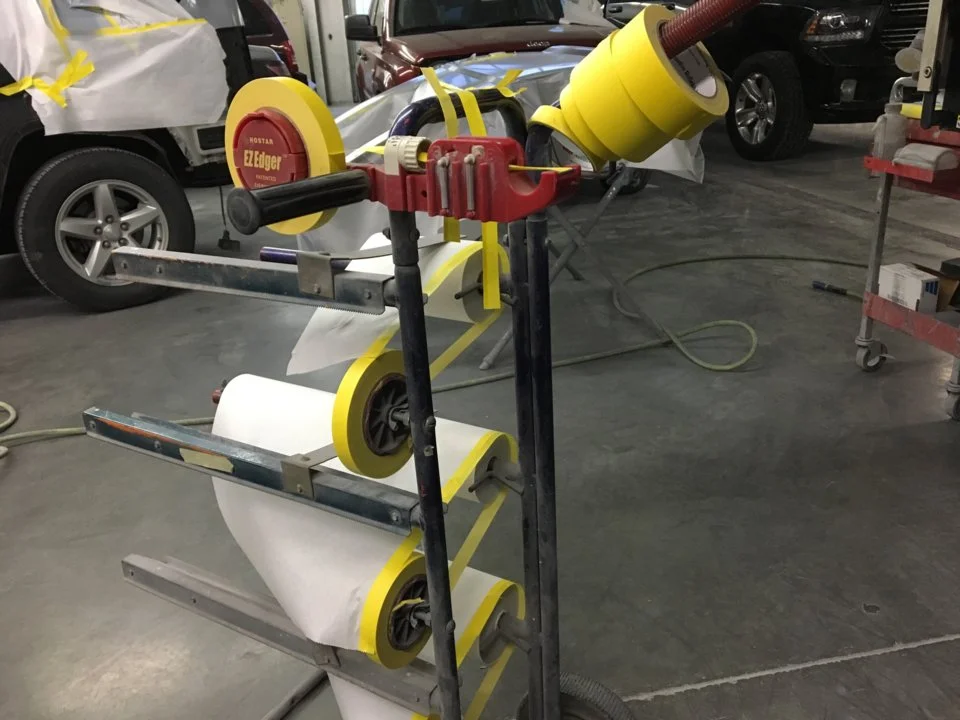
image.webp

As I mentioned in my build thread, it is a 3M machine. There are other masking machines out there, through trial and error I like theirs the best.

As you can see now, the 3/4" tape attaches to the paper along the side of the paper. You can adjust the overlap on the paper by adjusting the set screws on the side. It's simple, you pull out the desired length of the desired size of paper (6", 12", 18") and the tape comes off it's roll adhering to the side of the paper.

The red plastic device attached to the top with EZ Edger on it simply folds the edge of the tape roll on it, as it's name implies, it is for masking the edges of panels you are preparing to paint. The folded edge can be adjusted for different widths depending on the reason for it's use.

Here's an example of each:
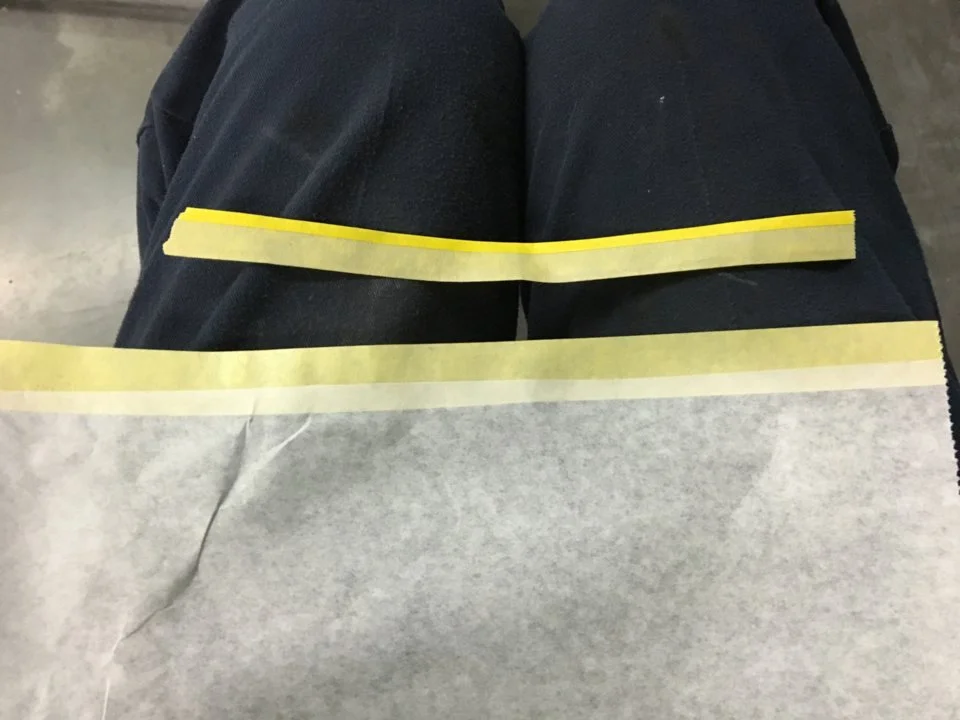
image.webp

This is my 36" masking machine, it is also a 3M product. Their 36" machines are far superior to any other one that I have used over the years. I've had it for a couple decades now as well. It does what the mobile machine does, except for 36" paper.
It cost about the same as my mobile machine, roughly $350. I have no idea what they might cost now, could be more or less.:
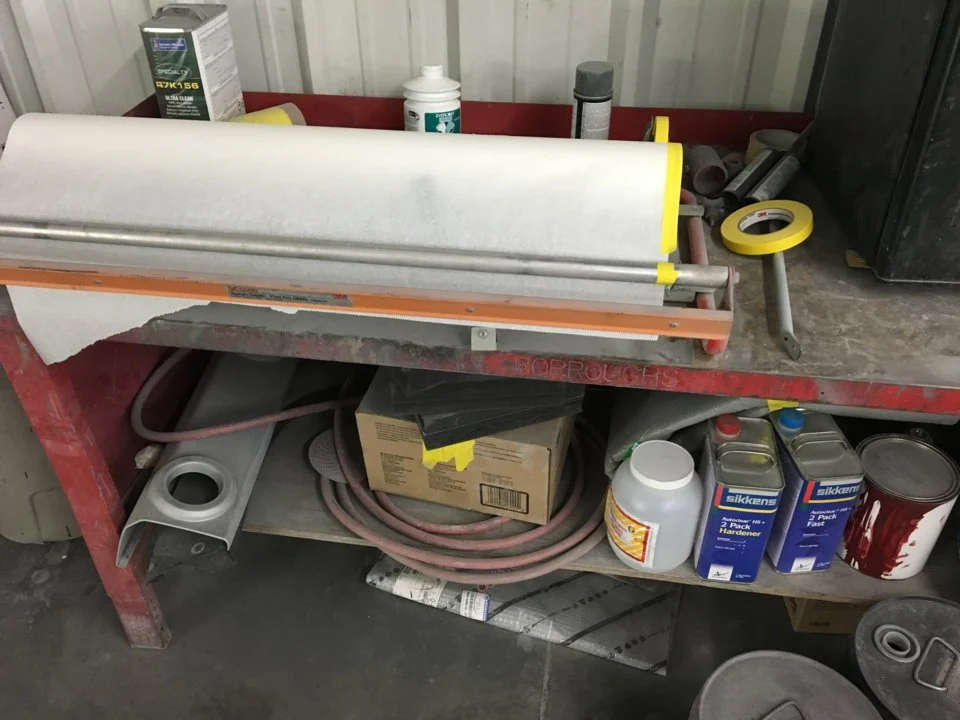
image.webp

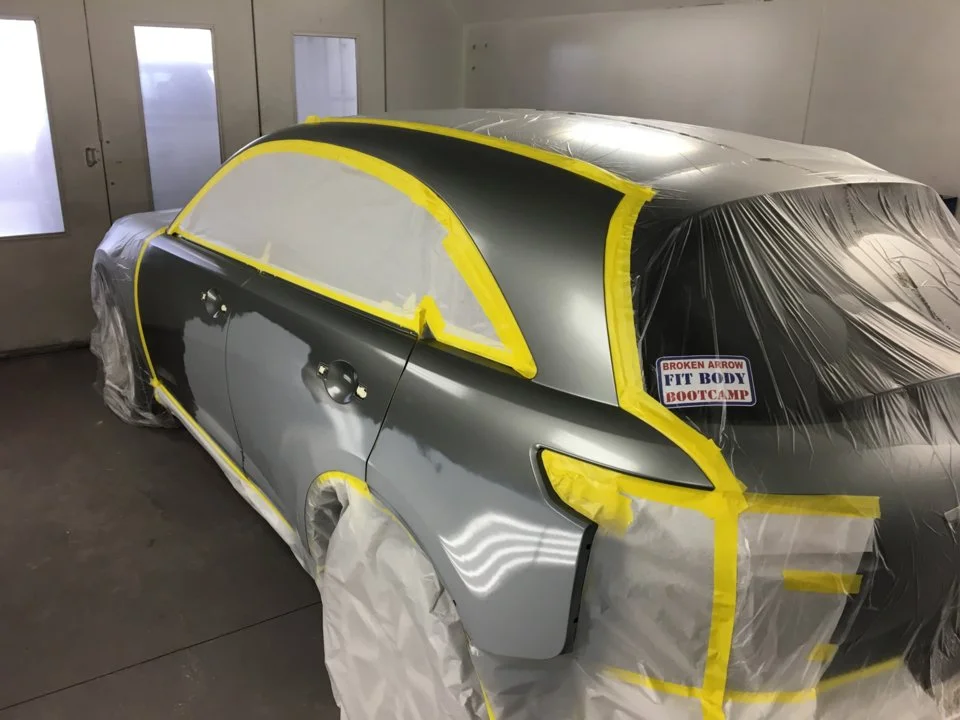
Just to show you the use of the different tapes and papers, I took a few pictures of my masking one of the cars I painted yesterday. It is an inifinit fx35 that was damaged down the left doors, 1/4, and rear bumper.

So, in this picture, I've masked the left 1/4 jamb using the folded tape, 2" tape, and 6" paper. The folded tape when used in this manner will give a soft paint edge in the jamb that isn't noticeable as it would be if you taped the jamb in a hard line fashion(meaning the tape edge wasn't folded and you will see exactly where the new paint stopped by the line left behind).
The folded tape allows a very small amount of overspray by it's edge preventing a hard line when used in this manner.
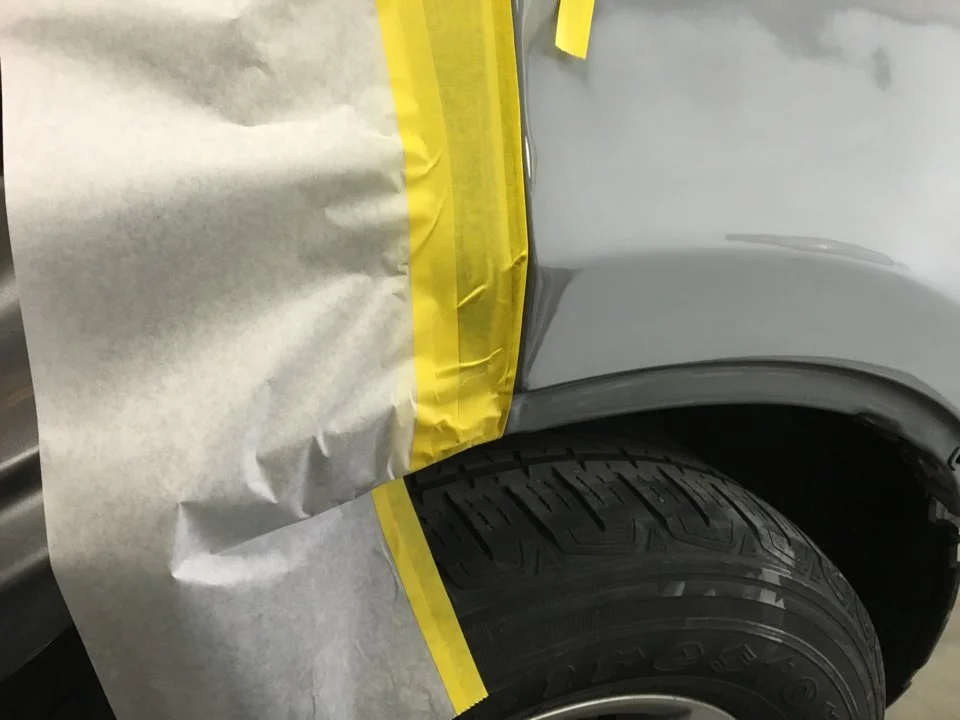
image.webp

The next couple of pictures of the vehicle show other areas I masked with the final one having it completely masked (at that stage of the process I have already shot a clear base on the panels, that's why it has a slight sheen to it):
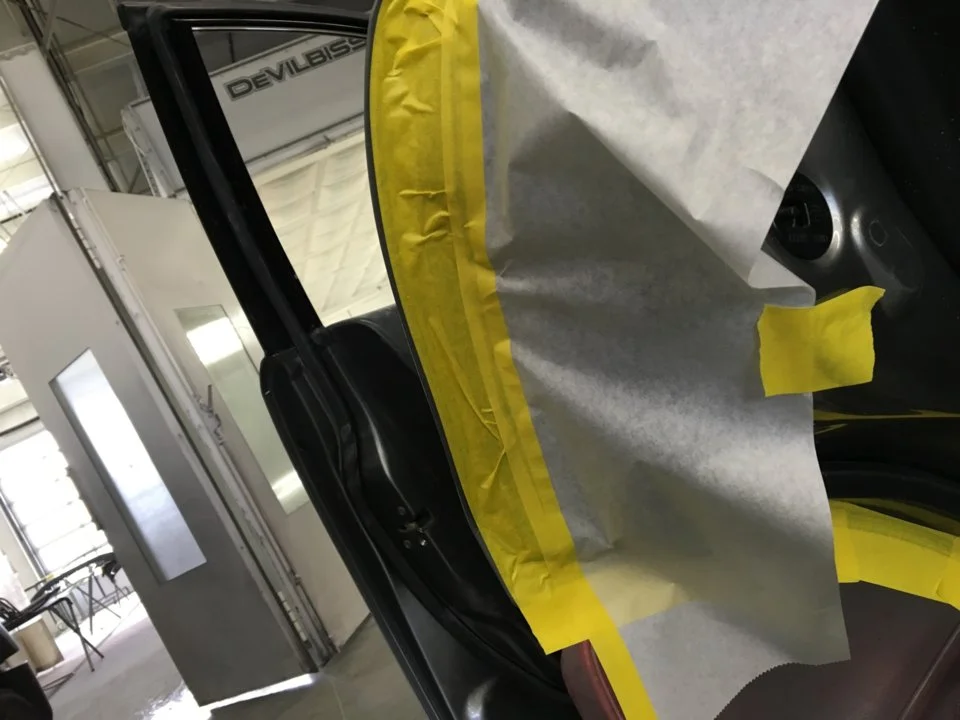
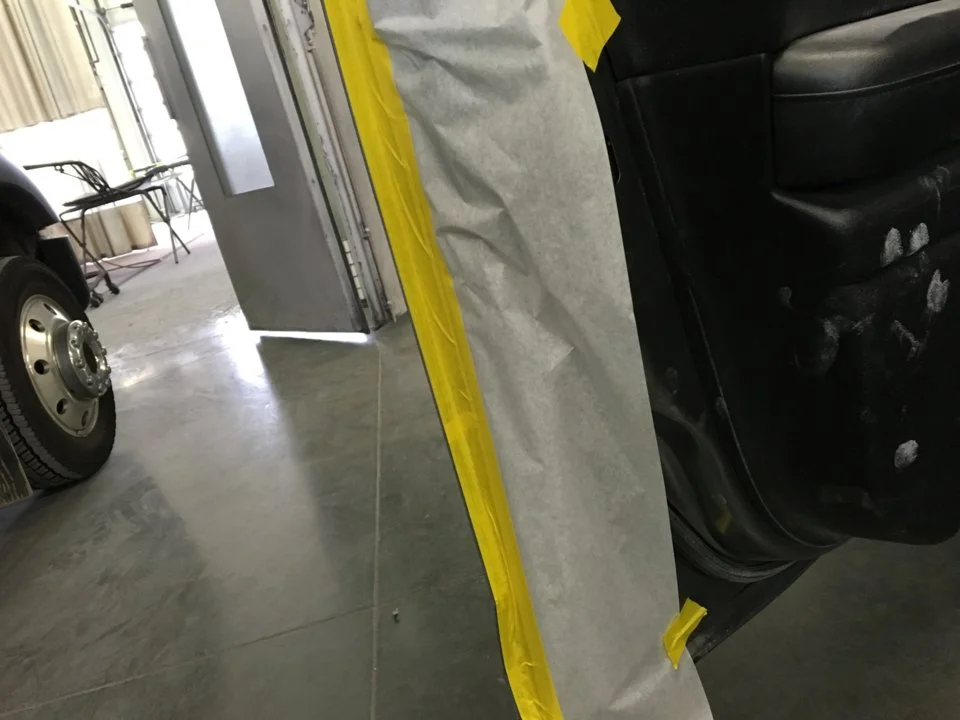
image.webp
image.webp
image.webp

So raggedy, there you go. That's how it works and what I use it for. Hope this helped.
I will give a more detailed description later about masking a vehicle, including the different tapes and techniques I use during an average day.

Obviously I'll show the masking of my mustang here in a couple weeks! Yay me! Doby will finally be painted.

That's really cool how that 3M machine works-thanks for going into detail on it explaining it to me (and others lol.)
I am looking forward to your how to write ups, will you be doing a write up on body prep for body work and priming?
Thanks again Dave.
 
  • Like
Reactions: Davedacarpainter
That's really cool how that 3M machine works-thanks for going into detail on it explaining it to me (and others lol.)
I am looking forward to your how to write ups, will you be doing a write up on body prep for body work and priming?
Thanks again Dave.
Yeah, I kind of figure a whole thing, beginning to end with techniques on each step. I'll try to get an overview posted this weekend. This will take time, in addition to figuring out an index to separate the sections. I've got some studying to do.
 
To back up a little, I want to address @madmike1157 's post again.
He would like for these post to be directed towards an affordable method of painting.

What I intended with this thread is to offer my knowledge on painting. To offer my advice gathered from many years of painting. To help with you and your paint jobs that you might be preparing to attempt.

So sometimes I might offer my opinion concerning tools or materials that might go beyond what you intended to spend. Here's what you should do, get what you can and ask me for help and I will help you to get the best results you can.

I'm not giving too much of a crap on what system or what tools you intend to get and use. Ask me my opinion, that's what you'll get, ask for advice, that's what you'll get.

What I'm saying is this....I'm not doing this to tell you some cheap way through painting your car. You can figure out what you can spend. If you might blow a grand on a gun and some sanders, then you have gone crazy. You can get guns like I use if you want, or DA's, and so on and so on.... This is what I do for a living, it pays for my house and all the associated bills that life has with children and grand children. It only makes sense that I would spend 3 grand or better on my tools. A mechanic will spend tens of thousands.

This is about the knowledge to accomplish a paint job from disassembly to bolting on your license plate and going for a drive.

You'll see me paint my car with some of the best paint out there. That doesn't mean you need to be envious and give up on yours, for goodness sake. I'll show you what I'll do through the process, emulate these steps and at least you'll get a decent paint job irregardless of what system you use. This paint is being given to me by the manufacturer because I have a reputation as a good painter and they figure it would help to showcase their product and cause body shop owners to consider using their paint.

So, if a paint company offers you the best paint out there to spray on your car for FREE! What would you do? I would not be able to buy this paint for my car. I get it because it's a sales technique that paint companies will use to allow certain painters to demo their paint line on their personal cars. I understand what they are doing, and I am gladly being used.

What I'll be showing you how to do can be used with any system, there are basic steps and techniques to do no matter what product you use.

You can get a beautiful paint job using almost any system out there. You just need to know what you're doing. I will help. If you need something outside of the area that I will be covering, just ask, I'll do,what I can.

If you need advice on a value priced tool, post the question, someone will be able to help. I am not an evaluator of tools for anybody. I do know some because a young helper will always buy the cheapest tools when I'm weaning them off of my tools. Yet my knowledge of those cheaper tools is based on it's ability over months time with daily usage. I haven't paid enough attention to their use for one or two times, instead for hundreds of usings.

So I'm not knocking cheap, I've used cheap before and got great results. But I am not going to focus on that in this thread. Same technique for cheap and expensive materials.

I probably won't have a new post until Sunday morning, I have to study the whole thread thing for a while to try to keep this tidy.

Pay attention to what I tell you in this thread, it does and will work for you.
 
Holy words.

I saw some mention of doing it the best, budget way possible for folks who don't have a complete shop in which to accomplish this with?

Then my eyes rolled back into my head before I got to the next thing.

To be fair, I am positive then I'll be reading a lot more carefully when it comes times for me to attempt this. The time an attention to detail that I will require, I could not touch for less than $10k for someone to do it.

It will also not be a Friday night out in my cave, half way through a 12 pack and oh more shiney...
:leaving:
 
  • Like
Reactions: Davedacarpainter
Holy words.

I saw some mention of doing it the best, budget way possible for folks who don't have a complete shop in which to accomplish this with?

Then my eyes rolled back into my head before I got to the next thing.

To be fair, I am positive then I'll be reading a lot more carefully when it comes times for me to attempt this. The time an attention to detail that I will require, I could not touch for less than $10k for someone to do it.

It will also not be a Friday night out in my cave, half way through a 12 pack and oh more shiney...
:leaving:
Yeah Noobz, I got a little bitchy, sorry.

I just want this to be informative about the how to's.

Getting a full paint job with all of the bodywork involved can be phenomenally expensive from a shop, Believe me, I got a clue on that one.

I was thinking (of course with next to no knowledges,lol), maybe to run this as a two thread post to provide an active forum for help for individual needs and the other to be a "tutorial". What do you think?
 
Body filler-
Over bare metal
Over primer
Over sealer?

I've heard all three in the past and some will swear by one of the three ways. And then harp on the others because of adhesion, eventual rusting, break down......opinions?
 
  • Like
Reactions: Davedacarpainter
Body filler-
Over bare metal
Over primer
Over sealer?

I've heard all three in the past and some will swear by one of the three ways. And then harp on the others because of adhesion, eventual rusting, break down......opinions?
I will use the word "bondo" at times when referring to body filler at times, if you see that, I'm not endorsing the Bondo product in itself. It just means any body filler out there and is a word I use in a general description and has less letters to type. Same thing for the word "mud" = body filler. Slinging mud = applying body filler.

Ok, thought I would let people know that.

So, mud should be applied over bare metal according to all the makers I've ever dealt with. The reasoning is due to mainly the expansion differences between a painted surface and the filler itself. As temps change, each product will expand and shrink at a different rate, this can cause a breaking of the mechanical bond between the two products. Bondo is a more stable (less shrinking and swelling) product than any paint. Metal has a lower thermal expansion issue than mud, more stable that is.

A second reason not to lay mud over any painted surface is when bondo hardens it releases heat in the process (similar to concrete). The heat of the hardening process is not tremendous, but can actually be felt by your hand. The heating process causes the substrate to swell. On metal the heat isn't enough to cause it to change any significant size. On paint, it swells easier, so what you have is an edge that the bondo was spread over that actually swells to a larger size than the paint next to it. When the heat goes away, it shrinks back, possibly causing a weaker bond than what is on the bare metal. Plus, depending on how much paint is on the panel (meaning previous paint jobs adding more layers), you'll have varying swell rates in the paint itself. When it all cools and shrinks back the bond isn't as good as over bare metal. The mechanical adhesion (the scoring from sanding the surface) is weekend since the actual scoring dimensions will change due to the heating and swelling of the paint. So let's say you prep the surface with 40 grit prior to spreading the mud, the scoring in the painted surface will change slightly due to the swelling caused by the heat while the mud is still soft (not hardened) and then will shrink back as the bondo cools and hardens, again, weaker adhesion.

Third reason, When you score the paint, you will open the sealed surface to the underlying porous (relatively) lower layers. When mud hardens, it is a chemical reaction between the mud itself and the hardener (that's what causes the heat). These chemicals will release and be absorbed by the scored paint causing it to break down minutely.

If you have painted a car that you have done mud work to and have noticed a ring around the area that you have applied mud to a week to a month later, these are some of the reasons that can cause that.

If you live in an environment that has a larger temperature range through the year, the more that you will have the above problems.

All that said, I see it done every day, all bodymen know not to do this, yet they do because it's more time consuming to do the repair properly.

The more flexible the surface (due to metal thickness, or even plastics), the more issue you will,have with this. Generally speaking, the mud isn't going to just fall off of the vehicle. While I have seen that happen on poorly repaired areas in my past, it wasn't caused by this issue.

Rusting of the metal below the repair will not be an issue as long as you follow through your repair in a timely manner (and you keep the bare metal CLEAN prior to the filler). Do not leave bondo exposed to the elements for any significant time, chemicals in the air (to include moisture) will pass through the mud with practically no resistance at all. If you get your bondo wet prior to applying the primer/filler, dry it immediately (compressed air) the water will make it down the the metal surface. This being said, a few days won't really be an issue for you unless you live in a high humidity area. If you know you can't get back on it soon, spray a cheap rattle can primer over it to provide a basic sealing for the metal underneath. Not a bunch, one or two light coats will keep it safe (not six months safe, btw). Don't put so much on as to cause the bonding issues we already talked about, just a quick light coat that will easily sand away when you get back on it.

Repairing plastics is a whole different issue. Don't use regular filler on plastics. There are fillers designed for plastics and other flexible parts.

Hope that clears up any issues concerning bondo on a painted surface for you.

I'll cover repairing damage to your vehicles with a step by step process and with brief reasons for the process used later.
 
Last edited:
Yeah Noobz, I got a little ****y, sorry.

I just want this to be informative about the how to's.

Getting a full paint job with all of the bodywork involved can be phenomenally expensive from a shop, Believe me, I got a clue on that one.

I was thinking (of course with next to no knowledges,lol), maybe to run this as a two thread post to provide an active forum for help for individual needs and the other to be a "tutorial". What do you think?
That is a good idea, but it wont change much with regard as to how many questions will still pop up in the tutorial. Probably best to keep it as is to minimize the amount of work you are having to do to keep the thing updated. On one hand, I can see trying to keep the thing clean, and concise. On the other hand,...this is the internet. Trying to keep people from asking a question in the tutorial will be like trying to keep people from posting tech questions in the talk section. Instructions/guidelines do not apply
 
  • Like
Reactions: Davedacarpainter
That is a good idea, but it wont change much with regard as to how many questions will still pop up in the tutorial. Probably best to keep it as is to minimize the amount of work you are having to do to keep the thing updated. On one hand, I can see trying to keep the thing clean, and concise. On the other hand,...this is the internet. Trying to keep people from asking a question in the tutorial will be like trying to keep people from posting tech questions in the talk section. Instructions/guidelines do not apply
Yeah, no kidding!
 
Why on earth would anyone want for there to be no questions? I will use some of Jrichker's threads as an example. He's embraced the idea that there's going to be input. He's also embraced the idea that in his 70 ish years, that he's seen a ton but maybe not everything.

This is also where internet myth gets duked out an laid to rest. "Grinding up fish eggs as an additive for paint flexibility", or whatever.

Might have been a good idea to reserve the first 3 or so, posts in the thread so that you have editing capability. I'll think of a way to fix that though. :chin
 
  • Like
Reactions: Davedacarpainter
Why on earth would anyone want for there to be no questions? I will use some of Jrichker's threads as an example. He's embraced the idea that there's going to be input. He's also embraced the idea that in his 70 ish years, that he's seen a ton but maybe not everything.

This is also where internet myth gets duked out an laid to rest. "Grinding up fish eggs as an additive for paint flexibility", or whatever.

Might have been a good idea to reserve the first 3 or so, posts in the thread so that you have editing capability. I'll think of a way to fix that though. :chin
Thanks noobz
 
Thanks Dave, already learning, Please do continue on the path of the best and how you do it, we all know how to dumb down to our individual budgets, "mud" "Bondo" "kleenex" there are tissues and there is kleenex, what muds do you recommend, or does that vary by task? say door acne...
 
  • Like
Reactions: Davedacarpainter
Thanks Dave, already learning, Please do continue on the path of the best and how you do it, we all know how to dumb down to our individual budgets, "mud" "Bondo" "kleenex" there are tissues and there is kleenex, what muds do you recommend, or does that vary by task? say door acne...
Honestly, no real recommendations for a particular brand. They have what is called a lightweight filler that's been out for a few years now that I like. Several manufacturers of fillers offer that type.
Now there are different fillers for metal, plastic and of course fiber glass.
If you look at my build thread closer to the end of it, you'll see a glaze I wipe on my mud as well.
Then there are "pinhole fillers" that come in real handy in the end as well.
But for the main filler, any major brand will be fine. Autozone, oreillys, etc.... all sell fillers that work fine.
Using the filler is an important topic that I'll cover early on. I'll give advice on how to use it that will make the whole experience easier and hopefully straighter.
 
  • Like
Reactions: 89oem
Okie dokie, let's get this thing started.

I'll give an outline of steps of the process of prepping your car, masking it, painting it, buffing it and the common problems you'll probably have during the main part of this thread.

Feel free to ask any questions in other areas not being covered yet and I'll do my best to help you.

I will only be covering one main topic a month since I'm working on my own build right now and it takes a considerable amount of my time. Truthfully, this could take a little time to go through too.

An outline then:

1. Preparing the car to paint:
a. Disassembly and importance of cleanliness.
b. Materials and tools needed for the repair and refinish process, to include chemical cleaners.
c. Preparing the car for primer, including bodywork (dents, rust, pealing paint, etc...)
d. Priming and prepping the vehicle for paint, including blocking out your primer, and painting panels on or off the vehicle.
e. Masking for paint.

2. Painting the vehicle:
a. Preparing an area for painting.
b. Painting the vehicle, including paint and material selection. With application techniques.
c. Buffing the vehicle with tips for removing dirt nibs, runs, orange peel, and other ugly things.
d. Reassembly, precautions and pointers.

3. Maintaining your newly refinished vehicle properly.

That's pretty much it. I will include as many pictures as I can through this thread to make things a little easier to understand. If you would like for me to get a photo of a specific area for clarification, let me know. I work in a body shop, so I do this stuff daily and will be able to get photos of wherever in the process.

So, this week I'll start with (1a) on Monday night. I will at least post new information every Monday night, more as times allows.
 
  • Like
Reactions: RaggedGT
All great info. Look forward to seeing more.
For those of us in the swampy south what kind of time frame would you say we have to mud and lay primer?
 
All great info. Look forward to seeing more.
For those of us in the swampy south what kind of time frame would you say we have to mud and lay primer?
Mud and primer won't be your issue, the humidity slows things down a little and can lead to blushing in your main paint job.

Be quick about getting primer over bare metal/mudded areas though. I spent some sht time in Alabama and Mississippi and Georgia in the middle of the summer. Humidity was a btch.

Bare metal will rust QUICK there as you know.
 
Very excited about this post. On my last car I locked up a cirvinis hood that had a small chunk missing from the corner and poorly drilled holes for hood pins. I filled the holes, repaired the corner, primed and painted. Only issue I had was shrinkage over the spider cracks. Used a purple harbor freight gun too ;) it had a bit of peel but nothing bad.

Looking to redo my current car to the factory black at some point.
 
  • Like
Reactions: Davedacarpainter
Very excited about this post. On my last car I locked up a cirvinis hood that had a small chunk missing from the corner and poorly drilled holes for hood pins. I filled the holes, repaired the corner, primed and painted. Only issue I had was shrinkage over the spider cracks. Used a purple harbor freight gun too ;) it had a bit of peel but nothing bad.

Looking to redo my current car to the factory black at some point.
Black is beautiful, a bit of a bitch in prep though.

Best thing to do on a repair is to let the primer set and cure for as long as you can. Even high dollar stuff will shrink back a bit into underlying defects.
 
  • Like
Reactions: Tendy90