
You are using an out of date browser. It may not display this or other websites correctly.
You should upgrade or use an alternative browser.
You should upgrade or use an alternative browser.
Mustang5L5’s progress thread -
- Thread starter Mustang5L5
- Start date


While you have the valve covers off just run the valves. Doesn’t take bit about an hour with a cold beer break or two. 
Adjusted the rockers a bit. Nothing really stood out and they seemed like they were all adjusted fine.
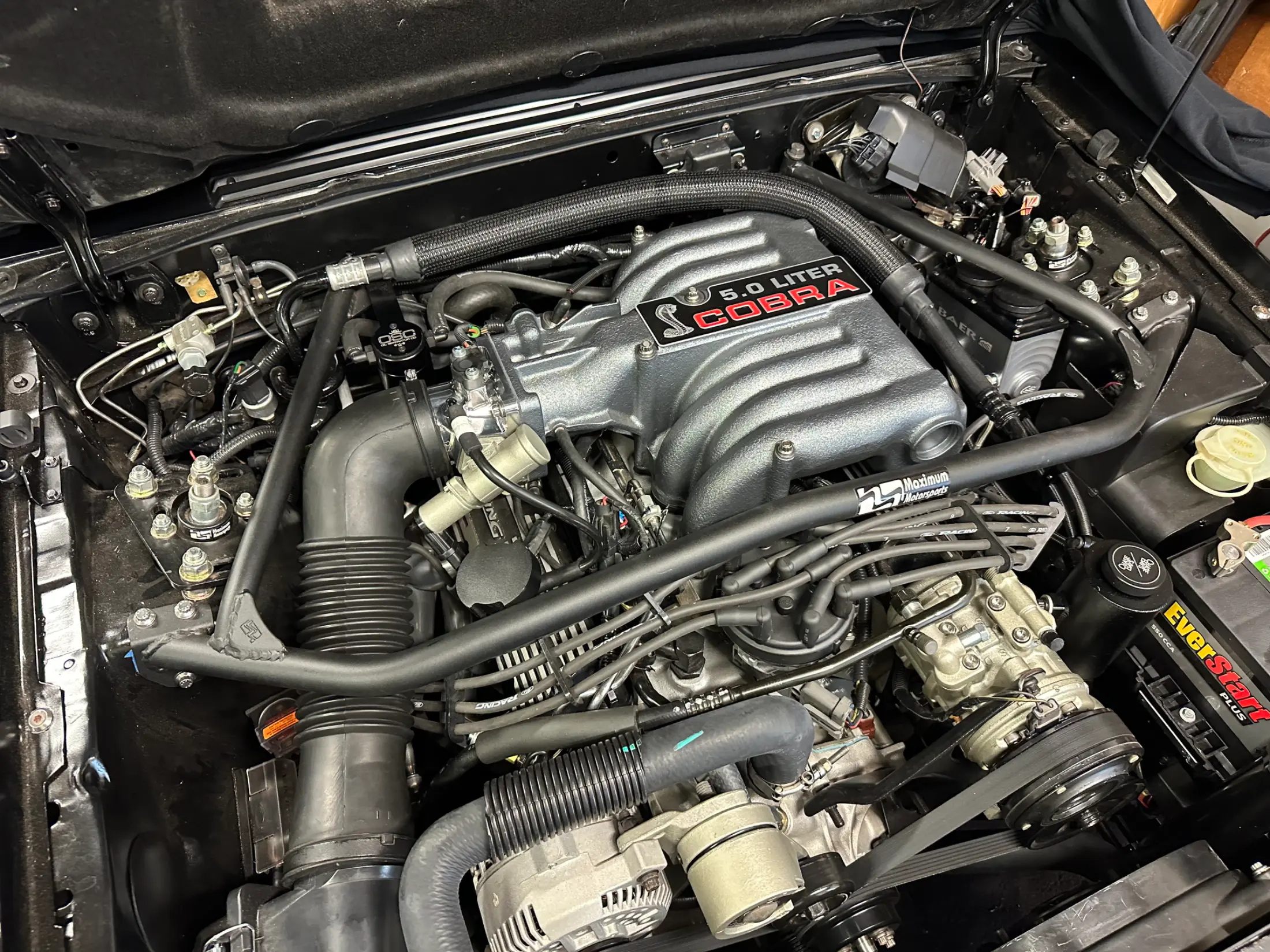
I need a polished IAC now
Back together. Adjusted the TPS and she fired up and idled same as before. Ok…now we can start dialing things in. I’m 99.9% sure this is the final configuration for this car. Unless I go coyote…
I need a polished IAC now
Back together. Adjusted the TPS and she fired up and idled same as before. Ok…now we can start dialing things in. I’m 99.9% sure this is the final configuration for this car. Unless I go coyote…
Last edited:


gkomo
now i can hopefully expect to receive the shaft
Is rewiring the harness required or do they also make little adapters?
They make adapters, but they are notorious for poor connections.
I already attributed my failed injector issue a few weeks back (lost one injector firing while on a drive) to a bad connection. Figured i'd just cut off the 30+ year old, tired connectors and go with fresh new tight connectors.
gkomo
now i can hopefully expect to receive the shaft
I had Crane Energizer rockers that were dead quiet. Changed short blocks (same heads) and made sure the push rods were good to go and they made noise. Pulled the Comp lifters and put Ford Racing lifters in it and still the noise. Bought a set of the Scorpion rockers and same noise. My engine builder reworked my 331 (failed cam bearings) and same noise. He said he adjusted the valves twice and no change. I gave up and it’s just part of the car now. It has Jomar rocker girdles on it so I know the valve train is not moving. It’s had them on three motors so they aren’t the issue either.
Anyhow, just saying my has noise as well.
Anyhow, just saying my
has noise as well.


I like hearing a mild sewing machine sound.
That's what this sounds like. I guess i'm just overreacting. I got used to the silky smooth 4.6L rumble.
Anyway, moving on. Going to wire in the fuel pressure sensor into the megasquirt. The injector settings are at a very specific 39.15 psi, so with the sensor hooked up I can datalog and see what it's doing to make some adjustments if needed.
Don't overthink it (even though I do, too). The sensor won't be that precisely calibrated, anyways. Close is good enough. The important thing is consistency across voltages & duty cycles. The rest will work itself out as you tune it.
Installed and wired up the sensor. Programmed it into TS and turned on car. I can manually run the fuel pump without starting the engine, so I did.
7 psi.
Hmm. That’s not right. Poked around with settings but they seemed right. Pump off drops to 5psi and if I fire an injector off it drops to 0 psi.
I doubt I have a 7 psi. Would engine even run? Not likely
Might have to pull the sensor off and put my mechanical gauge on and see what’s going on here. Possible the sensor is fubar? Ended up buying a cheapo Amazon sensor (same one?) to swap in just to see if my sensor is junk.
Edit: figured it out. Have to enter sensor data in kpa and convert to psi in the software. I entered it in psi initially. Oops.
7 psi.
Hmm. That’s not right. Poked around with settings but they seemed right. Pump off drops to 5psi and if I fire an injector off it drops to 0 psi.
I doubt I have a 7 psi. Would engine even run? Not likely
Might have to pull the sensor off and put my mechanical gauge on and see what’s going on here. Possible the sensor is fubar? Ended up buying a cheapo Amazon sensor (same one?) to swap in just to see if my sensor is junk.
Edit: figured it out. Have to enter sensor data in kpa and convert to psi in the software. I entered it in psi initially. Oops.
Last edited:
Ok fuel pressure solved. Got it adjusted to 39psi while engine running. Found I had to readjust my VE table after that. Seems I needed more fuel, so I think I was adjusted high previously. I may have done that due to the 19s to get a little more fuel.
Regardless, knocking it down to 39 means I essentially have to start all over.
Worked on getting the idle dialed in. Been watching a lot of Steve’s videos on DIYautotune.
There’s a lot to this tuning. I got my startup a bit better by opening the IAC a bit more during crank, and added a little more fuel to solve the post-start lean condition.
Problem I’m trying to work through is when I dial in the AFR at idle at anything above 14.0, it goes into a rhythmic chopping lope that shakes the car. If I keep it around 13.6-13.8 it’s a nice idle, although a bit on the rich side. I need to play with my idle timing a bit to see if I can get it a bit smoother with the chop and a lean mix. Idle set to around 850rpm.
I like how you can fine tune everything…but holy hell this learning curve is steep. I’m getting there though.
Anyway, likely won’t update on every bit of info I do here. Probably going to install the 2nd wideband to the other bank so I can run dual tables and dial in each side. Read that may help me finesse idle a bit better…plus the parts are already bought and paid for.
It’s getting chilly out now. A few more weeks of decent weather and then it’s just too cold to drive on summer tires. I should really buff and ceramic coat the fox. I think I might.
Edit: made some changes, went for a drive. Definitely driving the best it has. More to come
Regardless, knocking it down to 39 means I essentially have to start all over.
Worked on getting the idle dialed in. Been watching a lot of Steve’s videos on DIYautotune.
There’s a lot to this tuning. I got my startup a bit better by opening the IAC a bit more during crank, and added a little more fuel to solve the post-start lean condition.
Problem I’m trying to work through is when I dial in the AFR at idle at anything above 14.0, it goes into a rhythmic chopping lope that shakes the car. If I keep it around 13.6-13.8 it’s a nice idle, although a bit on the rich side. I need to play with my idle timing a bit to see if I can get it a bit smoother with the chop and a lean mix. Idle set to around 850rpm.
I like how you can fine tune everything…but holy hell this learning curve is steep. I’m getting there though.
Anyway, likely won’t update on every bit of info I do here. Probably going to install the 2nd wideband to the other bank so I can run dual tables and dial in each side. Read that may help me finesse idle a bit better…plus the parts are already bought and paid for.
It’s getting chilly out now. A few more weeks of decent weather and then it’s just too cold to drive on summer tires. I should really buff and ceramic coat the fox. I think I might.
Edit: made some changes, went for a drive. Definitely driving the best it has. More to come
Last edited:
Mike, you are doing great. It feels daunting at first, but the feel and your own style show up with hands-on time. You are not going to ruin anything and by working through it step by step, and maybe having to do a step or two over again, you'll learn a ton, have a better understanding of why it acts the way it does when you're driving around. Most folks never try this at home, so respect for jumping in.
I want to lay out the approach I am using. I picked it up from Leech Motorsports and it lines up with what you are doing. If you see anything that conflicts with what you are learning, I'd love the feedback. I'm definitely still a padawan regurgitating from the masters and having only had my hands on 3 cars.
The big win on Black Jack has been a working IAC with the stock computer. Grover did/does not have one since I got it. Father Time lost the BS3's IAC channel when I added driveshaft speed to gain slew rate control. On those two cars I stabilized idle with a higher RPM & timing only. We can get into that if it becomes relevant. For now, using the IAC to get a steady idle just works better. The stock computer can also preemptively bump airflow when the A/C turns on to keep things steady and handle similar loads.
The best idle comes from getting the base RPM & IAC DC right. Set the base, with IAC unplugged, fixed timing, & in open loop and at full temperature, so the engine barely idles, then plug the IAC in and look for about 100 to 150 rpm more with an IAC CD of 20-35%. That gives the IAC room to add air and also to pull a bit if it overshoots. I needs authority both ways. On mine I ended up near 30 percent and that sits in the window.
My steps. I lock timing at about 20 degrees using the computer instead of pulling the SPOUT. I unplug the IAC. I let the engine warm up fully and make sure it is in open loop. I set the throttle stop so the blade is almost closed and the engine will just barely run. Stumbling & stuttering is fine, so long as the engine doesn't surge or die. I note that rpm, then set the ECU target about 100 to 150 rpm higher. I plug the IAC back in hot and check that duty falls in the 20 to 35 percent range. There's some MAF settings & airflow expectations in the stock computer that I don't think are relevant to your MS.
Next, I work the commanded AFR and match it real O2 results by adjusting the VE table, as needed. I keep the idle cells smooth so I am not chasing steps. Picking the exact AFR is part art and part preference. With a healthier cam I usually land north of 13.5 to 1 for a clean idle. With a more mild cam you can go quite a bit leaner. I've been over 15:1, but honestly without cats, that's pretty eye-watering. If it chops at lean targets, give it what it likes and move on.
Once fueling and airflow are steady, I open the timing tables and let the computer assist idle stability with timing. Shape a small spark mound around idle so timing increases a few degrees below target RPM or at slightly higher MAP, and decreases above the target RPM or at slightly lower MAP. Avoid cliffs that make the ECU hunt in and out of the target. If you give it too much authority on air or timing you can create surging, so keep the corrections modest @ not more than a 2* delta between cells.
Two last notes. You are speed density here, not MAF, so smoothing the VE pad around idle matters. Also watch battery voltage at idle. Poor voltage control can look like a tuning issue.
Once you have a glass smooth idle, try a little more timing and see if it will accept a touch leaner AFR. You can bring the rpm down a bit too.
I hope you are having fun with it. I am having fun tagging along, getting a refresher as you work through the steps, and it is pushing me to get back into the tunes on my cars.
I want to lay out the approach I am using. I picked it up from Leech Motorsports and it lines up with what you are doing. If you see anything that conflicts with what you are learning, I'd love the feedback. I'm definitely still a padawan regurgitating from the masters and having only had my hands on 3 cars.
The big win on Black Jack has been a working IAC with the stock computer. Grover did/does not have one since I got it. Father Time lost the BS3's IAC channel when I added driveshaft speed to gain slew rate control. On those two cars I stabilized idle with a higher RPM & timing only. We can get into that if it becomes relevant. For now, using the IAC to get a steady idle just works better. The stock computer can also preemptively bump airflow when the A/C turns on to keep things steady and handle similar loads.
The best idle comes from getting the base RPM & IAC DC right. Set the base, with IAC unplugged, fixed timing, & in open loop and at full temperature, so the engine barely idles, then plug the IAC in and look for about 100 to 150 rpm more with an IAC CD of 20-35%. That gives the IAC room to add air and also to pull a bit if it overshoots. I needs authority both ways. On mine I ended up near 30 percent and that sits in the window.
My steps. I lock timing at about 20 degrees using the computer instead of pulling the SPOUT. I unplug the IAC. I let the engine warm up fully and make sure it is in open loop. I set the throttle stop so the blade is almost closed and the engine will just barely run. Stumbling & stuttering is fine, so long as the engine doesn't surge or die. I note that rpm, then set the ECU target about 100 to 150 rpm higher. I plug the IAC back in hot and check that duty falls in the 20 to 35 percent range. There's some MAF settings & airflow expectations in the stock computer that I don't think are relevant to your MS.
Next, I work the commanded AFR and match it real O2 results by adjusting the VE table, as needed. I keep the idle cells smooth so I am not chasing steps. Picking the exact AFR is part art and part preference. With a healthier cam I usually land north of 13.5 to 1 for a clean idle. With a more mild cam you can go quite a bit leaner. I've been over 15:1, but honestly without cats, that's pretty eye-watering. If it chops at lean targets, give it what it likes and move on.
Once fueling and airflow are steady, I open the timing tables and let the computer assist idle stability with timing. Shape a small spark mound around idle so timing increases a few degrees below target RPM or at slightly higher MAP, and decreases above the target RPM or at slightly lower MAP. Avoid cliffs that make the ECU hunt in and out of the target. If you give it too much authority on air or timing you can create surging, so keep the corrections modest @ not more than a 2* delta between cells.
Two last notes. You are speed density here, not MAF, so smoothing the VE pad around idle matters. Also watch battery voltage at idle. Poor voltage control can look like a tuning issue.
Once you have a glass smooth idle, try a little more timing and see if it will accept a touch leaner AFR. You can bring the rpm down a bit too.
I hope you are having fun with it. I am having fun tagging along, getting a refresher as you work through the steps, and it is pushing me to get back into the tunes on my cars.
Two last notes. You are speed density here, not MAF, so smoothing the VE pad around idle matters. Also watch battery voltage at idle. Poor voltage control can look like a tuning issue.
Once you have a glass smooth idle, try a little more timing and see if it will accept a touch leaner AFR. You can bring the rpm down a bit too.
I hope you are having fun with it. I am having fun tagging along, getting a refresher as you work through the steps, and it is pushing me to get back into the tunes on my cars.
I briefly looked into adding the MAF back on. Now that I have more understanding, things are clicking. I have a MAF I can use that has a built in IAT so i can kill two birds with stone and get the IAT out of the manifold. Alas, I'm running low on inputs so I reached out to DIY with a question. I want to add the 2nd wideband as well. Reading up that with the 2nd wideband, i can tune a VE for each back which will help a lot with idle.
My idle is pretty decent but rich. If i lean it out, it goes into a lope. Been playing with timing and such to dial it in a bit better. Batt voltage is decent. I get 14.4 at idle with my 3G and the 93 cobra pulley kit from LMR.
AC on puts me into a bit of a surge, so i need to see what's going on there.
It's coming along nicely. At some point i'll likely stop and call it a season and do a few maintenance items to get the cars ready for winter. Oil change on both Mustangs, and I have a few tasks to take care of on the SN95 as well before the covers go on.
85 degrees here in MA in Oct. Cools off at night, but I'm still DDing the convertible when I can.
All of that sounds solid. Do you know if you can program MS to add air/IAC with the A/C on signal? If not, like Father Time, I'm relegated to building in enough RPM & timing ramp from the idle RPM delta to catch it. In otherwords, the tune is stable enough and reactive in Father Time, whereas Black Jack hits the motor with more air (and therefore fuel) the moment the a/c switches on.
Similar threads
- Replies
- 12
- Views
- 334
- Replies
- 7
- Views
- 414
- Replies
- 0
- Views
- 211
- Replies
- 5
- Views
- 302

- Replies
- 2
- Views
- 338