Progress Thread Komo's 1990 GT - Parts Gathering Purgatory

Just an FYI, I've tried using the FP gauges that you can borrow from AutoZone and O'Reilly and they both won't provide any pressure info., I assume that the Schrader valve attachment was screwed up by other users. I then purchased one for $28 and it worked perfectly, so now I have another tool in my garage.

Innova EPI3640 I bought it via Home Depot, as it had the Ford Schrader vale adapter, just noticed OOS at HD.

 
Last edited:
  • Like
Reactions: gkomo
Can a shop drill and weld a bung in with the xpipe installed or is it best for me to remove it and just bring the xpipe itself? That dictates a lot regarding schedule of this getting done. Good news is everything is ran just literally need to plug the sensor in once the bung is there.
 
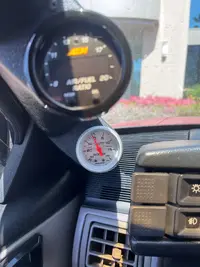
Shouldn't my boost gauge read right in the middle of the box when the car is off?

Fox Boost Gauge.webp

If you look closely, its like reading low or to the left most side of the zero box. That wouldn't affect the actual psi i'm seeing when in boost right? By that I mean its not reading like a psi lower than it should because its starting off less than zero? Just making sure my gauge isn't out of calibration or something.

Today, i got on it again and the boost spikes right to 3psi then just stays there, no gradual increase. I didn't rev it out to replicate the spark blowout condition, just got on it up to maybe high 4k rpms maybe up to 5k, straight to 3psi and then nothing. Interesting or normal in this narrow boost rpm band i'm giving it?
 
Last edited:
Another good use for the vacuum / pressure hand pump I linked earlier. Hook it up to the line to your guage, pump it up and watch your guage move. If the guage matches the pump it's not your guage. Then test that T and brass fitting by hooking it up to one side of the t and cap the other side.

But yes, I would think the needle should be at the middle of the box. Is there a way to zero it in the instructions?
 
  • Like
Reactions: gkomo
Another good use for the vacuum / pressure hand pump I linked earlier. Hook it up to the line to your guage, pump it up and watch your guage move. If the guage matches the pump it's not your guage. Then test that T and brass fitting by hooking it up to one side of the t and cap the other side.

But yes, I would think the needle should be at the middle of the box. Is there a way to zero it in the instructions?
I will try to go tomorrow to my nearest harbor freight and pick that vacuum pump up. That test seems easy enough and logical. I’ll have to dig up the manual online for the gauge to see if there is a way to zero it out, or if it makes a difference.
Is this where your instruction had you plumb them?

Do you have a port that is direct to the intake that you can use?
Autometers instructions from what I recall don’t specify. I think I picked that line just from researching what other people have done but that doesn’t mean it right.

I don’t think there are any other vacuum lines that small coming off the manifold currently.
 
Hmm reading up on my vacuum line routing… sharing the FMU line may not be ideal. I’m going to do the vacuum pump test on my boost gauge line to verify it’s even accurate, then probably try to move that line to something else less critical.
 
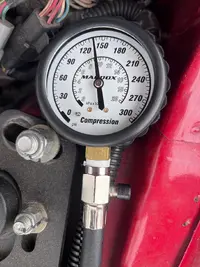
FINALLY got around to doing a compression check on my trouble-child cylinder #7. I did not do any of the other cylinders so i can't do a comparison at this time. Engine was warm, drove it to work and it had been sitting for maybe 45 minutes, but not freshly hot. Looks like its right around 136psi:

Fox Cylinder 7 Compression.webp

From my research this seems low? I am not able to do a 'wet' check while at work, so this is what i got for now. Unless this is almost considered a wet test since i have oil in the cylinder constantly (plug threads have fresh oil on them, per usual).

I unplugged the coil and held the accelerator pedal to the floor while cranking, cranked for a solid 4-5 seconds. I probably should have released the pressure and did the test a second time just to verify i didn't stop the test too early since i wasn't looking at the gauge while cranking.

Also, my dumbass released the quick connect between the hoses BEFORE releasing the pressure at the gauge... hopefully i didn't F up my tester doing that.
 
Last edited:
Ya I figured that would be the case. I guess at least I know it’s not a completely dead cylinder.

Maybe I can knock one drivers cylinder out a day and at least get a complete bank comparison.
 
Another good use for the vacuum / pressure hand pump I linked earlier. Hook it up to the line to your guage, pump it up and watch your guage move. If the guage matches the pump it's not your guage. Then test that T and brass fitting by hooking it up to one side of the t and cap the other side.

But yes, I would think the needle should be at the middle of the box. Is there a way to zero it in the instructions?

With the small graduations on that guage, it could be off by 1-2 PSI if that is true "center"@ off, IMO.

I ran my stock Cartech turbo kit on my 86 with only stock mass air conversion for years, before I had wideband.
Back then (like 1991) they were hard/impossible to get, sensors didn't last long, and were super expensive.

I did have accurate boost and direct run fuel pressure guages (no isolator). Kit also came with a huge inline external Bosch pump,
as I was hitting 105 PSI fuel pressure @ 10 PSI boost. It ran darn good, went from 92 to 108 MPH trap with no other changes.
Idled like crap cold though with no tune (did have shorty's, 2.5 catback and 3.27's, before turbo).

Anyway, not much reason not to run A/F guage these days, but if not (with a stock designed kit like that), at least need really
accuratte boost/FP guages, make sure you are running correct FP that kit wants, @ specific boost.
 
  • Like
Reactions: gkomo