tl;dr: I'm at a loss as to where some oscillations are coming from at 65 MPH.
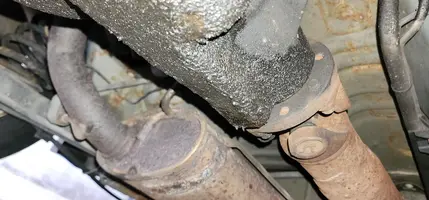
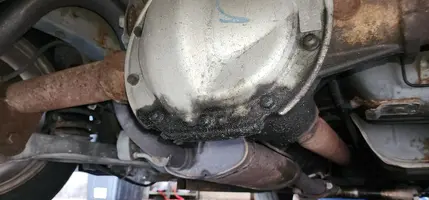
I think there's leaks at the pinion seals and at the rear cover gasket. I'm putting together a shopping list of what all I need to replace. I think there are two pinion seals, one on the driveshaft end and one on the pinion end. There's a lot of oil buildup on the brake rotor mud guards, so I'm thinking that's gear oil rather than brake oil, meaning there might be leaks on the axle seals also. *If* there's something wrong with the axle bearings or differential bearings causing wobbling, now would be the time to replace those. I just don't know which bearings or seals in the differential exactly are causing it. Rebuilding a differential is a very precise job, with like .002" tolerances in adjusting the pinion and ring gear alignment, so I only want to replace what needs replacing. I've seen rebuild kits that include carrier, pinion, and setup bearings and races; a pinion seal; and a housing cover gasket. It might also mean getting new crush sleeves or spacers, clutches, and carrier & pinion shims. I don't know if it's possible to put things back how they were or if everything needs to be readjusted from scratch. I think the differential ring gear size is 7.5", the gear ratio is 3.27, it has 28-spline axles, and it's an open type, if I'm reading this website correctly. Idk if changing to a 31-spline axle differential matters, but I guess I'd switch to that if I end up needing to replace a lot of the parts in it or end up buying a completely new one; the problem would be that I think you have to have a 8.8" compatible housing that could hold a new 8.8" compatible carrier. That means taking an 8.8" housing off at a salvage yard from a V8; I'd be able to install axle dampers if I got one of those.
I'm getting vibrations once it hits 65 MPH, at about 2100 RPM; the vibrations increase in intensity over like 10 seconds, and decrease in intensity over like 10 seconds. I've revved it to 2100 RPM in neutral, but there are no vibrations there. I've changed out the ball joints, control arms, and inner/outer tie rods. Given that the vibrations aren't constant at 65 MPH, and have a rise/fall cycle, I don't think it's the motor mounts or any rear control arm bushings; it's a pattern that belongs to some kind of rotating part. I don't think it's the drive shaft, because if it were, I'd be feeling it at neutral at 2100 RPM. I don't think it's the rims, because I've swapped where the wheels are before; I could try swapping them around again, since after I changed the control arms, the vibrations decreased. It could be that one of the wheels needs to be re-balanced. I don't think it's any wheel bearings, since I'd be hearing that loud roaring sound if it was; I've had a bearing go out before, it's hard to miss, lol. That leaves the rear axles and the differential. I'd like to think it's the rear axles or axle bearings, since the differential has like two dozen different parts to it. I don't know how the axles could possibly get bent out of shape, since they're inside the axle housing. If it is the differential, I have no idea which part it could be; I've never had to disassemble one before. I could just forget all that stuff and get a pre-built differential, but that'd be about $400 more than rebuilding it, but if that's not where the vibration is coming from, that'd be pointless. It's a labor & time vs money trade-off.
I think there's leaks at the pinion seals and at the rear cover gasket. I'm putting together a shopping list of what all I need to replace. I think there are two pinion seals, one on the driveshaft end and one on the pinion end. There's a lot of oil buildup on the brake rotor mud guards, so I'm thinking that's gear oil rather than brake oil, meaning there might be leaks on the axle seals also. *If* there's something wrong with the axle bearings or differential bearings causing wobbling, now would be the time to replace those. I just don't know which bearings or seals in the differential exactly are causing it. Rebuilding a differential is a very precise job, with like .002" tolerances in adjusting the pinion and ring gear alignment, so I only want to replace what needs replacing. I've seen rebuild kits that include carrier, pinion, and setup bearings and races; a pinion seal; and a housing cover gasket. It might also mean getting new crush sleeves or spacers, clutches, and carrier & pinion shims. I don't know if it's possible to put things back how they were or if everything needs to be readjusted from scratch. I think the differential ring gear size is 7.5", the gear ratio is 3.27, it has 28-spline axles, and it's an open type, if I'm reading this website correctly. Idk if changing to a 31-spline axle differential matters, but I guess I'd switch to that if I end up needing to replace a lot of the parts in it or end up buying a completely new one; the problem would be that I think you have to have a 8.8" compatible housing that could hold a new 8.8" compatible carrier. That means taking an 8.8" housing off at a salvage yard from a V8; I'd be able to install axle dampers if I got one of those.
I'm getting vibrations once it hits 65 MPH, at about 2100 RPM; the vibrations increase in intensity over like 10 seconds, and decrease in intensity over like 10 seconds. I've revved it to 2100 RPM in neutral, but there are no vibrations there. I've changed out the ball joints, control arms, and inner/outer tie rods. Given that the vibrations aren't constant at 65 MPH, and have a rise/fall cycle, I don't think it's the motor mounts or any rear control arm bushings; it's a pattern that belongs to some kind of rotating part. I don't think it's the drive shaft, because if it were, I'd be feeling it at neutral at 2100 RPM. I don't think it's the rims, because I've swapped where the wheels are before; I could try swapping them around again, since after I changed the control arms, the vibrations decreased. It could be that one of the wheels needs to be re-balanced. I don't think it's any wheel bearings, since I'd be hearing that loud roaring sound if it was; I've had a bearing go out before, it's hard to miss, lol. That leaves the rear axles and the differential. I'd like to think it's the rear axles or axle bearings, since the differential has like two dozen different parts to it. I don't know how the axles could possibly get bent out of shape, since they're inside the axle housing. If it is the differential, I have no idea which part it could be; I've never had to disassemble one before. I could just forget all that stuff and get a pre-built differential, but that'd be about $400 more than rebuilding it, but if that's not where the vibration is coming from, that'd be pointless. It's a labor & time vs money trade-off.
Attachments
Last edited by a moderator:


 They said all four shocks need to be replaced and that the front brakes were stuck closed. The stuck brakes seem to me to be like they could be the prime candidate for trying to solve this.