Mustang5L5’s progress thread - fuel pressure shennanigans SOLVED

OK. I can't tell from that screen shot but here me out.

Check to make sure you don't have a fuel pressure differential (PSID) enabled somewhere in your software. If you do, that is 100% your issue for everything.

It needs to be PSIG or PSI "guage" for the time being. I can elaborate more on that if this turns out to be the case.

TL;DR
Disable PSID and select PSIG. Start your car. Disconnect and plug your FPR vacuum line. Check your PSIG in your software. Betcha it says your base FP is 29 psi engine running vac line removed.

Prepare for a brain dump....

PSID or differential reads the difference between your rail and intake. It's getting your FP from the rail. It's getting your intake reading from your MAP (or other vac sensor in the intake, not familiar with your software/hardware exactly). However when thats enabled you don't actually see either of those values. You only see the calculated differential.

So, when you unplug your vac line from your regulator to set your FP the software is comparing rail FP against your vacuum in the intake. For easy numbers let's say you have 20" engine vacuum at idle. To do the differential calculation first we need to convert to like values for each side of the equation. It's easiest to convert vacuum inches of mercury to psi. The equation is divide vacuum by 2.03692 for the negative psi value. But 2 is close enough. Or in half. So 20" vacuum = negative 10 psi. The differential between positive 39 psi FP and negative 10 psi intake conditions is 49 psi.

So when you set your base to 39 psid on the software, you were actually setting it about 10 psi lower than you thought.


The following equations are for an engine vacuum at idle of 20"hg (or negative 10 psi intake conditions at idle) Your actual engine vacuum will differ of course. The equation works regardless, just enter your actual numbers.

-That would explain your KOEO FP of 29 becasue base FP is actually set at 29 psi. The differential calculation there would be base 29 fp + 0 intake vacuum = 29 psid. Exactly what you see KOEO.

-That would explain why it goes up to 39 in the software when you start it at idle with the vac line off the regulator as you mentioned. The differential calculation would be positive 29 base fp + half of engine vacuum (negative 10 psi) = 39 psid. Exactly what you are seeing.

-That would explain why it reverts to 29 psi at WOT becasue it's actually set to that. The differential calculation would be base positive 29 psi + 0 vacuum at WOT = 29 psid. Exactly what you're seeing.

-That would explain the lean spike becasue your FP is actually 10 psi low.

-That would explain why you were adding so much fuel and not seeing the outcome you expected.

It actually explains all of it. It's gotta be it.
 
Last edited:
Interesting....I need to sit back and digest that a little.

But it made me realize I set this menu up here. I assumed this would not do anything since my pump is not PWM controlled. Now i wonder if it is doing something here....

1780160186372.webp

But it made me
 
Oh boy

EDIT: I dont have fixed set here, but I need to understand what vac referenced means. Let me go back to the base tune and probably match those settings

EDIT2: Base tune is the same other than pressure set to 42psi. Let me change a few settings and see if this changes any readings when i key cycle.

1780160462186.webp
 
Last edited:
So, Vac-referenced is what makes sense to me, and I also see "Sensor type: gauge" at the bottom. That too looks right. Can you give us the other options for both settings?

In any case, you need to know that the pressure reading you're making decisions off of is what you think it is. I'd get away from all of it and use a manual pressure tester to set the rail pressure baseline. They screw into the schrader valve on the stock fuel rail. Then I'd rev it and see if mechanical pressure actually drops. Get away from the electronics for a second and back to analog.
 
Last edited:
  • Like
Reactions: nicholase
OK. I can't tell from that screen shot but here me out.

Check to make sure you don't have a fuel pressure differential (PSID) enabled somewhere in your software. If you do, that is 100% your issue for everything.

It needs to be PSIG or PSI "guage" for the time being. I can elaborate more on that if this turns out to be the case.

TL;DR
Disable PSID and select PSIG. Start your car. Disconnect and plug your FPR vacuum line. Check your PSIG in your software. Betcha it says your base FP is 29 psi engine running vac line removed.

Prepare for a brain dump....

PSID or differential reads the difference between your rail and intake. It's getting your FP from the rail. It's getting your intake reading from your MAP (or other vac sensor in the intake, not familiar with your software/hardware exactly). However when thats enabled you don't actually see either of those values. You only see the calculated differential.

So, when you unplug your vac line from your regulator to set your FP the software is comparing rail FP against your vacuum in the intake. For easy numbers let's say you have 20" engine vacuum at idle. To do the differential calculation first we need to convert to like values for each side of the equation. It's easiest to convert vacuum inches of mercury to psi. The equation is divide vacuum by 2.03692 for the negative psi value. But 2 is close enough. Or in half. So 20" vacuum = negative 10 psi. The differential between positive 39 psi FP and negative 10 psi intake conditions is 49 psi.

So when you set your base to 39 psid on the software, you were actually setting it about 10 psi lower than you thought.


The following equations are for an engine vacuum at idle of 20"hg (or negative 10 psi intake conditions at idle) Your actual engine vacuum will differ of course. The equation works regardless, just enter your actual numbers.

-That would explain your KOEO FP of 29 becasue base FP is actually set at 29 psi. The differential calculation there would be base 29 fp + 0 intake vacuum = 29 psid. Exactly what you see KOEO.

-That would explain why it goes up to 39 in the software when you start it at idle with the vac line off the regulator as you mentioned. The differential calculation would be positive 29 base fp + half of engine vacuum (negative 10 psi) = 39 psid. Exactly what you are seeing.

-That would explain why it reverts to 29 psi at WOT becasue it's actually set to that. The differential calculation would be base positive 29 psi + 0 vacuum at WOT = 29 psid. Exactly what you're seeing.

-That would explain the lean spike becasue your FP is actually 10 psi low.

-That would explain why you were adding so much fuel and not seeing the outcome you expected.

It actually explains all of it. It's gotta be it.
That's brilliant and makes perfect sense!

Have you tried to read the sensor's raw voltage at idle and make the TF calculation yourself? If this hypothesis is true, you'll see about 8-10 psi difference with the ECU reading depending on your altitude and how much idle vacuum your cam allows.

Another option to confirm mechanically: if you can cap the fuel pressure sensor port on the fuel lines, you could run the pressure sensor in ambient, start the car, and see if it's reading changes - probably negative. If it doesn't support a negative readying, then you could try to pressurize the sensor outside of the fuel system with air and see if it drops when you fire up the car and pull vacuum in the intake.

Good luck!
 
Last edited:
  • Like
Reactions: nicholase
I messed with a bunch of settings in MS, and nothing changed how the transducer read. I changed a bunch of stuff here to wild numbers and it made no difference. 29, 39, 79psi. All the same
1780189549025.webp


I took the pressure sensor off the car and plumbed it into a gas cylinder I have. I then used a compressed air to fill this cylinder to various pressures with a mechanical gauge on the cylinder. The transducer reads within 1 psi or so of the gauge. Ran it up to about 75PSI or so. The sensor free in ambient is 0 psi, as you’d expect.

I'm feeling pretty good here that the transducer is reading accurate enough and is configured properly in MS. I have a better mechanical gauge coming so i'll likely try and set up a tee.

Appreciate the out-of-the-box thinking here though. Keep it coming.


Someone else suggested checking my injector dead times. If they were way off it would account for extra fuel being injected. SO i need to sit down and go through that again. My AFR is not excessively rich when driving, so I don't think this is the case.

I need to sit down and go through this from scratch and make sure i have this set right
 
Last edited:
So, Vac-referenced is what makes sense to me, and I also see "Sensor type: gauge" at the bottom. That too looks right. Can you give us the other options for both settings?

Guage was the right setting. But changing it did nothing. I don't think this menu affects much since my pump is an on/off type and not PWM controlled
1780171210754.webp
 
  • Like
Reactions: FastDriver
The Friday log still keeps the channel/math question alive for me.

The only thing I still don’t think is fully settled is whether the exact value you’re watching in the datalog is raw gauge rail pressure or some calculated/derived fuel pressure value. The Friday log actually makes that concern stronger for me, because MAP and the displayed fuel pressure look inversely correlated at the exact same timestamps, even though the FPR vacuum line was disconnected and capped.

If actual rail pressure were really 29 PSIG, and the logged channel were showing differential pressure, then at idle with around -10 psi manifold pressure it could display about 39 psi. Then when you blip the throttle and MAP rises toward ambient, the displayed value would fall back toward 29-30 psi even if actual rail pressure never changed.

Is there another fuel pressure channel you can datalog? Can you datalog the raw transducer input/output separately from any calculated fuel pressure value?

Your mechanical gauge test should settle whether this is a real pressure drop or a channel/math issue.

While dead time is a tuning concern, it doesn’t explain the fuel pressure drop. The fact that it was happening with the 30s makes me doubt injector demand was overwhelming the pump or lines, and neither should the 14 ms blip shown in the log.
 
Last edited:
Ok fuel pressure solved. Got it adjusted to 39psi while engine running. Found I had to readjust my VE table after that. Seems I needed more fuel, so I think I was adjusted high previously. I may have done that due to the 19s to get a little more fuel.

Regardless, knocking it down to 39 means I essentially have to start all over.
Hmmm.... Adding VE everywhere is possibly another indicator that 39psi wasn't really 39. Another indicator is how rich you need it to be to idle right, 13.8:1, IIRC. If you're really at 29 psi base fuel pressure, it's not 'atomizing' or spreading as well, so you're fattening it up to compensate.

Edit: I looked at your VE maps from back then, and the 2600 rpm column in particular. You had to add 15-23% more fuel compared to the stock table. I'm not shocked at VE adjustments given your H/C/I mods, but just another interesting nugget is that if you were running 29 vs 39, you'd need 16% more time to compemsate for volume without accounting for poorer atomization.

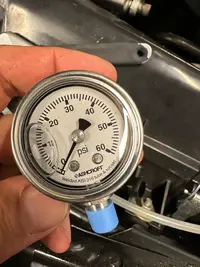
Well, grabbed another pressure sensor off Amazon and made this little grenade from some parts at work.

IMG_8763.webp


Hooked it up to the car and ran it up and down to verify pressure and the MS is reading spot on, so i trust the numbers. TBH i wanted to do this anyway just to be sure as i'm basing my fuel injector data off this value.


IMG_8765.webp


Just for the hell of it, i ran the fuel pump with the engine off by commanding it on with Tuner Studio. No vac since engine is off. Ran right at 29-30psi. Aww damn. Pretty sure I verified this with engine running but I could have sworn I set this with pressure at 39psi with engine running. I'm 99.5% sure I did. This is an interesting discrepancy. Was too late to fire up the engine so maybe i'll play with this on the weekend. I need to adjust this with engine running anyway as my pressure should be a little higher with the pump at 14.4 volts vs the 12V or so I have with the engine off.
This post is the smoking gun. Your base pressure is and has been 29psi, not 39.

Here's some more data. Did another start

Key cycle on: 29psi. Unable to get any higher no matter how many times I cycle the key.
Cranking: 29psi
Engine running(vac line on) 32 psi
Engine running(vac line plugged) 39psi
Reving engine (Vac line on) 29 psi
Revving engine (vac line plugged) 30 psi


The unable to go higher than 29 psi during initial prime is telling. I wonder if i have a split S-hose that can hold up to 29psi
This is just telling you that base fuel pressure is 29. then when you run the car and pull the vacuum from the AFPR and get 39, that base is suddenly higher. How is that possible? I think the answer is that it isn't possible. Slightly more voltage, fuel being injected at idle, etc... these do not account for the 10psi change, but adding the intake vacuum in psi to the fuel pressure at the rail does.

Admittedly, I’m still thrown by the use of a stock FPR. If the FPR vacuum line is disconnected and plugged, actual rail pressure should not have dropped below base on a throttle blip.

Edit: I went back and I don’t actually see where you tried a stock FPR. I see where you retried the original non-adjustable Kirban you had before, but the results were *not* the same.

With the Kirban, you saw higher pressure: a drop from 47 to 42 psi without vacuum reference, and only down to 45 psi with vacuum reference. I don’t think that difference should be dismissed. Either that Kirban is set about 8 psi too high for normal base pressure, or it is actually close to right and the displayed/logged value is again being affected by manifold-vacuum/differential-pressure math.

Either way, the difference between the Kirban and the current AFPR seems meaningful. It points back toward the current AFPR being adjusted too low, or toward the displayed value not being raw rail PSIG.
 
Last edited:
  • Like
Reactions: nicholase
^Yeah, I'm really curious here. I'm waiting to see the mechanical guage reading before I can add much more.


Looking forward to the next set of diagnostic info.
 
Last edited:
Well I fired the parts cannon. I bought a brand new Aeromotive FPR that has a port to add a pressure sensor. This will cross FPR off the list for good.

Plan is to install the transducer at the regulator and put my mechanical at the stock location where the transducer currently is.

At this point, I’ll verify the reading, and would have crossed injectors and FPR off the list.

This almost feels like a leak of some sort. I’m losing it somewhere. Since it’s not external, there are only so many places it can leak and not be visible. I did run the pump while looking into the tank through the filler hole and didn’t see any leakage.

I’ll likely have to get back into the tank if this step doesn’t work. Might run it sans filter sock, or try some other stuff.

Need a few days to get parts and do some work.
 
I can tell you that on my car there was zero pressure difference on my Autometer full sweep gauge when I had the sensor at the schrader valve location or where it is currently connected which is the port on the Aeromotive FPR. Not sure if that helps but thought I would share.
 
Some quick thoughts for the next steps, which I think you might have already done or be headed toward.

1) With the vacuum reference unplugged from the regulator and the manifold side capped, put a mechanical gauge on the fuel rail Schrader valve. Run the engine at idle, set the rail pressure to 39 psi based on the mechanical gauge with whatever adjustable pressure regulator is currently on your car.

2) With the engine off, jump the fuel pump relay to keep the fuel pump running and check the pressure with the mechanical gauge - expected to be right around 39 psi.

3) If the pressure is still in the 39 psi neighborhood with the engine off, repeat steps 1 and 2 and compare the pressure transducer readings through MS with the mechanical gauge.

4) If the MS-read pressure numbers don't match the mechanical gauge, pull the transducer's raw voltage from either MS or a by a volt meter and manually calculate the pressure from the slope / offset TF.

5) If the manually calculated numbers match the mechanical gauge (39 psi), but the MS numbers do not, take the MS pressure reading and add the MS measured MAP value to it to see if the MS software is subtracting MAP by default to calculate the delta-pressure.

Some fuel injector basics / background that you probably already know:

Fuel injector flow is determined by five things:

1) The size of the holes in the director plate.
2) The density of the fuel
3) The battery voltage
4) The energizing or valve opening time
5) The square root of the delta pressure across the injector

The first three items are essentially fixed. The battery voltage impacts the opening delay / offset time, or dead time as they put it in your MS software. Assuming that your system is fully charged and running between 12V and 14V, it's not really an issue here. The energizing time is determined by the ECU to match the load / air flow.

For a return-style fuel rail, the delta-P on the injector is maintained mechanically by the vacuum reference on the fuel pressure regulator. This keeps a constant delta-P which in turn keeps a constant injector slope regardless of the MAP, and saves the ECU from having to calculate the flow correction over changes in MAP for the injector's slope.

For a returnless fuel system where the regulator is located in the tank and does not have a vacuum reference, the ECU has to calculate the delta-P across the injector and correct the injector slope by the square root of the delta-P vs. the reference pressure as MAP changes. This is fairly easy for a fixed pressure fuel system as long as you either have a MAP sensor or a MAP model on a MAF system (spec fuel pressure PSIG + ambient - MAP). If it's a variable fuel pressure system, then it will have a fuel pressure sensor and the delta-P comes from both sensors (fuel pressure sensor PSIG + ambient - MAP).

It really seems like the MS system is treating it's measured fuel pressure signal like it has a returnless system and using a MAP modifier. This is where the steps above will help to sort out the sensor's reading vs. their software, with the mechanical gauge as the reference.
 
Last edited:
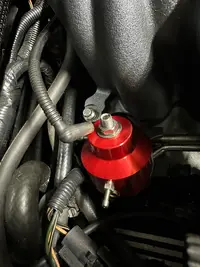
New reg installed. I didn’t have the right assortment of fittings to attach my transducer however so had to order an adapter. Why couldn’t aeromotove just offset the vac port 45 degrees ?

IMG_1933.webp


Not a fan of the red on my engine setup, so I really hope the intake obscures this.

Also, do NOT use the Eastwood Aluma Blast spray paint. As you can see, it yellows with heat. Prob will redo that tensioner at some point. Ac compressor a bit harder
IMG_1930.webp


Obviously couldn’t start the engine, but I test for leaks. I ran the pump and adjusted the pressure to 39psi. I will say I did finally notice something is different

Before with the Kirban, when I data logged my key prime, it would spike to 31 and drop to 29.

When this aeromotive, a key prime is direct to 39 without that spike.

Now, I need to engine start to see if my pressure now overshoots. It did with the Kirban. 39psi set with the engine off would give me almost 50psi.

I’m crossing my fingers that it’s the reg. We will debate the reason why I missed it later.

Hopefully get my adapter fitting tomorrow so I can move the transducer and install this mech gauge at the stock location. Long term once I solve this, I’ll put the transducer back. I think it will be quite visible up top. At least this way I can run mech and digital pressure guages to see if they are saying the same thing.


IMG_1934.webp

If this doesn’t work, I hope this will at least verify the problem does in fact exist.
 

Attachments

  • IMG_1929.webp
    IMG_1929.webp
    410 KB · Views: 9
If this works, and I feel it just may, take that other one apart and maybe you'll find something amiss inside.

I have taken it apart. I rebuilt it with a new diaphragms

I absolutely loathe the design of that regulator. I had to use several brass footings to get the gauge and the vacuum port to work and looks so tacky.
But yay for progress!
Even the vac port. The stock vac connection doesn’t reach it. Now I need to scrounge up a new line. I feel this could have been done better


. IMG_1938.webp
 
Erm... I thought mine was an aero when you mentioned it, but it's an accufab. Can you send it back? Just tell em it didn't fit a stock setup. You might like this one more:

Screenshot_20260601_234745_Yahoo Mail.webp


IMG-20240219-WA0009.webp
 
  • Like
Reactions: hoopty5.0